

Ukraine’s program of medium-range strikes on Russian military targets in occupied Crimea and southern Ukraine is now fatally disrupting Moscow’s military logistics chain. The lack of any logistical support or transport is now forcing some Russian infantry units to walk up to 19 miles to reach their frontline positions.
This development was reported by Ukraine’s Defense Minister, Mykhailo Fedorov, on Wednesday, 1 July. Fedorov was speaking at a joint press conference in Kyiv with Swedish Defense Minister Pål Jonson. During his comments, the Defense Minister said Ukraine’s attacks against Russian logistics were creating increasing problems for Moscow’s armed forces.
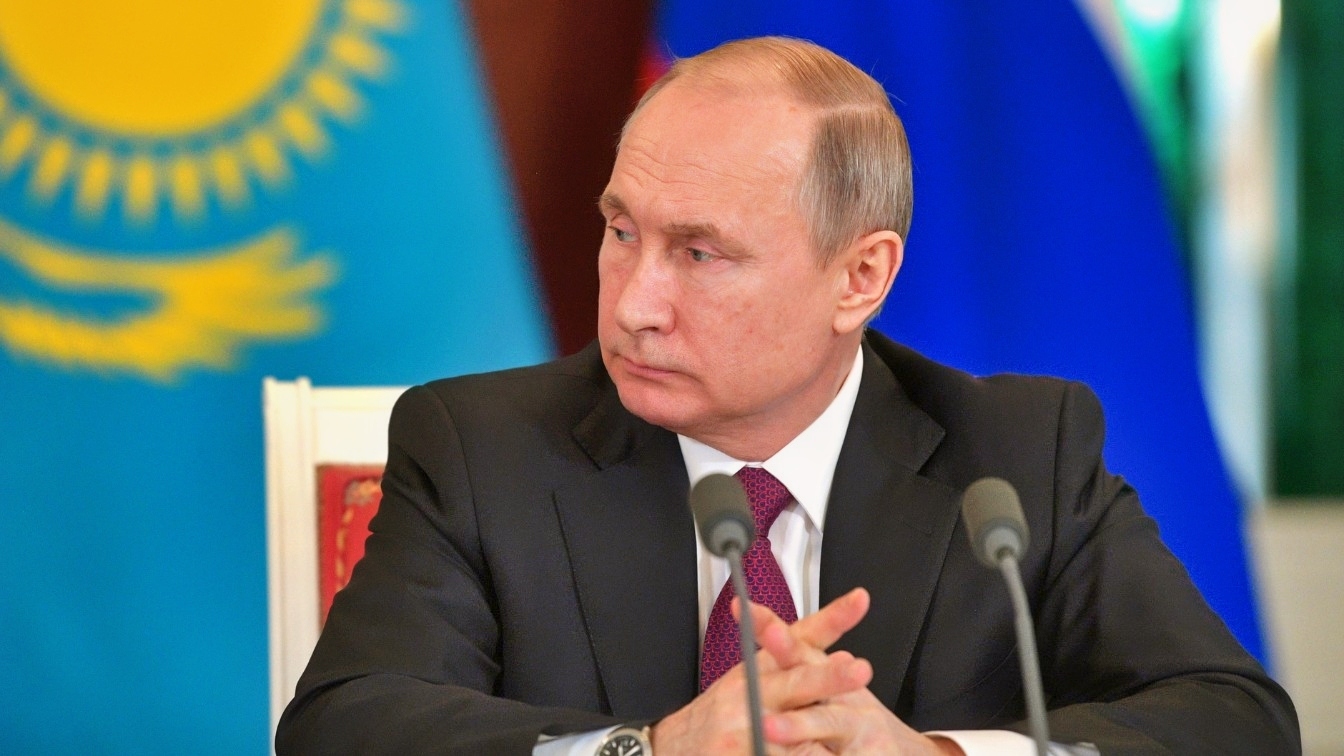
Putin in 2019 Russian Federation Photo
“We already see, for example, in the south, sectors of the front where Russian infantry, because logistics have been destroyed, have to walk 30 kilometers (19 miles) to reach their positions,” Fedorov said, according to a report from the news service Interfax-Ukraine.
He detailed that Russia was facing increasing difficulties in transporting troops to the front lines and supplying them with ammunition, food, water, and medical supplies. And at all points along the way, once they reach their frontline positions, there is a shortage of fuel.
When fuel cannot be delivered to the front line, it creates major difficulties even once these troops arrive. The massive reduction in fuel that forces them to walk for miles to reach their positions has also made it impossible for Russian units to power the generators that are used by their drone operators.
Creating Second- and Third-Order Problems
The Washington, DC-based think tank, the Institute for the Study of War (ISW), has collected evidence that Ukrainian forces conducted at least 303 of these medium/intermediate-range strikes against Russian targets in occupied Ukraine during June 2026 alone. This is almost a 50 percent increase over the 210 strikes that Ukrainian forces launched in May 2026.
ISW also calculated that Ukrainian forces carried out at least 31 strikes against Russian oil infrastructure and at least 47 strikes against Russian military assets in no fewer than 41 Russian federal districts in June 2026.

Russian T-72 Tank Ukraine War. Image Credit: Creative Commons.
According to Fedorov, the disruptions caused by these strikes are producing a range of less visible problems, all of which, combined, are eroding the intensity of Russian offensive operations against Ukraine. The Defense Minister also said Ukraine continues to see signs of fuel and critical infrastructure crises not just in Crimea and Southern Ukraine but also inside Russia itself.
“We see that in Crimea they announced fuel sales by QR code, then canceled the plan, and now it is impossible to buy fuel at all. A large number of crises are beginning to pile up, and it is becoming increasingly difficult for Russia to deal with one crisis after another,” he said.
Fedorov said that this campaign against Russian military infrastructure would be maintained as part of the 40-day operation announced by President Volodymyr Zelenskiy. The goal of this pressure campaign, said the Ukrainian president, is to create so many dislocations and instability in Russia that Moscow would be forced to conclude a peace agreement.
According to the Plan
“So far, everything is going according to plan,” Fedorov said, adding that Ukraine will simultaneously increase the intensity of long-range strikes and accelerate defense procurement, which is facilitated by financial support from European partners.
The minister described the arrival of the first tranche of a new European defense loan as “bad news for the Russians.” He said that this funding would enable Ukraine to expand its military purchases and maintain the initiative on the battlefield.
Fedorov said Ukraine’s goal is to reduce the intensity of any Russian attacks by disrupting logistics.
At the same time, these Ukrainian strikes on Russian military infrastructure will protect both frontline troops and civilians in the cities.
Several Ukrainian cities in the south of the country continue to suffer from Russian strikes, including Dnipro and Zaporizhzhia.
Russian forces have launched strikes across southeastern Ukraine, killing at least three people and wounding more than a dozen when drones hit petrol stations in the Dnipropetrovsk region and guided bombs struck civilian areas in Zaporizhzhia.
In the Dnipropetrovsk region, drone strikes hit five petrol stations and damaged railway infrastructure, while in Zaporizhzhia, seven guided bombs hit civilian areas.
During these attacks, Ukraine’s air defenses said they intercepted 130 of 151 Russian drones and a Kh-59 air-to-surface missile.
About the Author: Reuben F. Johnson
Reuben F. Johnson has thirty-six years of experience analyzing and reporting on foreign weapons systems, defense technologies, and international arms export policy. Johnson is the Director of Research at the Casimir Pulaski Foundation. He is also a survivor of the Russian invasion of Ukraine in February 2022. He worked for years in the American defense industry as a foreign technology analyst and later as a consultant for the U.S. Department of Defense, the Departments of the Navy and Air Force, and the governments of the United Kingdom and Australia. In 2022-2023, he won two awards in a row for his defense reporting. He holds a bachelor’s degree from DePauw University and a master’s degree from Miami University in Ohio, specializing in Soviet and Russian studies. He lives in Warsaw.


