


Key Points – Russia is modernizing its Kirov-class nuclear-powered battlecruiser, Admiral Nakhimov, a Cold War-era warship designed to challenge US Carrier Strike Groups with heavy armament like P-700 Granit anti-ship missiles and S-300FM air defenses.
-These warships had one mission: to take on and defeat NATO navies in combat.
-Recently, both of its nuclear reactors were reported active, a key milestone.
-However, the program faces significant challenges, including Western sanctions hindering component sourcing, scarce naval funding despite overall defense budget increases, and broader Russian shipyard delays.
-Given these issues and the vessel’s reliance on a robust protective escort (which Russia may struggle to provide), the Admiral Nakhimov’s timely and effective return to service remains questionable.
Kirov-Class Battlecruiser Explained
Russia’s Kirov-class battlecruisers, massive nuclear-powered guided missile warships, made their debut with the Soviet Navy in the 1980s, during the waning years of the Cold War, and are among the latest ships in the Russian Navy today.
Designed explicitly to challenge American Carrier Strike Groups, the Kirov-class battlecruisers are heavily armed.
Robust S-300FM air defense systems, as well as P-700 Granit medium-range anti-ship cruise missiles, equip the Kirov-class with robust offensive and defensive capabilities, providing sufficient firepower to challenge some of the best assets NATO members deploy at sea.
Acting as a command ship, the Kirov-class would have been a formidable opponent to NATO navies.
Naval Doctrine and the Cold War
The Kirov-class battlecruiser’s design reflected the operational necessities facing the Soviet military, particularly the Soviet Navy, during the Cold War. Technologically out-matched by the United States in particular, the Soviet Union attempted to offset the technological disparity between its opponents through a combination of overwhelming firepower and massed naval and land formations.
To that end, the Kirov-class battlecruisers were armed to the teeth: 10 P-700 Granit missiles lined each of the ship’s sides, and each missile could be outfitted with either a high-explosive, thermobaric, or nuclear warhead. Despite the battlecruiser’s nearly 25,000-ton displacement, the ships were surprisingly nimble, with a top speed of over 30 knots, thanks in part to their nuclear propulsion, which gave the battlecruisers virtually unlimited range.
But like the Carrier Strike Groups, they were meant to blow out of the water. The Kirov-class does not operate alone—at least not ideally. Air cover from other surface elements, as well as screens from cruisers, submarines, and anti-submarine air assets, would be essential to the battlecruiser’s security. However, given the Soviet and now Russian Navy’s somewhat limited naval aviation assets, the ability of the Kirov-class battlecruisers to perform the kinds of missions they were initially tasked with is doubtful.
Fire it Up
“With both reactors started up and active, the modernization and recommissioning of the RFS Admiral Nakhimov has passed another important milestone. Activation of both reactors means that the vessel can now start to operate under her own power and become less depended on external electric power supplies,” Naval News wrote earlier this year.
“The next steps will now most likely include the testing all the onboard electronics and see if they are powered correctly by the ships own power generators. At the same time, reactor crews can be trained on how to manage the daily reactor operations and react to shifting needs in electric power consumption and reactor output.”
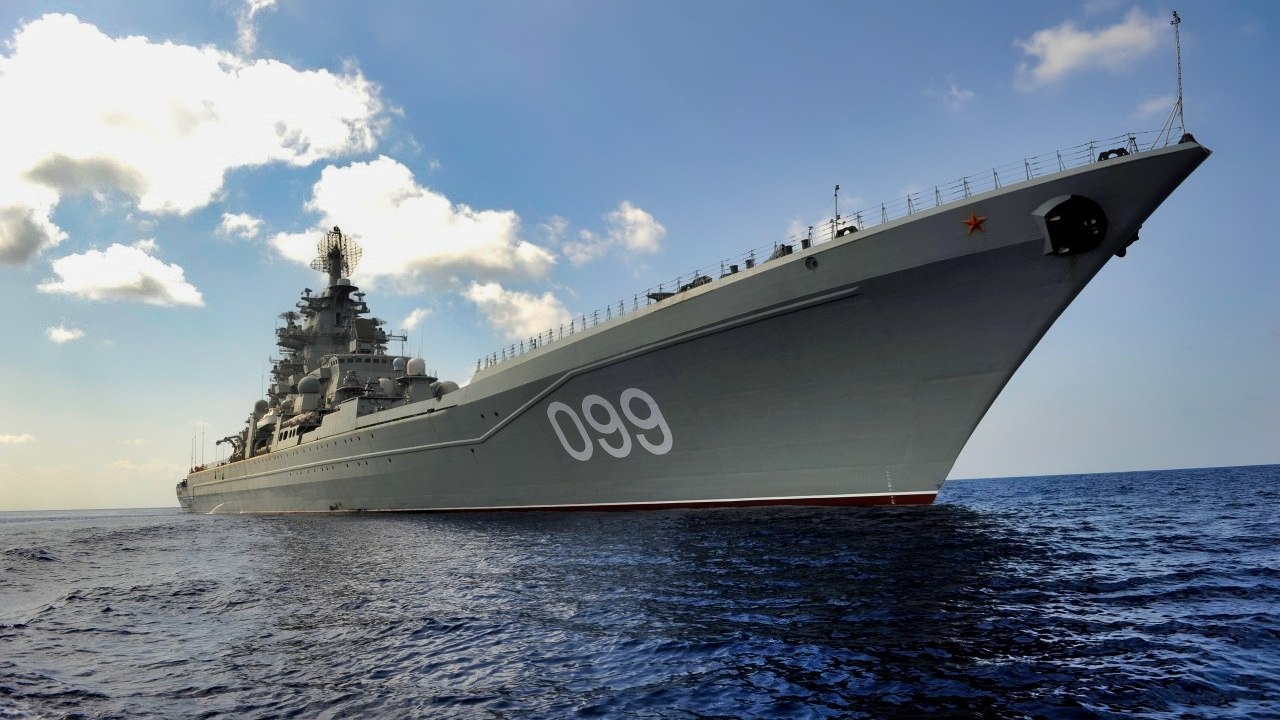
Kirov-Class Battlecruiser Russian Navy. Image Credit: Creative Commons.

Kirov-Class Russian Navy. Image Credit: Creative Commons.

Russian Navy Kirov-class Battlecruiser. Image Credit: Creative Commons.
As a consequence of Russia’s ongoing invasion of Ukraine, Western sanctions are still in place, targeting broad swaths of multiple sectors of the Russian economy. Sourcing Western-made components for the Admiral Nakhimov—and other ships as well as other non-naval systems—has become more difficult and expensive than during the pre-2022 years. Funding for the Russian Navy and the shipyards that sustain it has also become scarce despite the massive boost to the Russian defense budget.
“Sevmash shipyard does find itself in a relatively comfortable position compared to other shipyards,” as per Naval News. “It is the only shipyard in Russia that specializes in the construction and maintenance of nuclear-powered submarines, both attack as ballistic missile submarines, and as such is directly linked to Russia’s strategic deterrence. This direct link to Russia’s strategic maritime deterence ensures that funding and support for Sevmash is assured.”
“Even though the shipyard has been reporting delays in most of its projects in recent years, likely a result of the effects of the war in Ukraine, it nevertheless has a solid track record in delivering ships,” Naval News explained. “Though modernization of the RFS Admiral Nakhimov took a long time, it went smoother than the modernization of the aircraft carrier RFS Admiral Kuznetsov which was plagued by several accidents and whose return to active service seems very questionable.”
The Black Sea Lesson
Ukraine has proven highly adept at targeting Russian ships in the Black Sea under the auspices of Russia’s Black Sea Fleet. Not only have the Ukrainians been able to sink the Black Sea Flagship the Moskva, but dozens of other smaller vessels have been damaged or sunk. Why then invest in such a large ship, one that requires a well-protected periphery, the loss of which could doom the ship to a watery grave?
Postscript
Although capital ships like the Admiral Nakhimov and the Admiral Kuznetsov signal the Russian Navy’s intention to be recognized as a powerful maritime nation that fields nuclear-powered surface ships — joining a small club of countries with nuclear-powered vessels and aircraft carriers — the Kirov-class survivability and usefulness at sea is very much dependent on a robust umbrella of protection provided by other ships.
Absent those screening elements, ships like the Admiral Nakhimov and the Admiral Kuznetsov would struggle to survive.
Given the difficulties experienced by some of the Russian Navy’s other significant surface assets, however, the Admiral Nakhimov’s repair and reactivation timetable appears questionable. Time will tell if the battlecruiser can be modernized and brought to a seaworthy state in a realistic timeframe.
About the Author: Caleb Larson
Caleb Larson is an American multiformat journalist based in Berlin, Germany. His work covers the intersection of conflict and society, focusing on American foreign policy and European security. He has reported from Germany, Russia, and the United States. Most recently, he covered the war in Ukraine, reporting extensively on the war’s shifting battle lines from Donbas and writing on the war’s civilian and humanitarian toll. Previously, he worked as a Defense Reporter for POLITICO Europe. You can follow his latest work on X.
Hypersonic Weapons In Depth
Russia’s Hypersonic Missiles Summed Up in 4 Words


