

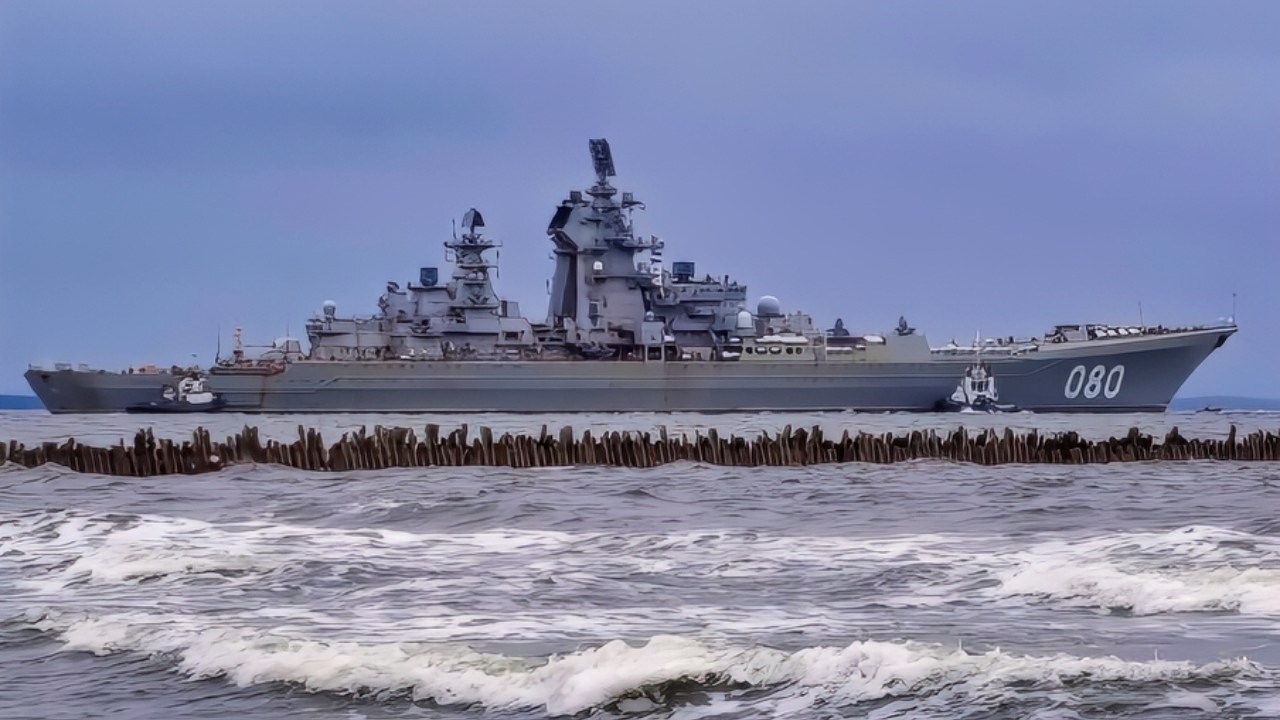
Key Points and Summary – Russia’s Kirov-Class Battlecruiser Reboot Has ‘Museum Piece’ Written All Over It
-Russia is pouring billions of dollars and decades of work into resurrecting a Kirov-class nuclear battlecruiser, Admiral Nakhimov, as the likely future flagship of its navy.
-On the surface, the ship looks terrifying: nuclear propulsion, heavy armor, and a magazine stuffed with long-range missiles.
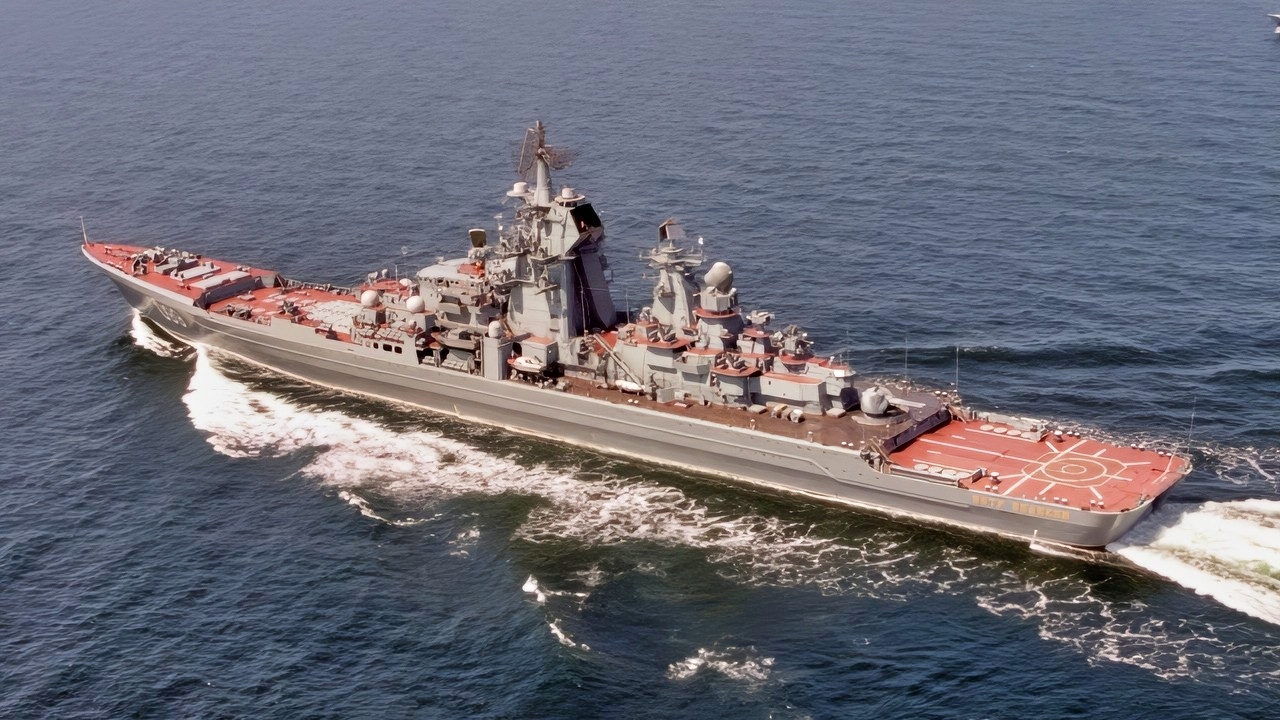
Russian Navy Kirov-Class. Image Credit: Creative Commons.

Kirov-Class from the Russian Navy. Image Credit: Creative Commons.
-But this is an old Cold War hull being dragged into an era of cheap drones and missile swarms.
-The Kirov-class may impress in parades and satellite photos, yet it is a slow, obvious target that soaks up money and shipyard capacity Russia desperately needs elsewhere.
The Kirov-Class Comeback Explained
If you wanted to build the perfect target for the 2020s, you would start with something that cannot hide.
Make it nearly 30,000 tons. Give it a nuclear reactor, a towering superstructure, and a profile that could be spotted from orbit without even trying. Then sail it into a world where cheap drones and long-range missiles are crawling across every battlefield.
That, in essence, is what Russia is doing with its Kirov-class nuclear battlecruiser Admiral Nakhimov.
The Kirov-class was a genuine terror when it appeared in the late Cold War. These ships were built as “carrier killers,” designed to shadow NATO carrier groups, launch massive salvos of supersonic anti-ship missiles, and stay at sea for months on nuclear power. They were the only surface combatants that could look an American battleship in the eye and not blink.
Forty years later, Moscow is trying to bring one of these giants back to life. It is a stunning piece of metal. It is also the wrong ship for the wrong era at the wrong price.
A Twenty-Year Refit for a Ship From the 1980s
Admiral Nakhimov is not a new hull. It is an old Soviet ship that last went to sea in the 1990s, then was laid up and effectively mothballed. Only in the 2010s did serious modernization begin, with workers stripping the ship down to bare steel and rebuilding much of its combat system.
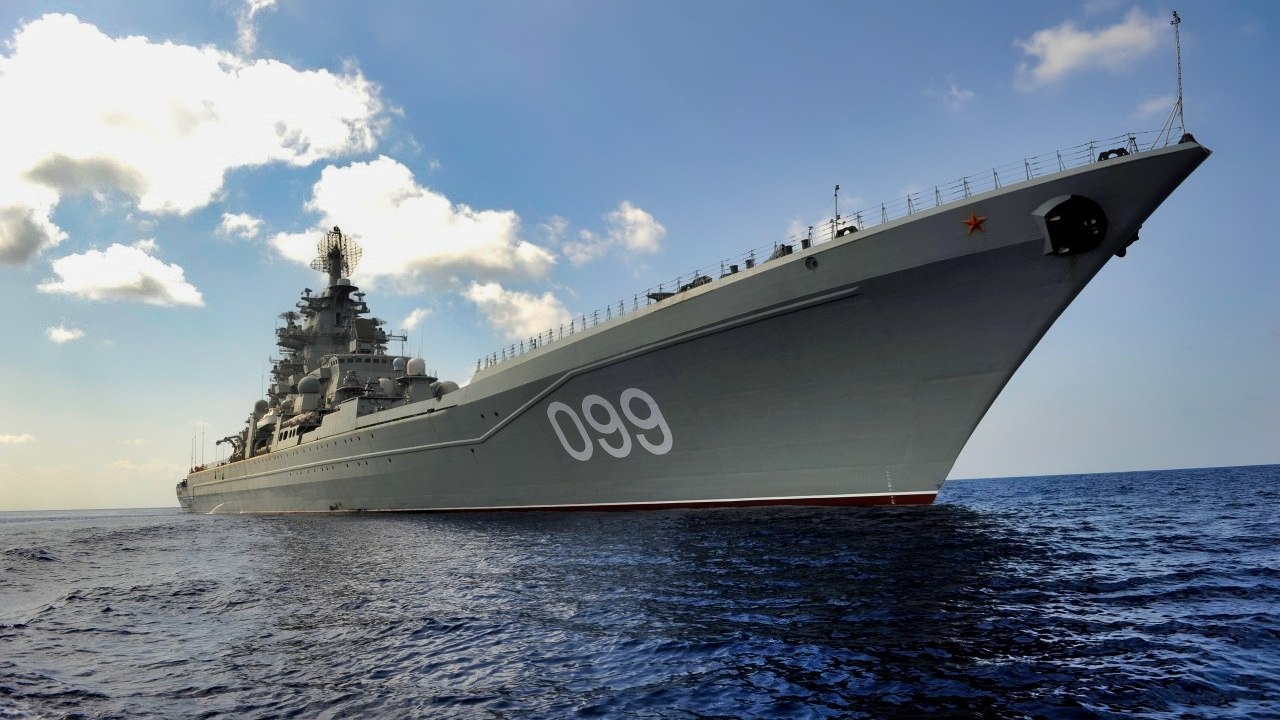
Kirov-Class Battlecruiser Russian Navy. Image Credit: Creative Commons.
That work has dragged on for nearly two decades, with repeated promises of “just a few more years” before the ship reenters service. Deadlines have slipped from the late 2010s to 2020, then to 2023 and 2024, and now into the middle of this decade. In the meantime, whole generations of Russian naval officers have come and gone without seeing the ship at sea.
The bill for this resurrection is enormous. Open-source estimates put the cost in the multi-billion-dollar range, comparable to building multiple new frigates or a flotilla of modern corvettes. The ship’s original P-700 Granit missiles are being ripped out in favor of modern vertical launch systems that can fire Kalibr, Oniks, and Zircon missiles. Its air defenses are being replaced and upgraded. Sensors, combat systems, and much of the wiring are being rebuilt from scratch.
By the time Admiral Nakhimov is fully back in service, Russia will have spent decades of labor and billions of dollars to field a single ship whose keel was laid in the early 1980s.
Even in the best case, you end up with a heavily armed warship that still shares all the vulnerabilities of its original design: size, signature, crew requirements, and dependence on a very fragile industrial base.
What Russia Could Have Built Instead
Every ruble spent on Admiral Nakhimov is a ruble you cannot spend somewhere else. That “somewhere else” matters in a country fighting a grinding land war and trying to keep a global navy afloat under sanctions.
Consider what that money and yard time could have purchased.
Russia could have put more hulls in the water: additional Admiral Gorshkov–class frigates, cheaper patrol ships, or more modern submarines. It could have doubled down on coastal defenses, anti-ship missile batteries, and the drone and uncrewed surface craft that have proven so effective against Ukraine and, ironically, against Russian ships in the Black Sea.
Instead, Sevmash and other key yards have been tied up for years wrestling with a one-off science project: gutting and rebuilding a nuclear battlecruiser that requires specialized workers, unique parts, and a logistics tail that will never scale.
The opportunity cost is not abstract. Russia’s surface fleet is aging. Its shipbuilding sector is under pressure from sanctions, labor shortages, and outdated equipment. Export customers are nervous about buying Russian kit for fear of triggering secondary sanctions or receiving late deliveries. In that world, choosing to sink money into a single prestige ship looks less like strategy and more like denial.
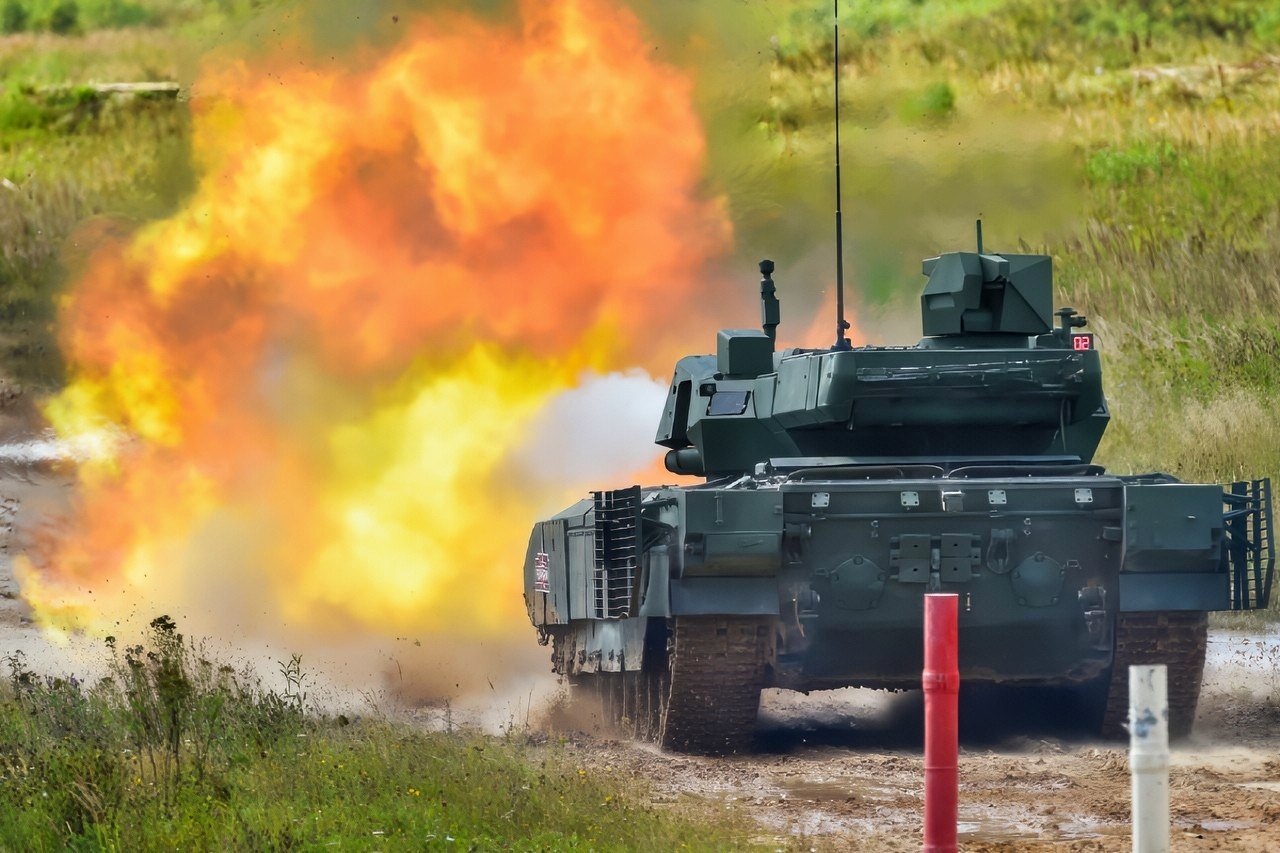
T-14 Armata Tank Russian Army. Image Credit: Creative Commons.
You see the same dynamic in Russia’s armored forces. The T-14 Armata was supposed to revolutionize tank warfare. Instead, Moscow has gone back to refurbishing T-72s and T-62s because that is what it can actually field at scale. The Kirov-class refit is the naval version of the same mistake: chasing a symbol while the practical fleet withers.
Big Targets in the Drone and Missile Era
The most obvious problem with Admiral Nakhimov is not on a balance sheet. It is in the sky and on the sea around it.
Ukraine has shown the world what modern missile and drone warfare looks like against major surface combatants. The Russian cruiser Moskva was sunk by a pair of subsonic anti-ship missiles after a career spent as a symbol of Black Sea power. Russian landing ships and support vessels have been damaged or destroyed by uncrewed surface vessels and long-range strikes that would have been nearly unthinkable a decade ago.
That is against a navy that, on paper, should know its own vulnerabilities.
A Kirov-class ship is larger, more heavily armed, and more heavily defended than Moskva ever was. It will carry layers of surface-to-air missiles, close-in weapons, and electronic warfare systems. But physics do not care about prestige. This is still a single hull with a finite number of missiles and guns, a giant radar signature, and a reliance on a limited number of radars and fire-control systems that can be blinded, saturated, or attacked directly.
In a world of cheap, AI-enabled drone swarms and persistent maritime surveillance, a ship like Admiral Nakhimov is less a ghostly hunter and more a glowing lighthouse in a dark sea. It cannot hide in coastal clutter. It cannot slip quietly through narrow straits. It will be tracked from the moment it leaves port.
To protect that ship, Russia would need a full escort group, reliable air cover, and robust airborne early warning — precisely the areas where its navy and air force are weakest. Without that protective bubble, a refurbished Kirov is simply a more expensive Moskva waiting for its own unlucky day.
The Iowa-Class Lesson Washington Already Learned
If this story sounds familiar, it should. The United States has been here before.
In the 1980s, the Reagan administration reactivated four Iowa-class battleships that had been sitting in reserve. The logic looked compelling at the time. These were massive, armored warships with big guns and plenty of room for new electronics and missiles. The Navy bolted Tomahawk and Harpoon launchers onto their decks, upgraded their systems, and sent them back to sea. We know, we went and saw them this summer on the deck of the USS Iowa. You can see some of the photos we took just below.
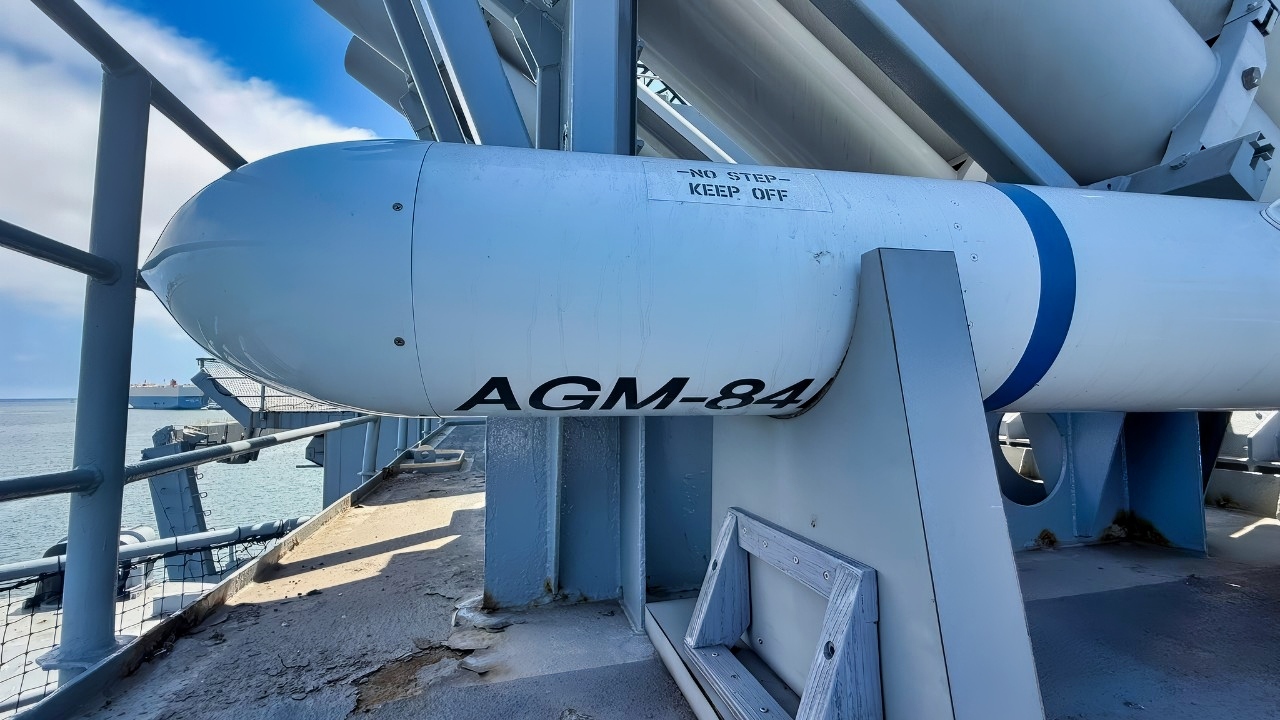
Harpoon Missile Onboard USS Iowa. Image Credit: National Security Journal.
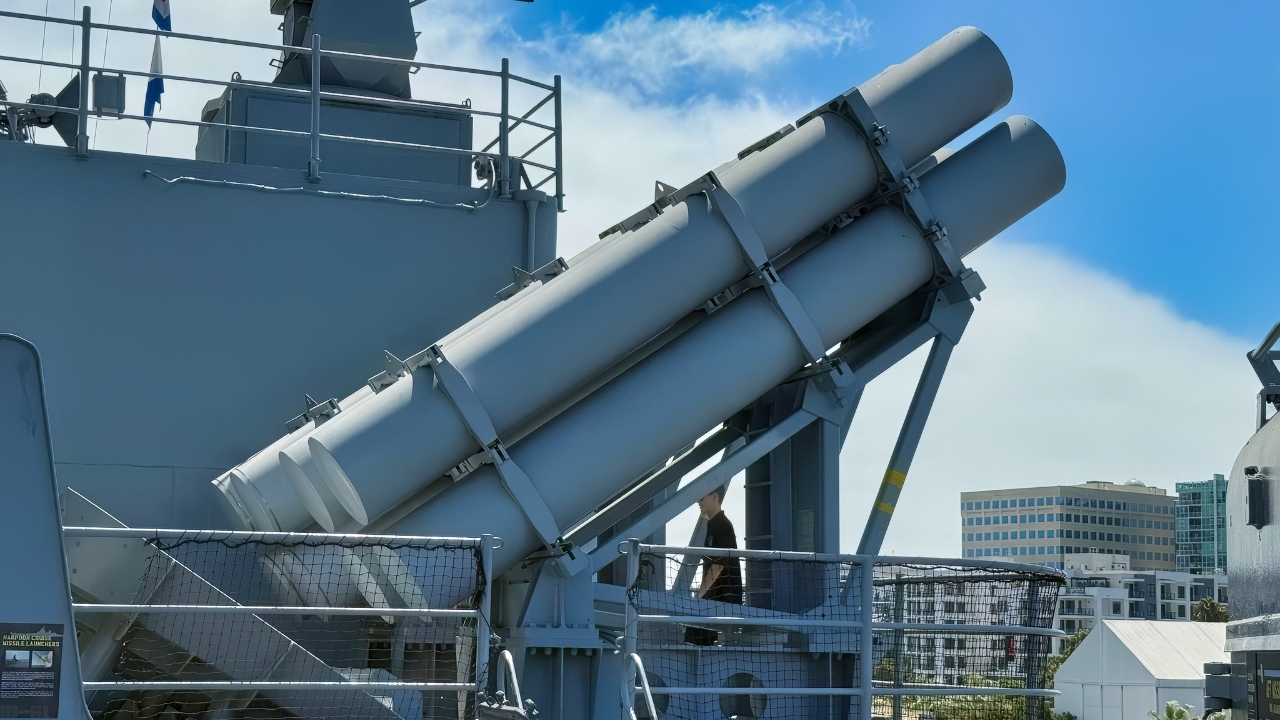
USS Iowa Harpoon Canister. Image Credit: Harry J. Kazianis/National Security Journal.

Missile Box on USS Iowa. Image Credit: National Security Journal.
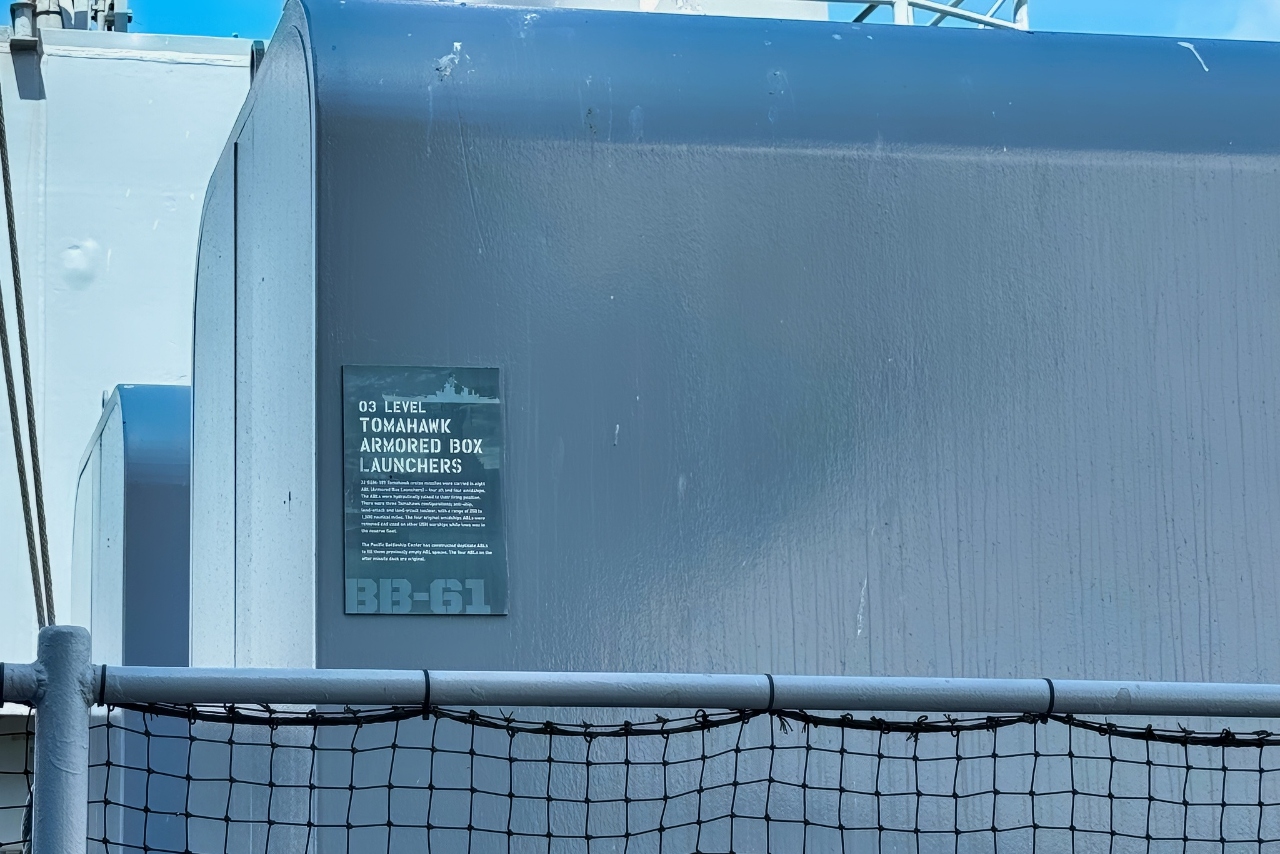
USS Iowa Tomahawk Box. National Security Journal Photo.
For a few years, the Iowas looked like the perfect symbol of American power: World War II armor married to Cold War missiles, cruising past Soviet spy ships with an unmistakable message.
Then reality intruded.
It turned out that keeping 16-inch gun battleships in service was stunningly expensive. Their crews were large and specialized. Their maintenance needs were unique. Their armor, while impressive on paper, did not magically protect them from modern sea-skimming missiles. As the Cold War ended and budgets tightened, the Navy had to choose between keeping museum-quality icons afloat and funding capabilities that actually mattered in a new era.

Iowa-Class 5-Inch Guns. Image by Harry J. Kazianis/National Security Journal.
The battleships lost. They are now static displays in museums — magnificent pieces of history, but not tools you would send into a modern fight.
Russia watched all of that. The Kirov-class was a big part of why the Iowas came back in the first place. The Soviets built nuclear battlecruisers; the United States dusted off battleships. Both sides were reaching for symbols in a very specific Cold War context.
The lesson Washington ultimately drew was blunt: giant gun-and-missile ships are not worth the long-term price in a world dominated by aviation, submarines, and precision missiles. It took the U.S. Navy a decade or so to admit it and move on. And, honestly, anyone who says these Iowa-class battleships are in for a rude awakening. They are so old that, when I visited, USS Iowa was a total analog mess and really in what I consider a rough shape. It would take billions to reboot her.

USS Iowa and Old Systems. Image by Harry J. Kazianis/National Security Journal.
Moscow seems determined to ignore such lessons and run the experiment itself, with fewer resources and a more fragile economy.
Prestige Flagship, Limited Warfighting Value
The one thing Admiral Nakhimov will do very well is look impressive. But so would a rebooted Iowa-class battleship.
When the ship finally joins the fleet, it is likely to become a likely flagship, bristling with new missile launchers, modern air-defense systems, and fresh paint. It will dominate parades in Severomorsk or St. Petersburg. Satellite imagery will capture its size. State television will run slow-motion footage of hypersonic missiles blasting off its decks.
None of that automatically translates into real combat power.
In a crisis with NATO, the ship will be too valuable to risk far from Russia’s northern bastions. Its nuclear propulsion and heavy weapons give it reach, but its replacement cost and political symbolism make it a poor candidate for forward, high-risk missions. In any conflict near Ukraine’s coastline, the sheer density of shore-based missiles, drones, and Western ISR support would make sailing such a ship into range an almost suicidal move.
That leaves Admiral Nakhimov in an awkward spot. It is too expensive to risk and too visible to ignore. At best, it becomes a heavily guarded command ship operating in carefully controlled waters. At worst, it spends most of its service life as a floating billboard for a navy that needed many other things first.
Meanwhile, the Russian fleet still needs more modern frigates and corvettes, better mine countermeasures, improved anti-submarine warfare capacity, and the kind of cheap, attritable systems that can be lost in combat without causing a strategic panic. A single refurbished battlecruiser cannot solve any of those gaps. It simply consumes resources that might have.
The Kirov-Class Mistake Looks Pretty Clear
There is something undeniably compelling about a Kirov-class battlecruiser.
It is a piece of Cold War steel that can still make even seasoned sailors stop and stare. Nuclear power, deep magazines, and massive missiles all wrapped in one hull — it feels like a statement that Russia is still a blue-water power that can match anyone, at least on the surface.
But strategy is not about what looks impressive in a photo. It is about what survives contact with enemy weapons, budgets, and time.
In today’s world, resurrecting a Kirov-class ship is less of a good idea and more of a costly diversion. It ties up shipyards, drains scarce funds, and yields a vessel that will spend its life under the shadow of cheap drones, ubiquitous surveillance, and missile swarms. It is the naval equivalent of dragging an Iowa-class battleship out of a museum, repainting it, and pretending the calendar reads 1985.

USS New Jersey July 2025. Image Credit: National Security Journal.
Russia is not going to cancel Admiral Nakhimov now. Too much money and prestige have already been sunk into its hull. But that does not make the project wise.
It makes it a floating reminder that even in Moscow, nostalgia can be more powerful than strategy.
About the Author: Harry J. Kazianis
Harry J. Kazianis (@Grecianformula) is Editor-In-Chief and President of National Security Journal. He was the former Senior Director of National Security Affairs at the Center for the National Interest (CFTNI), a foreign policy think tank founded by Richard Nixon based in Washington, DC. Harry has over a decade of experience in think tanks and national security publishing. His ideas have been published in the NY Times, The Washington Post, The Wall Street Journal, CNN, and many other outlets worldwide. He has held positions at CSIS, the Heritage Foundation, the University of Nottingham, and several other institutions related to national security research and studies. He is the former Executive Editor of the National Interest and the Diplomat. He holds a Master’s degree focusing on international affairs from Harvard University.
More Military
The Mach 2.2 YF-23 Black Widow II Stealth Fighter Has a Message for the U.S. Air Force
Mach 10 Missile Showers: China’s Aircraft Carriers Have 1 Big Advantage over the U.S. Navy
China’s New H-20 Stealth Bomber Keeps U.S. Air Force Generals Up at Night
The A-6 Intruder Has a Message for the U.S. Navy
How NATO Got Its Hands on Russia’s ‘Black Hole’ Kilo-Class Submarine


GhostTomahawk
November 17, 2025 at 12:45 am
What a clod. This guy types the purpose of this vessel in the article and then talks about its vulnerability to drones. This is a steel behemoth that can take a beating and hunt far from coastal waters. It’s exactly what the US navy fears. A nuclear powered ship that can operate independently that can fire carrier killers. It’s not worried about drones like the US is with its fleets of ships covered in aluminum and Kevlar. Granted the Russian navy would need more to make a significant impact but it could wipe a carrier out before the carrier could save itself. This ship isn’t scared of harpoon or tomahawk missiles the Burkies fire. It’s AA and defenses can protect it and by the time the carrier got hit and was going down… it’s planes are worthless.
Way to miss it. Were going back to the cold war and the US missed the memo and too broke to do anything about it.
Robert stevenson
November 17, 2025 at 6:00 am
Russia is a fallen empire,it had a chance a few months in just when the realized it was now a war of attrition to use its bombers and level most of Ukraine pull back and live.Sure they would of lost some men and equipment but they would of survived intact.Now they will lose everything over unfounded fear or delusions of grandeur trying to bring back a failed dream.Its funny how putin wanted to bring back the soviet union and failed because he didnt follow the soviet playbook of warfare.He wanted to show off and it costed him everything.
Barondog
November 17, 2025 at 7:33 am
I agree that the Kirov class is an outdated oversized expenditure of resources. But this is good for the US and European navies.
Every comment made about the Kirovs applies to our Carriers and Burke Destroyers. Our Carriers are larger, older, less well armed, and cost more to maintain and operate. I know a Carriers purpose is to support its aircraft. But the Navy would be wise to use some of the weight and space on Carriers (even at the cost of reducing the air wing) for a more robust on board weapons capability. New technology is creating more cracks in our defenses. We need to go back to if it floats it fights. This may shore up some vulnerabilities. Certainly it will make our fleet more lethal.
The only escorts currently available is a single 1980s design Destroyer. The Burkes have been updated as much as possible. No more space or power is available. Naval warfare technology will continue to advance while the Burkes cannot. This makes them less effective the longer they remain in service. The defensive bubble around our combat groups are stretched now and will only degrade further over time. To excarabate matters, we do not have the correct jets and ships in service. The Navy has become so risk adverse and only plans to buid ships that are incremental improvements. We are behind and need to develope the most powerful and effective ships and jets we can properly design. Designing and building at the current pace takes time the Navy does not have. The urgency of this situation seems to be lost not only with the Navy but the Pentagon and Congressional levels as well.
We have no shipyards, no professional work force and no way to correct these deficiencies in the short term. A way around this problem must be found. It appears we can build jets and drones. It only takes resolve and funding. But combat ships are a different matter. They take time to design and build. The Navy cannot even build Frigates. How can they build Destroyers, Cruisers and Corvettes that are large enough, advanced enough and armed well enough to do the job? China is building a fleet of new ships and jets that are more advanced and effective. A fleet made up of of all new ships and jets spends less time being maintained. The USN is spending more time and money on maintaince.
The Navy is facing a crisis of epic proportions. We need to address it as such. This means multifaceted solutions and more money. If our allies have surplus shipyards laws must be changed to be to utilize them in the short term. The DDX should be canceled as insufficient for the job. The Constellation Frigate program should be put on notice if the problems cannot be resolved. Regardless we would be wise to learn from the mistakes made. More powerful advanced designs need to be produced. That does not mean building such ships smaller numbers. The required technology must be developed and tested more rapidly. Navy contracting must be streamlined and based on a fixed time and cost. In the long term the US shipbuilding industry must be rebuilt quickly and efficiently.
If we do not do all these things we will fail to build the fleet we need. The Pentagon and Congress must realize the scale and urgency of the problem. Only a strong military in all branches can assure peace and stability. The longer we remain weak the more aggressive our enemies will be.
Krystal cane
November 17, 2025 at 3:15 pm
Is it trump blew bubba?