


Key Points and Summary – The Iowa-class battleships did something no other big-gun warships managed: they stayed relevant, repeatedly, for half a century.
-Built for World War II speed and punch, they proved just as valuable when called back for Korea, Vietnam, the Cold War’s late surge, and even Desert Storm.
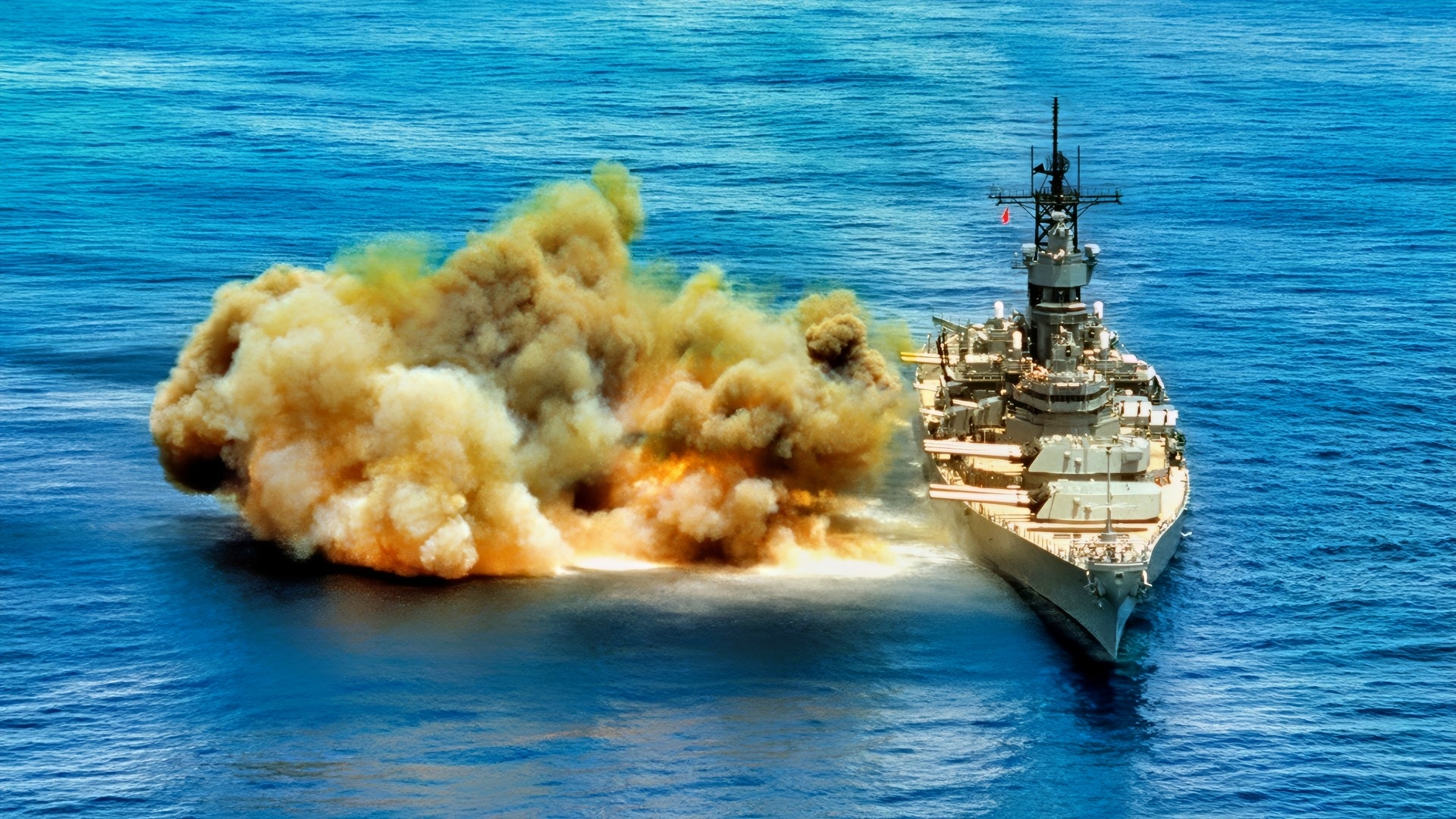
Iowa-Class Firing 16-Inch Guns. Image Credit: Creative Commons.
-Their blend of long-range firepower, high endurance, and surprising adaptability—adding cruise missiles, modern sensors, and close-in defenses—let them bridge eras other battleships could not.
-They were tough enough to take punishment, fast enough to be where it mattered, and imposing enough to deter. If any class can claim the title “best ever,” the Iowa quartet makes the strongest case.
-BONUS – National Security Journal spent a lot of time on various Iowa-class battleships this year. We have included many photos of those visits in this article.
The Iowa-Class: The Best Battleships Ever. Period
“Best ever” is a slippery phrase in naval history. But, after spending a lot of time on the USS Iowa this past summer, I can tell you who I think deserves the title of best battleship ever.
You can measure armor thickness, shell weight, radar sophistication—and still miss the point.
The real question is simpler: which battleships delivered the most value to their navies over the longest, most varied span of time?
By that yardstick, the Iowa-class battleships are in a league of their own.
5 Reasons the Iowa-Class Are the Best of the Battleships
They were conceived in the furnace of World War II, yet they never became museum pieces on arrival. Instead, the United States dragged them out of mothballs—again and again—because their core virtues never went out of style: reach, survivability, and the ability to put steel on target at long range, quickly, and for as long as commanders needed.

Top of USS Iowa. Image Credit: National Security Journal.
No other battleship class did that across so many decades and missions. Here are five reasons why.
1) Speed And Reach The Ocean Couldn’t Shrink
Most people picture battleships as floating fortresses—massive, unstoppable, and a little ponderous.
The Iowa-class broke that stereotype. They were designed to keep up with the fastest carrier task forces of their day, meaning they could sprint at more than 30 knots, cover vast distances without babying their machinery, and arrive with enough fuel and ammunition to make the trip worthwhile.
That speed wasn’t a party trick. It was strategy. In World War II, the Pacific theater punished anything slow. Carriers moved like knife points; escorts had to match pace. An Iowa could reposition overnight to screen a carrier group, bombard a shoreline at dawn, and be halfway to the next assignment by evening.
In later years, the same speed gave presidents and fleet commanders political flexibility. When you want to signal resolve fast—without relying on basing rights ashore—few messages are clearer than a 58,000-ton ship that shows up on schedule.
Range mattered just as much. Long legs meant fewer refueling pauses and more on-station time. A ship with both speed and endurance is a ship that commanders will keep calling, decade after decade.
2) Big Guns That Solved Problems Nothing Else Could
Naval warfare reinvented itself around aircraft and missiles, but there’s still something uniquely useful about a heavy shell landing precisely where troops need it. The Iowa-class delivered that effect like nothing else afloat.
Their nine 16-inch guns could hurl projectiles the size of a compact car tens of miles inland, hour after hour, with a shock effect that no rocket artillery quite replicates.
In World War II, those guns flattened shore defenses and airfields ahead of amphibious landings. In Korea and Vietnam, they provided sustained, accurate fire that commanders ashore could count on when the weather grounded planes or the enemy proved stubborn.
In Lebanon in the 1980s, and again in 1991 during Desert Storm, the guns gave political leaders a dramatic but controllable tool: precision by the standards of naval gunnery, scale by the barrel, and credible warning that more could follow.

Those Iowa-Class Guns. Image Credit: Harry J. Kazianis/National Security Journal.
It wasn’t nostalgia. A battleship could loiter within range without the sortie rhythm that constrains aircraft. It didn’t need a runway. It didn’t need tanker support. When a division needed heavy steel on a ridgeline, the Iowas delivered repeatedly, safely, and—by naval standards—cheaply.

16-Inch Iowa-Class Guns. Image Credit: National Security Journal.
3) Built Like A Bank Vault, Yet Surprisingly Graceful At Sea
The Iowa design team understood a harsh truth: ships are only as useful as they are alive to fight again tomorrow. Armor layout, internal subdivision, and damage-control architecture gave these ships the ability to absorb hits and keep fighting.
Their hulls were honed for speed and seakeeping; they handled heavy weather with the kind of poise that keeps crews effective on day three and day ten, not just day one.
Survivability isn’t only about stopping shells. It’s also about forgiving the thousand cuts of an ocean deployment. The Iowas’ robust engineering plants, redundancies, and well-practiced damage-control culture turned risk into resilience.
In an era when a single modern anti-ship missile can ruin your day, it’s easy to forget that resilience isn’t just a design choice—it’s an ethos that starts with a ship built to take a punch.

USS Iowa Battleship Guns. Image Credit: National Security Journal.
That toughness fed morale and deterrence. Sailors trust ships that feel unbreakable. Adversaries hesitate when they know the first blow might not end the fight. The Iowas projected that message just by existing.
4) The Battleship That Became A Missile Ship—Without Losing Its Soul (We Have the Photos)
Most battleships disappeared because they couldn’t adapt. The Iowas did the opposite. When the Navy brought them back in the 1980s, the ships returned with new eyes and new fists: Tomahawk land-attack cruise missiles tucked into armored box launchers; Harpoon anti-ship missiles for sea control; modern electronic warfare suites; and Phalanx close-in guns to swat incoming threats at the last moment.
And to my surprise, much of that missile infrastructure is on the USS Iowa out in California today; we have the pictures below to prove it.
They kept their catapults for history; they added helicopters and modern communications for relevance.
You could watch that adaptability at work in 1991. USS Missouri and USS Wisconsin fired Tomahawks to open the air campaign and used their big guns to crack Iraqi positions once the shooting war began in earnest. The ships were, in effect, joint-force Swiss Army knives—part missile battery, part floating artillery, part psychological operations tool.
They didn’t ask the Navy to choose between past and future; they collapsed that choice into one hull.
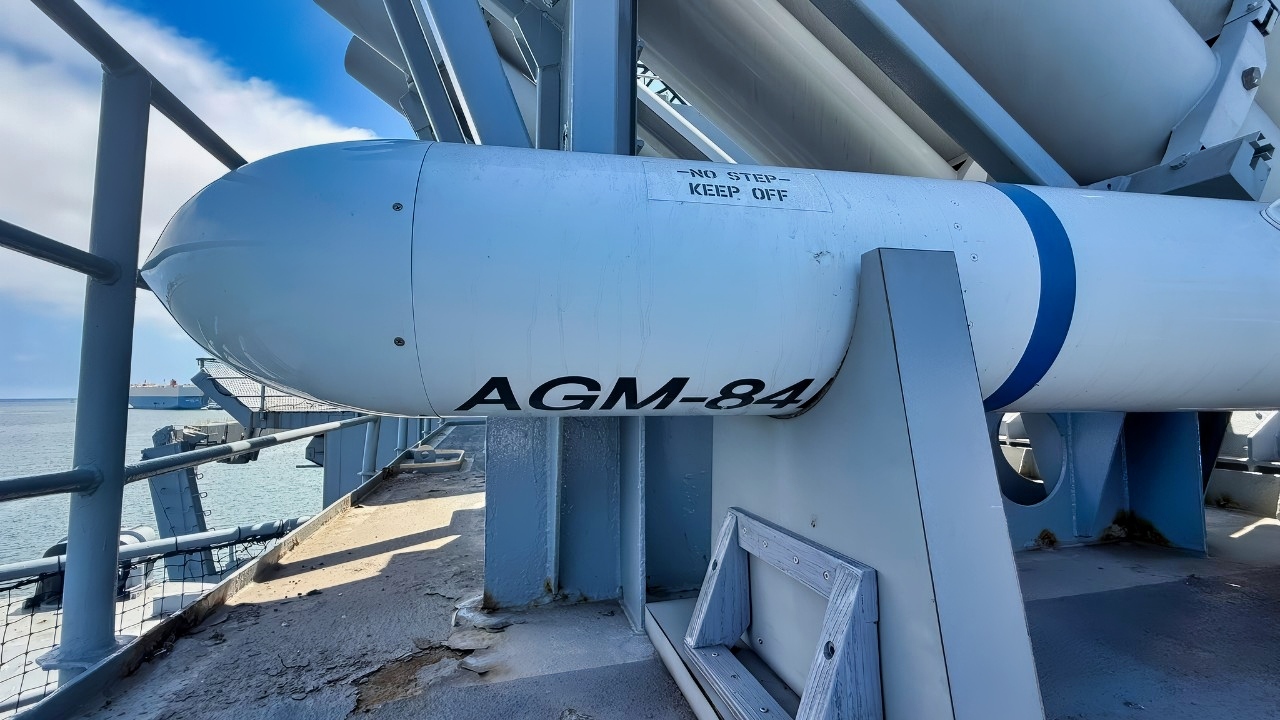
Harpoon Missile Onboard USS Iowa. Image Credit: National Security Journal.
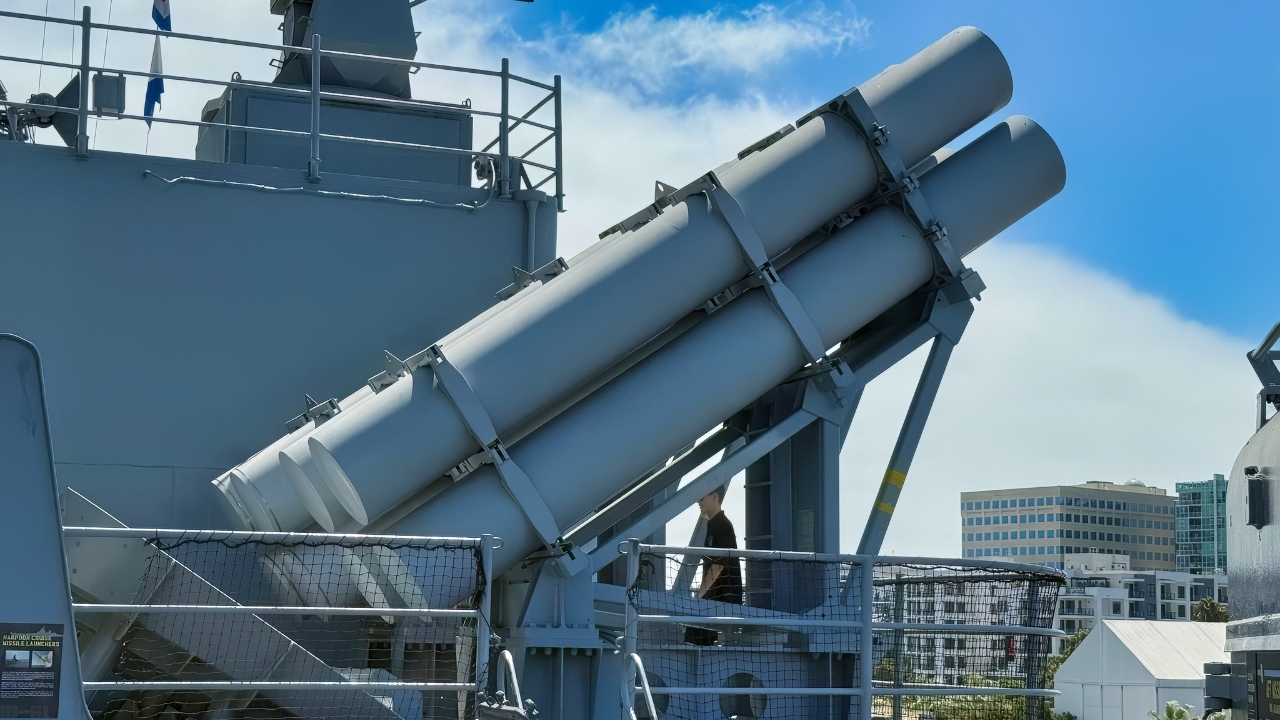
USS Iowa Harpoon Canister. Image Credit: Harry J. Kazianis/National Security Journal.

Missile Box on USS Iowa. Image Credit: National Security Journal.
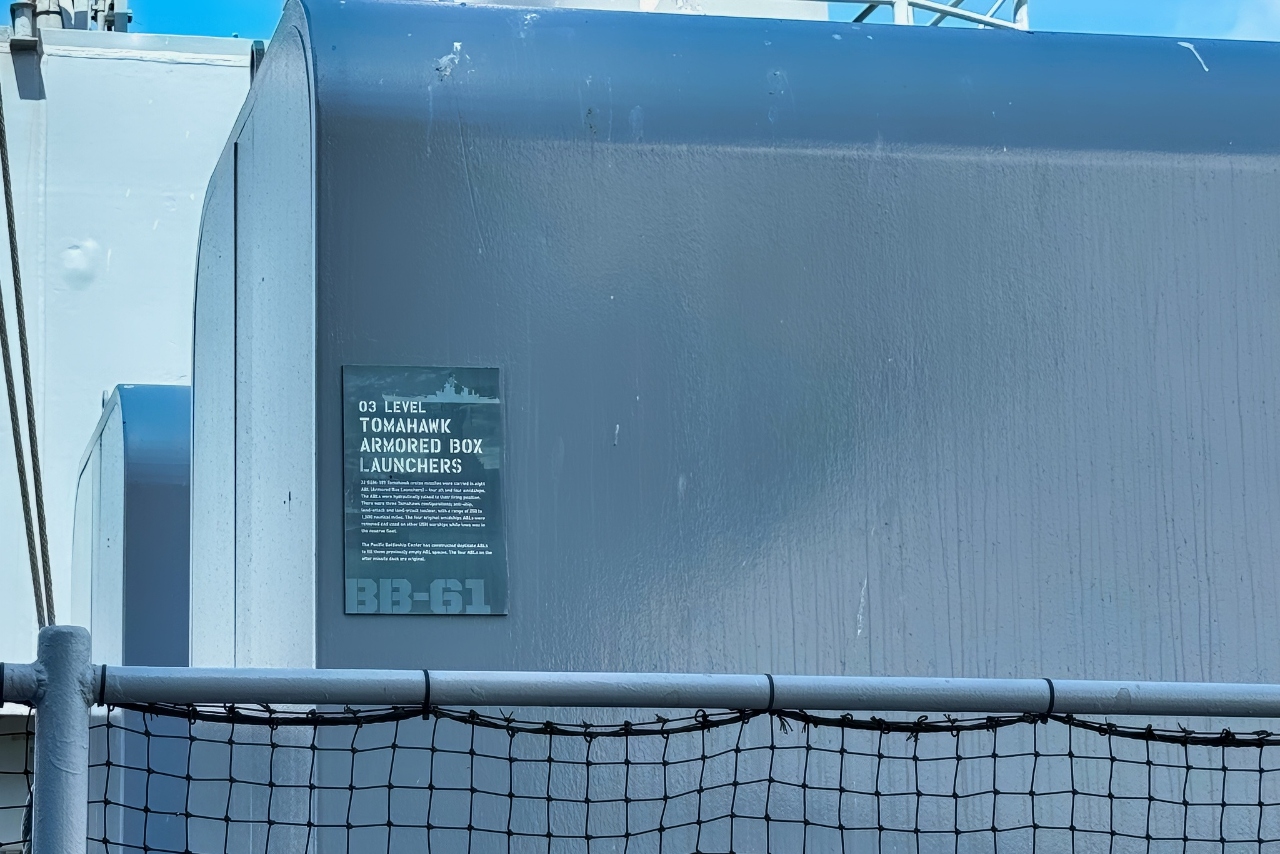
USS Iowa Tomahawk Box. National Security Journal Photo.
Adaptability also meant room to grow. The Iowas’ physical volume—so often a liability in older designs—became a virtue. When the Navy wanted to cram in modern combat systems, it had power, space, and cooling to spare. That is the hidden currency of ship design: margins that let a vessel accept tomorrow’s technology without a full rebuild.
5) Presence, Politics, And The Power Of A Moving Monument
Finally, there’s the intangible that isn’t really intangible at all: the politics of presence.
A battleship changes the temperature of a crisis simply by arriving. Allies feel steadier; adversaries think harder.
The Iowas were deterrence you could photograph from the quay—an unmistakable signal that Washington was paying attention and had options short of air raids or occupation forces.
That presence carried domestic weight, too. Bringing the Iowas back in the 1980s wasn’t just a military decision; it was a statement about American industrial capacity, crews, and will.
When the ships returned home for the last time, they slid into another form of public service as museum ships, teaching new generations what power at sea looks like up close.

Iowa-Class Battleship Looking Really Old. Image Credit: Harry J. Kazianis/National Security Journal.
Few platforms have lived such a full civic life: warship, deterrent, and, finally, national classroom.
Presence isn’t a substitute for capability. But marshaled correctly, it reduces the number of times you have to use that capability. The Iowas embodied that paradox better than any battleship before or since.
Why The “Best Ever” Argument Holds Up—Even With Honest Caveats
Every love letter to the Iowa-class deserves a dose of humility. They were expensive to crew and maintain by modern standards. They demanded logistics tails and pier space that smaller ships do not. And no amount of armor makes a ship invulnerable to today’s layered anti-ship weapons.
If you tried to design a battleship from scratch for the 2030s, you wouldn’t start here.
But that misses the heart of the claim. The Iowas weren’t perfect; they were persistently useful. They spanned eras that murdered other designs. They gave commanders a unique kit of tools: the thunder of heavy guns, the precision of cruise missiles, the speed to be where they were needed, the range to stay there, and the toughness to shrug off the ocean’s malice.

USS New Jersey Iowa-Class Battleship. Image Taken on 8/2/2025 by National Security Journal/Stephen Silver.
When the Navy needed a statement—at the close of World War II, off Korea and Vietnam, in the Beirut cauldron, and over the sands of Kuwait—it reached for the same four names.
Call that nostalgia if you want. It looks more like evidence.
What Their Legacy Should Teach Us Now
We will not bring the Iowas back, forget what any politician says. Their moment passed with the rise of precision munitions and the spread of anti-ship missiles. But their legacy is more than museum steel. It’s a design philosophy that prizes margin, growth, and credible, repeatable effects.
It’s a reminder that speed and endurance still matter even in the age of satellites. It’s proof that a ship’s best trick is sometimes its ability to be many different ships as the world changes around it.
The next time the Navy sketches a platform meant to serve for decades—whether a large surface combatant or a future arsenal ship—it should remember what made the Iowas “best.”

USS Iowa and Old Systems. Image by Harry J. Kazianis/National Security Journal.
Build for the missions you know. Leave room for the missions you haven’t imagined.
And never forget that presence is a capability, too.
If “best ever” means the class that did the most, longest, when asked by history to do more than it was built for—it’s hard to see how anything tops the Iowas.
About the Author: Harry J. Kazianis
Harry J. Kazianis (@Grecianformula) is Editor-In-Chief and President of National Security Journal. He was the former Senior Director of National Security Affairs at the Center for the National Interest (CFTNI), a foreign policy think tank founded by Richard Nixon based in Washington, DC. Harry has over a decade of experience in think tanks and national security publishing. His ideas have been published in the NY Times, The Washington Post, The Wall Street Journal, CNN, and many other outlets worldwide. He has held positions at CSIS, the Heritage Foundation, the University of Nottingham, and several other institutions related to national security research and studies. He is the former Executive Editor of the National Interest and the Diplomat. He holds a Master’s degree focusing on international affairs from Harvard University. Email Harry: [email protected].
More Military
Why the U.S. Navy Finally Said No to the F-14 Tomcat
Israel’s Merkava Tanks Have a Message for Any Army On Earth
The Mach 1.4 X-59 Could Create Military Nightmares for Russia and China


John Sweeney
November 3, 2025 at 10:35 pm
The US Navy sure could use the remaining battleship’s that can still perform, if another war broke out, those battleships, could give our Navy, added firepower in any conflict, that should, or could happen again.