


Key Points and Summary – The Navy’s Constellation-class frigate was supposed to be the cheap, proven ship that fixed U.S. procurement dysfunction.
-Instead, delays and cost overruns gutted the program, leaving only two hulls limping toward completion.

An artist rendering of the U.S. Navy guided-missile frigate FFG(X). The new small surface combatant will have multi-mission capability to conduct air warfare, anti-submarine warfare, surface warfare, electronic warfare, and information operations. The design is based on the FREMM multipurpose frigate. A contract for ten ships was awarded to Marinette Marine Corporation, Wisconsin (USA), on 30 April 2020.
-That failure is not an outlier—it mirrors the Army’s M10 Booker, the KC-46 tanker, and the T-7A trainer, all trapped in the same slow, brittle, overcomplicated acquisition system.
-Meanwhile, adversaries like China and Russia are building and firing faster than Washington can define requirements.
-Unless the U.S. rebuilds industrial capacity, shortens timelines, and kills failing programs early, it risks entering the next war with yesterday’s force.
The U.S. Military Has a Procurement Crisis. The Constellation-Class Proves It
When the Navy’s Constellation-class frigate was first announced, it was heralded as the moment when the United States finally escaped the gravitational pull of its own procurement dysfunction.
A modest frigate, built on a proven European design, marketed as the ship America could actually build. Instead, the program has been effectively gutted—cancelled after massive delays and cost growth, with only the first two ships limping toward completion.
What was sold as a low-risk course correction has become one more monument to a system that has forgotten how to turn plans into hulls.
The Constellation’s failure is not an isolated embarrassment. It is a symptom of a deeper rot spreading across the armed forces—one that quietly threatens to hollow out American power at the moment the world is least forgiving of weakness.

Constellation-Class Frigate U.S. Navy. Image Credit: Industry Handout.
What the Navy is experiencing is not confined to the water. The same procurement pathologies now run through the Army, the Air Force, and the broader defense-industrial ecosystem.
The M10 Booker—a promising light tank in concept—has already been knocked off course, with the Army terminating low-rate production and shelving plans for full-rate fielding as budgets, priorities, and requirements lurch in new directions.
Other programs show the same pattern: long timelines, spiraling costs, and platforms conceived for threat environments that no longer exist. The disease is systemic. The consequence is strategic.
A Military Designed for Yesterday
For a generation, the United States grew accustomed to fighting the wars it had rather than preparing for the wars that were coming.
The counterinsurgency era lulled Washington into believing that technological superiority would always be available on demand, that industrial capacity would remain elastic, and that the arsenal of democracy could be switched back on when needed.
Those assumptions are now colliding with reality. The industrial base is thin. The acquisition system is baroque. The services do not speak to one another in ways that produce integrated, modern force design.
The Constellation-class sits at the intersection of these failures. It was meant to compensate for the Navy’s shrinking surface fleet, the retirement of aging cruisers, and the loss of Littoral Combat Ship hulls that never lived up to their billing. A functioning procurement system would have delivered these frigates on time, in numbers, with a clear role in distributed maritime operations. Instead, the Navy is watching the calendar and hoping the geopolitical clock does not run out first.
The Army faces its own version of this problem.
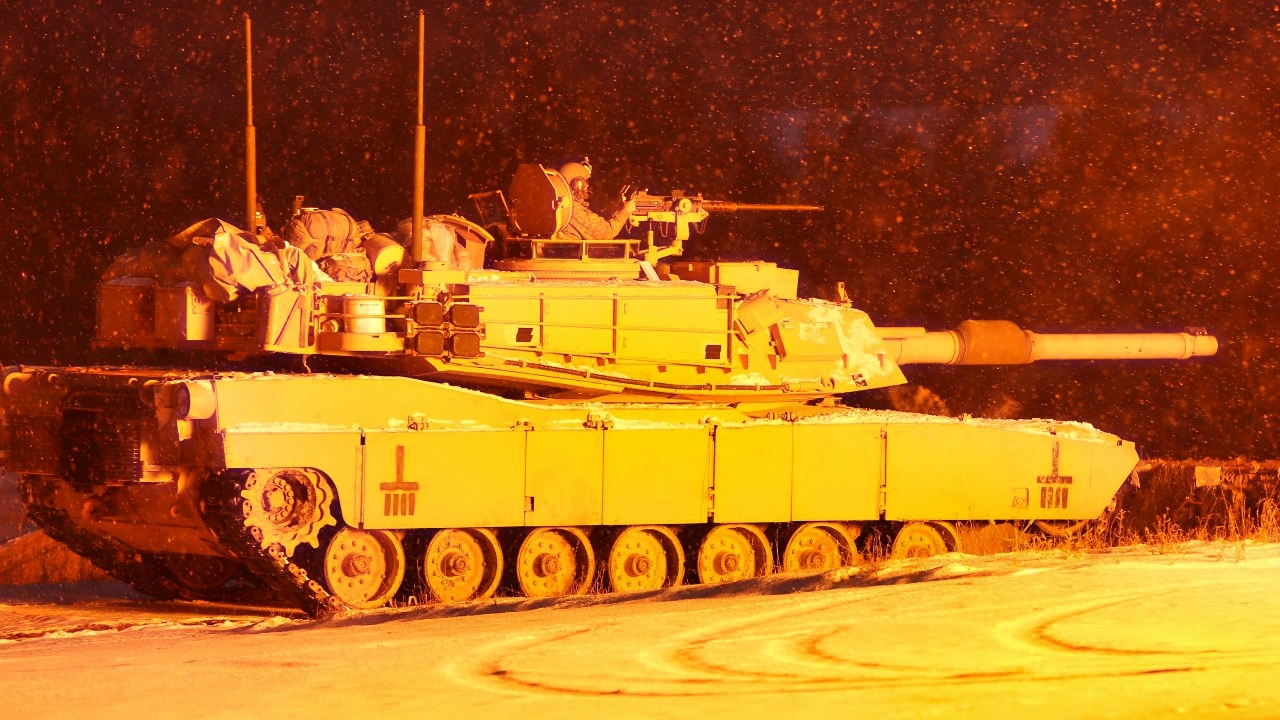
U.S. Soldiers assigned to 1st Squadron, 7th Cavalry Regiment, 1st Armored Brigade Combat Team, sit ready to engage targets in an M1 Abrams Main Battle Tank during Combined Resolve XV live fire exercise at Grafenwoehr Training Area, Germany, Feb. 9, 2021. Combined Resolve XV is a Headquarters Department of the Army directed Multinational exercise designed to build 1st Armored Brigade Combat Team, 1st Cavalry Divisions’s readiness and enhance interoperability with allied forces to fight and win against any adversary. (U.S. Army photo by Sgt. Randis Monroe)

The 1st Battalion, 194th Armor Regiment,1st Brigade Combat Team, 34th Infantry Division, test fire their M1 Abrams Tank at Udairi Range, Kuwait, May 3, 2021. The main cannon of the M1 Abrams Tank shoots a 105mm round. (U.S. Army Photo by Spc. Juan Carlos Izquierdo, U.S. Army Central Public Affairs)
The M10 Booker was advertised as a nimble, survivable answer to the demand for mobile firepower in contested environments. But it has arrived in an era when the character of land warfare is being rewritten in real time.
Artillery has returned to primacy. Sensors and strike systems are compressing the battlespace. Uncrewed systems are eroding traditional concepts of maneuver. Yet the procurement system still behaves as though it has unlimited time to debate requirements rather than field urgently needed capability.
The Air Force offers its own cautionary tales. The KC-46 tanker—marketed as a low-risk, proven-airframe solution—has spent years hobbled by design flaws and repeated delays.
At the same time, the T-7A trainer has stumbled through escape-system failures and slipped timelines, mirroring the same procurement pathologies now crippling the Constellation-class and the M10 Booker.
The Industrial Base That Isn’t There
The deeper problem is no longer simply poor management—it is capacity.
The United States cannot build fast enough, cannot scale production rapidly, and cannot surge to meet strategic shocks. Shipyards struggle with workforce shortages and obsolete facilities.
Munitions manufacturing remains brittle. Key components depend on fragile supply chains that tighten whenever the world becomes dangerous.
This is why the Constellation program matters so much: it exposes the illusion that the United States can recover shipbuilding capacity through incrementalism. A similar mirage is projected over other programs.
The Army expects to modernize its formations even as the industrial base cannot sustain artillery production at the rates demanded by the war in Ukraine. The Air Force expects to maintain dominance in airpower while relying on procurement cycles that span decades rather than years.
Across the services, the gap between ambition and capacity continues to widen.
A Strategic Moment That Won’t Wait
All of this is happening at a time when the demands on American power are rising, not shrinking. The Western Pacific is becoming the decisive theater of the century.
Russia’s war in Europe has recalibrated assumptions about land warfare and industrial-age attrition.
Iran’s expanding network of proxies is pulling the Middle East into recurring crisis cycles. In each theater, the United States faces adversaries who are learning faster, building faster, and adapting faster than Washington’s procurement bureaucracy can process a change request.
A military built by committees will not survive the next war. A system that takes twenty years to field a platform in an era when the character of warfare evolves every three years will not deliver deterrence, let alone victory.
The Constellation-class debacle is a warning flare.
Reclaiming the Arsenal
Fixing this problem requires more than tinkering with contracting rules or scolding manufacturers.
It demands a return to strategic discipline. It requires clear choices about what the United States actually needs to fight and win in the coming decades, rather than what legacy constituencies insist on preserving.
It demands a radically new approach to industrial readiness: one that treats shipyards, munitions plants, and critical-component production as pillars of national security equal to alliances, basing, and force structure.
It also requires intellectual honesty.
The services must be willing to abandon programs that cannot deliver, compress procurement timelines, and embrace iterative development rather than chasing exquisite, once-in-a-generation platforms.
Warfare is now defined by adaptation cycles that reward speed, resilience, and redundancy. Those qualities are absent from the current system.
The Stakes of Inaction
The uncomfortable truth is that the United States is entering a period of global danger with a force designed for a bygone era and an industrial base that cannot replace losses fast enough.
The Constellation failure illustrates the problem. The Booker, KC-46, and T-7A cases show that it is not limited to the Navy.
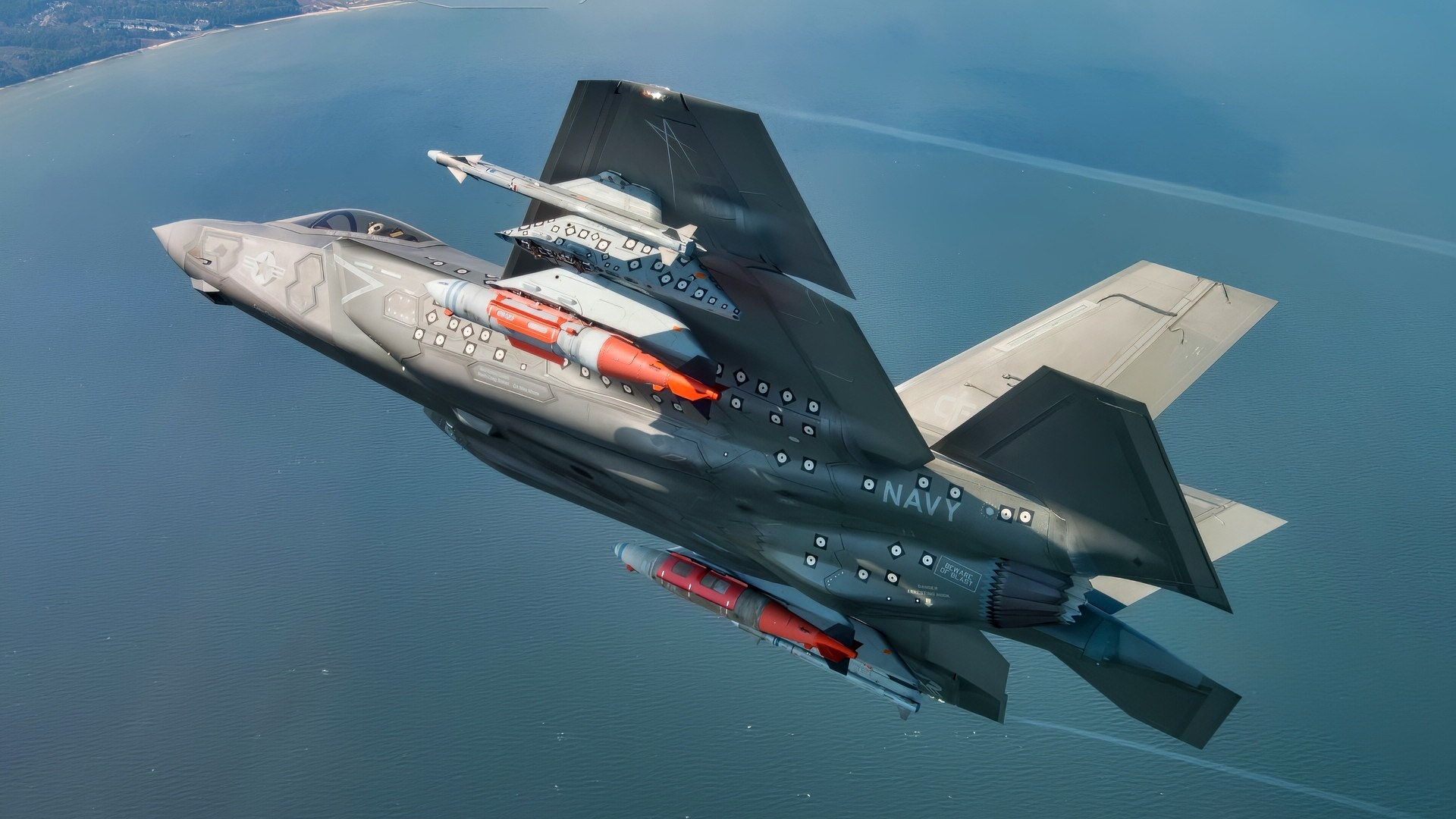
The final SDD Test flight CF-2 Flt 596 was piloted by BAE Test pilot Peter Wilson, April 11, 2018, from the F-35 Pax River Integrated Test Force. The F-35C completed a mission to collect loads data while carrying external 2,000-pound GBU-31 Joint Direct Attack Munitions (JDAM) and AIM-9X Sidewinder heat-seeking missiles. (Photo courtesy of Lockheed Martin)
The broader pattern reveals a military drifting toward strategic insolvency—not because talent is lacking or threats are misunderstood, but because the system responsible for transforming ideas into capability has become its own worst enemy.
A great power cannot deter, compete, or fight with paper strength. It needs real ships, real tanks, real munitions, and the ability to build more when the shooting starts.
Until Washington confronts the procurement system that no longer delivers these things, America will play a dangerous game: relying on the ghosts of past strength while its rivals arm for the future.
About the Author: Dr. Andrew Latham
Andrew Latham is a non-resident fellow at Defense Priorities and a professor of international relations and political theory at Macalester College in Saint Paul, MN. You can follow him on X: @aakatham. He writes a daily column for the National Security Journal.


Randolph E.Obosi
December 1, 2025 at 10:12 pm
To comment on this articles,I would say that the navy must press on the refitting of the ship yard into new setup and flexible building ship yard to allow swift and precise operation that will allow quick production of various parts at a massive numbers while other lines are focus on hulls and bows and many other parts all this must be analyzed and simplified integrated into the systems hard drive for easy roll out on the production lines ,so this must be reconsidered and reconfigured change the building line into a quick and fast roll out of many different major components of the many ships of same design with slight variants
Steven
December 1, 2025 at 10:31 pm
Procurement depends on spreading production across political constituencies.
That means if every state gets to participate, then there will be support in Congress and in the Budget, otherwise, kiss the system or purchase goodby.
There needs to be involvement of Congress in the research, development and procurement from the beginning.
The way things go now, it’s like all these different systems, weapons, what not, are pie in the sky initiatives, but then when it comes to budgetary priorities, they’re abandoned with billions of dollars wasted.
There needs to be multi-year outlays, embedded in the budget from the beginning so once programs initial procurement, they good ahead to completion.
Maybe they need to fire everyone in the Pentagon except the janitors and replace them with kitchen table economists who actually know how to economize, and get the uniformed service members back into combat units and as far away from Washington DC as possible.
In the face of overwhelming budgetary deficits, somethings got to give.
It’s time to unify the Marines and Army, eliminate overlapping mission services.
Air Force and Naval Air Force missions likely could be consolidated as well.
Air frames overlapping Navy and Air Force missions need to be eliminated.
Although this was tried in the past with the F111 being both a Navy and Air Force air craft, and the Phantom also being such a platform and the F35 A, B and C models for different services, consolidation needs to be emphasized based on budgetary constraints or we’ll end up empty handed when there is a major war with peer opponents. Likely it’s only a matter of time and even proxy states and organizations now have access to advanced weaponry as evidenced by the Houthis in Yemen having access to advanced missile technology from Iran.
The lessons of past wars, such as WWII, indicate industrial capacity and logistics are the keys to winning wars, rather than just advanced weapons. The industrial base needs to be developed with the same priority as the uniformed military services.
This includes ship yard capacity, as exemplified in the article. Again, diversification of productive capacity throughout the entire US is important to be able to generate a favorable response from Congress, Representatives being especially sensitive to the job prospects of constituents.
US-is-a-JOKE
December 2, 2025 at 11:48 am
At this point virtually Everything about the U.S. is a huge JOKE! The Gov’t is the most corrupt, inept, criminal bunch for DUMMIES one could ask for. If China & Russia were smart they would whip our a$$e$ like RIGHT NOW!! It’s the perfect timing. Face the facts, we can’t take care of 15th clown running around in robes and slippers. I stand by my original comment, the U.S. is a Monster size J O K E.
Gedion Jura
December 2, 2025 at 1:53 pm
If America wants to win the coming war with China it MUST divest itself of old ideologies and ways of thinking. We have to learn to adapt rapidly to threats that seem to pop up almost daily. The shipbuilding industry has to fix it’s wage problems,if we can do that and get people back to work in the shipyards then we might just stand a chance.
Jay
December 2, 2025 at 2:58 pm
We may have reached a technological advancement level that obsoletes ships and airplanes.✈️ A modern ship is just a sitting duck unless it has a missile fast enough or a laser accurate enough and hot enough to knock out and incoming missile. Or maybe even knock out a legion of incoming enemy lasers. Who knows? Laser technology might be outdated too. Much of the next real war will likely happen in space and cyberspace before any surface ordinance is even an issue. And it will all be so automated and so fast that there won’t be time to make a phone call to reason out a change of policy or stop the inevitable war.
Ron Fischer
December 2, 2025 at 3:39 pm
The problem with the constellation class was that the USN modified it to the nth degree. It was a perfectly good frigate they should have just put in US comms and combat system and called it a day
Sunny Waite
December 2, 2025 at 11:25 pm
You can’t use Ukraine as a guide because they don’t have the infrastructure set up to support the weapons that we gave them they don’t even have Apache helicopters or air support that gives them the superiority that we enjoy with how our units are set up, you have to look back at Desert Storm that is a battlefield War that shows what our units can do on a battlefield against an enemy. Don’t even go to the Gulf War because that was Urban warfare that’s not Battlefield Warfare.
Ted Striker
December 2, 2025 at 11:52 pm
This entire article is written with the same bygone mentality which seems to be the derision being described of the armed forces procurement system. The author seems like your standard run-of-the-mill MIC lobbyist or alarmist.
U.S. cannot be beaten military in the foreseeable future. The weakness of the U.S. is the untenable debt, massive welfare state that caters more to immigrants than native citizens, the massive number of immigrants who have no sense of loyalty to the country and the societal preoccupation with the woke non-sense, entitlement mindset of significant population. Things have gotten so bad that we have a large number of people in the local, state and federal legislatures that have an open disdain for the country – Ilhan Omar, Rashida Tlaib, Cory Booker, Jaypal, AOC, etc., and then there are trigger happy war mongering characters on the other side.
Until the U.S. society and government focus on balancing the budget and improve civic and technical education and inspire a sense of purpose, admiration of the country, we’re bound to face continued challenges.
James Scatt
December 3, 2025 at 5:56 pm
The USA was sold out by the Israel 1st ethnic mafia. Until we deport them ALL nothing can change. Its time to admit it.
Edward
December 4, 2025 at 1:44 pm
The fall of an Empire. Its sad but true. The US is a consumer nation and can’t even make big wheel toys anymore.