

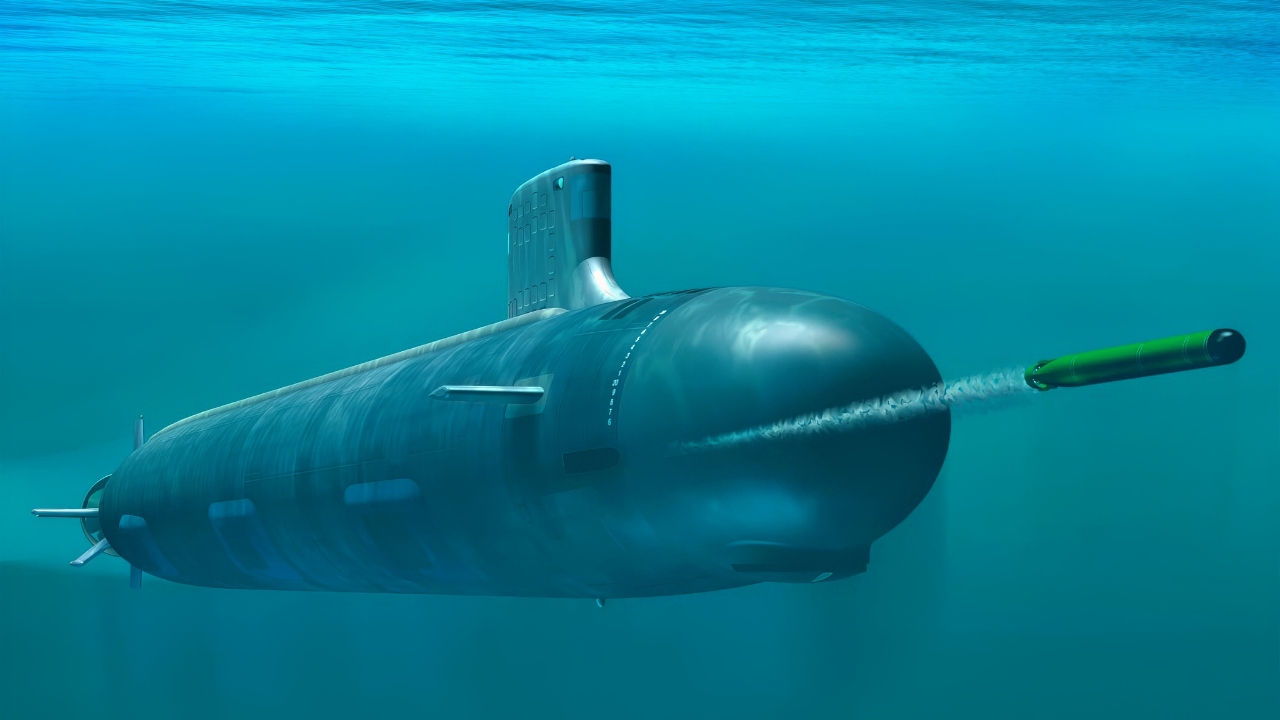
Key Points and Summary – Australia has begun a $5.2 billion upgrade of its HMAS Stirling naval base to host rotating U.S. and UK nuclear-powered submarines, a key first step in the AUKUS security pact.
-The deployments, set to begin as early as 2027, are designed to counter China and prepare Australian crews for their own future fleet. However, the ambitious pact faces uncertainty.

SSN-AUKUS. Image Credit: Creative Commons.
-The Pentagon is reviewing whether its industrial base can meet the production demands, while Australian politicians have raised concerns about the social strain the influx of thousands of U.S. personnel will place on local infrastructure.
Australia Preps for AUKUS Submarines – But Where are the Submarines?
Australia’s biggest naval base has begun preparing for U.S. and British nuclear-powered submarines to arrive. The fresh additions, which will require hefty infrastructure to operate smoothly, are part of the ambitious AUKUS security pact.
The HMAS Stirling, which sits on Garden Island close to Perth, has begun undergoing the $5.2 billion worth of upgrades required for rotations of up to four U.S. Navy submarines and one Royal Navy vessel. The rotations could begin as early as 2027.
The project is overseen by the Australian Submarine Agency, which says the improvements will also serve the country’s future fleet of conventionally armed, nuclear-powered submarines.
Pillar I of the AUKUS agreement makes provision for these plans. Australia, the United States, and the United Kingdom signed off on the security pact back in 2021, but its future has intermittently seemed mired in uncertainty.
This trio of governments have said the deal will help coordinate push back to China’s military aggression in the Indo-Pacific.
The Catch on AUKUS: No Subs?
Still, Washington is currently reviewing whether its industrial base is placed to produce enough submarines for both the U.S. Navy and Australia without overstretch.
There is now even an open question whether the Trump Administration will deliver the submarines or even cancel the AUKUS deal all together, something that is a real possibility according to some experts.
Anxieties have also been expressed in Australia, with opposition politician Andrew Hastie warning that the influx of thousands of American personnel as part of the scheme could pressure housing and infrastructure in Western Australia. “At the moment, there’s not enough homes for Australians,” Hastie told The Australian. “Roads are congested. Our essential services are overrun. So when you add up to 3000–9000 people, that’s going to potentially cause social license issues.”
The Australian government insists that HMAS Stirling will remain under national control, stressing that the arrangement does not amount to hosting a foreign base. “Australia has a longstanding bipartisan policy of not hosting foreign bases on Australian soil,” the submarine agency said.
Instead, the Submarine Rotational Force-West (SRF-West) is framed as a cooperative training and operational program to prepare Australians to operate their own nuclear-powered submarines by the early 2030s at the latest.
AUKUS Still Good to Go? Maybe
The Stars and Stripes blog reports that the Pentagon has been careful to emphasize that no final decisions have been made on adjustments to AUKUS.
“The review will assess current commitments, in both Pillars I and II, for strategic alignment and benefit to the United States,” the U.S. Pacific Fleet noted in a statement.
Pillar II, meanwhile, entails collaboration on advanced technologies beyond submarines, from artificial intelligence to quantum computing.
What Happens Now?
The stakes are huge. For Canberra, AUKUS is more than just access to elite hardware; it is an entry ticket into a deeper level of military and technological integration with two of its top allies.
For Washington and London, the partnership is an important opportunity to cement a solid Indo-Pacific anchor at a time when China’s navy is expanding at breakneck speed. But will the complex pact live up to such lofty expectations? Perhaps only time will tell.
About the Author: Georgia Gilholy
Georgia Gilholy is a journalist based in the United Kingdom who has been published in Newsweek, The Times of Israel, and the Spectator. Gilholy writes about international politics, culture, and education. You can follow her on X: @llggeorgia.
More Military
RANKED: 5 Worst Fighter Jets Ever
Vanguard: Meet the Very Last Battleship Ever Built
JAS 39: The Best Fighter Jet Not Named F-22 or F-35? You Decide
Step Aboard USS Iowa: The Iowa-Class Battleship That ‘Could’ Fight Again


