


Russia’s Su-33 Fighter Has a Problem That Can’t Be Fixed
Key Points and Summary: Russia’s Sukhoi Su-33 is a powerful and capable carrier-based fighter, superior in many ways to its naval counterpart, the MiG-29K.
-However, this formidable aircraft is now primarily operating from land bases.
-The problem isn’t the jet itself but its designated aircraft carrier, the Admiral Kuznetsov.
-Plagued by a long history of fires, accidents, and breakdowns, the problem-ridden carrier is likely destined for the scrapyard.
-This has effectively grounded Russia’s premier naval fighter, leaving the Su-33 a capable warrior without a ship to sail on, a symbol of the Russian Navy’s broader struggles.
The Su-33 Is a Great Fighter, But Its Aircraft Carrier Is a Wreck
The Russian Navy’s Su-33 is a powerful naval fighter. Yet, the warplane is operating from land rather than the sea. The issue lies not with the aircraft itself—the jet cuts few corners in terms of performance. Instead, the problem stems from the jet’s sea-based platform: the problem-ridden Admiral Kuznetsov aircraft carrier, which the Russian Navy is likely to soon sell for scrap.
Initially known as the Su-27K, and essentially a navalized derivative of the Su-27, the Su-33 is an all-weather carrier fighter and air superiority fighter designed by Sukhoi, the Russian aerospace firm, and built by the Komsomolsk-on-Amur Aircraft Production Association. Modifications in support of the Su-33’s naval aviation role include a strengthened undercarriage and airframe, reinforced to withstand the stresses and rigors of takeoff and landing from a moving carrier deck.

Sukhoi Su-33 launching from the Admiral Kuznetsov.
To support lower takeoff and landing speeds necessary for carrier operations, the fighter jet’s wings and canards have about 10 to 12 percent more surface area compared to the parent Su-27 design, and its landing gear is strengthened. The Su-33’s engines also boast greater thrust than the Su-27’s.
Compared to the Soviet Navy’s first fixed-wing naval fighter, the vertical takeoff and landing-capable Yak-38, which flew off the Soviet Navy’s first Kiev-class aircraft carriers, the Su-33 offered tangible advantages in range, time on station, and payload capacity compared to the MiG-29K, a rival navalized fighter. Compared to that jet, the Su-33’s statistics are notably superior.
A publication from the US Army notes that the Su-33’s “maximum takeoff weight (MTOW) is 50% higher; fuel capacity is more than double, allowing it to fly 80% further at altitude (or 33% at sea level). The MiG-29K can spend as much time as the Su-33 on station by using external fuel tanks, but this limits its ordnance capacity. The Su-33 can fly at speeds as low as 240 km/h (150 mph), in comparison, the MiG-29K needs to maintain a minimum of 250 km/h (160 mph) for effective control.”
But, the US Army concedes, “the MiG-29K carries more air-to-ground munitions than the Su-33. The Su-33 is more expensive and physically larger than the MiG-29K, limiting the numbers able to be deployed on an aircraft carrier.”
At the time of its conception, the Su-33 was envisioned as the ideal fixed-wing naval fighter for the Project 11435 and Project 1160 Orel aircraft carriers. The former, which, according to Soviet naval classification standards, would be categorized as a heavy aircraft cruiser, and the latter, a much larger, blue-water flattop aircraft carrier. Ultimately, the Project 11435 would become the Admiral Kuznetsov-class. Project 1160 Orel would be cancelled.
On paper at least, the Russian Navy’s Su-33 is, in most aspects, superior to the alternative naval aviation aircraft at Russia’s disposal. Why then have so few of the fighter jets been produced? And, equally as important, why are Russian Navy Su-33s now operating from land and not at sea? A variety of factors converged together in the years following the end of the Cold War to put that capable multirole fighter in the odd position it now finds itself in.
A Production Run Curtailed by the End of the Cold War
Despite the Su-33’s overall superiority to both the Yak-38 and Mikoyan’s rival MiG-29K, the platform’s full potential as a viable naval aviation platform was not realized, thanks in large part to the collapse of the Soviet Union and subsequent end to Cold War hostilities with the West. In the aftermath of Russia’s messy transition to a market economy following decades of state-managed centralized economics, belt-tightening hit virtually all sectors of the Russian economy, including defense budgets. Squeezed for funds, Sukhoi ultimately built a paltry 24 airframes.
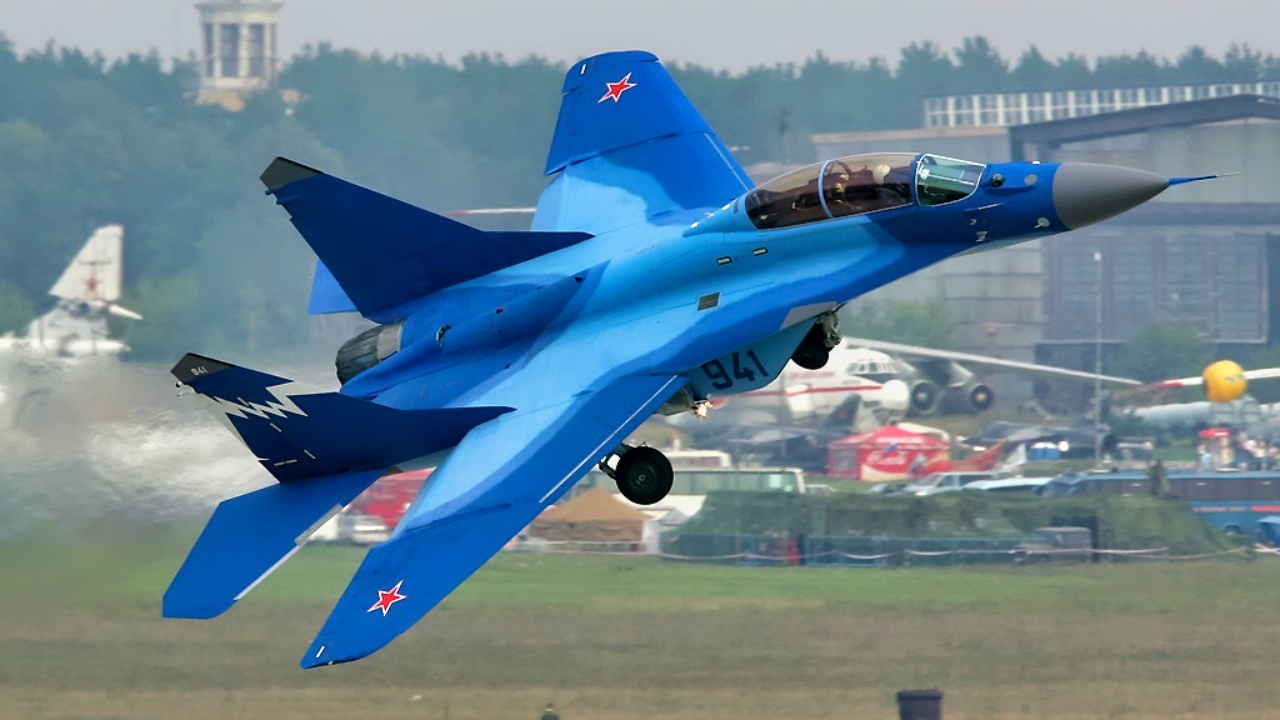
MiG-29K. Image Credit: Creative Commons.
The Army’s OE Data Integration Network notes that while the fighter does have some strengths, its radar quality may be poor. “The radar used, ‘Slot Back,’ has been speculated to have poor multi-target tracking,” ODIN explains. It adds that the Su-33 is, as a consequence, “reliant on other radar platforms and airborne warning and control system (AWACS) aircraft like the Kamov Ka-31 early-warning helicopter.”
A paper on covering trends in both Russian and Chinese air power published by the Royal United Services Institute, a defense think tank based in London, noted that Russia’s naval aviation branch, “the MA VMF, flies the single-seat Mig-29K and twin-seat Mig-29KUB airframes which have been navalised for use on the Admiral Kuznetsov, Russia’s sole aircraft carrier. The ship is in deep refit and repair until at least 2022 following the accidental sinking of its dry dock and subsequent fire on board.”
“These aircraft are intended to progressively replace the non-PGM-capable Su-33 navalised Flanker. However, in recent deployments, the Admiral Kuznetsov operated a mix of both types, including during the ill-fated Syrian deployment where a MiG-29 K and a Su-33 were lost in the Mediterranean due to deck landing accidents.”
But accidents and limited utility aside, the more pressing issue now for the small family of Su-33 navalized fighter jets is, what happens once the Admiral Kuznetsov is gone for good?
A String of Accidents and Mistakes
As other commentators have noted before, the Admiral Kuznetsov has suffered a string of accidents and incidents, several of which were more than minor missteps and resulted in fatalities.
The Admiral Kuznetsov was involved in several accidents in 2009. While anchored off the Turkish coast, an electrical short circuit started a fire. One Sailor died of carbon monoxide poisoning. Later, while off the southern Irish coast, the aircraft carrier dumped a significant amount of fuel into the ocean, polluting a large swath of the ocean.
A pair of aircraft were lost in 2016 and 2017 as part of the Admiral Kuznetsov’s deployment to Syria as part of Russia’s support of the Assad regime: one MiG-29K, which crashed during its landing, and a Su-33, which crashed into the sea after it failed to engage the aircraft carrier’s arresting cable.
In 2018, while in one of Russia’s floating dry docks during a refitting, a power outage flooded the dry dock, causing it to sink. Not long afterward, a massive repair crane, weighing approximately 70 tons, collapsed, falling to the aircraft carrier’s deck and punching a large hole into the deck.
In 2019, while the Admiral Kuznetsov was at port in Murmansk undergoing repairs, a fire broke out aboard the ship, possibly ignited by welding work that came into contact with flammable materials on deck. Though the fire was contained and the aircraft carrier avoided serious damage, the blaze did result in at least one fatality and several injuries. Russian naval officials estimated the cost of repairs would be nearly $5 million. Another fire broke out on the Admiral Kuznetsov late in 2022, though that blaze was much smaller in scale than the 2019 fire and was quickly contained.

Admiral Kuznetsov Aircraft Carrier Russia. Image Credit: Creative Commons.
Russia’s Admiral Kuznetsov has been effectively out of service since returning from Syria in 2017 for repairs. Online commentators were quick to point out that the ship seemed to be in an exceptionally bad state of repair, noting that the ship’s thick clouds of black, acrid smoke billowed out of the ship’s smokestacks while transiting international waters en route to Syria, as well as back to Russia for refit.
Broken Up for Scrap
Now forty years old, the Admiral Kuznetsov is to be either sold for service in another country’s Navy, or to a shipbreaker for scrap value. In either case, the end is near for Russia’s only aircraft carrier. Thanks in part to lengthy and problem-ridden refits, sustaining the Soviet-era aircraft carrier, which has played no role at all in Russia’s ongoing war in Ukraine, is no longer financially prudent.
Speaking to Kommersant, a Russian and political business daily, and reported in translation by Reuters, Andrei Kostin, the chairman of Russia’s state shipbuilding corporation, said that ”we believe there is no point in repairing it anymore. It is over 40 years old, and it is extremely expensive … I think the issue will be resolved in such a way that it will either be sold or disposed of.”
Given the highly secretive nature of individual ships’ combat readiness, it is clear that the Navy plans to scrap the Admiral Kuznetsov. But given the aircraft’s patchy service record and the series of mistakes and accidents that have marked its deployment, that warship may be the biggest hindrance to Su-33 operations while at sea. Perhaps cognizant of this shortcoming, the Russian Navy seems to have adjusted by sending its Su-33 fleet to land for operations in support of Russian forces fighting in Ukraine.
In February, NATO Allied Air Command posted to Facebook, explaining that a pair of Su-33s escorted a Tu-95 long-range bomber over international airspace north of Norway.
In a further sign of just how truncated the aircraft carrier’s naval aviation capabilities have become, open-source reporting indicated last year that Russian Navy Sailors from the Admiral Kuznetsov had been reassigned to units on land, part of Russia’s campaign to prop up its ranks and offset stiff combat losses.
The Chinese Connection
Although the Su-33’s future with the Russian Navy is uncertain, a very similar jet is in service with a different navy: China’s People’s Liberation Army Navy, or the PLAN. Though China had made several inquiries into acquiring the Su-33 for its own budding aircraft carrier fleet, Russia repeatedly rebuffed those entreaties. However, by closely examining and then reverse-engineering a Su-33 acquired, ironically, from Ukraine, the PLAN was ultimately able to build its own fleet of Su-33 derivative aircraft. Those fighters, known as the Shenyang J-15 in Chinese service, hew closely to the original Soviet design, albeit with some modifications to the jet’s powerplants, radome, avionics, and other components.

J-15 Fighter. Image Credit: Screenshot from Weibo.
However, as fifth-generation stealth fighters become the gold standard for aircraft survivability and combat effectiveness, the J-15’s future within the People’s Liberation Army Navy is uncertain. Given the aircraft’s dearth of radar-mitigating stealth features and the necessity of remaining hidden from adversary radar for survivability, a prolongation of the Shenyang’s service with China seems unlikely.
Su-33: What Happens Now?
The biggest hindrance to the Su-33’s effectiveness may ultimately stem not from shortcomings or flaws in that aircraft’s design, despite its Cold War-era origin, but rather from the Admiral Kuznetsov’s own lackluster capabilities.
Indeed, the aircraft carrier’s ability to sail problem-free — let alone the warship’s abilities during combat — has left much to be desired. Scraping the aircraft carrier might be the most economical decision for the Russian Navy to take at this point.
Perhaps the Su-33 will enjoy more success on land rather than at sea.
About the Author: Caleb Larson
Caleb Larson is an American multiformat journalist based in Berlin, Germany. His work covers the intersection of conflict and society, focusing on American foreign policy and European security. He has reported from Germany, Russia, and the United States. Most recently, he covered the war in Ukraine, reporting extensively on the war’s shifting battle lines from Donbas and writing on the war’s civilian and humanitarian toll. Previously, he worked as a Defense Reporter for POLITICO Europe. You can follow his latest work on X.
More Military
5 Ways Aircraft Carriers Could Be Destroyed in a War
Dassault Rafale Fighter: Stealth Made it Obsolete?


