

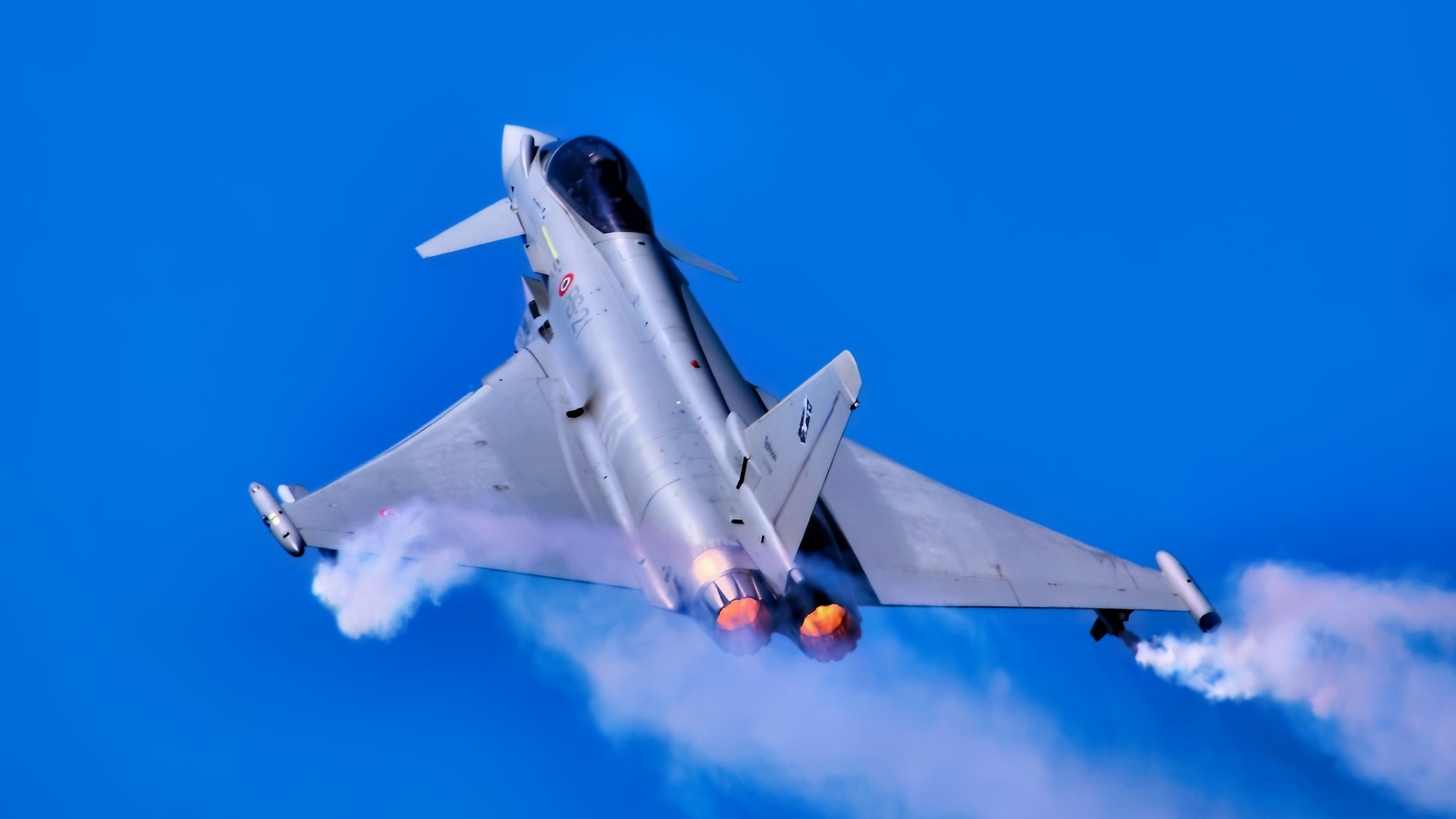
Key Points and Summary – Born to counter Warsaw Pact fighters, the Eurofighter Typhoon evolved into a versatile multirole jet after the Cold War.
-Now, rising fifth- and sixth-generation threats are forcing another reinvention.
-The Foes It Will Need to Face – No Stealth: Lacking true stealth, Typhoon’s relevance will hinge on upgrades: Captor-E AESA radar, deeper electronic warfare, long-range Meteor enhancements, and robust data-sharing with F-35s and future systems.
-Concepts include integrating loyal-wingman drones and expanded networking to fight as part of a distributed kill web.
-If European partners can field these improvements at scale, Typhoon can remain a fast, hard-hitting node in contested skies well into the 2030s; if not, it risks obsolescence.
How Eurofighter Typhoon Will Evolve
The origin story of the Eurofighter Typhoon begins during the later stages of the Cold War, when the Western European countries that made up the NATO alliance saw the need for a new, cutting-edge aircraft that would be able to secure the skies against even the most advanced air defense assets and adversary aircraft the Soviet Union could conceivably field.
In the late 1970s and onward into the 1980s, war planners within NATO feared the combination of increasingly capable Soviet fighter designs, particularly the MiG-29 Fulcrum and Su-27 Flanker, with sophisticated jet engines. The high maneuverability of these jets and their powerful radars presented a pointed problem.
How could the countries of Western Europe be sure that their own air forces would be able to go head-to-head with the Soviets and come out on top in a hypothetical conflict with the Warsaw Pact countries?
The answer to this question was multi-faceted and multi-national. Germany, the United Kingdom, Italy, and Spain joined forces in the 1980s, creating what is known today as the Eurofighter program. The aerospace program’s objectives were crystal clear: Build a highly maneuverable, very agile air superiority fighter.
Taking advantage of advanced aerodynamics, fly-by-wire controls, and sophisticated air-to-air weaponry, the Typhoon was designed to sustain super cruise speeds greater than Mach 2, using that high speed to keep airspace free of Soviet aircraft and ensuring that NATO could hold airspace and maintain that grip even in the face of a concerted Soviet effort to wrench control from NATO.
However, with the sudden and complete collapse of the Soviet Union in the early 1990s, Western Europe’s threat environment underwent drastic and rapid changes. When the Typhoon finally entered service in the early 2000s, the Warsaw Pact it was built to face had crumbled — gone.
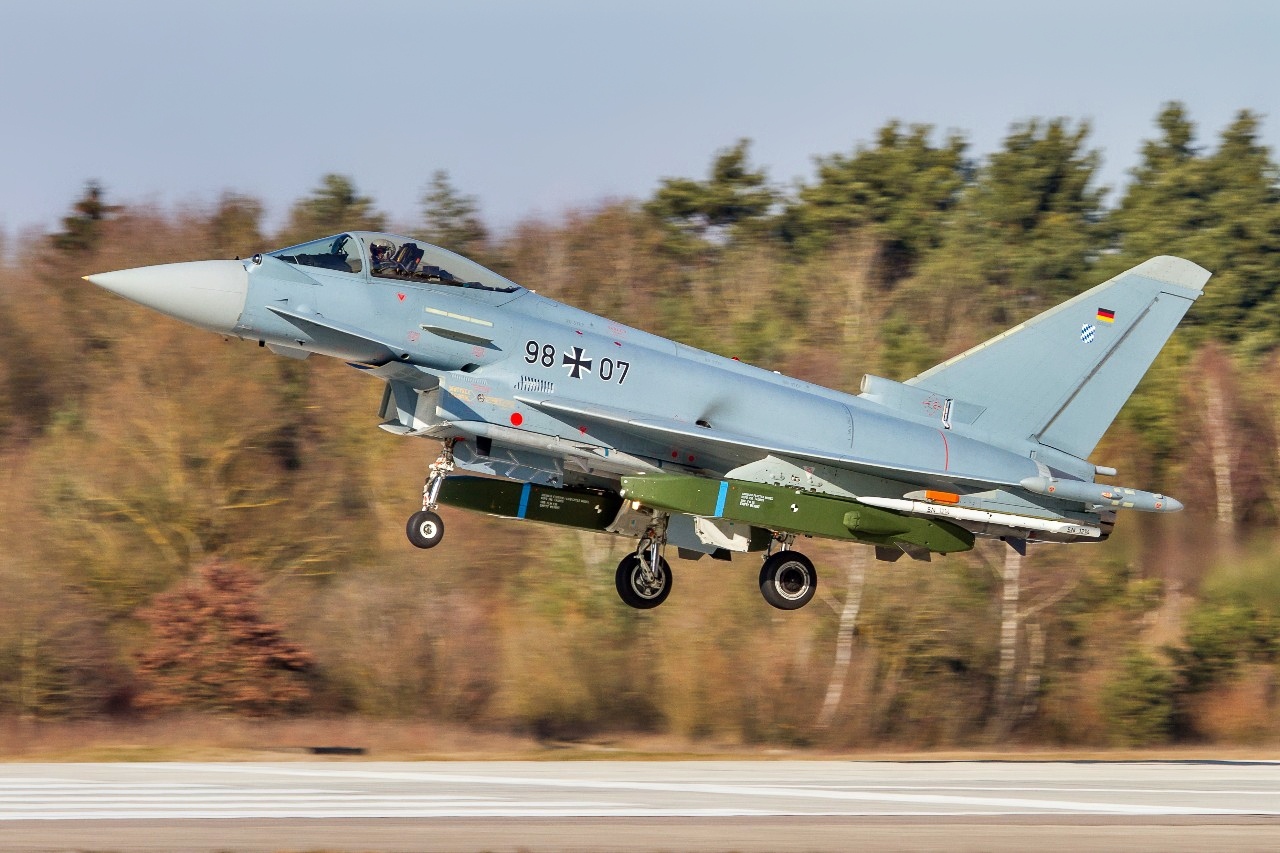
Taurus Missile on Eurofighter. Image Credit: Creative Commons.
Instead of the large-scale peer conflict that Europe had for many years prepared to face, the continent could itself instead launch expeditionary operations, peacekeeping efforts, humanitarian missions, and policing interventions.
These kinds of missions required close air support, reconnaissance, and strike capabilities, as well as air dominance. The Typhoon, resultantly, evolved in tandem with the threat environment and became an omni-role fighter platform.
Other upgrades to the jet have included enhanced radar, electronic warfare components, expanded ground attack capabilities, and the wider introduction of precision munitions into the jet’s mission set, allowing the Typhoon to remain relevant in a post-Soviet environment.
New Challenges
Just as the threat picture changed after the end of the Soviet Union’s control of the Warsaw Pact countries, that picture is once again adjusting to a newer reality, though one that, somewhat ironically, once again recognizes the significant threat emanating from the Kremlin.
Fifth-generation fighters, such as the American-led F-35 program, as well as the advancements made in Russia with the Su-57 and in China with the numerous advanced aircraft in development, pose several severe drawbacks for the Typhoon.
Very much a fourth-generation fighter aircraft, the Typhoon lacks the dedicated radar-defeating technologies that are staples of fifth-generation aircraft design, such as radar-absorbent coatings and carefully contoured fuselage shapes, which allow advanced aircraft to slip past air defense radars.
As the Typhoon lacks those features, it will increasingly rely on electronic warfare, connectivity with stealth platforms, and long-range stand-off weapons to survive in contested environments.
Eurofighter Typhoon Upgrades Won’t Be Easy
Upgrading a large, multi-national typhoon fleet won’t be easy, but several Typhoon modernizations are attempting to make the fighter more survivable against today’s threat environment.
Mating the Captor-E AESA radar to the Typhoon enhances aircraft detection ranges and electronic warfare capabilities. An effort is also being made to allow Typhoons to communicate and network with more advanced aircraft, such as the F-35, and, so the hope goes, remain relevant, thanks in part to the integration of unmanned systems.
Updates to the Meteor beyond-visual-range air-to-air missile will also be a boon to the Typhoon, as will avionics upgrades and other updates that could, if successful, extend the Eurofighter’s service life well into the next decade.
Eurofighter Typhoon: Flying Into the Future?
Though the Eurofighter Typhoon was first conceived of by Western European NATO countries as a peerless air superiority fighter that could keep the Soviets out of Central Europe, a drastically altered threat landscape forced the jet to reinvent itself as a high-performance multirole combat jet that today makes up a significant portion of the warplanes that sport European roundels.
However, if the Eurofighter hopes to remain relevant in the future, it will need to integrate several significant upgrades, including enhanced networking capabilities with fifth- and sixth-generation aircraft.

U.S. Air Force Maj. Kristin “BEO” Wolfe, F-35A Lightning II Demonstration Team commander and pilot, flies during a demonstration rehearsal at Hill Air Force Utah, April 28, 2021. The F-35A Lightning II Demonstration Team is part of the first operational F-35A wing for the Air Force, the 388th Fighter Wing, and flies over the Hill Air Force Base runway to practice and prepare for upcoming air shows around the world. (U.S. Air Force photo by Capt. Kip Sumner)
In some scenarios, where stealth itself is not the decisive factor, the jet’s high sustained speeds could be of use, particularly in tandem with the integration of Loyal Wingmen-type drones.
But the jet’s ability to adapt, despite its original application against the air forces of the Warsaw Pact, has managed to keep it relevant over three decades after its initial conception.
Whether it can adapt again in the future to a radically different threat environment remains to be seen.
About the Author: Caleb Larson
Caleb Larson is an American multiformat journalist based in Berlin, Germany. His work covers the intersection of conflict and society, focusing on American foreign policy and European security. He has reported from Germany, Russia, and the United States. Most recently, he covered the war in Ukraine, reporting extensively on the war’s shifting battle lines from Donbas and writing on the war’s civilian and humanitarian toll. Previously, he worked as a Defense Reporter for POLITICO Europe. You can follow his latest work on X.
More Military
B-1B Lancer: The Bomber The Air Force Needs to Keep Flying
Su-37 ‘Terminator’: The Thrust-Vectoring Super Flanker Fighter That Never Was
Russia or China Would Love to Have the Aircraft Carrier USS Harry S. Truman
NATO’s Big Fear: Putin Drops a Tactical Nuclear Weapon on Ukraine
The U.S. Military’s Big F-22 Raptor Stealth Fighter Mistake Cuts Deep


