

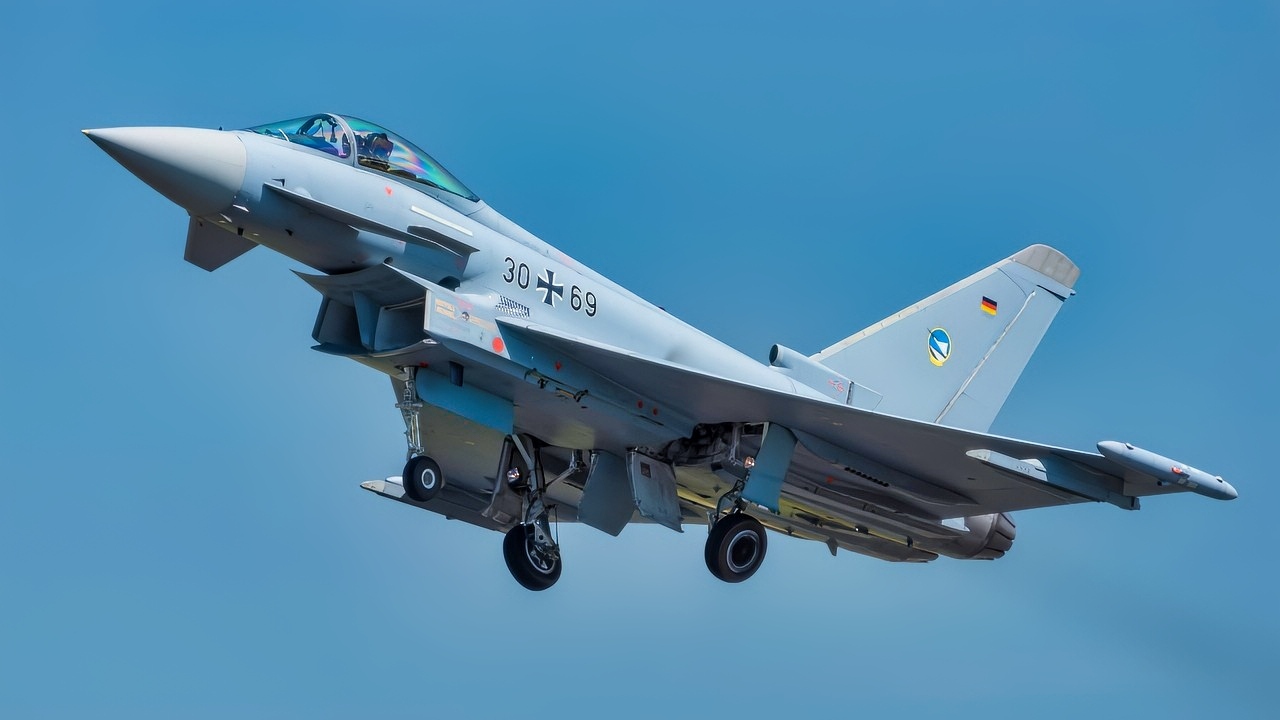
Key Points and Summary – European governments and industry are floating a “Super Typhoon”: an upgraded Eurofighter Typhoon with ECRS Mk2 wideband AESA for electronic attack, new EW/EK variants, Meteor integration, and revived production.
-It’s pitched as a bridge—mass and sovereignty now, momentum for GCAP/FCAS later—not a substitute for the F-35’s Day-0 stealth missions.
-Spain and Germany funding help anchor the line; eased export politics could add orders. For NATO, a mixed fleet offloads air defense, QRA, maritime strike, and escort-jamming to Typhoon while preserving scarce F-35 sorties for penetration.
-Risks: fragmenting stealth mass, budget cannibalization, and export politics. Done right, it buys time and readiness through 2025–2032.
Europe’s “Super Eurofighter Typhoon”: Bridge to 6th-Gen or F-35 Rival?
After a decade of treating the F-35 as the only rational choice, several European capitals and industry leaders are floating the idea of a “Super Typhoon”– a heavily upgraded Eurofighter with a wideband active electronically scanned array (AESA) radar, greater electronic-attack abilities, expanded weapons options, and a revived production line.
A Bridge, Not a Substitute
The pitch is straightforward: buy mass and sovereignty now, keep the industrial base warm, and bridge to Europe’s sixth-generation programs. The question for a U.S. national-security audience isn’t whether this aircraft displaces the F-35 in the opening nights of a serious war – it won’t – but whether a Super Eurofighter Typhoon is strategically sensible for allies and stabilizing for NATO’s air order of battle.
As a bridge and complement to the F-35, but not as a substitute, the answer is yes.
The technical case has moved beyond brochure talk. In late September 2024, a Typhoon flew with the ECRS Mk2—an AESA that pairs high-power electronic attack capabilities with sophisticated sensing and target geolocation.
That matters in contested Electronic Warfare environments, where jamming, deception, and agile targeting decide engagements well before missiles leave the rail. The Mk2 is not stealth. It is, however, the kind of brainy, high-emitter kit that lets a fourth-generation airframe punch up from sanctuary with stand-off weapons, contribute escort jamming, and reshape the air picture for stealth teammates.
The force-structure context in Europe has shifted as well. Spain has locked in two Halcón tranches, pushing its total Typhoon inventory well into triple digits and guaranteeing work across the consortium. Germany funded the Quadriga replacements and is fielding an electronic-combat (EK) variant built around a modern Electronic Warfare suite to assume the Tornado ECR mission in the next decade, meaning that an old NATO gap is finally being closed. These are booked aircraft and funded mission systems that may anchor a production base Europe had allowed to atrophy.
F-35 Will Still Be King
Politics, long the brake on Eurofighter exports, have also loosened. London and Berlin have tightened their defense-industrial cooperation in ways that unblock previously stalled co-export deals. If that cooperation holds, the consortium can chase orders that keep lines hot, skills intact, and unit costs sane. It is also the right kind of precursor to a genuinely European combat-air ecosystem in the 2030s. The recent easing of Berlin’s veto on specific exports – most visibly to Türkiye – shows what’s possible when politics are pushed aside.
For Washington, the obvious objection is opportunity cost: every Typhoon sold is a notional F-35 lost. That framing is misleading. The F-35 still owns the Day-0/Day-1 mission set – penetrating strike, dead-of-night Intelligence, Surveillance, and Reconnaissance, and suppression against modern integrated air defenses – because stealth, sensor fusion, and low-probability-of-intercept communications remain decisive.
But the Lightning II is contending with modernization churn and sustainment friction: Block 4 software has slipped; TR-3 integration pinched deliveries; and availability rates are still being pushed uphill. None of this dethrones the F-35. It does, however, create the argument for a mixed European fleet that preserves stealth mass for unique missions while offloading air defense, quick-reaction alert, maritime strike, and escort-jamming to a cheaper, sovereign European platform.
The Super Typhoon idea answers that division of labor. With ECRS Mk2 in the UK fleet and ECRS Mk1 for Germany and Spain, Meteor for long-range air-to-air work, and an EK variant for dedicated electronic combat, Typhoon can police NATO airspace, screen high-value assets, and prosecute maritime targets from outside the reach of the most powerful Surface-to-Air Missiles (SAMs). Deep-strike options exist today, thanks to the Storm Shadow/SCALP; anti-ship pathways are defined; and SPEAR-class standoff weapons remain in test and re-baselining, with timelines shifting into the early 2030s.
The Pitch on the Super Eurofighter Typhoon
Proposed conformal fuel tanks and incremental engine enhancements would extend the aircraft’s radius and persistence, making it useful in the North Atlantic and High North, where tanker tracks are thin. None of these upgrades turn the Eurofighter Typhoon into a stealth striker.
They make it the best version of itself: a high-end air-dominance and escort-attack platform that European air forces can buy in useful numbers now.
More to Come
There is also an industrial logic the United States should quietly welcome. Europe is pursuing two sixth-generation families – the Global Combat Air Program, a joint British, Italian, and Japanese project, and the Future Combat Air System pursued by France, Germany, and Spain.
Demonstrators and critical subsystems are due mid- to late-decade, but schedules slip and coalitions wobble. Keeping Typhoon lines warm and talent employed helps those programs sort through the usual issues, while also giving allies a pathway for upgrading sensors, Electronic Warfare, mission computing, and weapons integration – upgrades that can spiral into the future aircraft.
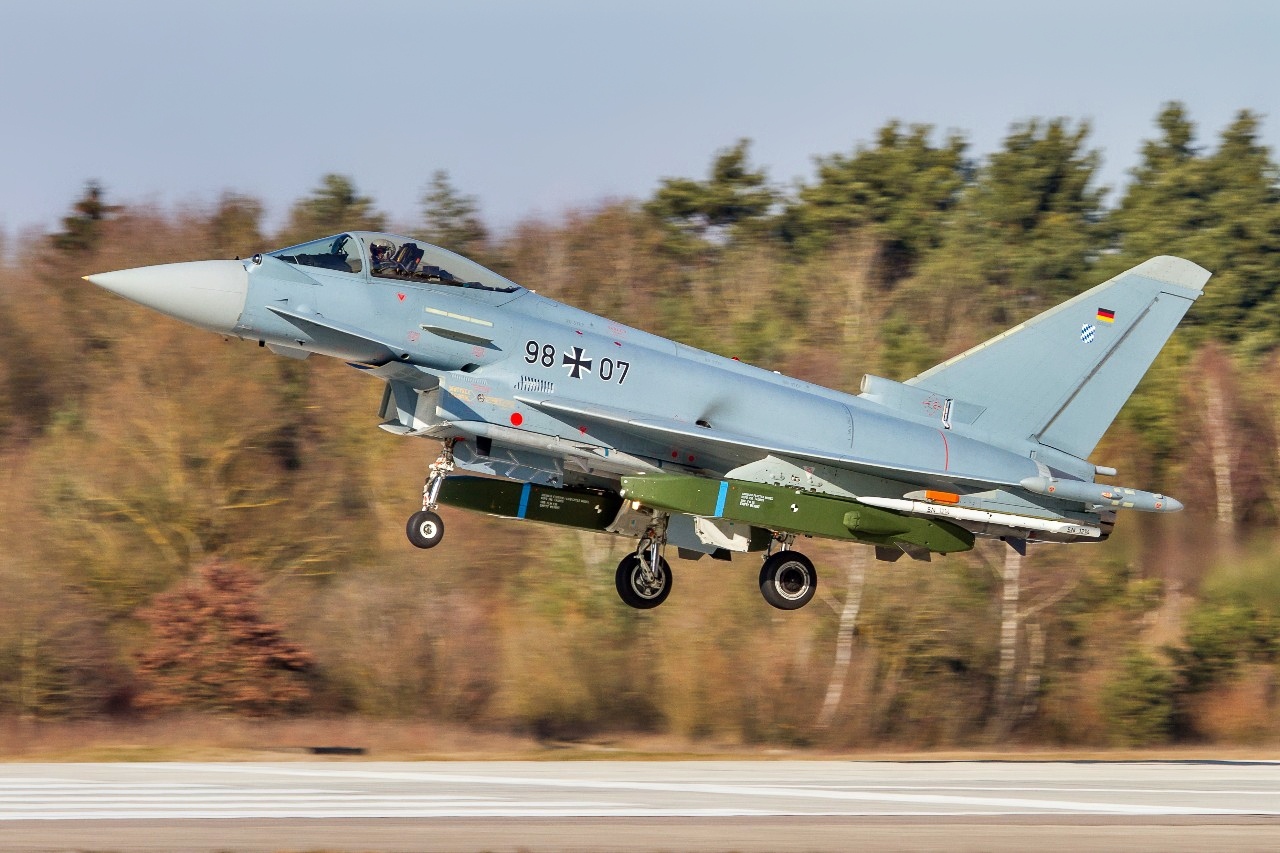
Taurus Missile on Eurofighter. Image Credit: Creative Commons.
A European bridge that actually delivers aircraft, software, and trained technicians during the 2025–2032 window makes NATO harder to coerce.
Mind the Gaps
Still, several risks are worth keeping in mind. The first is fragmentation. If capitals treat a Super Typhoon as a political alibi to dodge F-35 buys entirely, NATO will lose the stealth mass required to crack open a denied area. The cure is portfolio discipline: develop stealth for penetration; upgrade fourth-generation aircraft for air defense, escort, and standoff.
The second risk is budget cannibalization. Europe’s defense euros are finite; every Typhoon tranche should be tied to concrete readiness metrics, munitions stockpiles, and EW kits – not just airframes. Export politics are another danger. The consortium’s renaissance depends on a more permissive German posture and real London–Berlin alignment that survives electoral cycles. The recent thaw is encouraging, but it must endure.
A Compelling Picture
From an operational perspective, the pairing is compelling. Picture a Baltic or Arctic crisis in 2029: F-35s and B-21s break open the first shutters of the SAM belt; Typhoons with Mk2 radar and Meteor sanitize the airspace, jam the periphery, and keep maritime approaches honest.
In the Mediterranean, F-35s shoulder collect ISR and carry out first-night strikes; Typhoons execute Quick Reaction Alert, standoff maritime strike, and Suppression of Enemy Air Defense escort with dedicated EK kits. None of this duplicates effort. It spreads risk, increases daily sortie generation, and allows commanders to husband stealth sorties for the missions only stealth can do.
The final virtue is time. Europe needs ready squadrons now, not in 2035. The F-35 line will keep delivering, and Block 4 will mature, but air forces staring at pilot shortfalls, tired F-16s and F/A-18s, and meager air-defense magazines need relief.
New Typhoons delivered over the next five to seven years, and arriving with radars, jammers, and weapons, offer a practical way to strengthen NATO’s day-to-day airpower while sixth-generation prototypes learn to fly and fight.
So is a Super Eurofighter Typhoon a good idea? Yes, if Europe treats it as a disciplined bridge and the United States treats it as a complement. Let the F-35 keep the missions only it can do, and insist the Eurofighter earn its keep everywhere else.
About the Author: Dr. Andrew Latham
Andrew Latham is a Senior Washington Fellow with the Institute for Peace and Diplomacy, a non-resident fellow at Defense Priorities, and a professor of international relations and political theory at Macalester College in Saint Paul, MN. You can follow him on X: @aakatham. He writes a daily column for National Security Journal.
More Military
Russia’s ‘New’ Kirov-Class Battlecrusier Is Like a ‘Death Star’
The U.S. Military’s Big X-44 Manta Stealth Fighter ‘Mistake’ Still Stings
China’s New Fujian Aircraft Carrier Looks Close to Fully Operational
The Air Force Could Soon Have 32 Additional F-22 Combat Ready ‘Raptor’ Stealth Fighters
China’s J-20 Mighty Dragon vs. Russia’s Su-35 Flanker Fighter: Who Wins Summed Up in 4 Words


