


The Strait of Hormuz handles around one-fifth of global oil trade. Understandably, the Islamic Republic views this chokepoint as an “unbreakable red line”.
In a recent interview on Joe Rogan’s podcast, Vice President JD Vance described two factions in Iran: the “crazies” and the “pragmatists,” With the breakdown of the MoU indicating the “crazies” are currently winning the internal policy battle.
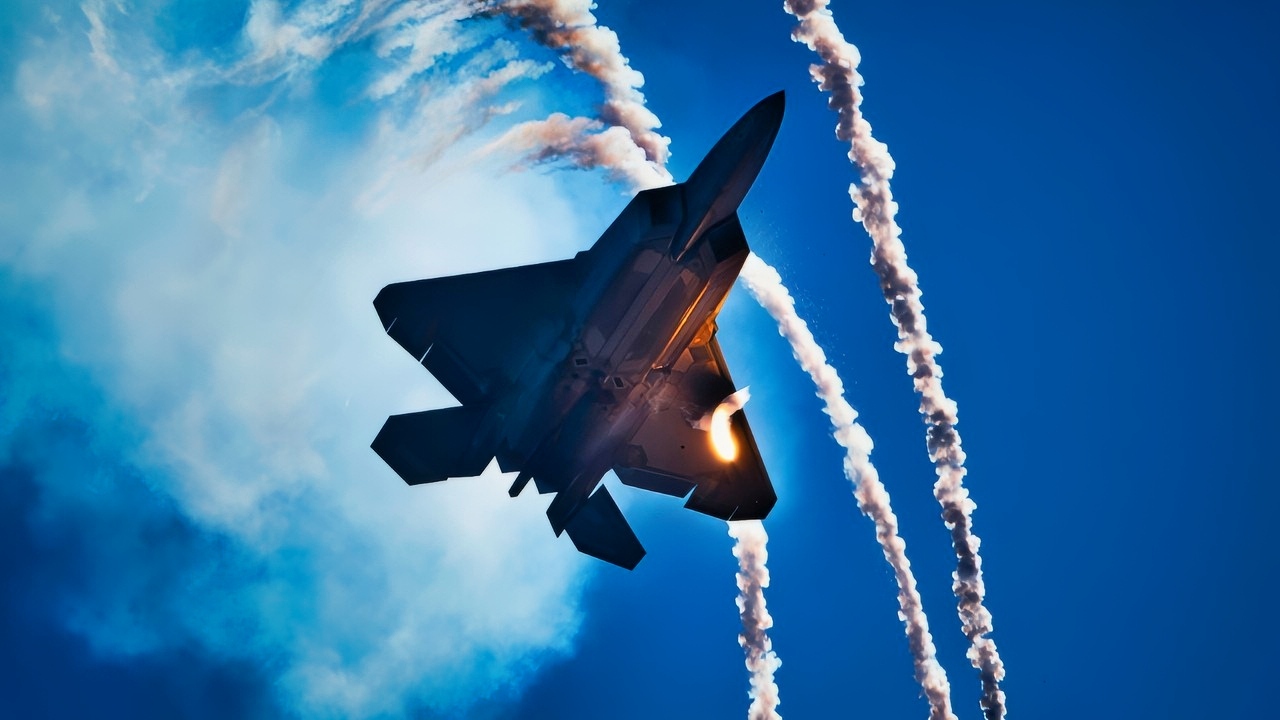
A U.S. Air Force F-22 Raptor, flown by Capt. Samuel “Razz” Larson, F-22 Raptor Demonstration Team pilot, deploys flares over the Gulf of Mexico during the 2024 Gulf Coast Salute Air Show at Panama City Beach, Florida, May 4. The F-22’s unique combination of stealth, speed, agility and situational awareness, combined with lethal long-range air-to-air and air-to-ground weaponry, makes it one of the most advanced fighters in the world. (U.S. Air Force photo by Staff Sgt. Stefan Alvarez)

An F-22 Raptor creates vapor trails during a high-speed maneuver during a training flight at Joint Base Langley-Eustis, Virginia, June 13, 2025. The aircraft’s design allows it to remain highly maneuverable while maintaining low observability. (U.S. Air Force photo by Senior Airman Adisen Smith)
But there comes a point where the “for now” part of that equation becomes permanent. And the Iranian regime appears to be speaking with one voice when it comes to the SoH.
After all, the MoU itself granted Iran de facto control over the SoH–only for the Trump administration to quickly realize that the MoU did that, and then reverse course immediately by forcing ships transiting the SoH to use the Omani route rather than the pre-approved Iranian one, collapsing the MoU in just 18 days after it was signed.
Iran says it will not accept any foreign military effort to seize or permanently control the Strait. It considers attempts to remove its leverage over Hormuz an existential threat, too.
What’s more, any expanded US operation against Iranian coastal infrastructure will trigger a wider conflict. In other words, Tehran is escalating–and the regime is framing Hormuz as a matter of national sovereignty and strategic survival.
Trump’s Threats
According to a recent CNBC report, President Trump warned that if Iran continues disrupting shipping, the US could launch strikes far more severe than those already conducted.
So, coastal missile batteries, IRGC naval facilities, command-and-control centers, logistics hubs, and even broader infrastructure are all on the table.
For the last week, as a demonstration of his seriousness on the matter, Trump has been presiding over increasingly brutal airstrikes deeper inside the Islamic Republic than what many had previously thought he would do, in light of the MoU.
But for Iran, as they’ve made clear, this is a matter of both national pride and regime survival. For them, the SoH is a symbol of their resistance to the United States and Israel. And that symbol of resistance is the source of their wider legitimacy.
For Iran’s regime, it is not about how much prosperity they confer to their people. It’s about their religiosity and their resistance to foreigners that is the means of their power.
Giving up the SoH to Trump will never be accepted because of that symbolism (after all, all politics rests upon the power of perception).
Trump will impose huge costs upon the Iranians resulting from their intransigence on this issue.
Yet, Trump is in a bind.
Because the US economy is weeks away from collapsing under the weight of this war, this is something that the president seems incapable of understanding.
Or, if he is capable of understanding, he appears unwilling to accept that reality.
The Strait handles one-fifth of globally traded oil and a substantial share of its LNG exports. While the Americans have ridden off their Strategic Petroleum Reserve (SPR), that is coming quickly to an end.
Most experts assess that we’ve already hit “bottom barrel,” meaning the longer the disruptions continue, the more economically painful it will get here.
Continued disruption impacts oil prices and insurance rates for ships, which affect tanker availability and render supply chains brittle, sparking inflation worldwide and forcing interest rate increases. All this also leads to demand destruction.
None of this will really hurt the Iranian regime, which has been heavily sanctioned for 47 years. It will, however, hurt America–and the rest of the world.
It could even end in a global depression that leads to Trump’s name becoming an epithet for all time, the way Herbert Hoover’s is.
Iran’s Escalation Ladder
Tehran has also hinted that if Washington attacks their country further, it would encourage allied groups (like the Houthis) to expand their attacks into the Bab el-Mandeb, creating pressure on two of the world’s most important maritime chokepoints at once.
Such a move would break the back of the already overburdened US Navy by placing too much demand on a finite fleet that is increasingly incapable of addressing the severe threats posed by advanced anti-ship ballistic missiles (ASBMs).
World War?
Both sides are now explicitly tying military escalation to control over the Strait of Hormuz rather than solely either Iran’s nuclear weapons program or its advanced ballistic missile program.
This development is truly significant, in that it means there will be no consensus diplomatically between the two sides, and the only resolution will be found at the end of a protracted, expanded, bloody war–that will collapse the world system if it reaches the levels many experts are fearing it will soon reach,
Once the SoH is truly off the negotiating table, and the negotiations themselves are over, then it’s all escalation, all the time.
We could easily see closures of the Strait of Bab El-Mandeb and the Red Sea. Attempted incursions by US-backed Iraqi Kurds into neighboring Iran.
Unpredictable escalations into Lebanon. Outside powers, like Russia and even China, might become more involved.
All because the Trump administration somehow (despite 20 years’ worth of US military wargames) did not understand that starting a regime change war wit
h Iran would lead to the closure of one of the world’s most important maritime chokepoints.
About the author: Brandon J Weichert
Brandon J. Weichert is Senior National Security Editor. He also manages The Weichert Brief on Substack. Weichert also hosts “National Security Talk” on Rumble. He is the author of four bestselling national security books, the most recent of which is A Disaster of Our Own Making: How the West Lost Ukraine (Encounter Books). Follow him via Twitter/X @WeTheBrandon.


