


The most alarming number in American energy this spring is not the price on the gas pump sign. It is the speed at which the country’s gasoline cushion is vanishing. Between early February and late May, US gasoline inventories fell by 47.5 million barrels, the largest drawdown in the Energy Information Administration’s weekly records dating back to 1990. The next-largest declines over that stretch of the calendar clustered around 30 million barrels, and the last time the country saw even that was fifteen years ago.
This year’s draw dwarfs them, and the timing tells you exactly what is behind it.
A Drawdown That Started On February 28

President Donald Trump delivers the Commencement address at the graduation ceremony for the University of Alabama, Thursday, May 1, 2025, at Coleman Coliseum in Tuscaloosa, Alabama. (Official White House Photo by Daniel Torok)
The clock on this collapse started the day the Iran war began. US gasoline stocks peaked near 259 million barrels in early February, then began falling almost in lockstep with the opening of Operation Epic Fury on February 28 and the choking of the Strait of Hormuz.
By the week ending May 22, inventories sat at 211.6 million barrels, the lowest level for that point in the year since 2014 and below the five-year average. The headline figure alone would not set off alarms. The trajectory is what should.
What makes the drop genuinely strange is that it is happening for none of the usual reasons. American refineries have been running flat out, with utilization at 94.5 percent and crude inputs near 17 million barrels a day, the kind of activity that normally rebuilds stocks rather than depletes them. And drivers are not the culprit either; gasoline supplied to the market has been essentially flat, even slightly below last year. Production is strong, demand is ordinary, and the cushion is disappearing anyway. That combination points away from anything domestic and toward the war.
How The Strait Of Hormuz Closure Pulls American Barrels Overseas
The mechanism is the global market reaching into American storage tanks. With the Strait of Hormuz, the conduit for roughly 20 million barrels a day of oil before the war, effectively shut since late February, supply has been ripped out of the system everywhere at once, and prices have climbed worldwide. In a stressed market, US barrels do not stay home out of patriotism. They flow to the highest bidder, and right now the highest bidders are abroad.
The trade data is stark. The United States has been running as a substantial net exporter of crude and petroleum products, shipping roughly three million barrels a day more than it did a year earlier. American refineries are converting crude into fuel at full tilt, and a growing share of that fuel is leaving the country to plug holes torn open by the Hormuz closure. The domestic drawdown is, in effect, the rest of the world borrowing against America’s tank. That is why the inventories fall even as the refineries roar.
The SPR Cushions Crude, Not Gasoline
Washington’s emergency lever is being yanked hard, but it does not reach the part of the system that is bleeding. The Strategic Petroleum Reserve has been drained at the fastest weekly pace on record, falling by 9.1 million barrels in a single week and dropping by tens of millions of barrels below year-ago levels. That helps keep crude flowing to refiners, and it is a real cushion. But crude is not gasoline.
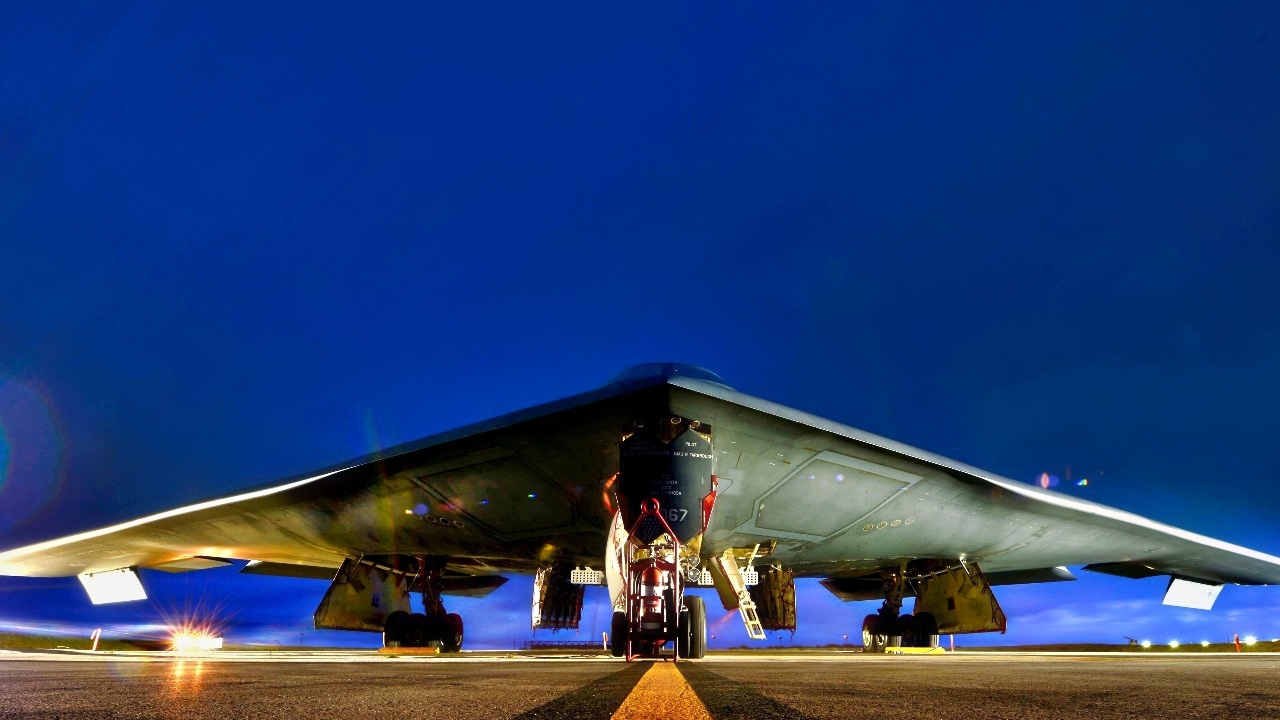
A U.S. Air Force B-2 Spirit aircraft deployed from Whiteman Air Force Base, Mo., sits on the parkway after landing from a local training flight at Andersen Air Force Base, Guam, Jan. 17, 2017. Close to 200 Airmen and three B-2s deployed from Whiteman Air Force Base, Mo., and Barksdale Air Force Base, La., in support of U.S. Strategic Command Bomber Assurance and Deterrence missions. USSTRATCOM units regularly conduct training with and in support of the Geographic Combatant Commands. USSTRATCOM, through its global strike assets, helps maintain global stability and security while enabling units to become familiar with operations in different regions. (U.S. Air Force photo by Tech. Sgt. Andy M. Kin)
A barrel released from a salt cavern in Texas still has to be refined, blended, and trucked into regional markets before it does a driver any good, and you cannot rebuild finished-product stocks when the refineries are already maxed out.
So the country is in the odd position of pouring its crude reserve into the front of a refining system that is running as hard as it can while gasoline drains out the back faster than it can be replaced. The SPR is patching the crude side of the ledger while the product side quietly erodes, which is the side that actually meets a car at the pump.
Why Diesel And The Summer Driving Season Make This Worse
The buffer is thinning at the worst possible moment on the calendar. The drawdown has front-run the summer driving season, the stretch when demand climbs, and inventories are supposed to be at their fullest, not their leanest. The market has spent its slack before the heaviest consumption even arrives.
Diesel sharpens the worry. Distillate stocks, which cover diesel and heating oil, are also running below normal, and diesel is the fuel that moves trucking, rail, farming, and construction. When diesel tightens, the cost shows up not just at the pump but across the price of nearly everything that travels by road or rail. The EIA has forecast that the war’s disruption would push retail gasoline toward a monthly peak near $4.30 a gallon and diesel above $5.80 at its height, with both staying elevated through the year, precisely because global supplies are tight and US inventories sit below their five-year norm. The pressure is already baked into the official outlook.
The Margin For Error Is Almost Gone
The greater danger is what this leaves the system unable to absorb. The world’s broader buffer is draining alongside America’s. The International Energy Agency has projected that global oil inventories would fall by an average of 8.5 million barrels a day in the second quarter, with the steepest draws in May and June, and Brent crude hanging near triple digits, as Gulf producers shut in millions of barrels of output they cannot ship.
The coordinated release of 400 million barrels by IEA members was only ever a temporary patch, and analysts have been blunt that emergency reserves can calm a panicked market but cannot manufacture the barrels that a closed waterway is no longer letting through.
That is the real exposure. A market this thin has no give. A single refinery outage, a hurricane in the Gulf of Mexico, a pipeline failure, or another lurch in the war, like this past weekend’s missile exchange between Israel and Iran, would now land on a fuel system that has already spent most of its protection.
And the damage outlasts the conflict itself, because once these stockpiles are run down this far, the market stays vulnerable to the next shock for a long time, even after Hormuz reopens.
None of this guarantees a price spike tomorrow. A diplomatic breakthrough, a softer demand patch, or a quiet stretch at the refineries could let inventories stabilize, and short-term fuel prices are notoriously hard to call.
But the calm of a sub-record headline price is hiding how much stress the system has already swallowed. The story in the data is not where America’s gasoline supply sits today. It is how quickly the safety margin disappeared while the country waited for a war on the other side of the world to end, and how little remains to cushion whatever comes next.
About the Author: Harry J. Kazianis
Harry J. Kazianis (@Grecianformula) was the former Senior Director of National Security Affairs at the Center for the National Interest (CFTNI), a foreign policy think tank founded by Richard Nixon based in Washington, DC. Harry has over a decade of experience in think tanks and national security publishing. His ideas have been published in the NY Times, The Washington Post, The Wall Street Journal, CNN, and many other outlets worldwide. He has held positions at CSIS, the Heritage Foundation, the University of Nottingham, and several other institutions related to national security research and studies. He is the former Executive Editor of the National Interest and the Diplomat. He holds a Master’s degree focusing on international affairs from Harvard University.


