

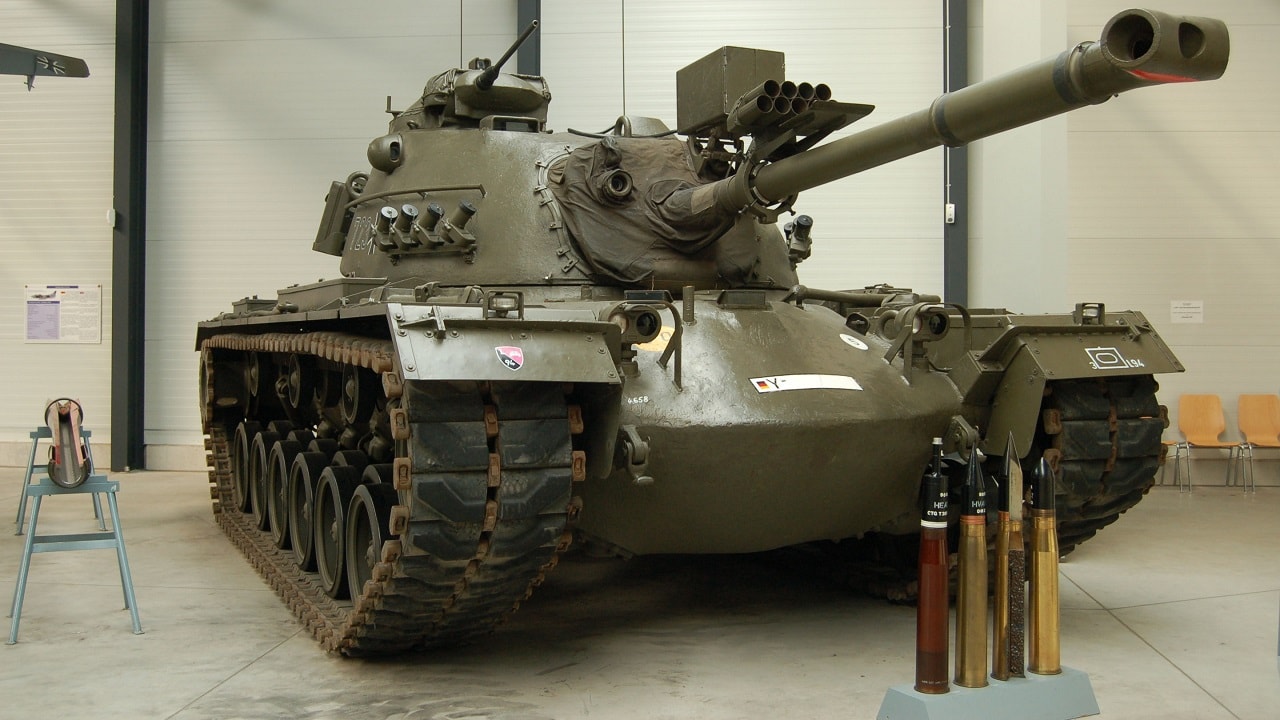
Key Points and Summary – The M48 Patton was America’s first truly post-WWII medium tank, built to solve Korea-era gaps in night fighting, mobility, and survivability.
-Early gasoline versions gave way to the diesel M48A3, while the M48A5 added a 105 mm gun and modern fire control.
-In Vietnam, the tank provided timely direct fire and urban breaching; Israeli Magach upgrades fought hard in 1967 and 1973, adapting after early ATGM shocks; Pakistan’s mixed successes in 1965/1971 underscored terrain and logistics. NATO, Asian, and Middle Eastern users kept upgraded M48s for decades.
-The U.S. retired the type as M60s—then Abrams—took over, but the Patton’s lessons shaped both.
M48 Patton: The Post-Korea Tank That Bridged Two Eras
When the Korean War exposed the limits of America’s World War II–era armor, the U.S. Army needed a tank that could do more than simply out-gun a T-34 on a good day. Korea’s hills, punishing weather, and rushed logistics highlighted three gaps: fire control suited to poor visibility and night fighting, mobility and reliability over long, rugged distances, and survivability against better guns and shaped-charge weapons that were proliferating fast. The stopgap M46 and M47 Pattons helped, but they were evolutionary—reworked drivetrains and guns on essentially WWII foundations.
The M48 Patton was the first truly postwar clean-sheet “medium” tank intended for mass production. It promised a hemispherical cast turret for better ballistic shaping, improved optics and night-fighting aids for the commander and gunner, a refined 90 mm main gun with modern ammunition, and a hull designed for easier maintenance in the field. In theory, it would deliver a more stable firing platform, a smarter crew station layout, and the reliability to keep battalions moving in a war of distance, not just a duel of silhouettes.
From Drawing Board To Production Line
Standardized in the early 1950s, the M48 kept the Patton family DNA—a low hull, good turret ergonomics, and a powerful gun—but changed the details that mattered. Early M48 and M48A1 variants paired a 90 mm cannon with a commander’s M1 cupola mounting a .50-caliber machine gun under armor, better radios, and infrared searchlights. The M48A2 rationalized the powerpack and cooling for improved road performance.
The big leap came with the M48A3, which swapped the gasoline engine for a diesel—transforming range, safety, and sustainment. Later, the M48A5 upgrade re-gunned the platform with the 105 mm M68 (a U.S. derivative of the British L7), modernized sights and ballistic computers, and extended the service life of hundreds of hulls well into the 1970s and 1980s.
That ability to spiral in capability—better engines, better optics, better gun—kept the M48 tactically relevant while the Army fielded the heavier-hitting M60 family and, ultimately, moved toward the Abrams.
How The Tank Fought: A Global Operational History
The M48 quickly became a workhorse at home and abroad. U.S. armored battalions trained hard through the 1950s against the possibility of a high-end fight in Europe. Allies bought the tank in quantity, creating a globe-spanning footprint that ensured deep pools of spare parts, ammunition, and know-how. West Germany, Italy, Spain, Greece, Turkey, Iran, Jordan, South Korea, and Taiwan were among the many users who found the Patton a sensible, supportable choice while they built industrial capacity for their own future designs.
Because the M48 could be upgraded in place, each user community tailored the platform to its doctrine—new fire-control systems here, 105 mm guns and improved commander’s cupolas there, and add-on armor packages where urban combat demanded them. In short: the same hull wore many uniforms, and that flexibility kept it relevant across very different terrains and opponents.
Vietnam: Firepower At The Speed Of The Fight
If you want a single test that shows what the M48 brought to the U.S. military, it’s Vietnam. The M48A3—dieselized, with improved reliability and range—gave both the Army and the Marine Corps a mobile, protected direct-fire hammer that could arrive with infantry instead of days later. Tanks secured convoy routes, guarded firebases, and crushed ambushes. In the Battle of Hue (1968), Marine M48s were decisive street-clearing tools, blasting entry points through thick walls, neutralizing machine-gun nests, and providing shock where rifle platoons stalled under interlocking fire.
The Patton also met enemy armor. At places like Ben Het, American M48s tangled with North Vietnamese PT-76 amphibious tanks in night fights that showcased the value of stabilized guns, crew discipline, and night sights. Later in the war, as U.S. heavy formations rotated home, South Vietnamese M48 crews used their tanks in the Easter Offensive to blunt attacks that included T-54/T-55 battalions. The M48’s 90 mm gun could kill modern Soviet-type armor with the right shot and ammunition—and in the close, terrain-broken fights typical of Vietnam, the tank’s ability to show up, stay, and shoot accurately often mattered more than raw paper penetration.
Arab–Israeli Wars: Strengths, Weaknesses, And Adaptation
Israel received early M48 variants and upgraded them extensively into the Magach series: lower-profile Urdan commander’s cupolas to replace the tall American design, the 105 mm gun, better radios and stowage, and eventually explosive reactive armor. In the Six-Day War (1967) and Yom Kippur War (1973), these M48-based tanks saw the best and worst of modern armored combat. On open ground with room to maneuver and supported by competent crews and maintenance, they could dominate older Arab tanks.
In 1973, however, massed anti-tank guided missiles and RPG ambushes inflicted heavy losses, especially in the opening days when Israeli forces were thin and tactics had not yet adapted to the missile threat. Israel’s response—add armor packages, refine combined-arms drills, and tighten coordination with artillery and infantry—became a global lesson: tanks survive when the brigade fights together.
Indo-Pakistani Wars: Reputation Forged In Mud And Fire
Pakistan fielded Pattons alongside other U.S. types in the 1965 war, using them in large armored thrusts that initially shocked Indian defenders. But long, exposed axes and canal-laced terrain turned into traps. At Asal Uttar, Indian defenses funneled Pakistani armor into killing zones; dozens of knocked-out Pattons became a propaganda exhibit known as “Patton Nagar.” Strip away the myths and the underlying truth remains: the M48 was a potent tank, but terrain, reconnaissance, and logistics decide battles. Pakistan’s use of the type again in 1971 saw hard fighting and mixed results—proof that no tank, however capable, overcomes poor alignment between plan, ground, and support.
Europe And Asia: The Patton As Deterrent
Across NATO, the M48 served as the backbone of armored brigades until Leopard 1/2 and Chieftain/Challenger families took over. Germany’s deep upgrades (culminating in the M48A2GA2 standard with 105 mm gun and modern sights) kept the type in rear-area and reserve roles well into the 1980s. In South Korea and Taiwan, the M48 became both a training platform and a ready reserve—often re-gunned and refit to local standards—while indigenous programs matured. In Turkey and Greece, successive modernization waves (105 mm guns, thermal sights, improved fire control, and later explosive reactive armor on some fleets) kept M48s relevant for decades in rough, mountainous terrain where reliability and crew familiarity count.
How Crews Rated It: Strengths And Pain Points
What crews liked. The M48’s turret ergonomics and gun handling stood out. The rounded turret offered decent protection for its era, the 90 mm (and later 105 mm) gave accurate, repeatable fire, and the dieselized A3 variant finally delivered the operational range and safety commanders wanted. The stabilized platform and sensible sight lines, especially with later thermal imagers, made the tank a trustworthy shooter day or night.
What crews fought through. Early gasoline models had ugly fire risks and short legs; maintenance crews wrestled with powerpack quirks and thirsty engines until dieselization. The tall commander’s cupola on early versions drew complaints for silhouette and cramped handling of the .50-caliber gun. And like any 1950s design, baseline armor—good against older guns—needed add-ons in urban fights and against modern HEAT/ATGM threats. Survivability in cities depended on tactics (infantry screens, smoke, overwatch) as much as on steel.

CINCU, Romania – U.S. Army Soldiers of 1st Battalion, 66th Armored Regiment, 3rd Armored Brigade Combat Team, 4th Infantry Division, setup their M1 Abram Tanks during Getica Saber 17, July 10, 2017. Getica Saber 17 is a U.S.-led fire support coordination exercise and combined arms live fire exercise that incorporates six allied and partner nations with more than 4,000 Soldiers. Getica Saber 17 runs concurrent with Saber Guardian 17, a U.S. Army Europe-led, multinational exercise that spans across Bulgaria, Hungary and Romania with more than 25,000 service members from 22 allied and partner nations. Image Credit: US Military.
The Final U.S. Chapters: M48 Tank Upgrades, Hand-Offs, And Conversions
By the late 1960s, the M60 family—evolutionary from the M48 but with a sharper hull, 105 mm gun from birth, and growth room—was becoming the U.S. standard. The Army’s answer for remaining M48 hulls was the M48A5 conversion: the 105 mm gun, better fire-control components, and selective reliability updates. These served in Army National Guard units into the 1980s while active formations shifted to M60A1/A3 and then to M1 Abrams. The Marine Corps, which had leaned hard on the M48A3 in Vietnam, moved to M60 variants in the 1970s.
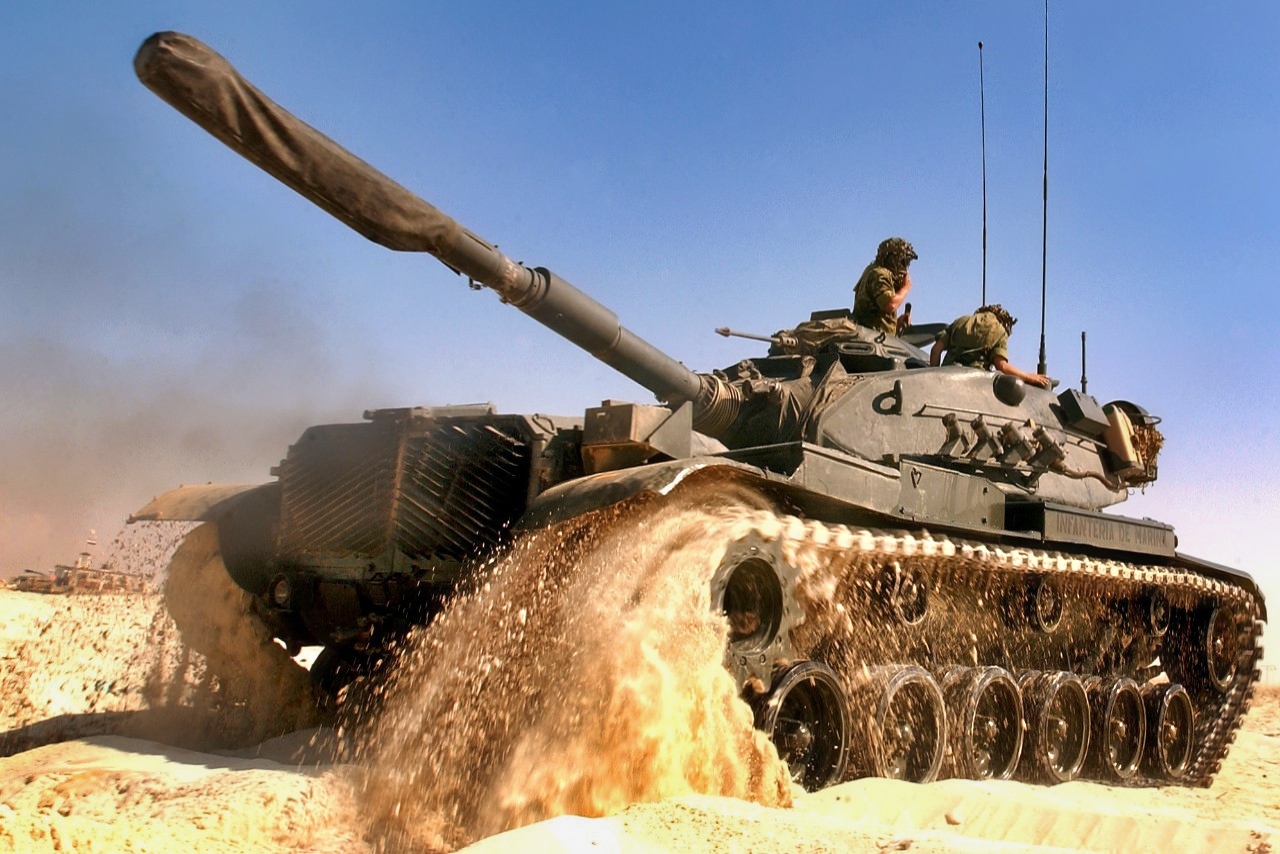
M60A3 Tank. Image Credit: Creative Commons.
The M48 hull also proved a versatile parent for specialized vehicles. The M728 Combat Engineer Vehicle (CEV) married a short-barrel 165 mm demolition gun to a crane and winch; armored vehicle-launched bridges (AVLBs) on M48 chassis provided essential gap-crossing. Those derivatives kept Patton DNA in U.S. service long after line tanks were gone.
Why It Endured Abroad
Three reasons explain the M48’s longevity overseas. First, upgradeability: swapping in a 105 mm gun, thermal sights, laser rangefinders, and new radios turned a 1950s tank into a competent 1980s shooter. Second, roads and bridges: in countries with constrained infrastructure, an M48’s weight and dimensions fit better than heavier later designs. Third, training pipelines: decades of users meant manuals, simulators, and seasoned maintainers existed in quantity. A modest defense budget could keep a battalion of M48s ready and relevant far more easily than it could stand up a cutting-edge fleet from scratch.
How It Was Ultimately Retired
In the United States, the M48 bowed out as part of a two-step handover: first to the M60 series, then to the M1 Abrams. By the late 1970s the Patton name lived mostly in reserve components and specialized engineering variants; by the mid-1980s, line tank roles were over. Abroad, retirements stretched much longer. Some European users kept upgraded M48s into the early 1990s; several Middle Eastern and Asian fleets held on even later, either as second-line armor or as training tanks while newer types entered service.
Retirement decisions tracked the same calculus everywhere: survivability against modern threats, the cost of yet another upgrade, and the availability of used Leopard 1s, M60s, or newer domestic designs. Where armies could accept the risk profile—internal security, low-intensity patrols, or as mobile guns behind infantry—the M48 stayed. Where ATGMs, top-attack munitions, and urban ambushes defined the threat, the Patton’s margins were gone.
What The M48 Proved
The M48 Patton did not win fame for a single spectacular battle. It earned its reputation the hard way: by being there—in jungles, cities, deserts, and on the inter-German border—for three decades of imperfect wars. It showed that crew training, fire control, and logistics decide tank fights as much as armor thickness. It taught armies to dieselize, to invest relentlessly in sights and rangefinding, and to treat combined arms as the true shield for armored crews. And it bridged the generational gap from WWII steel to Cold War sophistication so that better tanks—M60, then Abrams—could start a war on third base instead of at bat.
M48: A Proud Tank Legacy
Conceived after Korea to fix real shortcomings and built with room to grow, the M48 Patton became the world’s quintessential “good enough in the right hands” tank. Early gasoline models were thirsty and unforgiving; later A3/A5 standards were confident, accurate, and reliable.
In Vietnam, the Middle East, South Asia, and on NATO duty, the M48 delivered timely, precise fire that infantry could count on—and it absorbed the harsh new lessons of missiles and cities that would shape tank design for the next half-century.
By the time it retired, the Patton had done what great bridge designs do: make the next generation better by carrying the weight in between.
About the Author: Harry J. Kazianis
Harry J. Kazianis (@Grecianformula) is Editor-In-Chief and President of National Security Journal. He was the former Senior Director of National Security Affairs at the Center for the National Interest (CFTNI), a foreign policy think tank founded by Richard Nixon based in Washington, DC. Harry has over a decade of experience in think tanks and national security publishing. His ideas have been published in the NY Times, The Washington Post, The Wall Street Journal, CNN, and many other outlets worldwide. He has held positions at CSIS, the Heritage Foundation, the University of Nottingham, and several other institutions related to national security research and studies. He is the former Executive Editor of the National Interest and the Diplomat. He holds a Master’s degree focusing on international affairs from Harvard University.
More Military
Su-75 Checkmate: Russia’s Big Stealth Fighter Flop
Russia’s ‘New’ MiG-35 Fighter Looks RIP
5 Worst Aircraft Carriers Ever


