


Key Points and Summary – A speculative analysis pits China’s 5th-gen J-20 against the U.S. Navy’s conceptual 6th-gen F/A-XX.
-On paper, the F/A-XX is the decisive winner, boasting superior 6th-gen stealth, a massive speed advantage (approaching Mach 3), longer range, and hypersonic weapons.

F/A-XX U.S. Navy Fighter. Image Credit: Creative Commons.
-However, this comparison highlights a critical reality: the J-20 exists in large and growing numbers, while the F/A-XX is a not-yet-built “paper tiger.”
-The J-20’s significant quantitative advantage would severely challenge the F/A-XX’s qualitative edge, assuming the U.S. Navy’s next-generation fighter is ever produced in sufficient numbers.
China’s J-20 Versus the US Navy’s F/A-XX: Who Wins?
What happens when two stealth fighter jets dogfight each other? This story should arouse your interest because we always wonder how China’s best jet—the J-20 Mighty Dragon—would perform against the competition. This time, we’ll look at the proposed new sixth-generation fighter—the US Navy’s F/A-XX.
The US’s carrier-borne airplane will eventually replace the F/A-18 E/F Super Hornet should it come to fruition.
Let’s first take a closer look at the J-20. This Chinese warbird can dogfight and perform ground strike missions. The J-20 has supercruise without afterburners and many integrated systems that make it China’s first fifth-generation airplane.
Could the J-20 Terrorize Taiwan?
The J-20 is recognized for general homeland defense and air policing of borders. But it is the multi-role interceptor’s diverse mission set that makes people stand up and take notice. The Mighty Dragon will be instrumental in any attempt by China to attack Taiwan.
It flies regular missions near the Taiwanese Air Defense Identification Zone that are known as “grey zone warfare” operations. Grey zone refers to activities that fall between peaceful training missions and full-scale shooting battles with live ordnance. However, the J-20 has never engaged in real combat.
More Specs on the J-20
The J-20 first flew in 2011 and entered full-time service in 2017. It has a canard-delta wing configuration, which improves maneuverability, and diverterless supersonic inlets that enhance stealth and airflow efficiency. The airplane features advanced radar-absorbing materials. The J-20 has internal weapons bays to emphasize its stealth attributes. There are also thrust vectoring engines that enable a respectable MACH 2.0 speed. The J-20 also has electronically scanned array (AESA) radar, plus infrared search and track (IRST) systems, and advanced electronic warfare suites.
F/A-XX May Have More Promising Features
The F/A-XX, on the other hand, will likely become much stealthier than the J-20. The Mighty Dragon’s radar evasion abilities may be overrated, and it could be discovered early by the F/A-XX’s improved sensors and radar.
They Each Have Drone-Teaming Ability
Both airplanes have manned-unmanned teaming plans. This means there would be at least one “Loyal Wingman” drone to fly out ahead of the formation and collect intelligence, surveillance, and reconnaissance data. The unmanned wingman craft could also conduct battle damage assessment, which is so important these days. The drones also have better electronic warfare for jamming and spoofing enemy air defenses.
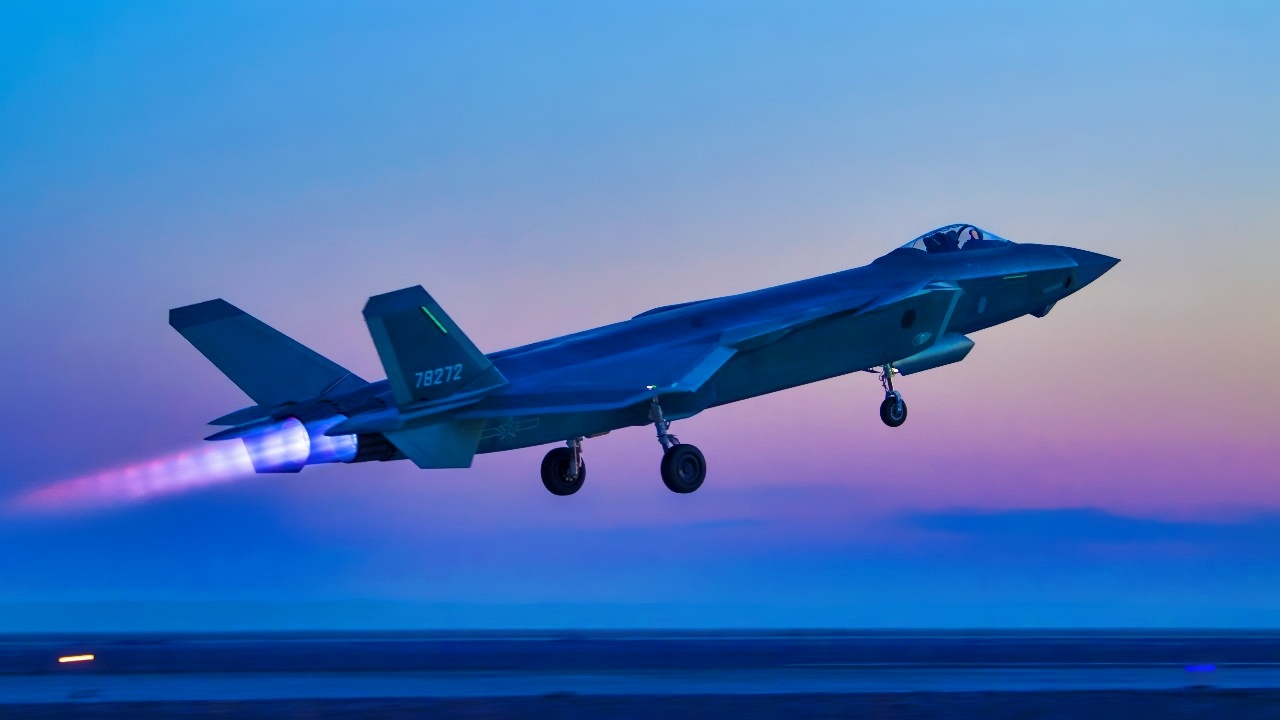
China J-20 Amazing Colors. Image Credit: PLAAF.
The F/A-XX Has the Advantage in Speed and the Nuclear Option
The F/A-XX is sixth-generation, though. That means better speed than the Super Hornet and advanced stealthiness, as mentioned above. The F/A-XX could hit a top velocity approaching MACH 3. This is a significant advantage over the J-20. The F/A-XX could also be equipped with hypersonic weapons and be nuclear-capable. The Navy’s new fighter will also have a longer range than the Super Hornet and J-20.
Like the J-20, the F/A-XX will be a multi-role strike fighter. They both allow the execution of varied operations and tactics. The F/A-XX may be more strategic than the J-20 with the nuclear-equipped option. While the J-20 is likely a more regional warbird. Meanwhile, the F/A-XX will be a worldwide fighter since it is deployed on aircraft carriers.
The F/A-XX Will Have Better Range
The F/A-XX is designed for quick transitions from high to low-speed flight and high angles of attack, making it suitable for carrier landings. The F/A-XX will have 25 percent greater range than the Super Hornet and F-35C, the Navy’s other carrier-borne stealth fighter. The F/A-XX will refuel in the air with the stealth drone tanker called the MQ-25 Stingray. This will allow the F/A-XX to fly closer to China to engage with enemy aircraft or conduct surface strikes against People’s Liberation Army Navy (PLAN) ships.
The F/A-XX will have artificial intelligence in the cockpit and may even become a “flying supercomputer” that features newfangled quantum computing. The avionics and sensor fusion will be more advanced than the J-20 as well. F/A-XX will have an answer for the PLAN’s anti-access/ area denial strategy due to its long range, speed, and ultra-stealthiness.
With the high levels of electronic warfare, the F/A-XX will be better able to survive in multi-threat environments and outfox China’s surface-to-air missile batteries.
In 2 Words: F/A-XX Wins
My money is on the F/A-XX, but keep in mind that this proposed airplane hasn’t been built yet. China has between 200 and 400 J-20s. The Navy is not likely to have nearly that many F/A-XX models. The new airplane will be highly expensive. Plus, the Air Force is building its own sixth-generation fighter – the F-47 NGAD – and that will force the “Department of War” to make difficult decisions about the features of the F-47 and F/A-XX. The two fighters may share the same engines to cut costs.
Overall, the J-20 has the advantage in numbers. We don’t know how well the F/A-XX will perform in dogfighting. It will be faster and more survivable in close-in combat. But let’s say the J-20 has a three-to-one or even two-to-one advantage in numbers. The pilots of the F/A-XX will have their hands full going head-to-head with the more numerous J-20.
I still like the proposed features of the F/A-XX. This fighter has strategic, operational, and tactical advantages. The range will be excellent, and carriers can deploy them anywhere, anytime. The F/A-XX will be stealthier and faster than the J-20 with the ability to fire hypersonic weapons. However, the J-20 has been built in numbers, and the F/A-XX is still in research and development stages, and the Navy could still cancel it.
Time will tell if the F/A-XX is a winner in reality or just another paper tiger that is never produced in high numbers.
About the Author: Brent M. Eastwood
Brent M. Eastwood, PhD is the author of Don’t Turn Your Back On the World: a Conservative Foreign Policy and Humans, Machines, and Data: Future Trends in Warfare plus two other books. Brent was the founder and CEO of a tech firm that predicted world events using artificial intelligence. He served as a legislative fellow for US Senator Tim Scott and advised the senator on defense and foreign policy issues. He has taught at American University, George Washington University, and George Mason University. Brent is a former US Army Infantry officer. He can be followed on X @BMEastwood.
More Military
Why the U.S. Navy Loves the F-14 Tomcat
F-14 vs. MiG-29: The Winner Is Clear


