

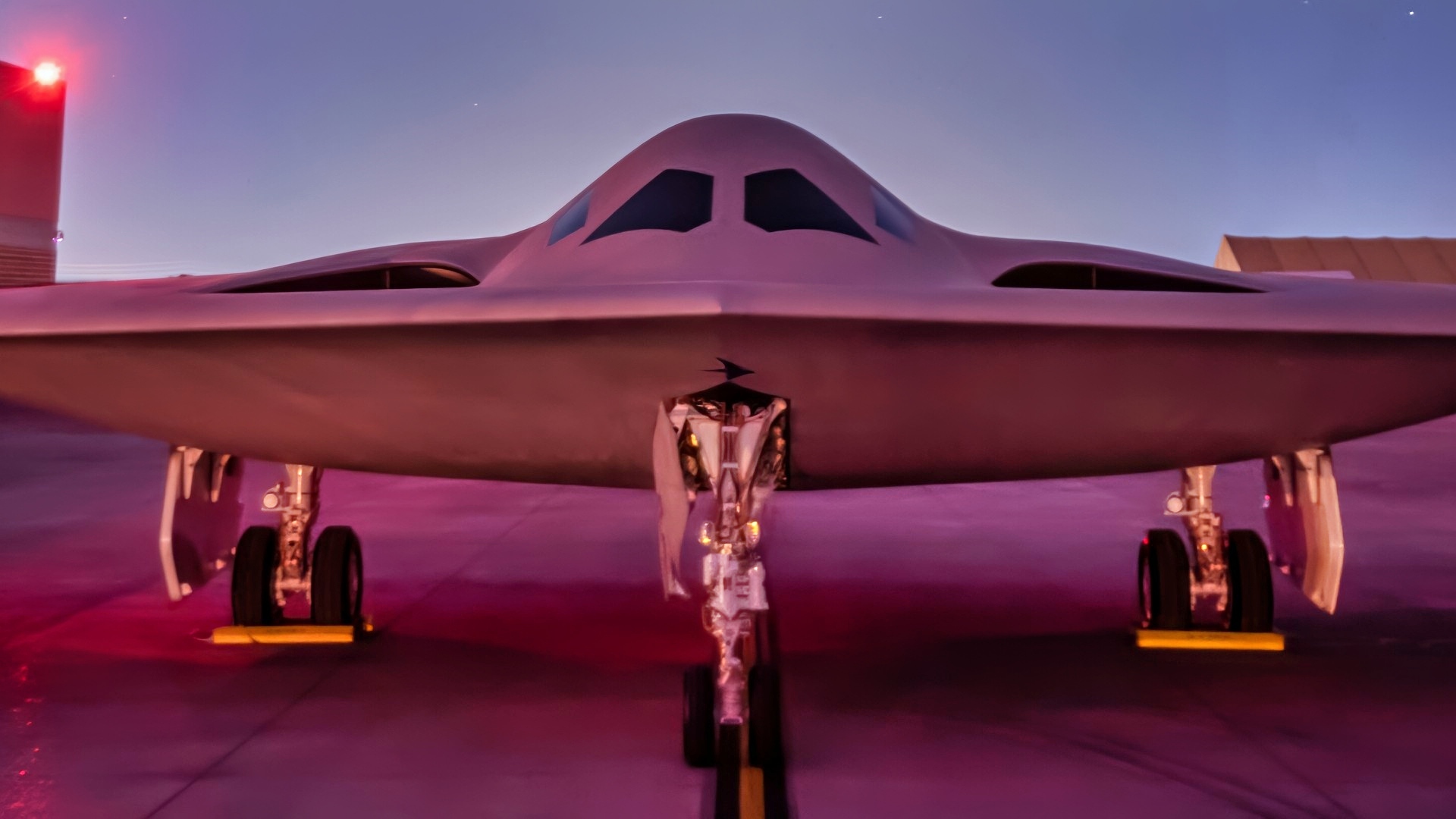
The Secret Weapon? Size (Key Points and Summary) – The B-21 Raider is smaller than the B-2, prompting doubts about range. But size alone misleads.
-The Raider’s flying-wing design, refined stealth shaping and likely high-bypass, fuel-efficient engines could equal—or exceed—the B-2’s reach at subsonic speed.
-Modern computational fluid dynamics enables serpentine inlets that hide fans while feeding higher-bypass cores, improving specific fuel consumption and lowering infrared signature.
-Unlike the B-2’s late-added low-level requirement, the B-21 appears optimized for efficient medium-altitude penetration and networked sensing.
-Until specifications are public, questions remain, yet evidence suggests the Raider trades raw volume for overall efficiency, survivability and mission systems without sacrificing strategic range.
Small but Mighty? The B-21 Raider and the Question of Range
The upcoming sixth-generation stealth bomber will be smaller than its B-2 predecessor, leading some critics to ask whether the Raider will have sufficient range.
Ahead of the wider rollout of the newest aircraft to enter service with the United States Air Force, the B-21 Raider bomber, experts, talking heads, and tech commentators are attempting to glean as much information as they can from the relatively limited publicly available knowledge. Most of the information that can be gleaned comes from a small number of photographs and other media. And thanks to the Raider’s similarities to the B-2 Spirit bomber, there might be some commonalities between the two strategic bombers.
Both bombers are flying wing designs, a two-fold design consideration that reduces both the aircraft’s radar cross-section and drag during flight. Compared to the older B-2, the B-21 sports updated radar-absorbent coatings, several oddly-shaped pilot windows, and a pair of engines that are tucked away within the bomber’s fuselage. Overall, the B-21 is an iterative design, and one that manages risk by building on the technologies pioneered by the Spirit, rather than attempting to perfect and integrate a variety of new technologies simultaneously on a single platform.
“The design of Northrop Grumman’s B-21 Raider points to a conservative approach on the part of the U.S. Air Force’s Rapid Capabilities Office. The B-21’s resemblance to the original B-2 bomber design is close. Still, it is a smaller aircraft, with a wingspan estimated at 132 ft. compared with the B-2’s 172 ft.. It is approximately half the empty weight,” Aviation Week, an American military aircraft-focused publication, explains in nitty-gritty detail.
“The platform itself is driven by the need to accommodate complex inlets and exhausts and a large weapon bay within the flying-wing profile while staying within a maximum thickness-to-chord ratio compatible with efficient flight above Mach 0.8.”
An infographic of the B-21 Raider, created by Aviation Week and full of detail and insight, illustrates the location and function of many of the B-21’s anticipated features and is well worth examining.
While the B-21 Raider has faced criticism from certain quarters and sparked skepticism about its smaller size and lower internal fuel capacity, detractors argue that this reduces the aircraft’s range. However, these critiques may be inaccurate.
While a smaller airframe size may indicate that the B-21 carries less internal fuel than its B-2 predecessor, this line of argumentation overlooks the engines that fuel it. The B-21 Raider’s anticipated high-bypass engines may be better suited to long-range flight at subsonic speeds, potentially leading to better fuel economy than the older Spirit.
“On the B-2, the low-bypass GE F118 engine was selected because it was too risky to place a higher-bypass engine, more sensitive to flow distortion, behind the curved and RAM-treated inlet ducts needed to hide the fan face from radar,” Bill Sweetman, a journalist who covers military aviation, wrote.
“With the aid of better CFD, that problem can be eliminated: Northrop Grumman proposed a large bomber UAV in 2005, powered by two modified GE CF34 turbofans, and Lockheed Martin flew the Polecat demonstrator in 2006 with two Williams FJ44s.”
“A higher bypass ratio provides much better specific fuel consumption than the B-2’s fighter-type engine,” Sweetman added. This resulted in “improving range, and would enable a cooler, lower-velocity exhaust, not only lowering the B-21’s infrared signature but also alleviating thermomechanical stress on the open “aft deck” area of the exhaust, immediately ahead of the trailing edge.”
Despite the B-21 Raider range critique, which maintains that the bomber must have a lower range than the B-2, modern powerplants may actually offer higher range, depending on how efficient the engines are. But what kind of engine would power the B-21 Raider? Aviation Week has one theory.
“The center-body section [of the B-21 Raider] matches images of highly serpentine inlets mated to a medium-bypass engine,” Aviation Week explains. “Pratt & Whitney discussed such an engine, the PW9000, as a future bomber powerplant in 2010, but has not mentioned it since. The PW9000 used the core of the PW1000G commercial engine family, mated to a direct-drive fan with a 4:1 bypass ratio.”
The B-21 and B-2 are fairly similar aircraft from a purely visual perspective, though crucial differences between the two aircraft are illustrative of slightly different operational uses. The B-2 Spirit features a triangular tail area, a control surface that affords the bomber better control during turbulent air conditions—a fairly typical phenomenon during flight at low altitudes—and is a feature that the B-21 Raider lacks.
This design requirement — low-altitude flight — was imposed on the B-2 later in its design stage, adding technical complexity, weight, and cost to the bomber. According to Aviation Week, the low-level flight capability was never utilized by the B-2 Spirit. In contrast, the B-21 Raider lacks the B-2’s distinctive tail control surfaces and possibly low-level flight as well.
The Small B-21 Raider Is the Future
As the bomber is not yet in service, fewer details about the B-21 are currently known, although this may change in the future. Questions about fuel efficiency and range will naturally remain outside the scope of public knowledge—but what can be surmised with a high degree of confidence is that compared to the Cold War-era B-2 Spirit, the upcoming Raider will be a stealthier and more capable—but somewhat smaller—strategic bomber.
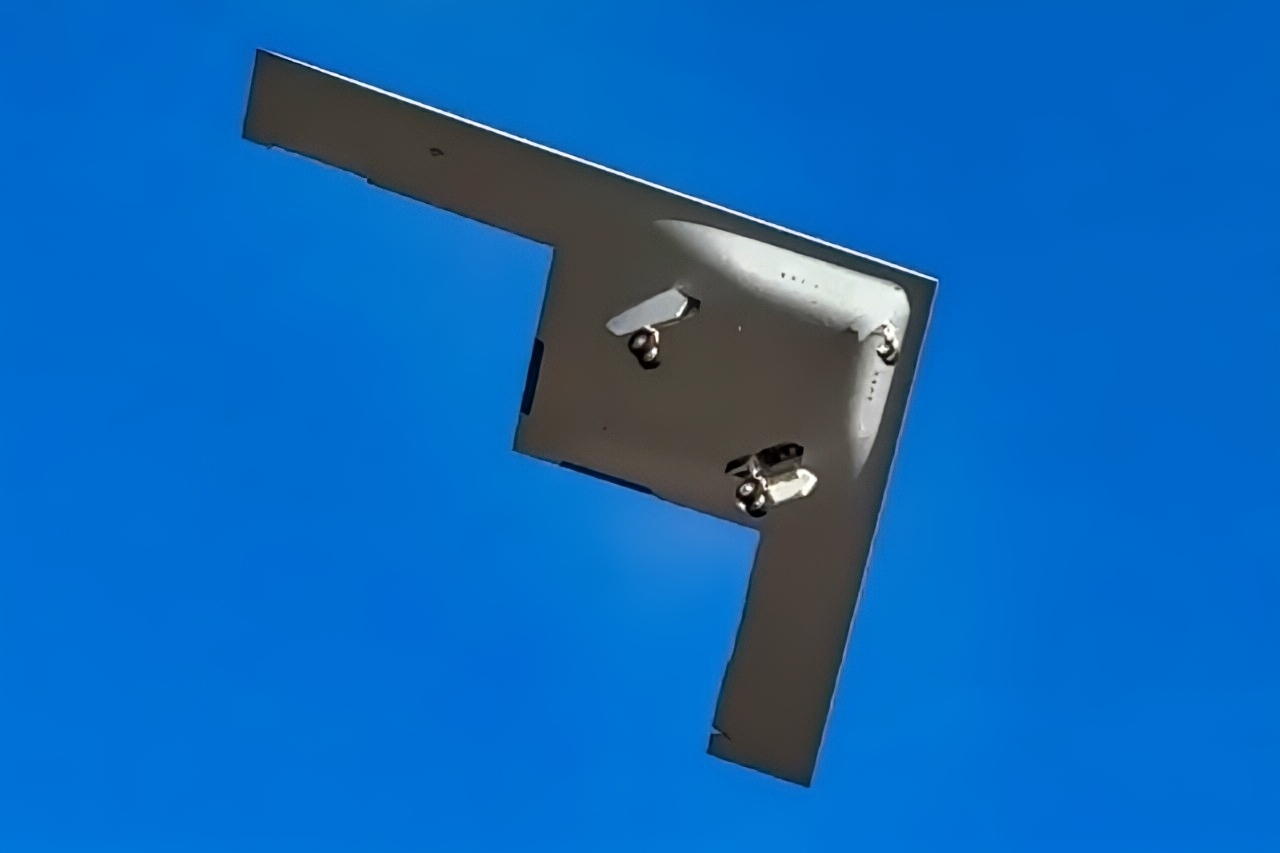
B-21 Raider New Flight of Second Bomber. Image X Screenshot from Video Posted.
About the Author: Caleb Larson
Caleb Larson is an American multiformat journalist based in Berlin, Germany. His work covers the intersection of conflict and society, focusing on American foreign policy and European security. He has reported from Germany, Russia, and the United States. Most recently, he covered the war in Ukraine, reporting extensively on the war’s shifting battle lines from Donbas and writing on the war’s civilian and humanitarian toll. Previously, he worked as a Defense Reporter for POLITICO Europe. You can follow his latest work on X.
More Military
The B-21 Raider Will Transform the U.S. Military
SR-72 Darkstar Might Be Coming Soon…
The B-2A Spirit Stealth Bomber Has a Message for Russia and China
China Has a Masterplan to Make the B-21 Raider Bomber Obsolete
The New B-21 Raider Is Far More Than Just A ‘Stealth Bomber’


