

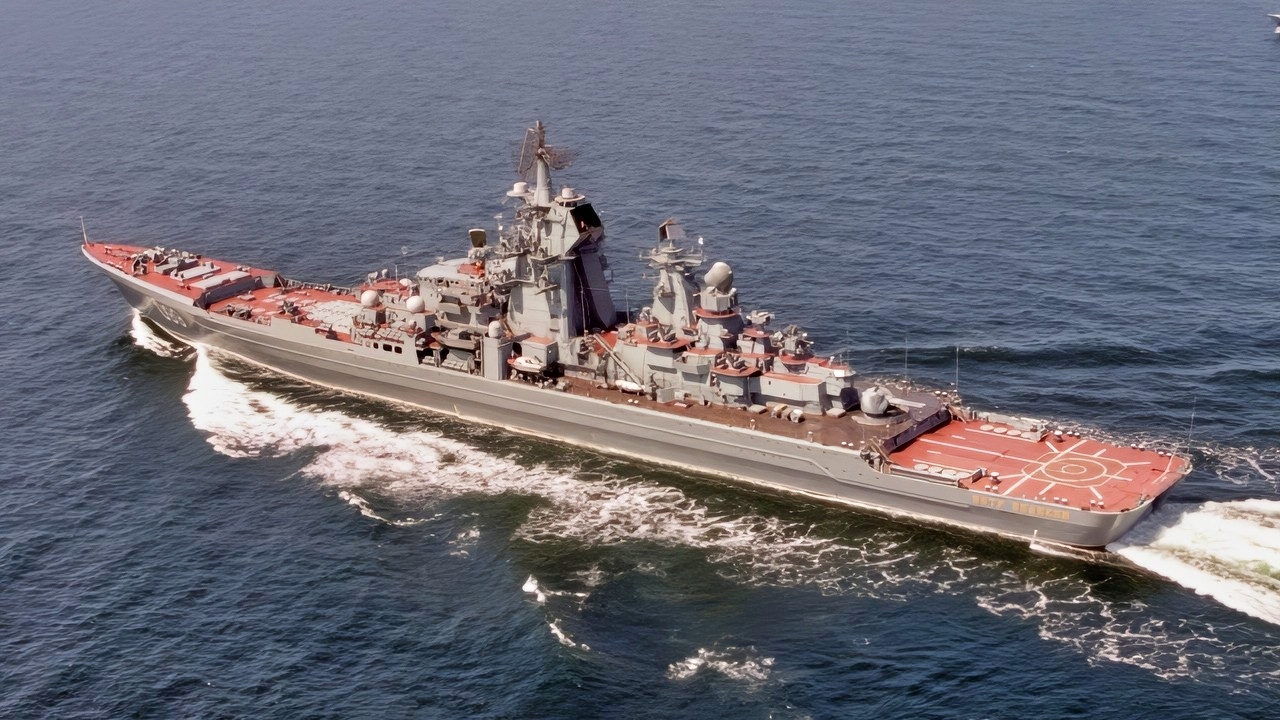
Key Points and Summary – Despite Vladimir Putin’s rhetoric, the Russian Navy is in a precarious state, struggling with combat losses, an aging Soviet-era surface fleet, and a crippled shipbuilding industry.
-Its only aircraft carrier is gone, and plans for large warships have stalled. However, there are pockets of success. The Admiral Gorshkov-class frigate program is delivering modern, Zircon-armed vessels on schedule, and the submarine force remains a capable threat.
-Russia recently announced its first new destroyer program since the Cold War, but its future fleet will likely consist of smaller ships with powerful missiles and a robust submarine presence.
The Russian Navy Is Trying to Reboot
“The [Russian]Navy has been an asset and a source of pride for our Fatherland since the time of Peter the Great,” Vladimir Putin said on July 27, Russia’s annual Navy Day.
From a Western perspective, it is hard to see the Russian Navy as a source of pride, especially since the outbreak of the war in Ukraine.
However, despite its many setbacks, corruption scandals, international setbacks, and budget constraints, Russia remains determined to modernize its navy and rebuild its lost capabilities.
The Project 22350 Frigate
The Project 22350 frigate (also known as the Admiral Gorshkov-class) has been a key focus of the Russian Navy in recent years and is one of its most significant successes.
These small missile cruisers have a range of around 4,850 nautical miles, significantly smaller than that of a destroyer or an aircraft carrier.
However, the Admiral Gorshkov-class compensates for its small range with its advanced armament.
The frigates can be equipped with either Kalibr cruise missiles, Onyx anti-ship missiles, or Zircon hypersonic missiles as their main armament.
The Zircon in particular makes the Admiral Gorshkov a particularly deadly adversary.
Currently, the Russian Navy has three ships of the class in service, with two undergoing active sea trials and another five planned. Out of all of Russia’s naval projects, the Admiral Gorshkov-class is the only surface vessel that has been consistently completed on schedule.
However, the Gorshkov-class has also garnered criticism for failing to address the actual needs of the Russian Navy, specifically a serious blue-water presence.
The Gorshkov, and all other post-Soviet frigates, are inferior to their Soviet predecessor in terms of speed, and efficiency.
This suggests that Russia has yet to achieve the ship-building capabilities that the Soviet Union possessed, although it is making progress.
Russia is Working on a New Destroyer
One of Russia’s most significant naval challenges is the lack of long-range surface vessels capable of projecting power far from Russia’s shores.
This problem is further compounded by the recent decommissioning of the Admiral Kuznetsov, Russia’s only remaining aircraft carrier.
However, in August of 2025, the Russian Navy announced that it was working on its first destroyer program since the dissolution of the USSR. This project will feature long-range capabilities and replace the old Soviet-era destroyers.
The Russians have previously floated ideas for a new destroyer. In 2010, a design for a new destroyer, tentatively named the Shkval or Lieder-class destroyer.
In 2020, it was announced that the Shkval-class was ready for serial production, but the Russian Navy never ordered any due to the immense cost of the project. The Shkval-class relied on nuclear-powered propulsion and weighed almost twice as much as the American Arleigh Burke-class destroyers.
No details are available on the newest class of destroyers currently in development, but one can only hope that the Russians have finally learned their lesson.
Submarines: the Russian Navy at its Best
Russia’s Submarine Forces are the only area of the Russian Navy that is in good order. Russia currently maintains a diverse fleet of SSBNs, SSGNs, SSNs, and attack submarines, with a total of 79 military submarines.
While it has struggled to field the Lada-class, Russia has managed to complete two Borei-A class submarines in recent years, with six Yasen-M class multipurpose nuclear submarines at different stages of construction.
While it lags behind the U.S. in overall production, Russia’s submarines are undoubtedly advanced and arguably pose the greatest threat to the U.S. Navy.
The Russian Navy is Still Lagging Behind
Despite modernization efforts, the Russian Navy continues to face a host of structural and operational problems. One of the most pressing issues is the aging surface fleet, which is largely composed of Soviet-era cruisers and destroyers.
These vessels suffer from reliability issues and lack the endurance required for sustained blue-water operations. The Navy’s only aircraft carrier, Admiral Kuznetsov, has been plagued by mechanical failures and extended refits, rendering it more symbolic than functional.
Russia’s shipbuilding industry also presents a significant bottleneck. While the Kremlin has announced plans to build hundreds of new vessels by mid-century, the sector is hampered by outdated facilities, limited capacity, and frequent delays.
For example, although there are at least three aircraft carrier projects in development, none has been officially approved, and the construction of a new carrier in Vladivostok may take up to 20 years to complete. The lack of large-scale shipyards capable of building such vessels further complicates these ambitions.
Still a Blue Water Fleet For Now
Economic pressures have further strained the Navy’s resources. International sanctions targeting Russia’s “dark fleet” of oil tankers have forced the Navy to escort commercial vessels, stretching its operational capacity. These escort duties are a drain on naval assets, highlighting the Navy’s limited ability to maintain a global presence. Moreover, the fiscal need to defend Russia’s oil exports has become increasingly acute, especially as signs of economic weakness emerge, such as a decline in GDP in early 2025.
Overall, the Russian Navy currently operates around 420 ships, with 359 in active service. This includes 83 submarines, 105 corvettes, 17 frigates, and a single aircraft carrier. While the submarine force remains technologically advanced and forms the backbone of Russia’s sea-based nuclear deterrent, the surface fleet is increasingly obsolete.
The Navy’s operational reach is most potent in the Arctic, where Russia maintains the world’s largest icebreaker fleet and has expanded its presence.
In the future, Russia is likely to maintain a blue-water fleet, but it will require significant economic investment and exceptional leadership to keep the Russian Navy relevant against the U.S. or Chinese Navies.
About the Author: Isaac Seitz
Isaac Seitz, a Defense Columnist, graduated from Patrick Henry College’s Strategic Intelligence and National Security program. He has also studied Russian at Middlebury Language Schools and has worked as an intelligence Analyst in the private sector.
Military Affairs
China’s Stealth Air Force Has 1 Mission


