

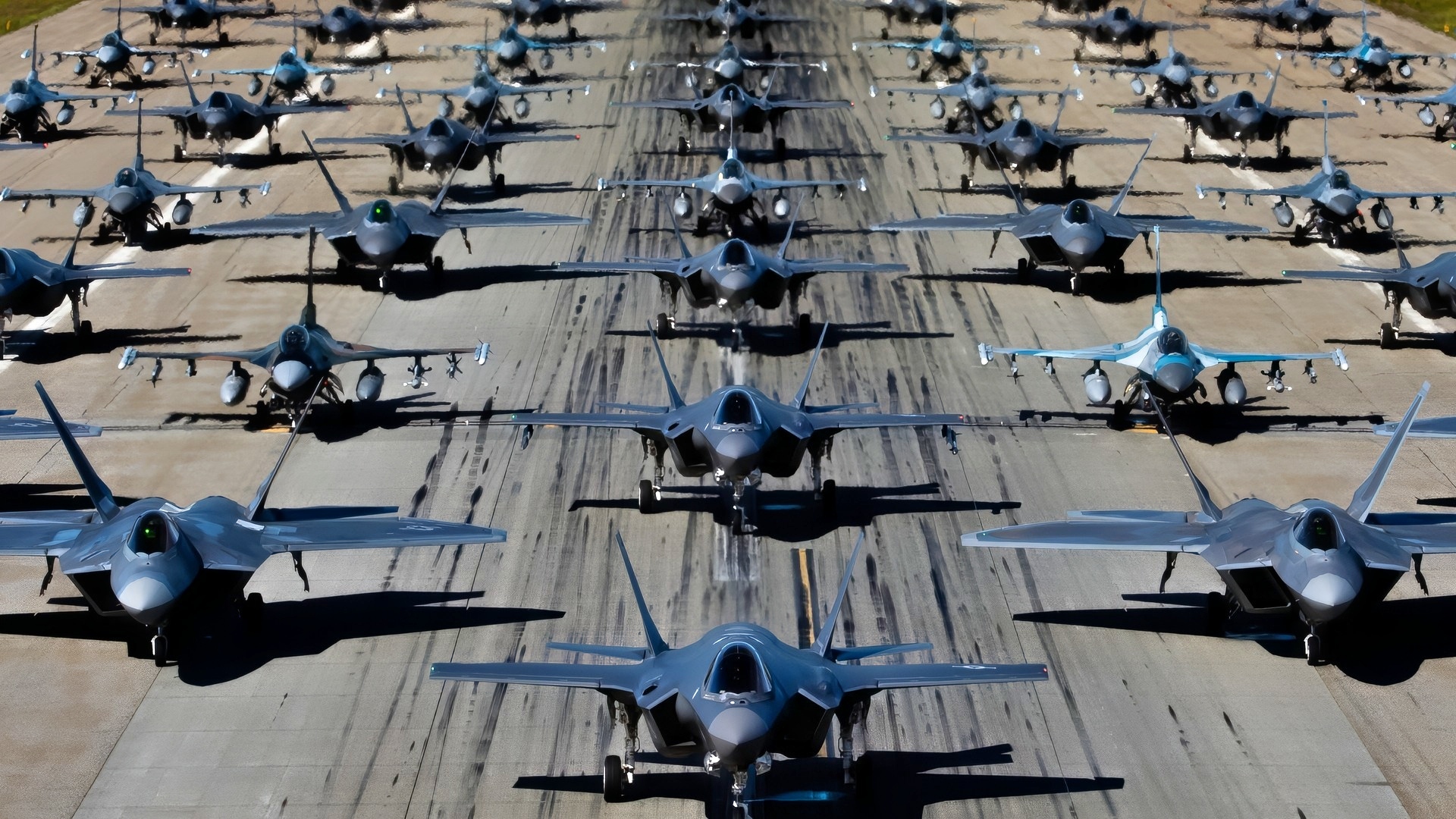
On May 6, 2025, the U.S. Air Force conducted one of the largest elephant walks seen at Kadena Air Base in Okinawa in recent years — a coordinated mass-launch demonstration featuring 25 F-35A Lightning II stealth fighters, 8 F-15E Strike Eagles, 6 KC-135 Stratotankers, an E-3G Sentry AWACS, an RC-135 Rivet Joint, two MQ-9 Reapers, six HH-60 Jolly Green II helicopters, and two U.S. Navy EA-18G Growlers, all backed by two U.S. Army Patriot missile batteries staged near the runway.
The U.S. Air Force Wants to Show China That The F-35 Is a Powerhouse Fighter That Means Business

F-22 and F-35 and the Flag. Image Credit: Creative Commons.

F-35I Adir Lockheed Martin Photography by Todd R. McQueen.
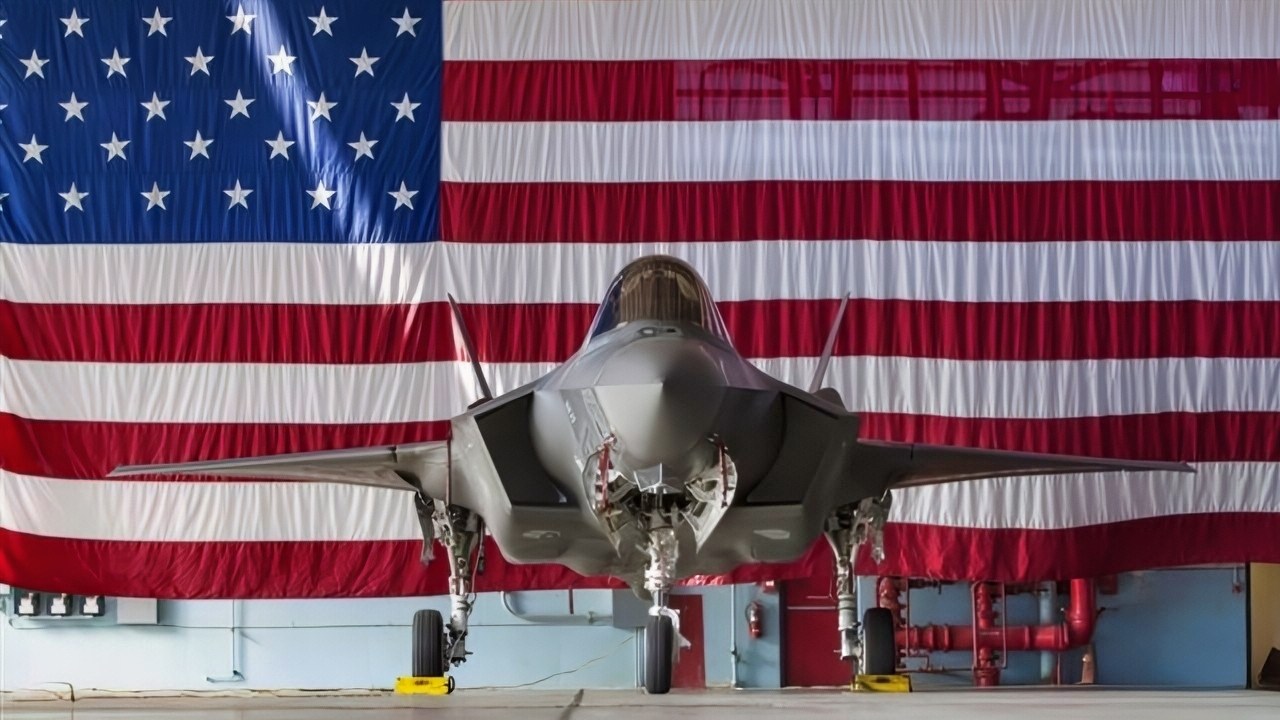
F-35 Fighter Image by Lockheed Martin
On May 6, 2025, Kadena Air Base in Okinawa, Japan, hosted one of the largest demonstrations of U.S. airpower seen in the Indo‑Pacific in recent years when it conducted a large‑scale elephant walk as part of a routine operational readiness exercise.
Kadena, often described as the “Keystone of the Pacific,” occupies a unique position, sitting closer to potential regional flashpoints than any other major U.S. air base. Because of its proximity to China, every exercise at Kadena carries special importance.
The elephant walk, which featured more than 50 aircraft and missile defense systems from the U.S. Air Force, U.S. Navy, and U.S. Army, was designed both to test real-world combat readiness and to communicate unmistakable resolve to allies and adversaries alike.
The Elephant Walk and Its Significance
The “elephant walk,” as it is commonly referred to, is a coordinated taxi of large numbers of aircraft in close sequence meant to simulate a rapid mass launch under wartime conditions.

F-16 Fighting Falcons assigned to the 114th Fighter Wing sit ready on the ramp while conducting an elephant walk at Joe Foss Field, South Dakota, July 2, 2025. The 114th Fighter Wing conducted an elephant walk to demonstrate its ability to project fighter airpower. (U.S. Air National Guard photo by Master Sgt. Luke Olson)
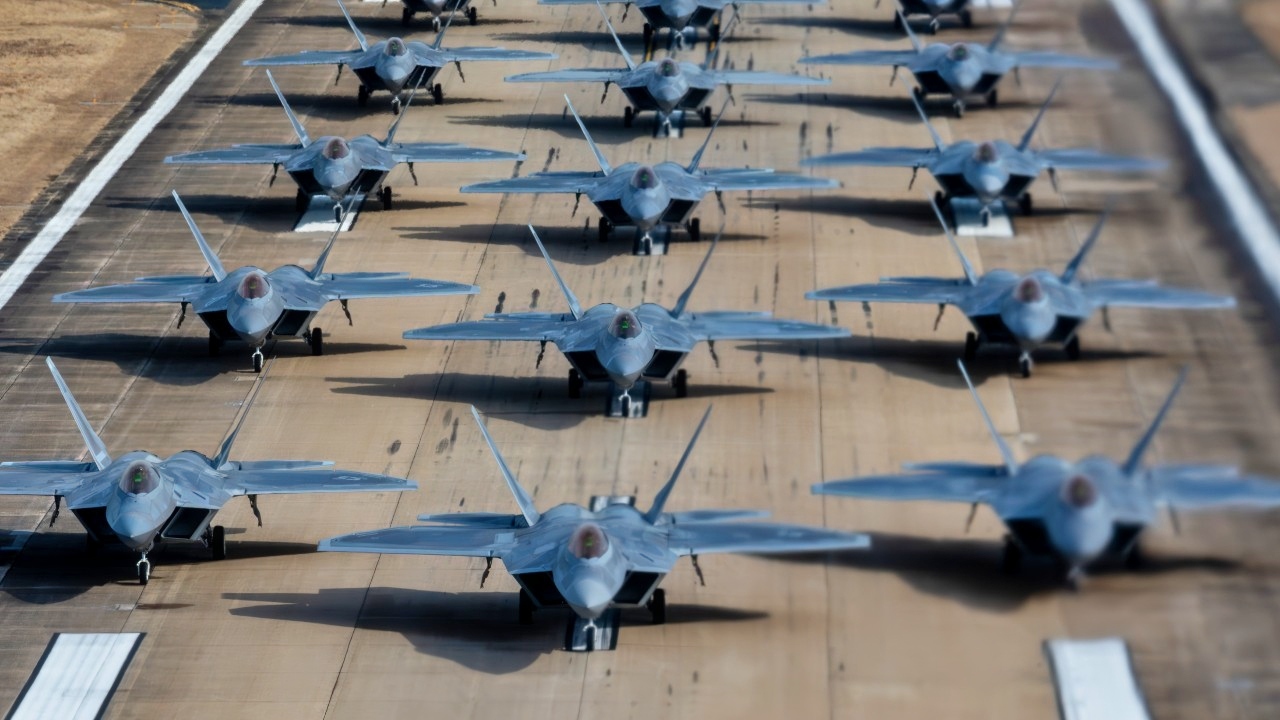
Aircraft from the 1st Fighter Wing conducted an Elephant Walk at Langley Air Force Base, Jan. 31, 2025, showcasing the wing’s readiness and operational agility. This demonstration highlighted the wing’s capability to mobilize forces rapidly in high-stress scenarios. The wing’s fleet includes F-22 Raptors and T-38 Talons. As Air Combat Command’s lead wing, the 1 FW maintains unparalleled combat readiness to ensure national defense at a moment’s notice. (U.S. Air Force photo by SrA Ian Sullens)
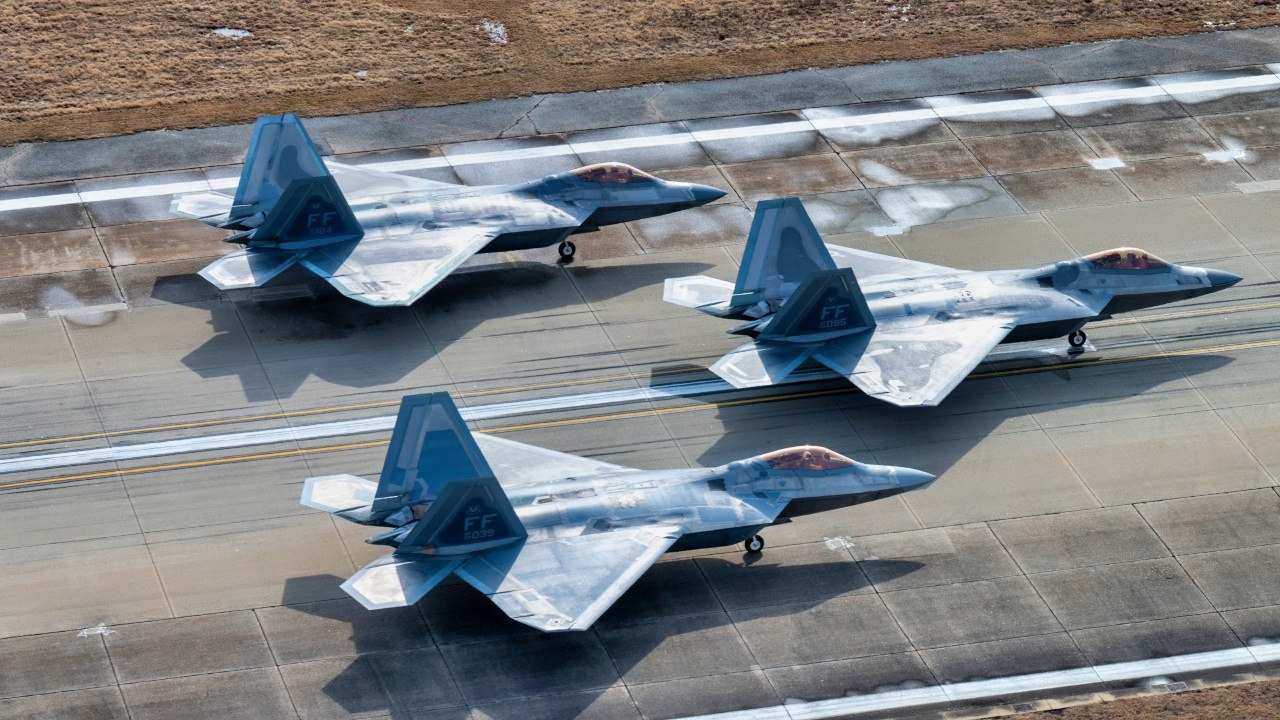
LANGLEY AIR FORCE BASE, Va. – F-22 Raptors from the 1st Fighter Wing sit in position on the runway fduring the Elephant Walk at Langley Air Force Base, Virginia, Jan. 31, 2025. The surge was designed to showcase the wing’s operational readiness and its ability to rapidly mobilize airpower. The 1st FW operates F-22 Raptors and T-38 Talons, maintaining combat capabilities that enable the U.S. Air Force to execute missions across the globe. With a focus on air superiority, the 1st FW plays a critical role in defending the nation’s interests. (U.S. Air Force photo by Tech Sgt. Matthew Coleman-Foster)
The practice was implemented during the Cold War to simulate rapid launches of strategic aviation, but it is now mostly a symbolic display. Such exercises show off the base’s ability to synchronize aircrews and runway operations to generate maximum combat power in minimal time.
At Kadena, the scope of the lineup was especially significant because nearly every component required for a modern air campaign was present, including fighters and tankers, intelligence platforms, rescue helicopters, and ground-based air defense systems.
F-35s on Parade
What was most interesting about this particular elephant walk was the assembly of F-35A fifth-generation stealth fighters.
Twenty-five F-35s in total were present at this exercise along with numerous others, making it one of the largest elephant walks in recent history. These fifth-generation aircraft were the largest single contingent in the formation and underscored the aircraft’s importance in the USAF’s broader fighter network.
Unlike earlier generations of fighters, the F‑35 is not defined solely by speed or maneuverability, but by its ability to gather, fuse, and distribute information across a wide battlespace.
Its advanced sensors combined with its low-observable design allow it to penetrate contested airspace, detect threats, and share targeting data with other aircraft and units in real time. In the context of the Indo‑Pacific, where potential adversaries have invested heavily in long-range missiles and layered air defenses, those capabilities are essential.
The presence of so many F‑35As at Kadena AB is a clear example of how the U.S. Air Force operates forward bases in the region. Rather than permanently stationing a single fighter type, Kadena now hosts rotating units from stateside bases such as Hill Air Force Base and Eielson Air Force Base.
This rotational model might seem insignificant, but it complicates adversaries’ planning while ensuring that aircrews remain familiar with operating in the Pacific’s unique environment. In other words, the F‑35s were showing off the Air Force’s ability to rapidly concentrate advanced combat power at a forward location on short notice.
The F-15E: America’s Premier Strike Fighter
Accompanying the F-35s were eight F‑15E Strike Eagles, deployed to Kadena AB from Seymour Johnson Air Force Base.
The F‑15E is a very different kind of aircraft from the F‑35, but one that remains indispensable for the Air Force. Designed as a dual‑role fighter with a dedicated pilot and weapons systems officer, the Strike Eagle excels at delivering large payloads of precision-guided munitions over long distances.
Its range, payload capacity, and proven combat record make it particularly valuable in the vast expanses of the Pacific theater, where targets may be widely dispersed and heavily defended.Taken together, the F-35 and the F-15E are some of the heaviest hitters in the Air Force’s fighter inventory, capable of bringing mass and persistence once access to contested airspace has been established.
The F-15E’s precedence is a reminder that, even with the advent of stealth fighters, fourth-generation aircraft remain relevant in contemporary warfare. The Strike Eagle’s adaptability and continual upgrades have allowed it to remain relevant decades after its introduction, and its appearance at Kadena established that relevance quite clearly.
Unmatched Airpower: Sending a Strong Signal
The fighter component was only one part of the massive elephant walk. The fighters were accompanied by six HH-60 Jolly Green IIs, two MQ-9 Reapers, two MC-130J Commando IIs, six KC-135 Stratotankers, an RC-135 Rivet Joint, and an E-3 G Sentry, along with two U.S. Navy EA-18 Growlers and a P-8 Poseidon. Meanwhile, on the ground, two U.S. Army Patriot missile batteries were positioned near the runway, providing air defense.
It was a full show of force from the U.S. Armed Forces. “The diversity of capabilities is a testament to the lethality Kadena AB can leverage to deter adversarial aggression in the Indo-Pacific region,” a spokesperson from Kadena AB explained.
The decision to conduct this exercise on Kadena AB also carries significant weight. Kadena AB sits within China’s first island chain, a stretch of territory critical to controlling access to the Western Pacific.
By demonstrating its ability to generate dozens of sorties across multiple mission sets, the U.S. military sent a deterrence message to any potential adversary considering coercive action in the region. “Working alongside our allies and partners, Kadena stands ready to project airpower throughout the region to ensure a free and open Indo-Pacific,” said Brig. Gen. Nicholas Evans, 18th Wing commander. As Evens suggested, the elephant walk was not only a symbol of deterrence but also of the U.S. commitment to its allies in the region.
About the Author: Isaac Seitz
Isaac Seitz, a Defense Columnist, graduated from Patrick Henry College’s Strategic Intelligence and National Security program. He has also studied Russian at Middlebury Language Schools and has worked as an intelligence Analyst in the private sector.


