
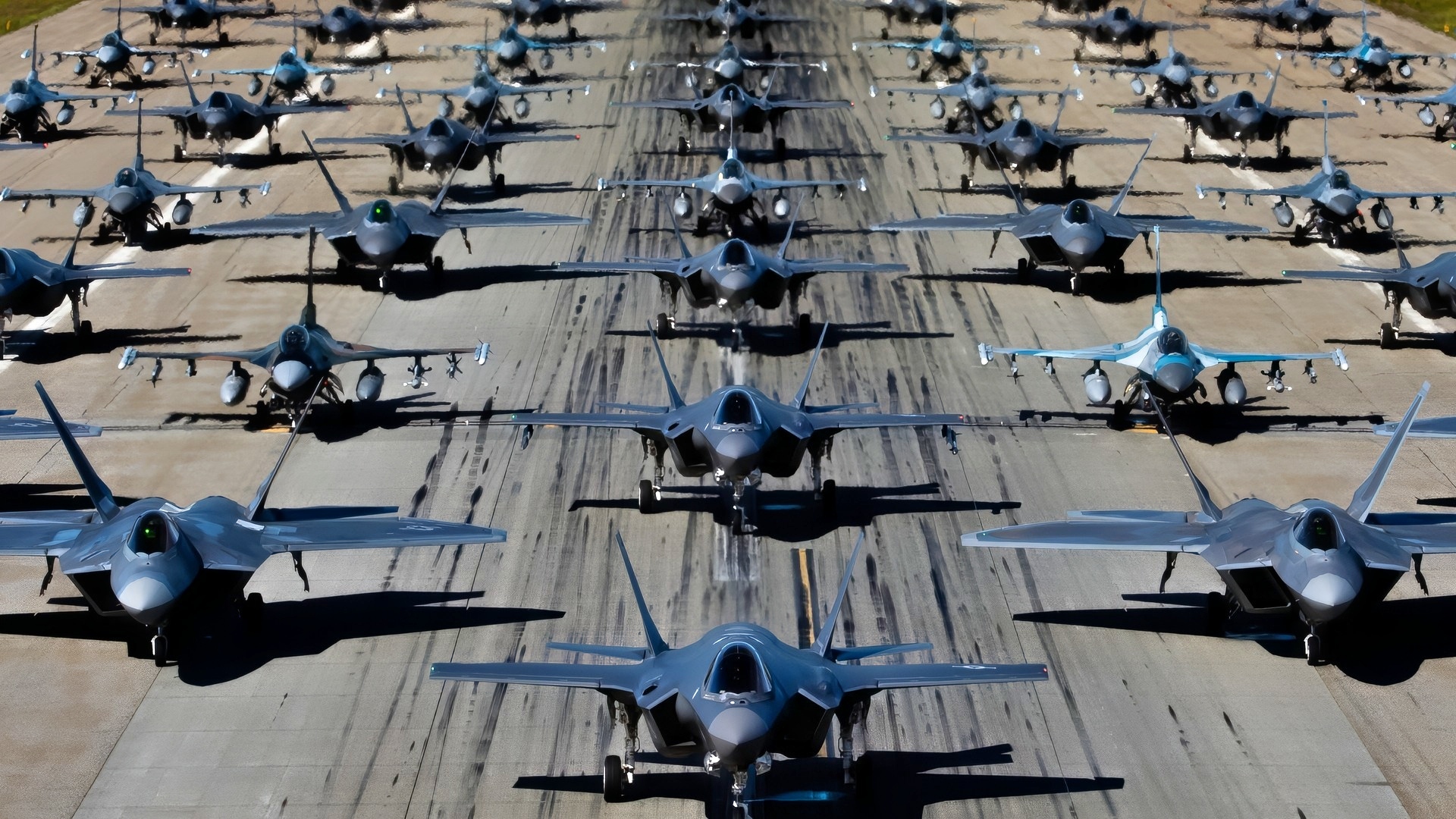
Key Points and Summary – On May 6, 2025, the U.S. Air Force’s 18th Wing at Kadena Air Base, Japan, conducted a massive “elephant walk” that “almost nobody covered.”
-The demonstration, a “direct message to China,” involved over 50 aircraft, including 24 F-35As, F-15Es, Navy EA-18 Growlers, and U.S. Army Patriot missile batteries.

Aircraft from the 1st Fighter Wing conducted an Elephant Walk at Langley Air Force Base, Jan. 31, 2025, showcasing the wing’s readiness and operational agility. This demonstration highlighted the wing’s capability to mobilize forces rapidly in high-stress scenarios. The wing’s fleet includes F-22 Raptors and T-38 Talons. As Air Combat Command’s lead wing, the 1 FW maintains unparalleled combat readiness to ensure national defense at a moment’s notice. (U.S. Air Force photo by SrA Ian Sullens)

F-16 Fighting Falcons assigned to the 114th Fighter Wing sit ready on the ramp while conducting an elephant walk at Joe Foss Field, South Dakota, July 2, 2025. The 114th Fighter Wing conducted an elephant walk to demonstrate its ability to project fighter airpower. (U.S. Air National Guard photo by Master Sgt. Luke Olson)
-This joint-service display was designed to signal operational readiness and the U.S.’s ability to rapidly mobilize its “integrated air and missile defense” from a key strategic base inside the first island chain.
-Base leadership stated the exercise showed adversaries that U.S. forces are “united, capable, and ready.”
The Kadena Elephant Walk the Media Missed
On May 6, 2025, at Kadena Air Base in Okinawa, Japan, the U.S. Air Force put on one of the most impressive shows of airpower in recent memory – and almost nobody covered it.
More than 50 U.S. aircraft rolled down the runway together, wingtip to wingtip, in what’s known as an “elephant walk.”
And it wasn’t just for show. In fact, this elephant walk—and all others like it—was a method of ensuring that American aircraft were ready to fly in large numbers. And it’s not just the U.S. Air Force that watched, either.
The world’s militaries were watching, and our adversaries knew that American forces were ready to act. It was significant, despite the lack of media coverage, because of where it happened: this was a direct message to China.
What Is An Elephant Walk?
The term “elephant walk” refers to a large number of military aircraft taxiing in close formation just before take-off, signaling to adversaries rapid sortie generation, readiness to launch, and coordination. It’s also designed to signal that a force’s maintenance logistics are in order. The exercise has, as mentioned, two overlapping purposes.
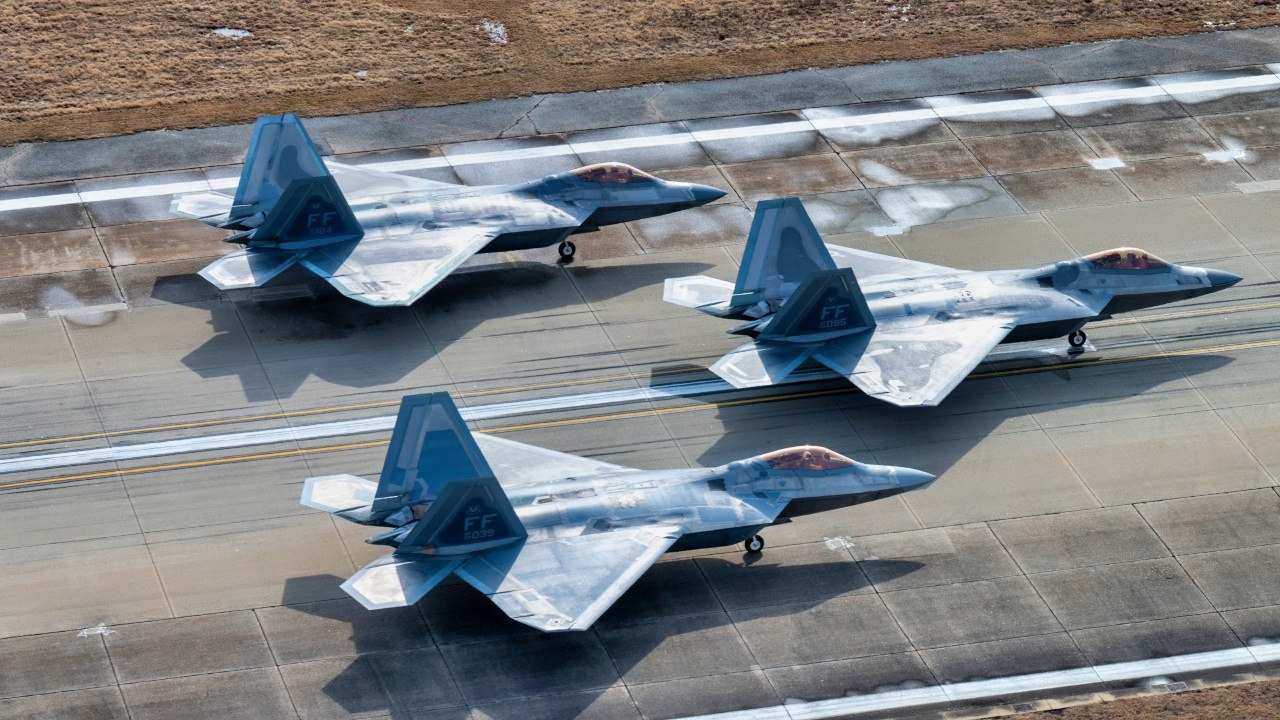
LANGLEY AIR FORCE BASE, Va. – F-22 Raptors from the 1st Fighter Wing sit in position on the runway fduring the Elephant Walk at Langley Air Force Base, Virginia, Jan. 31, 2025. The surge was designed to showcase the wing’s operational readiness and its ability to rapidly mobilize airpower. The 1st FW operates F-22 Raptors and T-38 Talons, maintaining combat capabilities that enable the U.S. Air Force to execute missions across the globe. With a focus on air superiority, the 1st FW plays a critical role in defending the nation’s interests. (U.S. Air Force photo by Tech Sgt. Matthew Coleman-Foster)
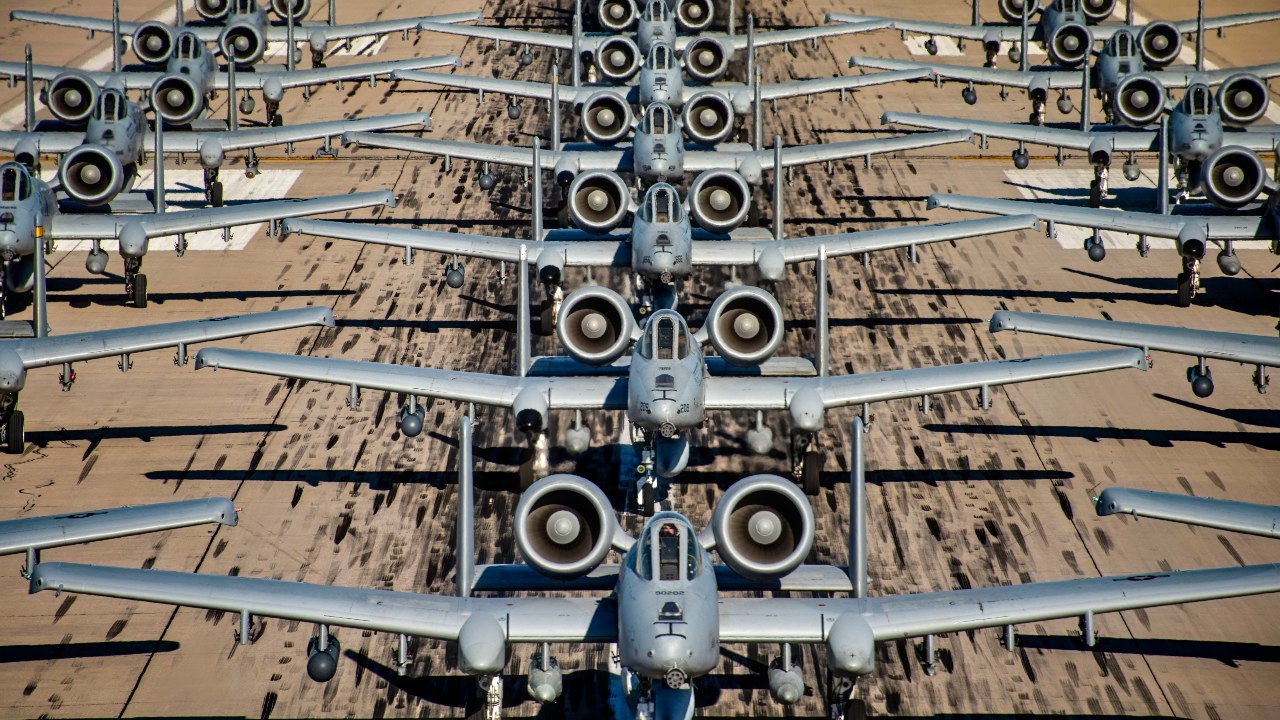
U.S. Air Force A-10 Thunderbolt IIs and an HC-130J Combat King II assigned to the 355th Wing taxi in formation on the runway at Davis-Monthan Air Force Base, Arizona, Feb. 9, 2022. The 355th Wing maintains and operates A-10 Thunderbolt IIs, HH-60G Pave Hawks and HC-130J Combat King IIs ensuring its Airmen and aircraft are ready to fly, fight and win. (U.S. Air Force photo by Senior Airman Alex Miller)
First is ensuring operational readiness. That means Air Force pilots and support crew are trained to launch as many aircraft as quickly as possible in a wartime or contingency scenario. Secondly, it’s a form of deterrence signaling.
It shows adversaries—and allies—that the force can rapidly mobilize.
In the Indo-Pacific, U.S. and allied forces increasingly use these displays to demonstrate their ability to operate in contested or high-threat environments, thereby raising the cost of aggression for adversaries. Now more than ever, demonstrating to China that the West is prepared is essential—but at the same time, China is already well aware of the West’s capabilities and is rapidly developing its own in anticipation of a future conflict.
The term itself dates back to World War II, when bombers lined up so closely before takeoff that they looked like elephants marching in a line.
What Happened at Kadena
The 18th Wing executed the Kadena Air Base elephant walk which was particularly large. According to official U.S. Air Force sources, the formation included among others: 24 F-35A Lightning IIs, eight F-15E Strike Eagles, six HH-60 Jolly Green II helicopters, two MQ-9 Reapers, two MC-130J Commando IIs, six KC-135 Stratotankers, one TC-135 Rivet Joint, one E-3G Sentry, two U.S. Navy EA-18 Growlers, one Navy P-8 Poseidon and two U.S. Army MIM-104 Patriot batteries.
“Kadena Air Base brought together aircraft that regularly operate out of Kadena day in and day out from the U.S. Air Force and U.S. Navy, along with U.S. Army Patriot missile batteries for a single capabilities demonstration, highlighting the strength of America’s integrated air and missile defense and its commitment to joint operations,” an official statement reads.
18th Wing commander Brig Gen. Nicholas Evans added that “Kadena stands ready to project airpower throughout the region to ensure a free and open Indo-Pacific,” while Chief Master Sgt. Brandon Wolfgang explained the purpose of the elephant walk directly.
“An elephant walk like this sends a message you can’t ignore—it shows our Airmen, allies, and adversaries that we’re united, capable, and ready,” Wolfgang said. “This kind of teamwork and presence is exactly how we maintain deterrence in the Indo-Pacific.”
Why This One Mattered
Kadena sits at the center of the first island chain, a line of U.S. and allied positions stretching from Japan through Taiwan and the Philippines.
This line shapes China’s maritime strategy, and holding a joint display of more than 50 aircraft there sent a clear, visible reminder to China that America can project power deep into the Western Pacific.

F-22 Raptor Elephant Walk. Image Credit: Creative Commons.
What made this exercise unique, too, was its service integration – and here’s what that means: alongside Air Force F-35As and F-15Es were a rare, full-spectrum formation of military assets. These assets demonstrated readiness across the air, sea, and missile defense domains. What China and other adversaries saw was that if conflict erupts in the region, the United States can rapidly launch a coordinated operation directly from Okinawa.

B-2 Spirit stealth bombers assigned to Whiteman Air Force Base taxi and take-off during exercise Spirit Vigilance on Whiteman Air Force Base on November 7th, 2022. Routine exercises like Spirit Vigilance assure our allies and partners that Whiteman Air Force Base is ready to execute nuclear operations and global strike anytime, anywhere. (U.S. Air Force photo by Airman 1st Class Bryson Britt)
But major media outlets barely noticed – perhaps due to routine drill fatigue and global crises unfolding virtually everywhere. So while the media missed a trick, it likely wasn’t deliberate. And ultimately, a lack of media coverage doesn’t mean China didn’t see it. Beijing knows very well what the United States is capable of, and this elephant walk only reinforced it.
About the Author:
Jack Buckby is a British author, counter-extremism researcher, and journalist based in New York. Reporting on the U.K., Europe, and the U.S., he works to analyze and understand left-wing and right-wing radicalization, and reports on Western governments’ approaches to the pressing issues of today. His books and research papers explore these themes and propose pragmatic solutions to our increasingly polarized society. His latest book is The Truth Teller: RFK Jr. and the Case for a Post-Partisan Presidency.
More Military
China Has the Missiles to Sink U.S. Navy Aircraft Carriers, But Questions Remain
The P-51 Mustang Was the Best WWII Fighter
The U.S. Navy’s Great Aircraft Carrier Shortage of 2025 Won’t End
The Navy Isn’t Prepared For What’s Coming
Not Made in USA: The Vanguard-Class Missile Submarine Has Just 1 Mission


