


Australia’s HMAS Waller, a Collins-class diesel-electric submarine, ‘notionally’ sank a U.S. Navy nuclear-powered aircraft carrier in a wargame simulation and several escorts at the RIMPAC 2000 exercise. The Waller penetrated the carrier strike group’s defenses through patience, acoustic discipline, slow deliberate movements, and the natural advantages diesel-electric propulsion offers at low speed in the littorals. The Collins-class is 77.8 meters long, displaces 3,400 tons submerged, carries 58 crew, runs to 20 knots underwater on battery, and is armed with six 533mm torpedo tubes. The incident forced the U.S. Navy to reassess its anti-submarine warfare capabilities. The lesson — that cheap diesel submarines can defeat expensive nuclear carriers — still holds.
Australia’s Diesel Submarines Can Sink U.S. Navy Aircraft Carriers
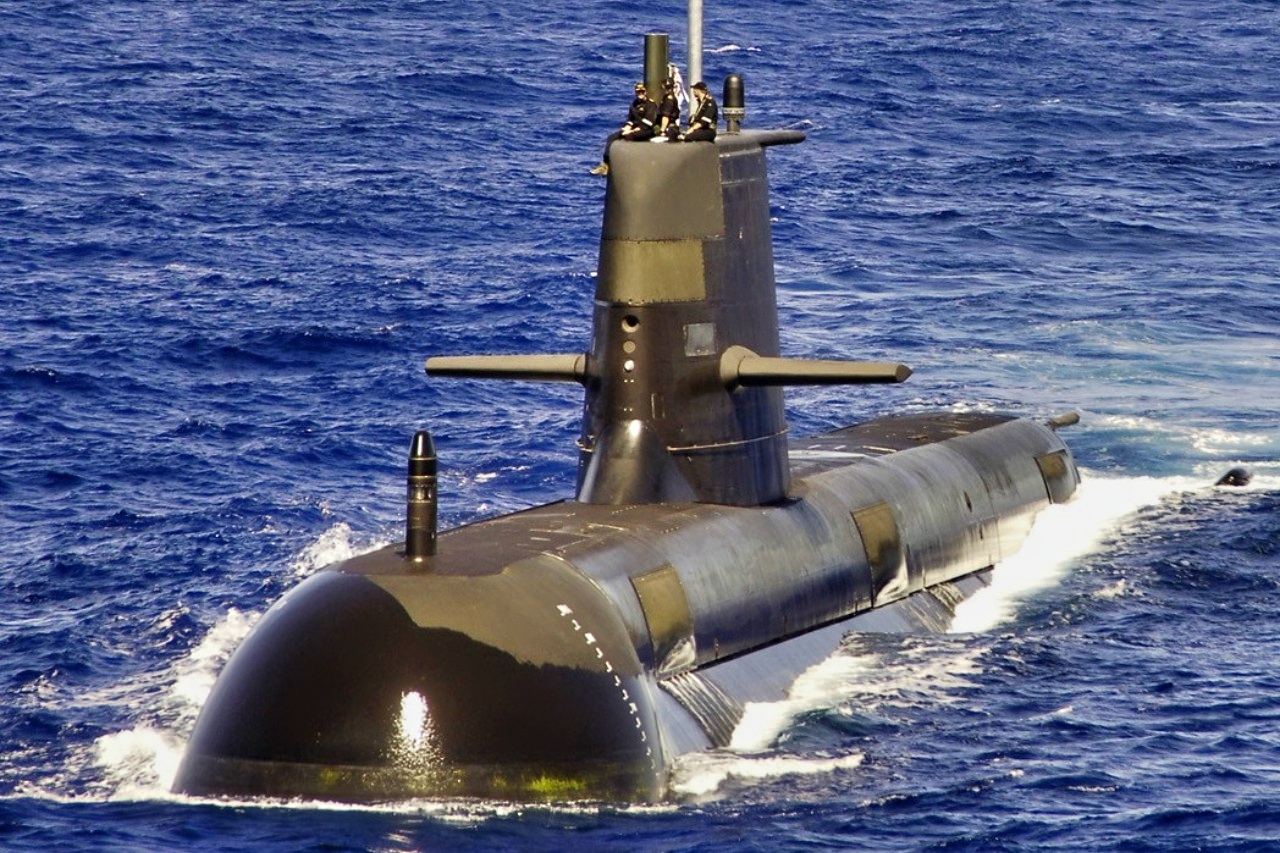
(July 25, 2006)- The Australian Submarine HMAS Rankin (Hull 6) and the Los Angeles Class attack submarine USS Key West (SSN-722) prepare to join a multinational formation with other ships that participated in the Rim of the Pacific exercise. To commemorate the last day of RIMPAC, participating country’s naval vessels fell into ranks for a photo exercise. RIMPAC includes ships and personnel from the United States, Australia, Canada, Chile, Japan, Peru, the Republic of Korea, and the United Kingdom. RIMPAC trains U.S. allied forces to be interoperable and ready for a wide range of potential combined operations and missions. Abraham Lincoln Carrier Strike Group are currently underway on a scheduled Western Pacific deployment. U.S. Navy photo by Mass Communications Specialist Seaman James R. Evans (RELEASED)
At the RIMPAC 2000 exercise, the HMAS Waller, a Collins-class submarine, scored simulated kills on US Navy assets. The target set reportedly included an aircraft carrier and various escorts. So how does a conventionally powered submarine penetrate one of the most advanced naval defenses in the world?
What Happened? A Cheap Sub Sinks an Expensive Nuclear Supercarrier
The Waller was tasked with serving as the opposing force (OPFOR) to penetrate a carrier strike group’s defenses.
To execute, the Waller evaded surface ships and ASW aircraft, then achieved a firing position and simulated a torpedo attack. In terms of the war game, the Waller “sank” multiple ships under exercise conditions. The incident demonstrated the vulnerability of even high-end naval formations.
Battery Stealth
The Waller pulled off the upset with diesel-electric propulsion, which is extremely quiet when operating on battery power, giving the Waller a stealth advantage. The exercise also took place in the littorals, which are shallow, complex waters—difficult sonar conditions—which gave the Waller further advantage.
During the exercise, the Waller was patient, with deliberate and slow movements and long-duration tracking, all while maintaining acoustic discipline. Eventually, the Waller got inside the CSG’s defensive perimeter; success was earned through stealth, not speed or firepower.
The incident forced the US Navy, the world’s most powerful, to reassess its ASW capabilities. The key lesson was that diesel submarines, though technically outdated, posed a serious threat.
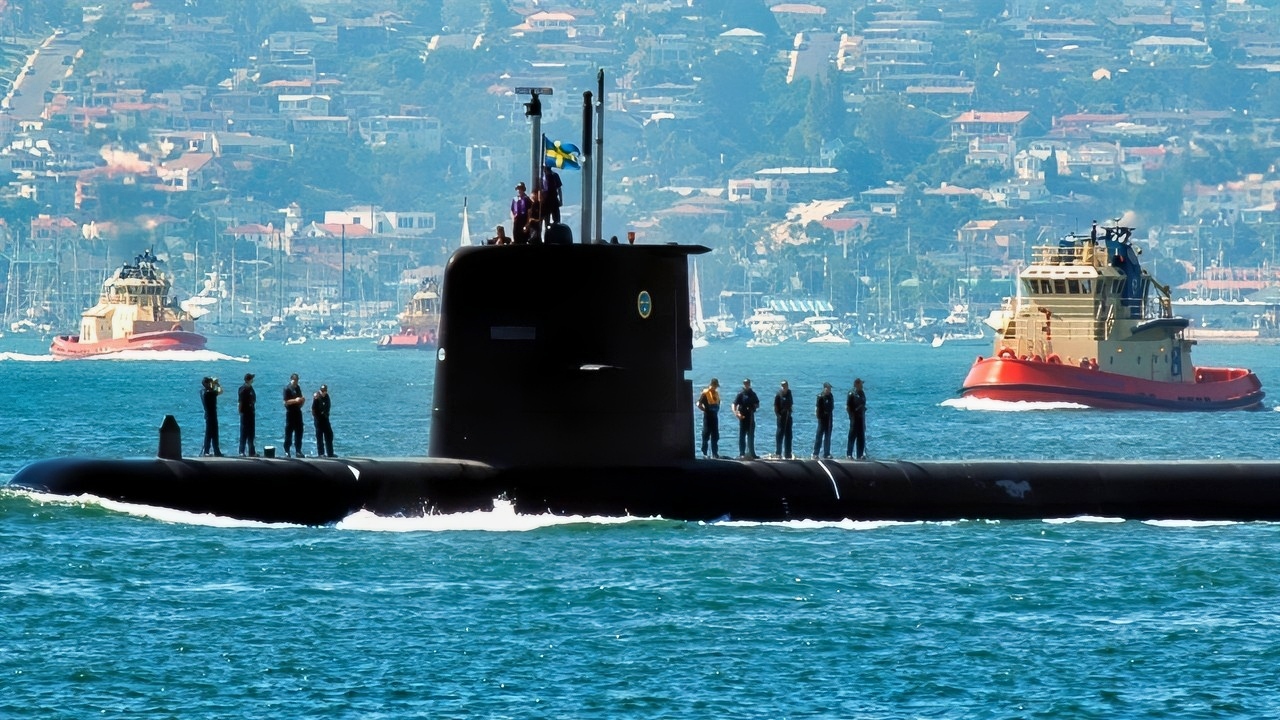
(Oct. 1, 2005) – The Swedish diesel-powered attack submarine HMS Gotland transits through San Diego Harbor during the “Sea and Air Parade” held as part of Fleet Week San Diego 2005. Fleet Week San Diego is a three-week tribute to Southern California-area military members and their families. U.S. Navy photo by Photographer’s Mate 2nd Class Patricia R. Totemeier (RELEASED)
The Collins-class Explained
The HMAS Waller is a Collins-class submarine. Measuring 77.8 meters long, the Collins displaces 3,400 tons when submerged. Using a diesel-electric propulsion system, the Collins operates on battery power when submerged and can achieve 10 knots at the surface or 20 knots submerged.
The submarine’s range is 11,000 nautical miles, well short of the unlimited range that a nuclear submarine offers.
The Collins sails with a crew of 58 personnel and carries six 533mm torpedo tubes capable of launching either torpedoes or anti-ship missiles.
The Collins is also outfitted with an advanced sonar suite offering a passive detection focus. In short, the Collins is designed for long-range, stealthy patrols rather than brute force.

Russian Kilo-Class Submarine. Image Credit: Creative Commons.
The design philosophy focuses on stealth; the operational concept is for an ambush platform.
This is optimal for the Indo-Pacific, which is defined by long distances. And though the Collins-class has less endurance than nuclear submarines, it is quieter in certain conditions. Essentially, the Collins gives Australia a regionally dominant platform rather than a tool for global power projection.
Persistent Problems
The Collins-class, however, has endured problems. Initially, engine reliability and noise concerns persisted; the combat system showed flaws.
The public perception of the submarine was negative; it was heavily criticized and mocked, and was generally considered a drain on resources.
But incremental upgrades and system refinements have transformed the Collins into a capable platform.
Diesel vs. Nuclear
While nuclear submarines are more prestigious, more expensive, and more heralded, the diesel-electric option does offer advantages.
For example, the diesel power plant is quieter at low speeds and harder to detect.
Of course, the nuclear option has unlimited endurance and a higher sustained speed, offering a true global platform. But the diesel sub is ideal for ambushes, making the platform optimal for navies with regional ambitions.
Strategic Implications
The RIMPAC 2000 incident demonstrated that carriers are vulnerable; even top-tier defenses can be penetrated.
And diesel-electric submarines represent an asymmetric threat, where cheaper subs pose a legitimate threat to expensive fleets and capital ships.
Many nations operate diesel subs; they are more affordable. So there is a proliferation risk. Despite immense investment in defensive technologies, undersea warfare remains one of the most dangerous domains.
In today’s strategic environment, the lessons from the Waller remain relevant, especially in the Indo-Pacific, where shallow seas and congested waterways favor quiet, conventional submarines.

P-8A Poseidon. Image Credit: Creative Commons.
For the US Navy, this fact underscores the importance of ASW capabilities, including sonar, unmanned systems, the P-8 Poseidon, and persistent surveillance.
And the Waller incident was hardly an anomaly; other diesel-electric submarines have felled US carriers under exercise conditions, meaning the Waller offered evidence of a broader trend in naval warfare: conventional submarines are dangerous, and vast asymmetries exist in which cheap platforms can do harm to expensive platforms.
MORE – The Dodge Durango of Submarine: The Virginia-Class Is Best on Planet Earth
About the Author: Harrison Kass
Harrison Kass is a writer and attorney focused on national security, technology, and political culture. His work has appeared in City Journal, The Hill, Quillette, The Spectator, and The Cipher Brief. He holds a JD from the University of Oregon and a master’s in Global & Joint Program Studies from NYU. More at harrisonkass.com.


