

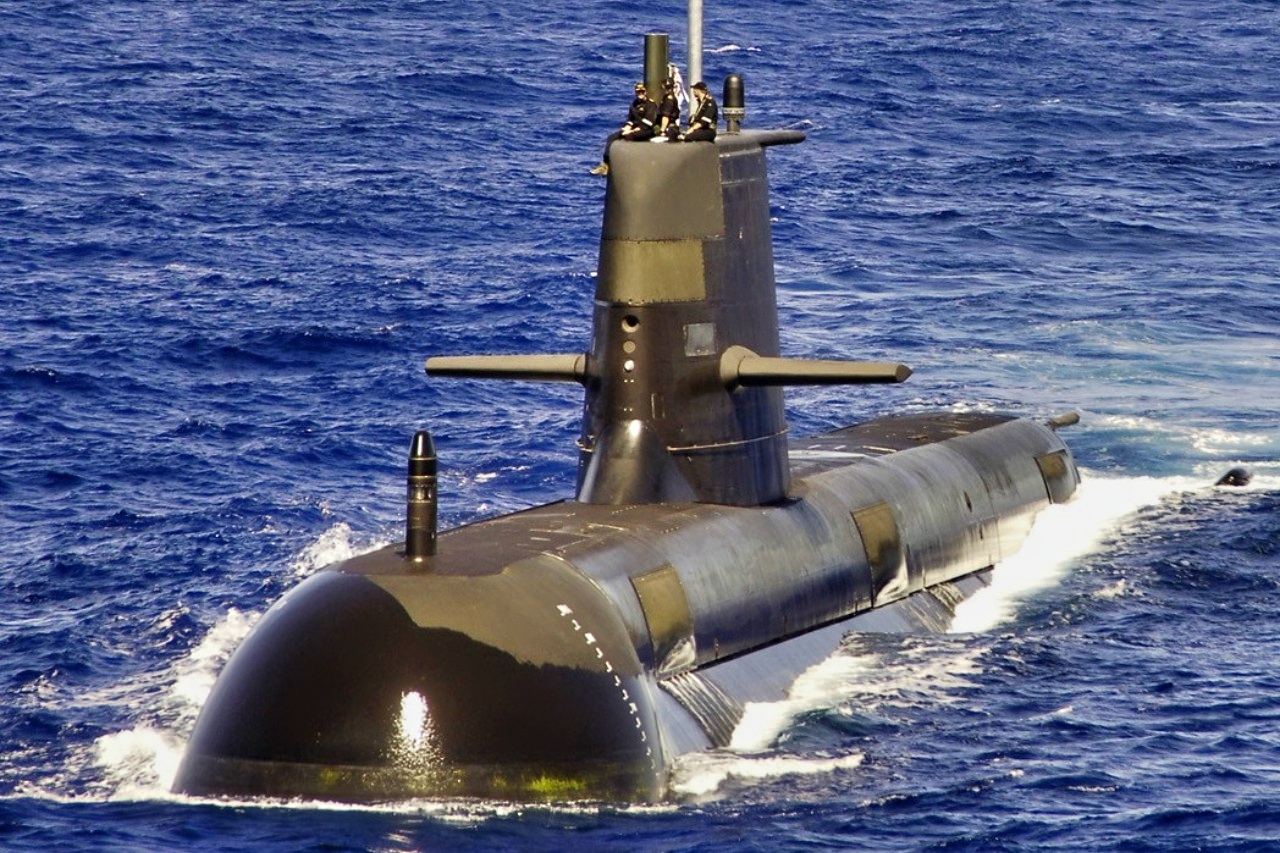
Key Points and Summary – Australia’s Collins-class submarine program, born from an ambitious desire for a regionally dominant undersea fleet, became a “national nightmare” and a multi-billion-dollar fiasco.
-The attempt to build a world-beating, indigenous submarine was plagued by a catastrophic cascade of failures.
-The boats were unacceptably loud, their American-supplied combat systems were riddled with bugs and would crash, and they suffered from a long list of defects, from unreliable engines to faulty periscopes.
-While the submarines are capable today after a decades-long recovery effort, their troubled development served as a strategic disaster for Australia for nearly 20 years.
Collins-Class in 4 Words: Australia’s Submarine Giant Disappointment
In the late 1980s, Australia embarked on one of the most ambitious and complex defense projects in its history.
With its aging fleet of Oberon-class submarines nearing the end of their service lives, Canberra sought a replacement that would represent a quantum leap in capability. The vision was for a regionally superior submarine, a silent predator that could dominate the vast and contested waters of the Indo-Pacific.
The result was the Collins-class, a program born of immense national pride and high technological ambition.
These six submarines were meant to be the cornerstone of Australia’s naval strategy, a potent symbol of a middle power determined to punch above its weight. They were designed to be the quietest, most advanced diesel-electric submarines in the world, a homegrown marvel that would guarantee Australia’s security for decades to come.
But it was not to be: the story of the Collins-class is not a tale of strategic triumph; it is a cautionary epic of what happens when national ambition collides with technical reality.
The program devolved into a national nightmare, a multi-billion-dollar fiasco plagued by a seemingly endless litany of design flaws, crippling defects, and operational failures that left Australia’s undersea warfare capability in tatters for years.
A Nation’s Ambition: The Quest for Regional Dominance
To understand the Collins-class, you must first understand the strategic anxiety that created it. In the 1980s, Australia looked out at a rapidly changing region. The Cold War was still simmering, and the proliferation of advanced Soviet-designed submarines throughout Southeast Asia was a growing concern. The Royal Australian Navy’s small fleet of British-designed Oberon-class boats, while reliable, were becoming obsolete.
Canberra’s vision was bold. Instead of buying a proven, off-the-shelf design, Australia would build its own submarine, tailored specifically to its unique operational requirements: long-range patrols across vast oceanic distances and ultra-quiet operation in the shallow, acoustically challenging waters of the littoral environment. The contract was awarded to the Australian Submarine Corporation, with a design based on a concept from the Swedish shipbuilder Kockums.
The hopes were immense. The Collins-class was to be a technological marvel. It would be larger and have a longer range than any conventional submarine of its day. It was to be fitted with a state-of-the-art American combat system, giving it a level of firepower and sensor capability that was unprecedented for a non-nuclear submarine. It was a program that was meant to showcase Australia’s industrial and technological prowess, a declaration that the nation had arrived as a serious player in the world of advanced defense manufacturing.
The Dream Becomes a Nightmare: A Cascade of Failures for Collins-Class
The problems began almost as soon as the first submarine, HMAS Collins, was launched in 1996.
The reality of integrating a Swedish-designed hull with an American combat system and a host of unproven Australian innovations proved to be a technical bridge too far. The program quickly became mired in a cascade of catastrophic failures that would have been almost comical if they weren’t so strategically devastating.
The most infamous and persistent problem was the noise. For a submarine, silence is life. The Collins-class was supposed to be one of the quietest submarines in the world. Instead, it was unacceptably loud. Early sea trials revealed a host of acoustic issues, from a noisy propeller that produced a distinctive cavitation signature to a flawed hull design that created a disruptive hydrodynamic flow. In the silent world of undersea warfare, the Collins was a clanging bell —a predator that could be heard from miles away.
But the problems didn’t stop there. The combat system—the submarine’s brain and central nervous system—was a disaster. The American-supplied system was riddled with software bugs and proved incapable of effectively integrating the submarine’s various sensors and weapons. Reports emerged of the system being unable to track multiple targets simultaneously, a fatal flaw in any modern combat environment. There were stories of the system crashing entirely in the middle of exercises, leaving the submarine blind and defenseless.
The list of defects grew to an almost unbelievable length. The diesel engines were unreliable and prone to failure. The periscopes were found to be defective. The backup generators were faulty. The torpedo tubes had welding defects. At one point, the entire fleet was effectively sidelined, with some boats tied up in port for years awaiting repairs and others deemed unfit for operational service. A scathing government report in 1999, known as the McIntosh-Prescott report, declared the submarines were not ready for operational deployment and that the program was in deep crisis.
A Long and Painful Recovery for Collins-Class
To its credit, the Royal Australian Navy and the Australian government did not abandon the program.
Over the last two decades, they have poured billions of additional dollars into a painstaking and arduous recovery effort. The noisy propellers were redesigned. The combat system was completely replaced with a more reliable and effective version. The diesel engines were rebuilt. Slowly, painstakingly, the myriad defects were identified and rectified.
Today, the Collins-class submarines are, by most accounts, a capable and effective platform. The lessons learned from their troubled birth have been hard-won, and the boats are now a key part of Australia’s naval forces. But the strategic cost of their failure has been immense. For nearly two decades, Australia’s submarine capability was a shadow of what it should have been, a hollow force that could not meet the nation’s strategic needs.
The saga of the Collins-class is a cautionary tale. It is a story of how national pride and technological overreach can lead to strategic disaster. It is a reminder that in the complex world of defense procurement, the gap between ambition and reality can be a dangerous and expensive chasm.
Australia wanted a world-beating submarine; for a long time, what it got was a national embarrassment and a strategic liability. And, of course, on deck: The AUKUS-SSN debate.
About the Author: Harry J. Kazianis
Harry J. Kazianis (@Grecianformula) is Editor-In-Chief and President of National Security Journal. He was the former Senior Director of National Security Affairs at the Center for the National Interest (CFTNI), a foreign policy think tank founded by Richard Nixon based in Washington, DC. Harry has over a decade of experience in think tanks and national security publishing. His ideas have been published in the NY Times, The Washington Post, The Wall Street Journal, CNN, and many other outlets worldwide. He has held positions at CSIS, the Heritage Foundation, the University of Nottingham, and several other institutions related to national security research and studies. He is the former Executive Editor of the National Interest and the Diplomat. He holds a Master’s degree focusing on international affairs from Harvard University.
Military Affairs
China’s Stealth Air Force Has 1 Mission


