

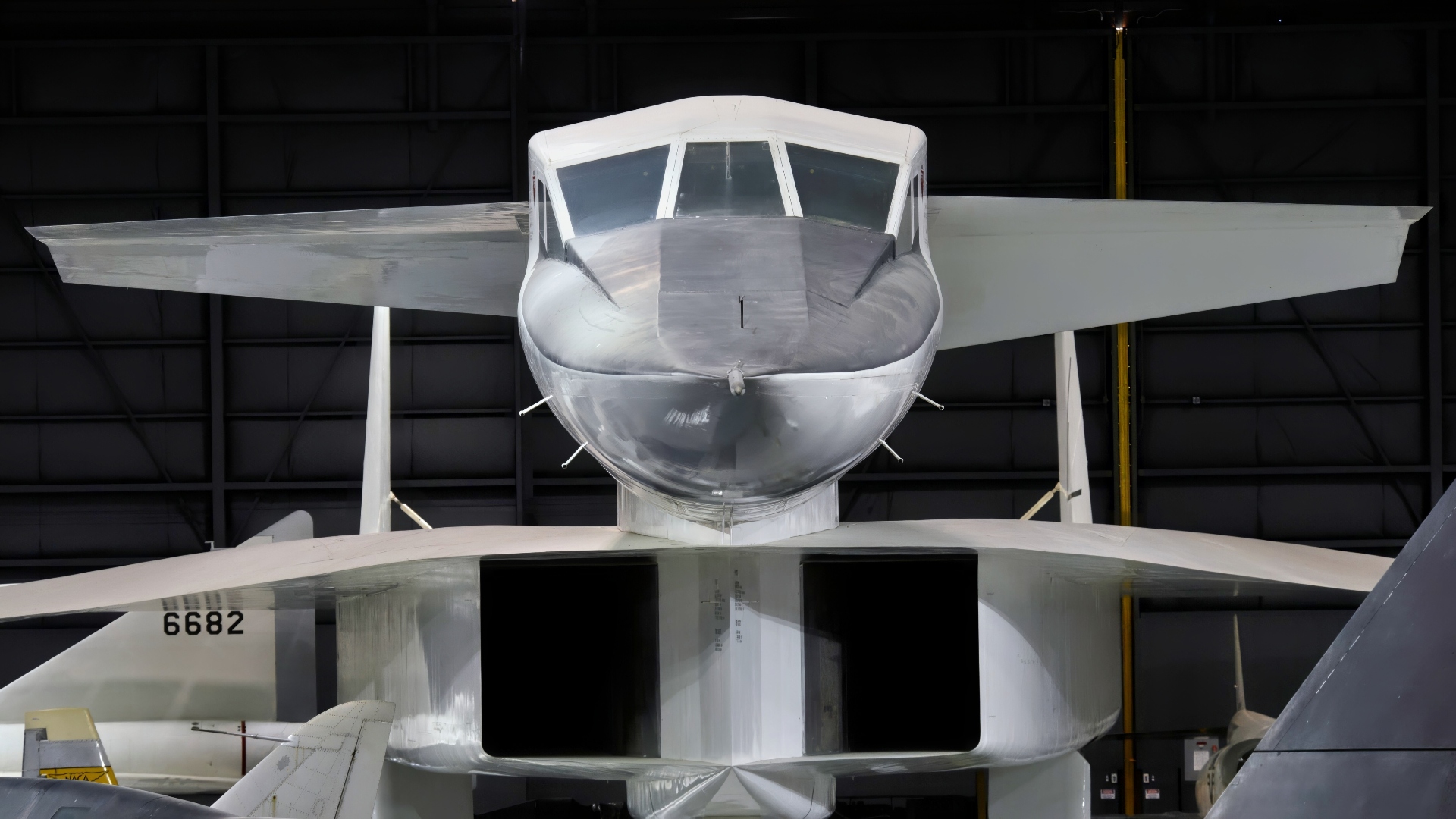
The Air Force commissioned the XB-70 Valkyrie in the late 1950s to drop nuclear bombs from Mach 3 at 70,000 feet. North American Aviation built only two prototypes. Six General Electric turbojets generated 600°F skin temperatures during Mach 3 flight. The Valkyrie used stainless steel honeycomb and titanium construction. The first supersonic flight came in October 1964. On June 8, 1966, during an unauthorized photoshoot for General Electric, an F-104 Starfighter drifted into the XB-70’s wingtip. The Valkyrie’s own wake vortex had pulled the F-104 into a roll. Both aircraft were destroyed. The co-pilot and the F-104 pilot were killed. Soviet SAMs and emerging ICBMs made the high-speed bomber doctrine obsolete. The program was canceled.
The XB-70 Valkyrie Mach 3 Bomber Failure

XB-70 In Flight. Image Credit: Creative Commons.

XB-70 in Dayton, Ohio Air Force Museum. Image Credit: National Security Journal.
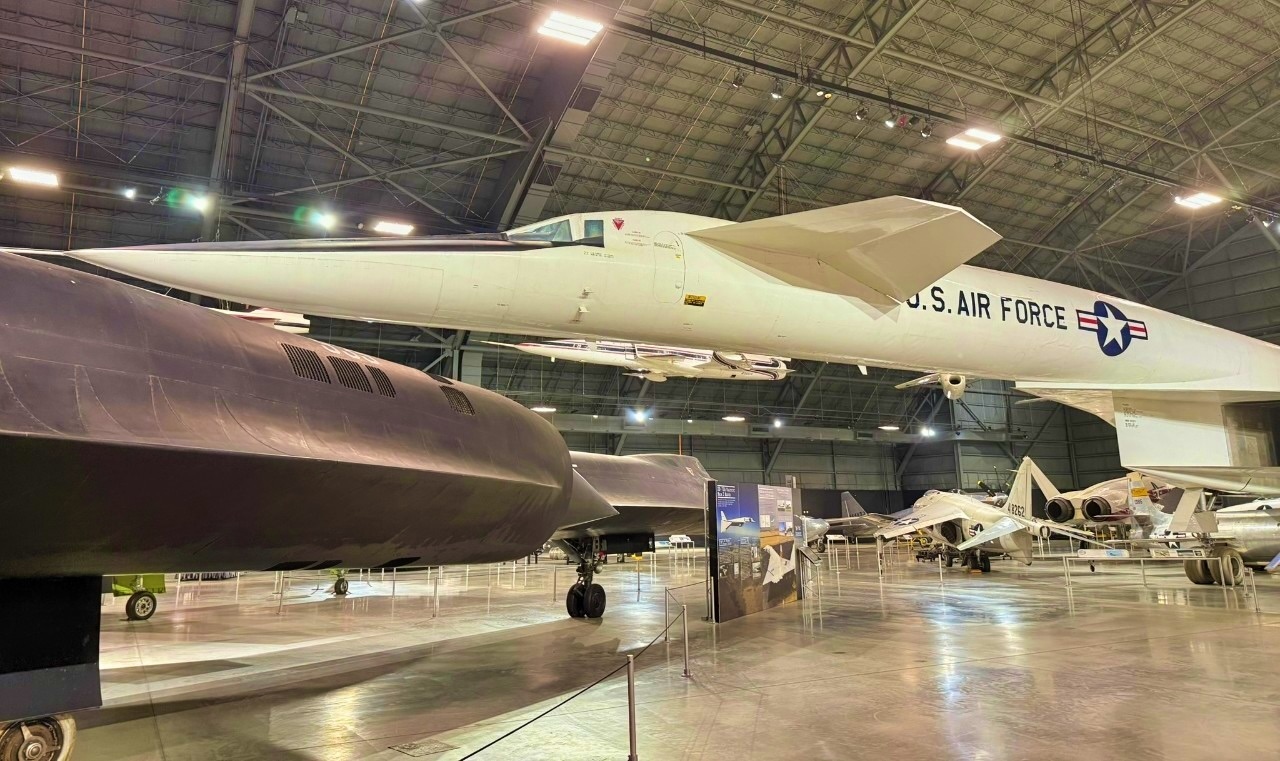
XB-70 Up Close @ U.S. Air Force Museum. Image Credit: Harry J. Kazianis/National Security Journal.
The 1950s and 60s were a time of experimentation and innovation in the American Aerospace industry. Multiple unconventional designs were proposed, but very few would make it past the drawing board.
One design that managed to take flight was the XB-70 Valkarie. This experimental aircraft was intended to be a high-altitude supersonic bomber that could quickly penetrate soviet airspace before dropping its nuclear payload. Only two prototypes were built before the program was canceled, one of which would later be destroyed in a catastrophic midair collision.
Development of the XB-70
Development of the XB-70 began in the 1950’s as the U.S. pursued a new type of nuclear bomber. According to research conducted by Boeing and the Rand Corporation, future nuclear bombers would have to be supersonic in order to escape their own blast radii (keep in mind this was before the development of airborne nuclear missiles).
The new bomber would need to meet dramatically higher performance requirements, including sustained flight at speeds exceeding Mach 3 and altitudes above 70,000 feet. These ambitious specifications were based on the belief that speed and altitude alone could provide sufficient protection against interception and missile threats.
North American Aviation was selected to design and build the aircraft, resulting in the XB-70 Valkyrie, a futuristic and unconventional-looking aircraft. The aircraft’s slender fuselage, long pointed nose, and large delta wing gave it an unmistakable appearance. One of its most notable features was its variable-geometry wingtips, which could be angled downward during high-speed flight.

XB-70. Image Credit: Creative Commons

XB-70 Bomber U.S. Air Force.
This design element, aside from giving it a cool, futuristic look, also played a vital role in the aircraft’s aerodynamic profile. At supersonic speeds, the downward-angled wingtips helped confine the high-pressure air beneath the wings, increasing lift through a phenomenon known as compression lift. This allowed the aircraft to ride on its own shockwave, improving efficiency and stability at extreme speeds.
Specs and Capabilities
Powering the Valkyrie were six General Electric YJ93-GE-3 turbojet engines, mounted in pairs beneath the rear portion of the aircraft.
These engines provided the immense thrust required to achieve and sustain Mach 3 flight, enabling the XB-70 to reach speeds of more than 2,000 miles per hour.
At Mach 3, friction between the aircraft and the surrounding air generated temperatures exceeding 600 degrees Fahrenheit across large portions of the airframe. To withstand these conditions, engineers employed advanced materials such as stainless steel honeycomb panels and titanium, ensuring the aircraft could maintain structural integrity during prolonged high-speed flight.
The Valkyrie also incorporated highly advanced avionics and control systems for its time. While the XB-70 was never fitted with an air-to-air or air-to-ground radar, the aircraft’s computer systems were designed to provide stability in an environment where traditional aerodynamic behavior was pushed to its limits.
Pilots needed to manage not only speed and altitude but also the thermal expansion of the aircraft’s structure, making operations complex and demanding. Despite these challenges, the XB-70 demonstrated remarkable performance during testing, validating many of the innovative concepts integrated into its design.
The Flight (and Crash) of the Valkarie
The Valkarie took its first flight in September 1964 and achieved its first supersonic flight just a month later. With the wingtips lowered, the aircraft reached Mach 3.02, but its composite panels were damaged at these speeds, leading to a Mach 2.5 speed limit until the issues were addressed.
After improvements were implemented, the second prototype reliably flew at Mach 3 for more than 30 minutes. Even while the B-70 program was in peril, the XB-70 continued to fly in a joint USAF/NASA test flight. The data gathered from these flights would later influence the development of other aircraft, such as the SR-71 Blackbird and the B-1 Lancer.
On June 8, 1966, one of the prototype aircraft, XB-70A-2, was involved in a photoshoot at the request of General Electric. It flew in close formation with four other aircraft, one of them being the F-104 Starfighter.
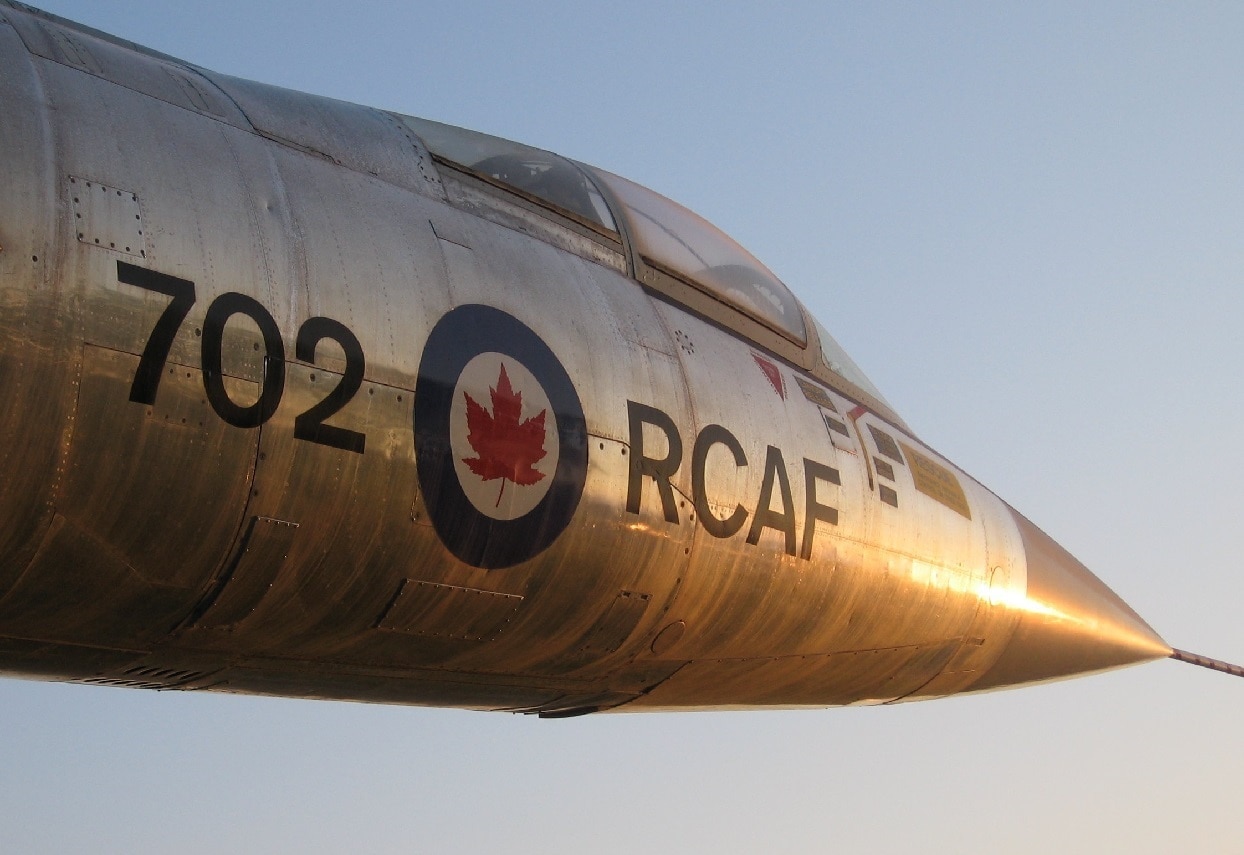
F-104. Image Credit: Creative Commons.
The F-104 then drifted into the right wingtip of the XB-70, striking the vertical stabilizers before violently exploding. The Valkarie then entered into an uncontrollable spin before it crashed.
As a result, the F-104 pilot, along with the XB-70’s co-pilot, was killed. A later investigation into the incident concluded that the Starfighter pilot was likely unable to perceive his motion relative to the Valkarie and that the wake vortex from the XB-70’s wingtip may have forced the F-104 to roll into the bomber.
All Air Force officials who oversaw the unauthorized photoshoot were either relieved from duty or heavily reprimanded.
Why the XB-70 Program was Canceled
Despite its groundbreaking design, the XB-70 program quickly became obsolete. Advances in Soviet air defense systems, particularly high-altitude surface-to-air missiles, reduced the effectiveness of the high-speed, high-altitude penetration strategy that had originally justified the aircraft’s development.
At the same time, intercontinental ballistic missiles were emerging as a more reliable and efficient means of delivering nuclear weapons.
These missiles could reach their targets faster and were far more difficult to intercept, diminishing the strategic value of manned bombers designed for extreme speed.
Financial considerations also contributed to the program’s decline. The XB-70 was extraordinarily expensive to develop and build, and its complexity made large-scale production impractical.
As priorities shifted within the Department of Defense, funding for the program was reduced, and plans for a full operational fleet were eventually abandoned.
Instead, the XB-70 was repurposed as a research platform, allowing engineers and scientists to gather data on high-speed flight and advanced aerodynamics.
About the Author: Isaac Seitz
Isaac Seitz, a Defense Columnist, graduated from Patrick Henry College’s Strategic Intelligence and National Security program. He has also studied Russian at Middlebury Language Schools and has worked as an intelligence Analyst in the private sector.


