

Ukraine has spent the early summer methodically choking off Crimea, hitting the fuel depots, the rail bridges, the ferry terminals, and the supply routes that keep the peninsula running, and the effect is now impossible for Moscow to hide. Russian occupation authorities have rationed gasoline, brought in fuel vouchers, and watched the summer tourist season collapse. Vladimir Putin’s options for hitting back are real, but they are also narrower than the Kremlin’s rhetoric suggests, and most of them are versions of things Russia is already doing without decisive effect.
The harder truth for Moscow is that the pressure in this fight is running toward Russia, not away from it, and the peninsula that Putin prizes above all his other conquests is the place where that pressure is hardest to relieve.
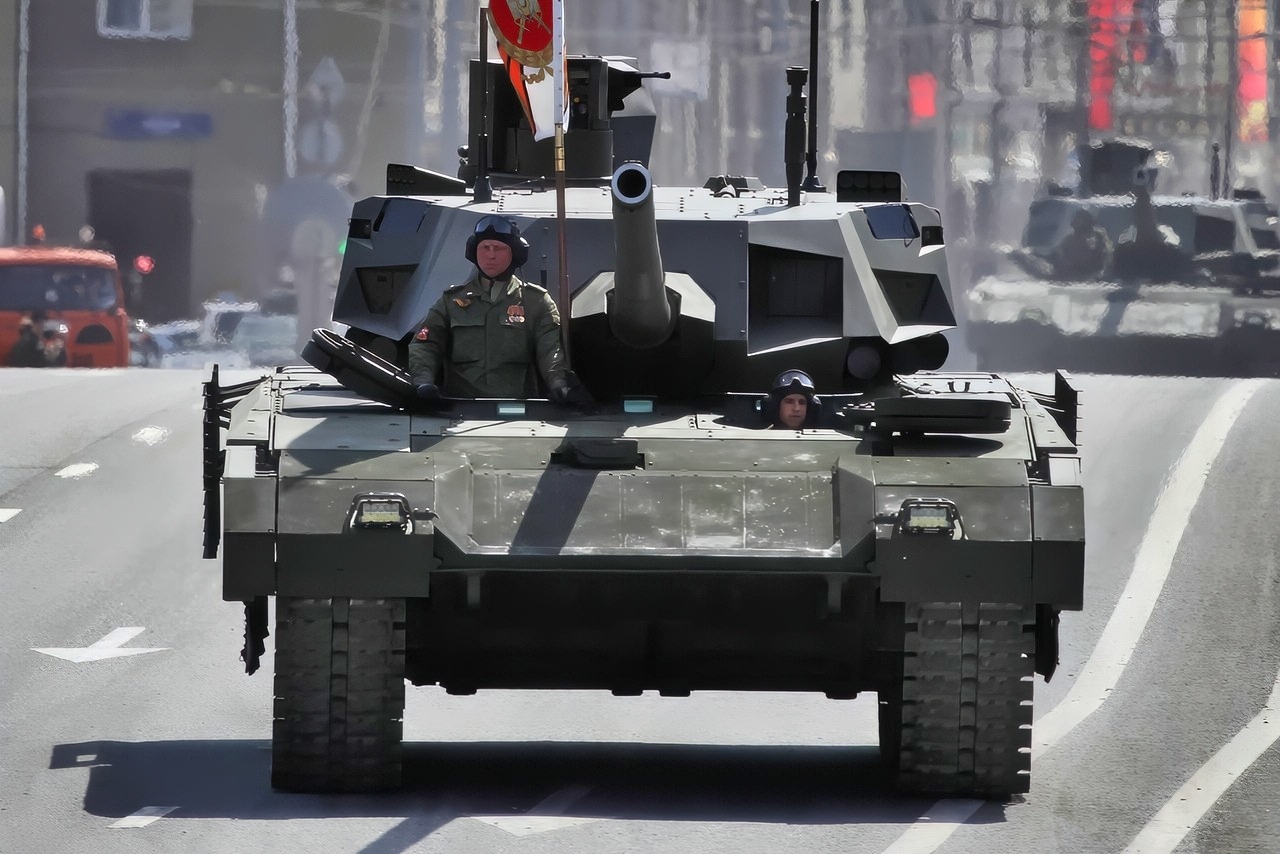
T-14 Armata Tank from Russia. Image Credit: Creative Commons.
The Crimea Fuel Crisis
What Ukraine has created on the peninsula is the worst fuel crisis Crimea has seen since Russia annexed it in 2014, and even the Kremlin has acknowledged the scope of the problem.
Russia supplies its forces and the civilian population there through three main channels: road and rail tankers over the Kerch Bridge, shipments by sea, and overland routes through the occupied parts of southern Ukraine.
Kyiv has been hammering all three. Moscow-installed authorities have tightened gasoline purchase limits week by week, and with fuel shipments over the Kerch Bridge long suspended for security reasons, supplies are increasingly carried by ferries that cannot move nearly enough to make up the gap.
Motorists who bring their own gasoline across the bridge are capped at 100 liters per vehicle, and speculators have been reselling fuel at double the market price.
The economic damage extends well beyond gas stations. Crimea drew nearly seven million tourists last year and had hoped to beat that figure, but the business daily Kommersant reported that close to 80 percent of hotel bookings were canceled in late May and early June, with some hotels offering gasoline as a booking incentive. The campaign behind this is deliberate and named.
Ukraine’s military calls it a logistics lockdown, built around medium-range drones striking targets at operational depth, and Defense Minister Mykhailo Fedorov said in mid-June the goal is to turn the peninsula into an island, cut off from the Russian mainland.
Recent strikes have hit oil depots in Kerch, an electrical substation in the west, a liquefied natural gas station in Simferopol, and rail bridges, while Moscow-installed officials reported civilian casualties from some of the attacks, including four people killed in one June drone strike.

Main battle tank T-14 object 148 on heavy unified tracked platform Armata. Image Credit: Creative Commons.
Why Defending Crimea Is So Hard
The reason Russia cannot simply shield the peninsula is a matter of arithmetic that is moving against it.
Ukraine’s air force and drone units have been steadily grinding down Russia’s air defenses, with Kyiv’s defense ministry reporting it has destroyed 1,447 Russian air defense systems over the course of the war, even as Ukrainian long-range drone strikes have jumped from around 110 in 2024 to more than 3,000 already this year.
Russia cannot replace those systems fast enough, and every battery it moves to protect Crimea is one not defending somewhere else.
The geography compounds the problem. The supply routes Russia depends on are long, fixed, and exposed, and the Kerch Bridge, Putin’s prized piece of infrastructure, has been hit repeatedly since the 2022 truck bombing and is no longer usable for fuel. Ukraine has also crippled Russia’s Black Sea Fleet over the course of the war, sinking multiple warships and forcing Moscow to pull its remaining vessels back to Novorossiysk on the Russian mainland, which means the naval shield that once protected Crimea’s seaward approaches is itself diminished.
Russia’s actual response to the fuel squeeze so far has been defensive and economic rather than a knockout blow. Deputy Prime Minister Alexander Novak told Putin that officials were considering suspending diesel fuel exports to protect domestic motorists, on top of existing bans on gasoline and jet fuel exports, and refineries postponed scheduled maintenance.
Those are the moves of a government managing a shortage, and they come at a direct cost to the oil revenue Russia needs to fund the war.
Option One: Hit Ukraine, Harder
The most likely Russian response is the one Moscow reaches for by default, larger and more frequent long-range strikes on Ukrainian cities, the power grid, and the defense industry.
Russia has the largest missile and drone arsenal in the theater and can surge it, and a punishing strike on Kyiv carries obvious political signaling value.
The problem for Moscow is that this is precisely what it has been doing for more than four years without forcing Ukraine to capitulate, and the approach is now running into harder limits.
Russia’s missile stockpiles and monthly production are finite, Ukraine’s air defenses intercept a large share of each barrage, and Kyiv has been systematically striking the Russian plants that build the launchers and components for those very weapons. Hitting Ukraine harder hurts, but it does nothing to reopen the supply lines to Crimea, and it has not changed the trajectory of the war before.
A related option is the conventional use of a weapon meant mainly to frighten.
Russia first fired its Oreshnik intermediate-range missile at Ukraine in late 2024 and used it again in early 2026 against Lviv, strikes that caused limited physical damage but were widely read as signals to Ukraine’s Western backers.
As a way to terrorize and to remind NATO of Russian reach, it has value for Moscow. As a way to solve the Crimea problem, it does nothing.
Option Two: The Nuclear Signal
When Russia suffers visible humiliations, it tends to reach for its nuclear arsenal as a tool of pressure rather than destruction, and the pattern is well documented.
In May 2026, after Ukrainian drones forced Moscow to hold its Victory Day parade without military vehicles and then struck the capital directly, Russia ran a series of nuclear signaling steps, including a sudden strategic-forces exercise and an intercontinental missile test, that analysts assessed correlated with its battlefield setbacks. The German Council on Foreign Relations judged the odds of that exercise being a prelude to actual nuclear use as low from the outset.
This is what Russian nuclear behavior in this war has consistently been, signaling designed to deter direct Western intervention and support for Ukraine, not a genuine move toward the threshold.
The track record cuts against the threat’s credibility. Russia’s repeated nuclear saber-rattling has failed to break Ukraine’s will, and Ukrainian forces have done things once assumed to be unthinkable, including pushing into Russian territory during the 2024 Kursk offensive, without triggering any nuclear response.
The 2026 US intelligence assessment judges that Russia is very unlikely to use nuclear weapons in the conflict unless its leadership concluded it faced an existential threat to the regime itself, and a fuel crisis in Crimea, however embarrassing, is nowhere near that bar.
Crimea matters enormously to Putin’s prestige, but losing tourist revenue and rationing gasoline does not threaten the survival of the Russian state, and nothing in how Moscow has behaved suggests it would gamble the regime over the peninsula’s supply lines.
What This Actually Means
The honest assessment is that Russia’s menu of major-force responses to the Crimea squeeze is mostly more of what has not worked, applied harder.
It can bombard Ukrainian cities, which it already does. It can pour more air defenses and engineering effort into protecting the peninsula’s logistics, while losing the underlying math. It can lean on the ferries and the overland routes, which lack the capacity to replace the bridge and are themselves targets. It can rattle the nuclear saber, which Ukraine and its allies have learned to read as theater.
None of those reopen the Kerch Bridge to fuel or rebuild the air defenses Ukraine has destroyed.
That picture should not be overstated into a claim that Russia is losing the war, because it is not that simple. The same US intelligence community that doubts Russian nuclear use also assesses that Moscow believes it is gaining the upper hand on the ground, that its army has grown despite heavy attrition, and that it remains confident it can force a settlement on its terms.
The front line in the east has been grinding in Russia’s favor even as its rear takes a beating. What Ukraine has accomplished around Crimea is to impose a real and growing cost on Russia’s most prized possession, and to do it in a way that Moscow has no clean answer for.
Putin can make Ukrainians suffer for it, and he will, but the specific problem of a peninsula being cut off from the mainland is one that more missiles on Kyiv and more nuclear exercises cannot fix.
The next move belongs to Russia, and its options for Crimea are louder than they are effective.
About the Author: Harry J. Kazianis
Harry J. Kazianis (@Grecianformula) was the former Senior Director of National Security Affairs at the Center for the National Interest (CFTNI), a foreign policy think tank founded by Richard Nixon based in Washington, DC. Harry has over a decade of experience in think tanks and national security publishing. His ideas have been published in the NY Times, The Washington Post, The Wall Street Journal, CNN, and many other outlets worldwide. He has held positions at CSIS, the Heritage Foundation, the University of Nottingham, and several other institutions related to national security research and studies. He is the former Executive Editor of the National Interest and the Diplomat. He holds a Master’s degree focusing on international affairs from Harvard University.


