


Key Points and Summary – The Iowa-class USS Kentucky (BB-66) was laid down in 1942 but never completed, a victim of World War II’s rapid shift from big-gun battles to carrier-led warfare.
-As Coral Sea and Midway proved aviation’s dominance, the Navy prioritized carriers, escorts, and submarines over finishing another battleship.

USS Iowa Logo National Security Journal Photo. Taken August 15, 2025.
-Postwar ideas to convert Kentucky into a missile ship died under cost and technology churn. Instead, her unfinished bow famously repaired USS Wisconsin in 1956, and parts of her machinery powered a modern support ship.
-Kentucky’s quiet afterlife is the real lesson: resources belong with fleets that fight at range, not with nostalgia.
-BONUS – All images in this text (besides the one up top) are from two Iowa-class battleships’ visits this publication conducted over the last several months.
The Unfinished Battleship: Why USS Kentucky Never Joined the Fleet
When people float the idea of bringing back big-gun battleships, it’s easy to picture steel mountains rolling through heavy seas and solving modern problems with old thunder. And, to be frank, up until this August, when I went aboard the USS Iowa for a tour, I always thought there was a chance of a comeback. As a kid, I even slept on board the USS Massachusetts.
But now, I can say that the ship has sailed. The bottom line is the old warhorse was really old on the inside, no matter how many billions of dollars were sunk into it. Sorry for all the puns; it wasn’t my intention, but you get the point.
Perhaps that brings me all too easily to why the Navy never finished an Iowa-class battleship they were working on, USS Kentucky (BB-66). Kentucky was laid out with every intention of joining Iowa, New Jersey, Missouri, and Wisconsin.
She never did. And her incomplete hull became a quiet, practical monument to a turning point in naval history: the moment when battleships yielded the stage to carriers, submarines, and missiles.
Thinking about all this, let me tell the story of why Kentucky wasn’t finished, what the Navy learned as World War II unfolded, and how one never-completed battleship became proof that the gun-line era was ending even before the war itself did.
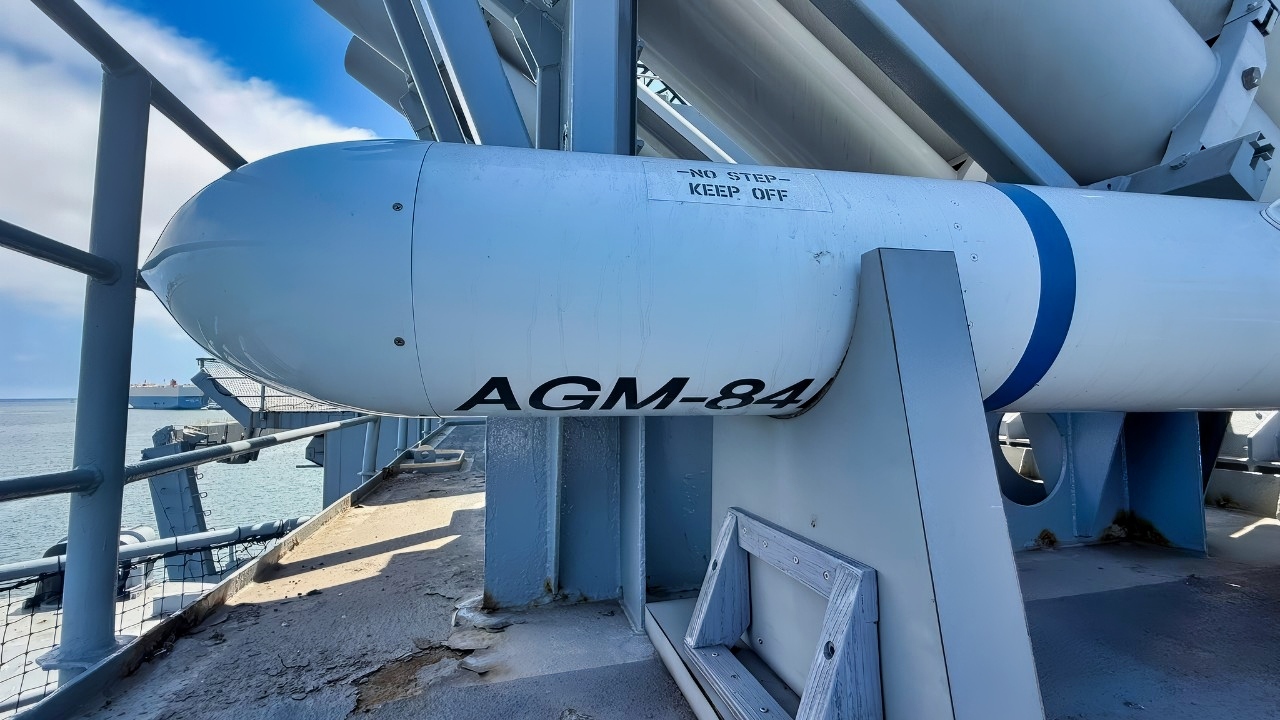
Harpoon Missile Onboard USS Iowa. Image Credit: National Security Journal.
A Ship Begun in Confidence—and Caught by Events
The Navy ordered Kentucky as part of the Iowa program for a simple reason: speed and protection.
Unlike older battleships built to steam in a slow battle line, the Iowas were fast battleships that could keep pace with the new fast carrier task forces. Kentucky’s keel went down in 1942 at Norfolk, in a country rushing to replace losses and overwhelm the Axis with production.
But the war at sea was evolving even faster than the shipyards. From the spring of 1942 onward—Coral Sea, then Midway—carrier air power proved it could decide campaigns at oceanic distances. As the Pacific widened, the Navy realized it needed more flight decks, more destroyers and escorts, and more submarines far sooner than it needed another pair of giant gunships. The industrial machine pivoted. Kentucky stayed on the ways, but her priority slipped behind the avalanche of Essex-class carriers, amphibious ships, and escorts that the war now demanded.
By the time Japan surrendered in 1945, finishing Kentucky no longer looked urgent. The war she’d been built for was over; the kind of war to come would be fought differently.
Why She Wasn’t Finished: The Cold Math of Tradeoffs
Three forces sealed Kentucky’s fate:
1) Strategy had moved on. The most important ships in the Pacific weren’t trading broadsides—they were launching and recovering waves of aircraft, screening those carriers from submarines and kamikazes, and hunting enemy logistics. Battleships did crucial work in shore bombardment and air defense, but they were no longer the core of sea power.

Iowa-Class Battleship Secondary Guns. Image Credit: Harry J. Kazianis/National Security Journal.
2) Resources are finite. Steel, labor, yard space, skilled welders, and testing facilities are not bottomless, even for the United States. Finishing Kentucky would have delayed other ships that mattered more to the postwar fleet—especially carriers and the escorts that kept them alive.
3) The cost of being unique. Once you’re outside a production run’s main wave, the price of every decision goes up. A late-finishing Iowa would have needed special allocations of parts, specialized yard time, and a crew and training pipeline for a ship class the Navy was already mothballing. That’s a hard sell in peacetime, especially with new weapons on the horizon.
The Postwar “What Ifs”: Missiles, Makeovers, and Practicality
In the 1950s, the Navy did kick the tires on finishing Kentucky as a guided-missile battleship—swapping some of her guns for early long-range missile systems. On paper, it sounded like a way to bridge eras: battleship survivability with modern punch.
Two problems killed the idea. First, cost. Converting a partially built battleship into a cutting-edge missile ship is akin to renovating a cathedral to conceal a data center within: everything fits, but nothing is easy. Second, the technology curve was climbing so fast that any bespoke conversion risked being outdated before it left the pier. In a world of rapidly improving missiles, radars, and computers, the smarter bet was to design purpose-built missile ships from the keel up.
So Kentucky stayed what she was becoming: a very valuable donor.
In 1956, when Wisconsin ripped open her bow in a fog collision off the Virginia Capes, shipfitters performed a minor miracle. They cut the prefabricated bow from Kentucky and grafted it onto Wisconsin in barely over two weeks. The fix was so famous the battleship earned a joking callsign—“Big WIS(KY).”
The Navy later used portions of Kentucky’s turbines to power the first Sacramento-class fast combat support ship, USS Sacramento—a reminder that big, efficient Iowa-class machinery still had a future, just not the one originally imagined.

Iowa-Class Sideview. Image taken by National Security Journal at USS Iowa Battleship. Taken August, 2025.
By 1958, the Navy struck Kentucky from the register and sold the incomplete hull for scrap. The grand ship that never was lived on efficiently.
Why Kentucky’s Story Marks the End of an Era
People often say, “Battleships were obsolete because airplanes got better,” or that aircraft carriers made them obsolete.
That’s partly right, but the full answer is broader—and USS Kentucky is a clean example.
Air power broke the geometry. A carrier can strike hundreds of miles away, rearm, and try again tomorrow. A battleship has to sail into range and stay there. In the age of massed carrier aviation—and later, guided missiles—closing the distance became the risk, not the solution.
Submarines changed the calculus. Throughout the war, U.S. submarines strangled Japanese logistics. After the war, quieter boats with better torpedoes and sonar made any big surface ship’s life more dangerous. If an adversary can’t see your submarine, it doesn’t matter how thick your belt armor is.
Information replaced armor. Radar, electronic warfare, and eventually satellites and networking changed how fleets fight. The winning edge moved from inches of steel to who sees first, decides faster, and shoots from farther away. Battleships can add sensors and missiles, but the giant hull and crew burden remain.

Top of USS Iowa. Image Credit: National Security Journal.
That’s the story the unfinished Kentucky tells. The Navy—never sentimental when budgets bite—could read the tea leaves. It finished the four Iowas already well along and sent the rest of its resources toward the ships that won wars at range.
The Temptation to Bring Back the Big Guns
Every few years, someone suggests reviving battleships, and the argument has a certain romance: big guns are cheaper per shot than missiles; armor looks reassuring; museum ships still awe visitors. In fact, our very own Commander-in-Chief just made the argument.
But the costs and risks pile quickly:
Survivability: In an era of long-range anti-ship missiles and swarming drones, a large, high-signature hull is a high-priority target.
Manpower: An Iowa-class ship requires a small town of sailors. Modern fleets struggle to recruit and retain the people they have.
Opportunity cost: Every dollar spent on a big-gun throwback is a dollar not spent on submarines, air defenses, uncrewed systems, or the maintenance backlog the fleet already carries.
Kentucky’s fate—pause, reconsider, repurpose—wasn’t a failure of nerve. It was the Navy being unsentimental at the right time.

USS Iowa 16-Inch Guns National Security Journal Photo. Taken August 15, 2025 By Harry J. Kazianis.
USS Kentucky in the Afterlife
There’s a poignant detail in Kentucky’s afterlife. Hurricane Hazel snapped her moorings in 1954 and grounded the unfinished hull in the Delaware. Workers re-secured her and went back to dismantling what had once been billed as the last and fastest of America’s great battlewagons.
Years later, a 68-foot section of her bow helped a sister ship sail again. Some of her machinery powered a very different kind of fleet workhorse—the fast support ship that kept carriers topped up and moving.
It’s fitting. The Navy didn’t waste what it could use. It just refused to finish a ship for a kind of war that was fading in the wake.
Bottom Line on USS Kentucky
The USS Kentucky wasn’t finished because the world changed faster than her blueprints. Walking the decks of the USS Iowa this summer made me realize that, for sure, the era of the battleship is over. Man, it was crushing, but it was reality.
The Pacific air war made carriers decisive, submarines made the oceans opaque, and missiles made distance the most important armor of all. By the time the shipyards could have delivered her, the Navy had already learned the lesson she symbolizes: the age of the battleship was ending, and finishing one more wouldn’t change history.
Letting Kentucky become parts—rather than a platform—was the hard, correct call. And that really hurts to say, but it’s the truth.
About the Author: Harry J. Kazianis
Harry J. Kazianis (@Grecianformula) is Editor-In-Chief and President of National Security Journal. He was the former Senior Director of National Security Affairs at the Center for the National Interest (CFTNI), a foreign policy think tank founded by Richard Nixon based in Washington, DC. Harry has over a decade of experience in think tanks and national security publishing. His ideas have been published in the NY Times, The Washington Post, The Wall Street Journal, CNN, and many other outlets worldwide. He has held positions at CSIS, the Heritage Foundation, the University of Nottingham, and several other institutions related to national security research and studies. He is the former Executive Editor of the National Interest and the Diplomat. He holds a Master’s degree focusing on international affairs from Harvard University.
More Military
F-22 Raptor vs. China’s New J-35 Fighter: Why You Might Not Like the Answer
China Has An F-35 Stealth Fighter Problem It Never Saw Coming
The F-35 Fighter’s Real ‘Secret Weapon’ Isn’t Its Stealth
Hwasong-20: North Korea’s New Solid-Fueled ICBM Has Arrived
Midway-Class Aircraft Carrier USS Coral Sea (CV-43) Has a Message for the U.S. Navy


Henry W. Meers, Jr.
October 12, 2025 at 8:05 pm
Don’t forget the USS Illinois, 80% complete.