

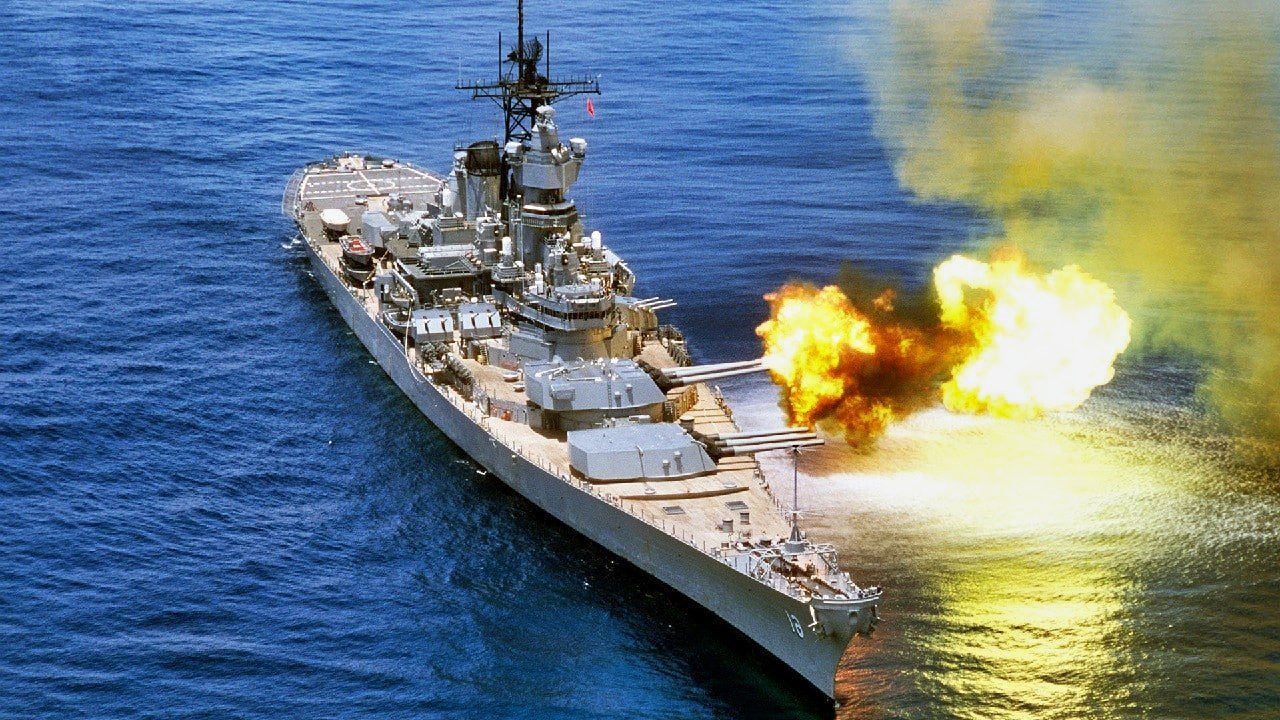
Key Points and Summary – The “battlecarrier” was a late-Cold-War plan to turn Iowa-class battleships into hybrid assault/strike ships, what could have amounted to a small aircraft carrier.
-After the Iowas were reactivated with Tomahawks and modern defenses, a second phase proposed scrapping the aft 16-inch turret, adding a ski-jump flight deck and hangars for AV-8B Harriers and helicopters, and packing in large VLS batteries plus space for Marines and command-and-control.
-The concept promised armored staying power in littorals and rapid crisis response. It collapsed under cost, crew, and engineering realities, redundancy with amphibs and Aegis ships, and a doctrinal shift toward carriers, subs, and precision fires—leaving the battlecarrier as a compelling but impractical “what-if.”
-We have included many Iowa-class battleship photos and video, thanks to recent visits to two of these battleships this year.
Iowa-Class Aircraft Carrier?
Throughout the Cold War, the U.S. Military experimented with several unconventional and downright bizarre ideas, most of which never saw the light of day for better or worse. One such idea they briefly considered was merging aircraft-carrying capabilities with an Iowa-class battleship. This concept was beautiful to some, but it was never left the drawing board due to cost considerations and its impracticality.
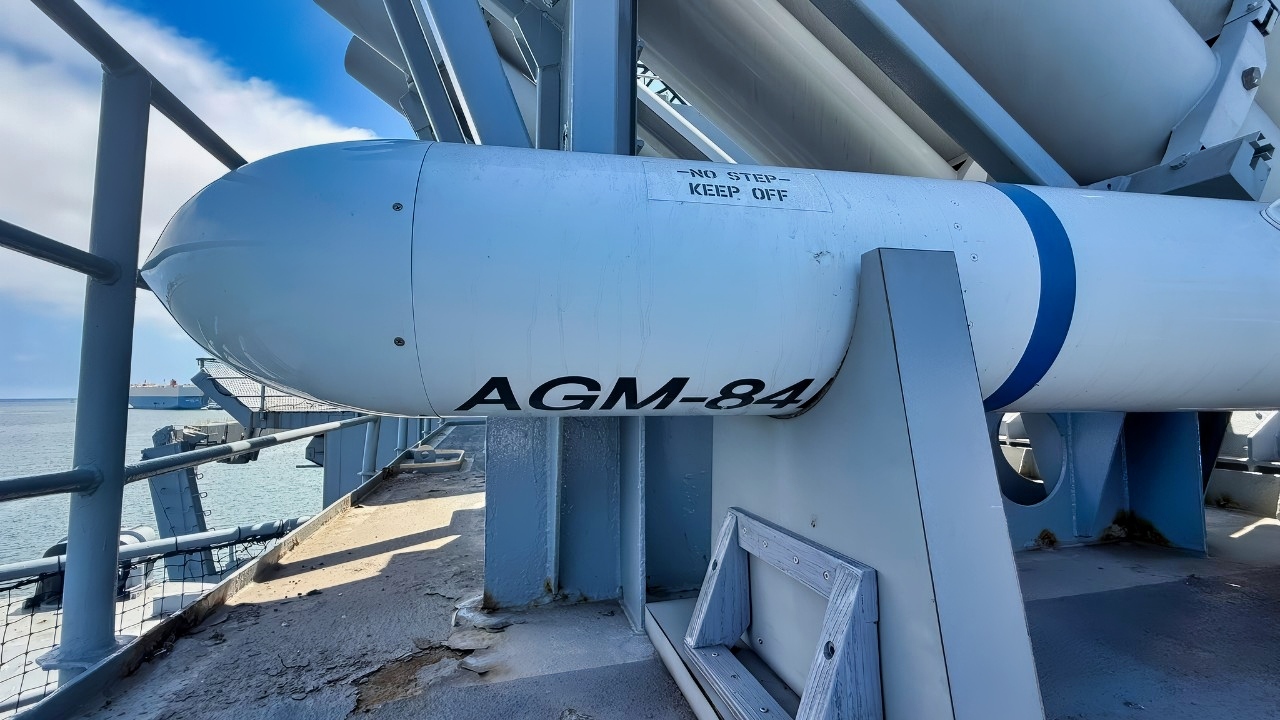
Harpoon Missile Onboard USS Iowa. Image Credit: National Security Journal.
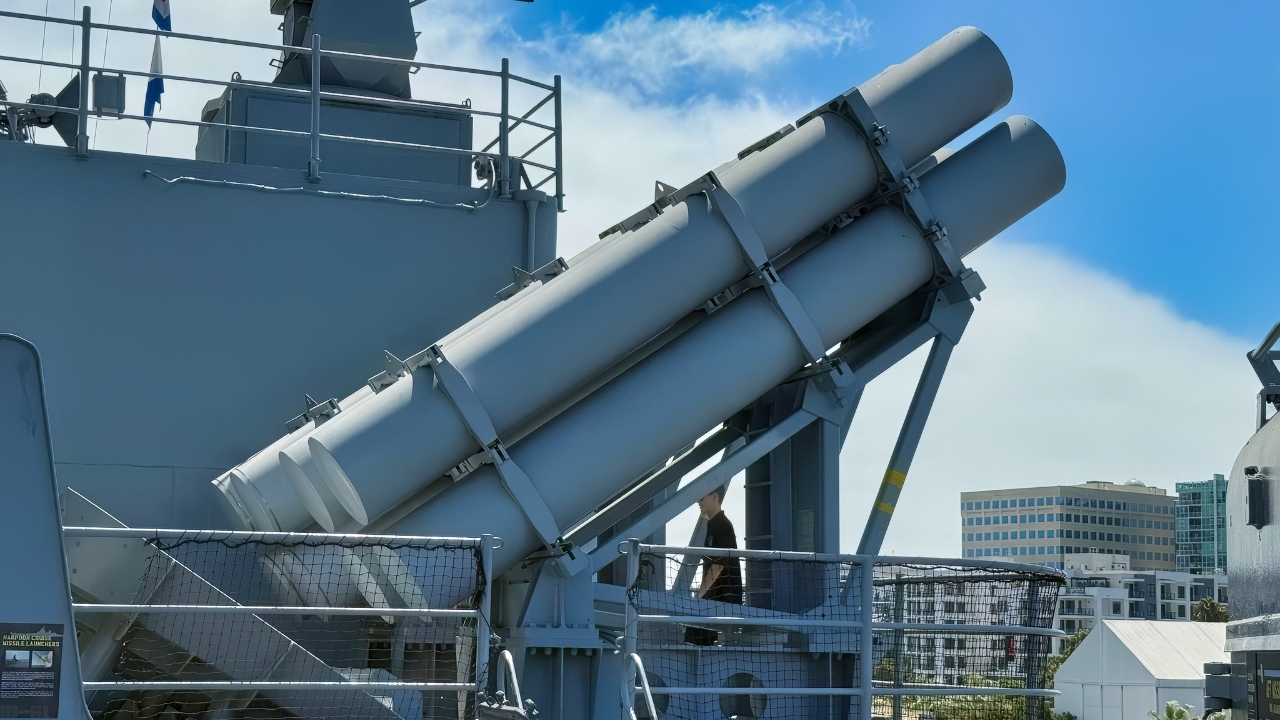
USS Iowa Harpoon Canister. Image Credit: Harry J. Kazianis/National Security Journal.

Missile Box on USS Iowa. Image Credit: National Security Journal.
What is a “Battlecarrier?”
The Iowa-class battleships were initially commissioned during World War II and saw service through the Korean War and, in some cases, Vietnam.
By the late 1970s, they were mothballed, but still structurally sound and considered viable platforms for modernization.
The idea to convert them into battlecarriers emerged from a desire to maximize their utility in a rapidly evolving strategic environment.
The Soviet Union was expanding its naval capabilities, including the deployment of aviation cruisers like the Kiev-class, which combined missile systems with vertical take-off aircraft.
The U.S. Navy, meanwhile, was seeking ways to project power more flexibly, especially in littoral zones where traditional aircraft carriers were vulnerable or impractical.
The concept of a warship capable of launching aircraft is not new. During World War I, the British experimented with the idea using the HMS Furious and the HMS Vindictive. Neither ship proved remarkably successful, as integrating a launch surface on an already existing superstructure proved to be more challenging than anticipated.
Likewise, the Japanese converted some of their older battleships into “battlecarriers.” Both the Ise and Hyūga had their rear turrets replaced with flight decks. Though these also were considered unsuccessful and were dismissed as a “silly waste of a battleship.”
Transforming the Iowa-Class
In the 1980s, the battlecarrier concept was formally explored under the Interdiction/Assault Ship (IAS) program. The idea was to transform the Iowa-class ships into multi-role platforms capable of launching AV-8B Harrier II jump jets, deploying helicopters and tiltrotor aircraft, and delivering massive firepower through cruise missiles and naval artillery.
The conversion would occur in two phases. The first phase, which was actually implemented, involved reactivating the battleships with updated electronics and weapons systems.
This included the installation of Tomahawk cruise missiles, Harpoon anti-ship missiles, and Phalanx close-in weapon systems. All four ships were recommissioned during the Reagan administration’s naval expansion push, which aimed to build a 600-ship Navy.

USS Iowa Logo National Security Journal Photo. Taken August 15, 2025.
The second phase was far more ambitious. It called for the removal of the aft 16-inch gun turret to make room for a flight deck and ski-jump ramp suitable for STOVL aircraft. Designs proposed by Martin Marietta and naval architects like Harold Pulver and Gene Anderson envisioned a reconfigured superstructure, hangar decks, and aviation facilities that would allow the ship to operate a small air wing. Some designs included up to 320 vertical launch cells for a variety of missiles, from Tomahawks to Standard surface-to-air missiles.
The ships would also carry up to 800 Marines, along with SEAL teams, medical facilities, machine shops, and command and control centers. In essence, the battlecarrier would be a floating fortress capable of launching air strikes, amphibious assaults, and missile barrages, all from a single, heavily armored platform.
The battlecarrier was envisioned as a “crisis control ship.” Advocates like Charles E. Myers argued that it could operate close to shore, inside the ten-fathom line, where traditional carriers feared to tread.
Its armor and survivability would allow it to withstand enemy fire, while its aviation and missile capabilities would enable it to respond rapidly to emerging threats. It could enforce blockades, support amphibious landings, and provide sustained fire support in contested zones. The concept was beautiful in light of the instability in the Middle East following the Iranian Revolution and the Soviet invasion of Afghanistan.

Iowa-Class Battleship National Security Journal Visit from August 2025. Image Credit: Harry J. Kazianis.
Why the Battlecruiser Concept Never Left the Drawing Board
As interesting as they seemed, the battlecarrier concept faced numerous obstacles that ultimately led to its cancellation. First and foremost was cost. The conversion would have been costly, requiring extensive structural modifications and new systems integration. Operating such a ship would also demand a crew of over 2,000 personnel, significantly increasing operational costs.
At a time when the Navy was already investing in new classes of destroyers and cruisers with advanced missile systems, the battlecarrier seemed redundant.
Aside from the cost concerns, battlecarriers were also redundant and impractical. The AV-8B Harrier could already operate from amphibious assault ships and aircraft carriers, making the battlecarrier’s aviation capabilities less unique.
Moreover, the missile systems proposed for the battlecarrier were already being deployed on other platforms, such as the Ticonderoga-class cruisers and Arleigh Burke-class destroyers.
The Iowa-class hulls, while robust, were aging and required significant maintenance. Their design was not optimized for aviation operations, and turbulence from the superstructure posed a challenge to flight deck safety.
Furthermore, with supercarriers already in operation, there simply was no need for a battlecarrier. The Navy concluded that flat-deck carriers were superior to ski-jump configurations for launching and recovering aircraft.
The rise of stealth technology, precision-guided munitions, and submarine warfare shifted the focus away from heavily armored surface combatants.
The Sea Control Ship (SCS) program, which aimed to produce lighter aviation-capable ships, was canceled, weakening institutional support for hybrid designs.
Additionally, the Navy’s leadership was divided on the concept, with some viewing it as a retrograde step rather than a forward-looking innovation.
About the Author: Isaac Seitz
Isaac Seitz, a Defense Columnist, graduated from Patrick Henry College’s Strategic Intelligence and National Security program. He has also studied Russian at Middlebury Language Schools and has worked as an intelligence Analyst in the private sector.
More Military
USS America: The U.S. Navy Failed To Sink Its Own Aircraft Carrier
The Mach 3 SR-71 Blackbird Summed Up in 4 Words
The Russian Military: A Spent Force?
How China Would Decide to Invade Taiwan
Russia’s ‘New’ Su-75 Checkmate Stealth Fighter Looks Like a ‘Fake Out’


