


America escalated militarily against the Islamic Republic of Iran.
On the sixth day of the return to war, Washington expanded its targeting of key Iranian military facilities.
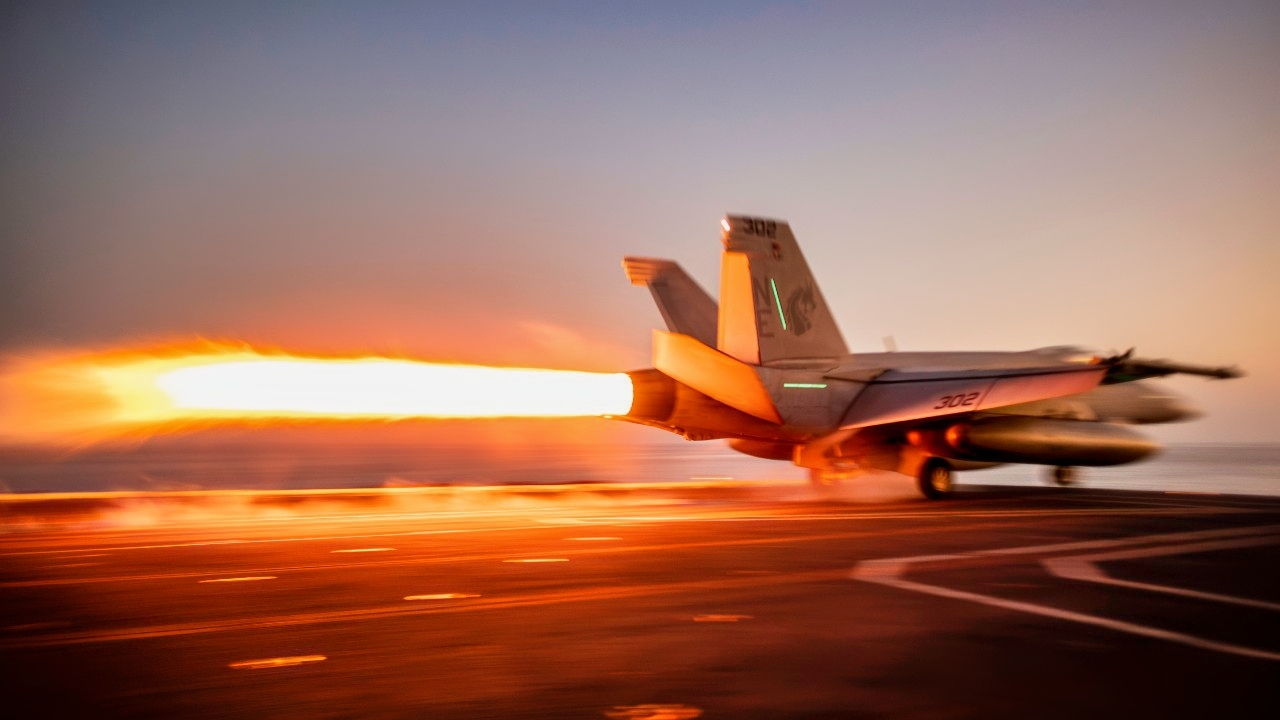
250429-N-FS097-1154 U.S. CENTRAL COMMAND AREA OF RESPONSIBILITY (April 28, 2025) An F/A-18E Super Hornet, attached to Strike Fighter Squadron (VFA) 192, launches from the flight deck of the Nimitz-class aircraft carrier USS Carl Vinson (CVN 70) in the U.S. Central Command area of responsibility. (Official U.S. Navy photo)

Nimitz-class carrier USS George H.W. Bush (CVN 77) transits the Atlantic Ocean while offloading munitions via helicopter to the world’s largest aircraft carrier, USS Gerald R. Ford (CVN 78), June 27, 2025. Gerald R. Ford, a first-in- class nuclear aircraft carrier and deployed flagship of Carrier Strike Group Twelve, incorporates modern technology, innovative shipbuilding designs, and best practices from legacy aircraft carriers to increase the U.S. Navy’s capacity to underpin American security and economic prosperity, deter adversaries, and project power on a global scale through sustained operations at sea. (U.S. Navy photo by Mass Communication Specialist Seaman Jarrod Bury)
The US Navy also intensified its pressure on Iranian targets in the Strait of Hormuz.
Tehran retaliated by widening its own regional attacks against American partners, eschewing confrontations with US forces.
Of course, that move by Iran was in keeping with its general strategy of asymmetrical retaliation, since Tehran has long assumed that the weakest elements of America’s force projection in the Middle East were its regional–notably Gulf Arab–partners.
By pressuring them, Tehran believes it can force America to draw down its attacks because the Arabs won’t want them to continue if the Gulf states absorb enough damage to their infrastructure and economy.
Clearly, this war is not about anything more than control over the essential route of the Strait of Hormuz.
Day Six: By the Numbers
On the sixth day of its air war against Iran, the Americans carried out strikes on key Iranian military installations throughout the Islamic Republic.
This move by Washington is clearly an attempt to degrade whatever military capabilities Iran still possesses.
Targets also included maritime systems that US forces associated with the Islamic Republic’s ongoing attempts to control the Strait of Hormuz.
The Guardian reported that the US struck an Iranian vessel they accused of trying to run the Navy’s counter-blockade around Iranian-controlled ports.
Washington insists that the Strait of Hormuz is an international waterway, highlighting its strategic importance.
Tehran denies this claim, arguing that the SoH is partly theirs (and the other part belongs to their neighbor across the Strait of Oman).
The government in Muscat, on the other hand, says it wants the SoH restored to prewar operations–meaning no national control over the waterway and no tolls imposed.
The Strait of Hormuz Is Choked Off
Because of these hostilities, by the sixth day of the conflict, all commercial shipping remained choked off. A handful of small commercial ships have passed through.
The global economy faces increasing risks as shipping remains blocked.
In fact, Tehran is conditioning any reopening of the SoH to prewar standards on significant concessions from Washington.
It must be stressed that after six days of American airstrikes, Tehran’s rulers are unlikely to agree to restore the Strait of Hormuz to prewar levels, regardless of concessions, signaling persistent escalation for policymakers and analysts to consider.
The world economy is running on a rapidly dwindling countdown. At some point, it will simply be unable to continue functioning at the level and way it did before February 28.
Regardless of who wiins the Iran War (right now, it looks like the Iranians are in the lead at the strategic level), the economic damage is likely unavoidable on some, significant level, simply because of how long the SoH has been blocked, and how little of the region’s energy supplies have made it to market in the more than 100 days that this war has raged.
Military Pressure Alone Will Not Change Tehran’s Position
So, the sixth day of strikes showed that the conflict has entered a broader escalation phase. Any talk of off-ramps, at this point, seems fanciful. The US is not interested in a mutually beneficial deal.
They are focused solely on degrading Iranian military capabilities along the Strait, as part of a larger plan to force Tehran to the table in a more conciliatory position.
But it is also increasingly obvious that military force alone will not change Iran’s policy on the SoH.
Meanwhile, Iran continues imposing costs by striking US regional partners and threatening wider disruption of Gulf energy infrastructure.
Day six of the second phase of the war is an inflection point.
It represents the loss of any hope for a near-term negotiated settlement–or any semblance of de-escalation–and the start of some new round of violence that will be highly damaging to the world economy for many years to come.
Expect more escalation in the coming days and weeks.
About the Author: Brandon J. Weichert
Brandon J. Weichert is the Senior National Security Editor. He also manages The Weichert Brief on Substack. Weichert also hosts “National Security Talk” on Rumble. He is the author of four bestselling national security books, the most recent of which is A Disaster of Our Own Making: How the West Lost Ukraine (Encounter Books). Follow him via Twitter/X @WeTheBrandon.


