


On April 7, 1945, the Imperial Japanese Navy battleship Yamato — the largest battleship ever built, displacing nearly 72,000 long tons and armed with the largest naval guns ever fitted to a warship — was sunk by 386 U.S. Navy aircraft during Operation Ten-Ichi-Go, a one-way mission to beach herself on Okinawa and use her 18.1-inch guns against the American invasion. After approximately two hours of attacks involving 10 bomb hits and at least 8 torpedo hits, the Yamato capsized and one of her magazines exploded, sending a smoke plume 4 miles into the sky that was visible 124 miles away — taking 2,740 of her 3,332 crew with her. The Yamato had been commissioned just nine days after the Pearl Harbor attack and never fired her enormous main guns at an American battleship.

Yamato-Class Battleship. Image Credit: Creative Commons.
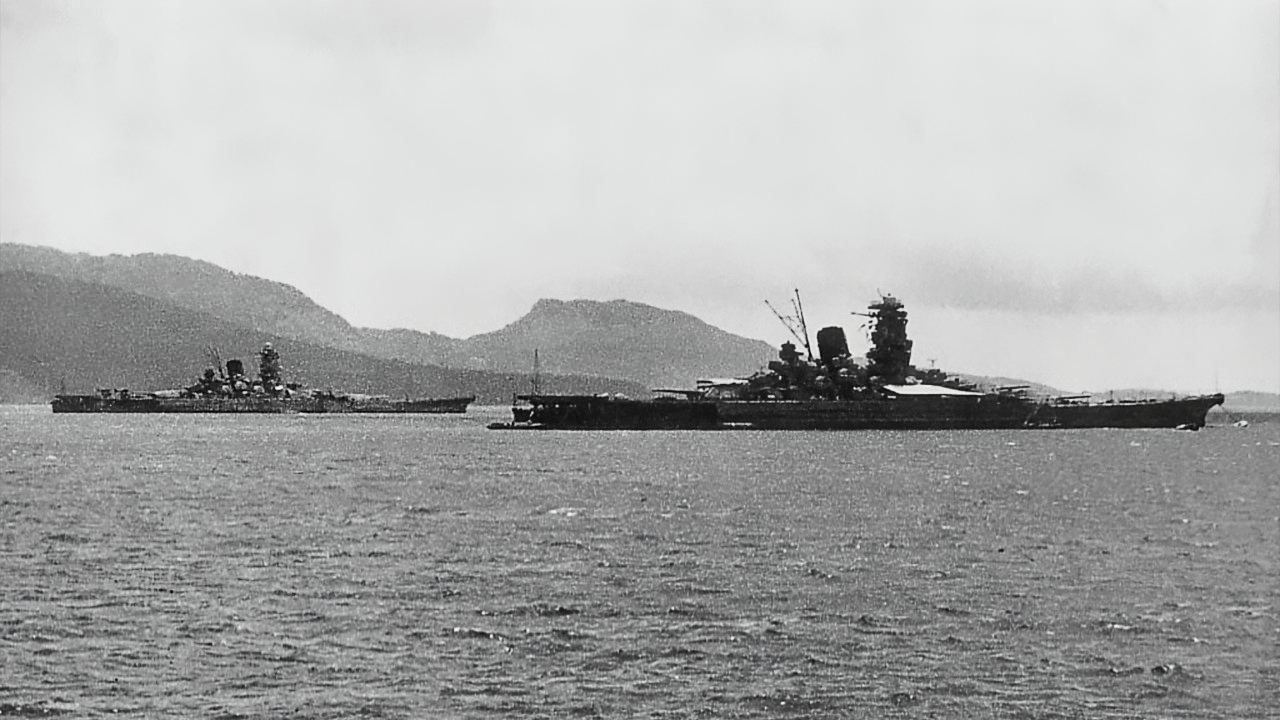
Yamato-Class Battleships Musashi and Yamato. Image Credit: Creative Commons.
The Yamato-Class Was One Big Battleship
The Yamato-class were battleships of the Imperial Japanese Navy. The Yamato and Musashi, whose hulls were laid down in November 1937 and April 1938, respectively, were completed as designed. A third hull, laid down in 1940, was converted to the aircraft carrier Shinano during construction. Displacing nearly 72,000 long tons at full load, the completed battleships were the heaviest ever constructed. The Yamato-class carried the largest naval guns ever fitted to a warship: nine 460-mm naval guns, each capable of firing 1,460-kilogram shells to a distance of 42 kilometers.
The Yamato was commissioned on December 16, 1941, just nine days after the attack on Pearl Harbor. The Musashi was commissioned on August 5, 1942, and the Shinano was commissioned on November 19, 1944.
Due to the threat posed by U.S. submarines and aircraft carriers, both the Yamato and Musashi spent most of their careers at naval bases in Brunei, Truk, and Kure. These were Japan’s most prestigious ships, and they didn’t want to risk losing them.
The Yamato was sent on a one-way mission in April 1945 to disrupt the U.S. landings on Okinawa. She was savaged by U.S. air attacks and sunk.
The Yamato Was The Pride Of the Imperial Japanese Navy:
After Japan withdrew from the Washington Naval Treaty in 1934, it made plans to build a super battleship. The Yamato-class was designed to take on and defeat multiple battleships at one time in the event of a war with the United States.
Japan feared America’s industrial might and decided to build the largest and most advanced battleships ever designed.

Iowa-Class Missile Launchers

Top of USS Iowa. Image Credit: National Security Journal.

16-Inch Guns of USS Iowa. Image Credit: National Security Journal.
The battleship was 862 feet long, with a beam of more than 127 feet and a draught of 34 feet. She was powered by two water-tube boilers that produced 150,000 shaft horsepower, enabling a top speed of 27 knots.
Yamato’s Eighteen-Inch Guns Were The World’s Most Powerful:
The Yamato-class battleships had three 3-gun turrets mounting 46-cm/45 caliber Type 94 naval guns—the largest guns ever fitted to a warship. Each weighed 2,774 tons for the complete mount. This made each gun turret weigh more than most destroyers.
Each gun was 21.13 m long, weighed 147.3 metric tons, and could fire 1,460-kg armor-piercing shells and 1,360-kg high-explosive shells at a rate of 1.5–2 shells per minute.
Her secondary armament comprised twelve 155-millimeter guns mounted in four triple turrets (one forward, one aft, two amidships), and twelve 12.7-centimeter guns in six twin mounts (three on each side amidships). These turrets had been taken off the Mogami-class cruisers when those vessels were converted to a main armament of 20.3-centimeter guns.
During a 1944 retrofit, the number of 155-mm guns was reduced to six, and 25-mm anti-aircraft guns were added for protection against U.S. air attacks.
The Yamato Was The Pride of the Imperial Japanese Navy:
After serving as Admiral Yamamoto’s flagship during the Battle of Midway, the Yamato spent the next two years moving between Truk and Kure naval bases, with her sister ship Musashi replacing the Yamato as the flagship of the Combined Fleet.
During this time, the Yamato, as part of the 1st Battleship Division, was deployed on multiple occasions to counteract U.S. carrier raids on Japanese island bases. On December 25, 1943, she suffered severe torpedo damage from the USS Skate (SS-305) and was forced to return to Kure for repairs and structural upgrades.
During the Battle of Leyte Gulf, the Yamato was part of the battleship group that took on the undergunned and tiny destroyer force Taffy 3 in what is known as the Last Stand of the Tin Can Sailors. During the battle, the destroyer USS Johnston (DD-557) made a speed run at the heavily armored Japanese ships.
The Yamato, believing it was a cruiser, hit the Johnston with its huge 18.1-inch guns, but the shells passed right through the lightly armored destroyer without detonating.
Operation Ten-Ichi-Go, April 7, 1945:
During the Battle of Okinawa, the Yamato was sent on a one-way mission as part of Operation Ten-Ichi-Go—in essence, the most significant kamikaze attack during the war. The Yamato didn’t have the fuel to go into prolonged action against the U.S. fleet off Okinawa. She was ordered to sail, beach herself, and then use her guns to repel the U.S. invasion.
However, before she could get to Okinawa to bring her big guns to bear on U.S. forces, she was spotted by U.S. submarines, Hellcat fighters, and PBM-3 Martin Mariner flying boats. The Americans launched 386 planes to attack the Yamato and her supporting vessels. On April 7, 1945, the aircraft pounced in three successive attacks.
At about 12:30 p.m., 280 bomber and torpedo bomber aircraft arrived over the Japanese force. The Surface Special Attack Force increased speed to 24 knots, and following standard Japanese anti-aircraft defensive measures, the destroyers began circling the Yamato. The first aircraft swooped in to attack at 12:37 p.m.
At 12:41 p.m., two bombs obliterated two of her triple 25-mm anti-aircraft mounts and blew a huge hole in the deck. A third bomb destroyed her radar room and the starboard aft 127-mm mount.
At 12:45 p.m., a single torpedo struck the Yamato far forward on her port side, sending shockwaves throughout the ship. At 12:46 p.m., another two bombs struck the port side, one slightly ahead of the aft 155-mm centerline turret, and the other right on top of the gun. These caused extensive damage to the turret and its magazines; only one man survived.
Shortly afterward, three more torpedoes struck the Yamato: two impacts on the port side—near the engine room and one of the boiler rooms—resulting in flooding in the engine rooms. The attack ended around 12:47 p.m., leaving the battleship listing 5–6° to port. Deliberately counterflooding compartments on the other side of the ship reduced the list to 1°.
One boiler room had been disabled, slightly reducing the Yamato’s top speed, and strafing had incapacitated many of the gun crews who manned Yamato’s unprotected 25-mm anti-aircraft weapons, obliterating her air defenses.
The second American air attack, at 1:00 p.m., savaged the ship. Dive bombers coming in from high altitude, and a swarm of torpedo bombers from all points overwhelmed the Yamato’s defenses. Four torpedoes struck in quick succession on the port side, and one on the starboard side.
Dive bombers hit the superstructure with four bomb hits, raking what was left of the 25-mm anti-aircraft guns. More torpedoes slammed into the ship. She was aflame from stem to stern.
A total of ten bomb hits and at least eight torpedo hits rocked the Yamato. She capsized, and then one of her magazines exploded, sending a plume of smoke four miles high. It was seen 124 miles away and took 2,740 of the 3332 crew members with her, including Vice-Admiral Seiichi Itō.
Japan’s Yamato-class was the biggest and most powerful battleship ever built. However, it was built too late and suffered the results of that lateness when the new king of the sea, the aircraft carrier, sank it.
Would The Japanese Strategy Have Worked?
What if the Yamato had made it to Okinawa? Would she have impacted the invasion with her guns?
That is very doubtful. While she could have affected the invasion force transports to a small degree, the United States had a massive fleet standing by to engage the Yamato in a surface action.
Admiral Raymond Spruance had sent six battleships into a blocking position. This force included the USS Massachusetts (BB-59), Indiana (BB-58), South Dakota (BB-57), New Jersey (BB-62), Wisconsin (BB-64), and Missouri (BB-63), as well as the battlecruisers Alaska (CB-1) and Guam (CB-2), five cruisers, and 21 destroyers.
The decision to change that from a surface action to an air attack was a sound one; the Yamato’s big 18-inch guns were ineffective against air attacks. But the assembled U.S. surface fleet was incredibly powerful.
Fighting against massed carrier-based aircraft and a huge surface fleet off of Okinawa, the Yamato, as big and powerful as it was, would have had no chance. Not to mention, if the Japanese had beached her as envisioned, she would have made an even easier target for U.S. warships and aircraft.
About the Author: Steve Balestrieri
Steve Balestrieri is a National Security Columnist. He served as a US Army Special Forces NCO and Warrant Officer. In addition to writing on defense, he covers the NFL for PatsFans.com and is a member of the Pro Football Writers of America (PFWA). His work was regularly featured in many military publications.


