

Key Points and Summary – The M1 Abrams was developed in the 1970s for one primary reason: to defeat the new Soviet T-72, which had rendered the U.S. Army’s aging M60 “Patton” tank obsolete.
-Chrysler won the $4.9 billion contract in 1976, incorporating revolutionary “first-of-its-kind” Chobham armor.

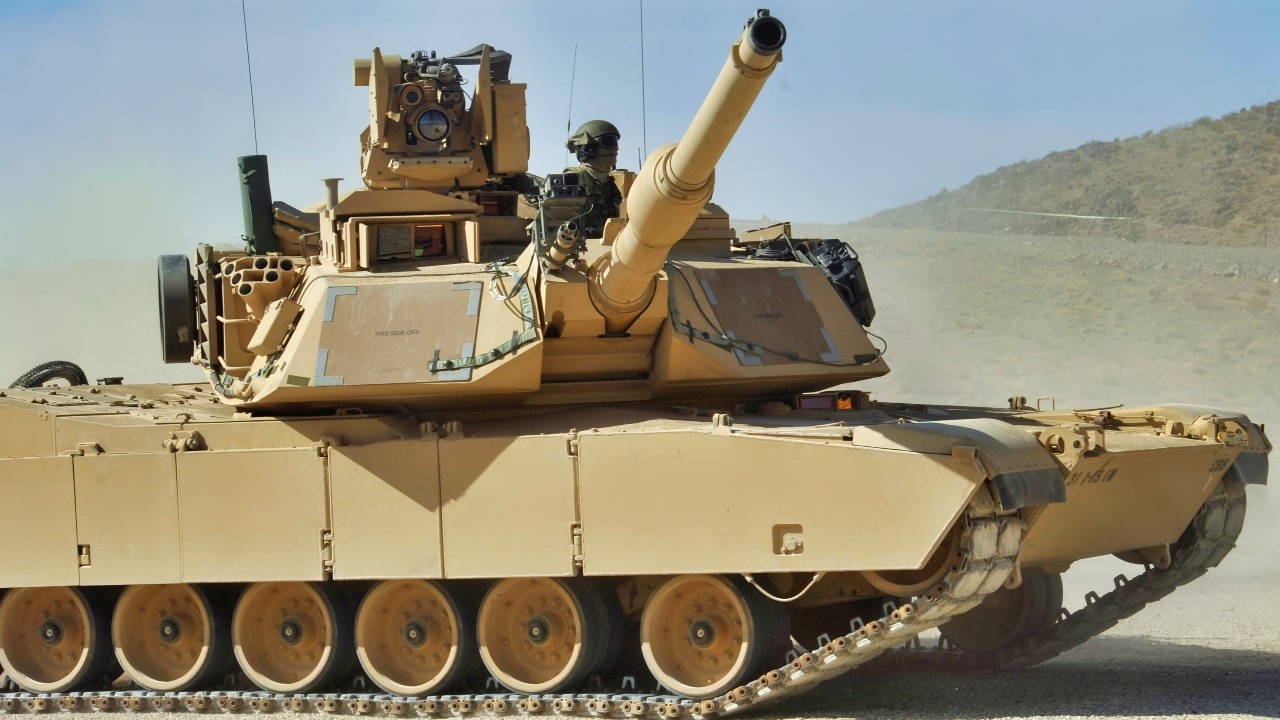
U.S. Army soldiers assigned to Bravo ‘Bad Bet’ Company, 2nd Battalion, 12th Cavalry Regiment, 1st Armored Brigade Combat Team, 1st Cavalry Division, conduct Table V exercises with the M1A2 Abrams Tank at Bemowo Piskie Training Area, Poland, July 12, 2024. The purpose of the training is to ensure the Abrams were fully functional and fit to fight. The 1st Cavalry Division’s mission is to engage in multinational training and exercises across the continent, strengthening interoperability with NATO allies and regional security partners, which provides competent and ready forces to V Corps, America’s forward-deployed corps in Europe. (U.S. Army photo by Spc. Kali Ecton)
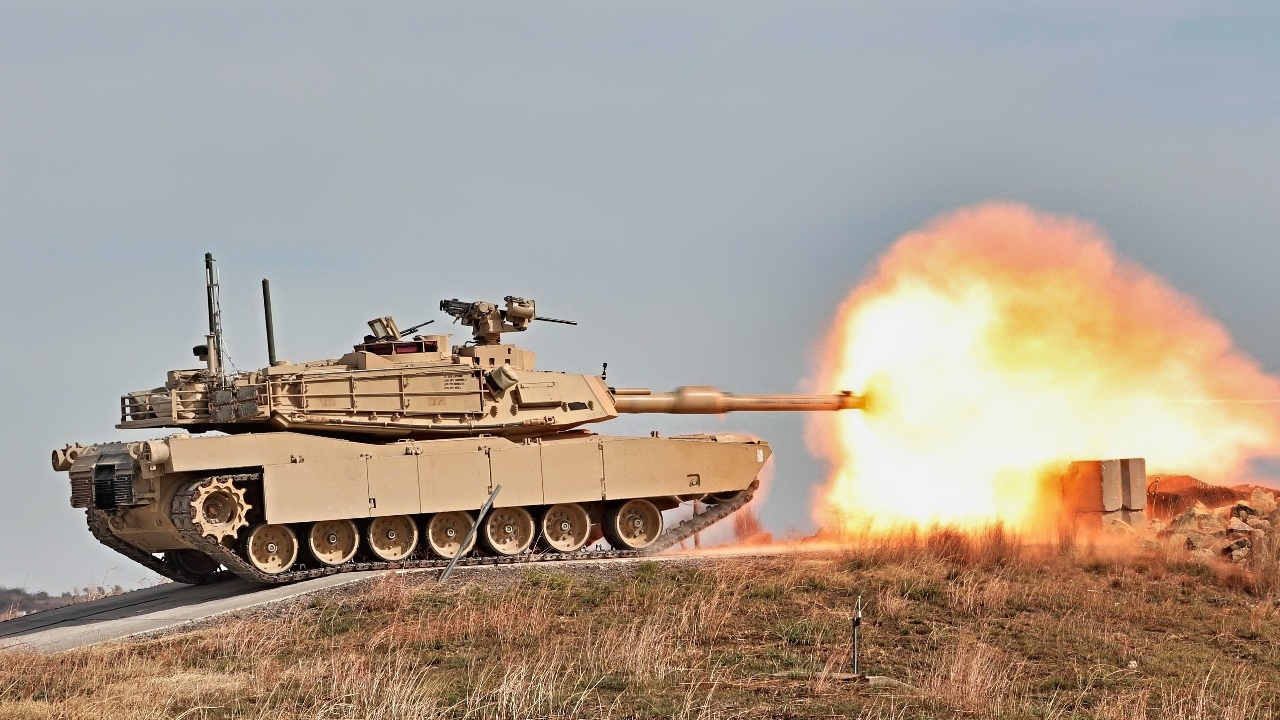
An M1A1 Abrams tank operated by Soldiers with the 2nd Battalion, 70th Armored Regiment, 2nd Armored Brigade Combat Team, 1st Infantry Division, fires over a barricade at the Douthit Gunnery Complex on Fort Riley, Kansas, Oct. 20, 2022. The tank crew was conducting gunnery qualification. (U.S. Army photo by Sgt. Jared Simmons)
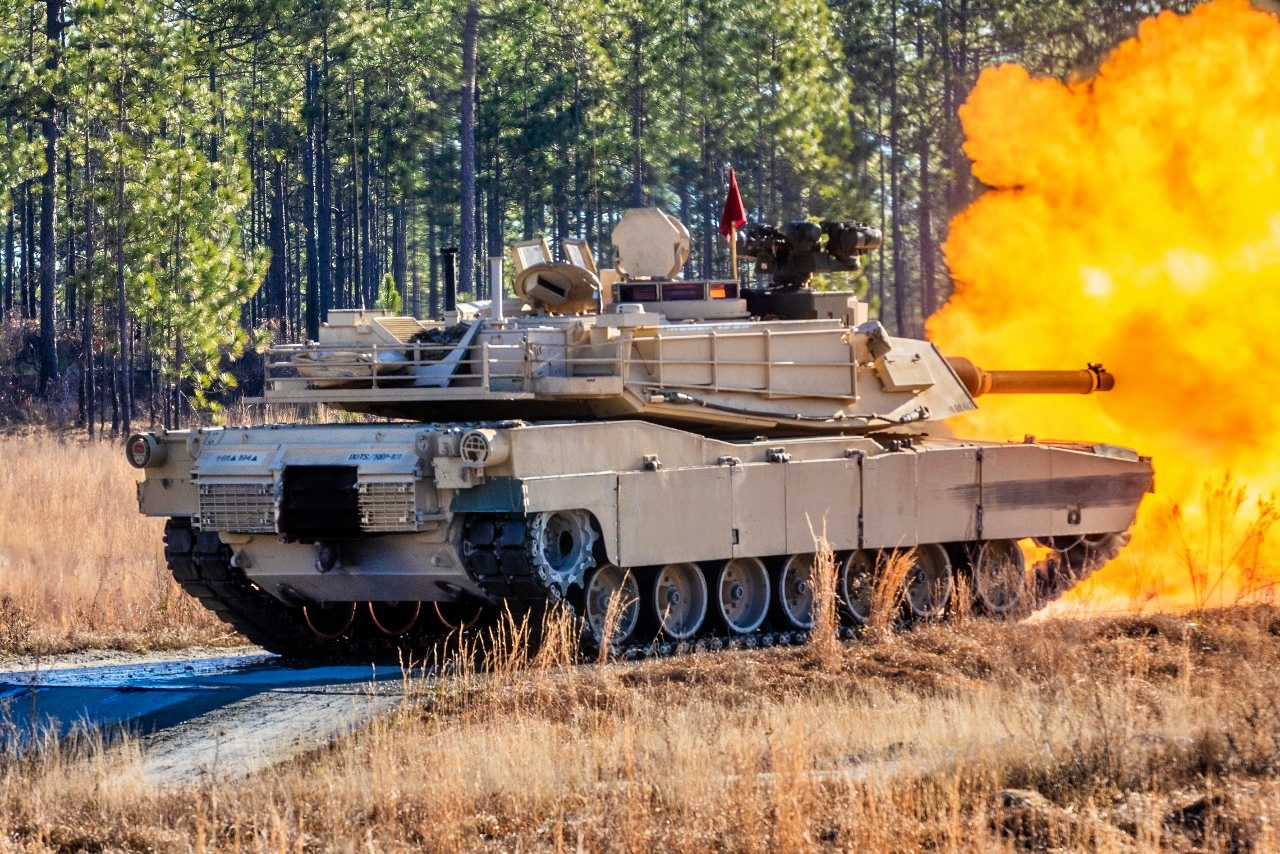
Soldiers from Echo Company, 1st Battalion, 81st Armor Regiment, 194th Armored Brigade, conduct gunnery training with the M1 Abrams tank, Jan. 14, 2025, at Brooks Range, on Fort Benning, Georgia. (U.S. Army photo by Joey Rhodes II)
-The tank’s design was spectacularly validated during the 1991 Gulf War, where 600 M1s “made mincemeat” of Iraqi T-72s, and “not a single one” was penetrated by enemy fire.
-The tank is named for Gen. Creighton Abrams, whom Gen. Patton himself called his “peer” and a “World Champion.”
Why Did the US Army Build the M1 Abrams In the First Place?
The M1 Abrams is the most successful main battle tank (MBT) of all time. Much has been written about its smashing performances in the 1991 Persian Gulf War and 2003 Iraq War, as well as its comparatively disappointing performance in the current Russo-Ukrainian War (which has been a bad time for tanks and armored personnel carriers in general).
But not as much has been written about this iconic MBT’s early history.
Accordingly, National Security Journal now takes a deeper dive into the origins of the Abrams and why the U.S. Army decided to develop it.
The Why and the Wherefore of the Abrams
The M1’s predecessor, the M60 MBT, had faithfully served the U.S. Army since 1959. However, by the 1970s, the M60 was showing its age, especially considering the Soviet Union’s new T-72.
To put that in historical perspective, when the M60 “Patton” debuted, the Soviet’s frontline MBT was the T-54/T-55.
The Army released its XM1 request for proposals in January 1973. Since Chrysler already had a good track record with the Army for producing the M60, they were a sensible choice to build its replacement. Thus it came to pass that on Nov. 12, 1976, the Army awarded the $4.9 billion ($27.97 billion in 2025 dollars) development contract.
Chrysler submitted nine XM1 test-bed experimental models in 1978. The Army was sufficiently impressed that production began in 1979, with 3,273 specimens built over the next six years. Among the major selling points for the M1 was its first-of-its-kind Chobham armor (an arrangement of metal and ceramic plates).
The original variant used a 105-mm main gun, just like the M60, but that was upgraded to a much more powerful 120-mm main gun starting with the M1A1 variant.
In February 1982, Chrysler Defense was sold to General Dynamics as part of Chrysler’s plan to revitalize as it teetered on the brink of bankruptcy.
That is why Abrams tanks today are built by General Dynamics Land Systems.
“The Proof is in the Pudding”
Though Abrams crews never ended up never squaring off against their Soviet adversaries, the M1 still got to fight the T-72, and in grand fashion, during Operation Desert Storm.
Not only did the U.S. Abrams crewmen make absolute mincemeat out of the T-72s manned by then-Iraqi dictator Saddam Hussein’s elite Republican Guard units, but out of 600 M1s that participated in that war, not a single one was penetrated by enemy fire.
The Abrams’ more powerful gun and tougher armor proved their worth as Saddam was evicted from Kuwait—the M1’s legacy was firmly cemented.
The Abram’s MBT’s Namesake
It’s appropriate that an MBT named for the legendary Gen. George Smith Patton—known as a genius of tank warfare—should be succeeded by a tank named for another Army general known as a top-notch armor officer: Gen. Creighton Williams Abrams Jr.
Lt. Col. Abrams commanded the 37th Tank Battalion—specifically, Combat Command B—during the Battle of the Bulge, the last major German offensive along the Western Front.
His courageous battlefield leadership earned the following high praise from no less than Patton himself: “I’m supposed to be the best tank commander in the Army, but I have one peer: Abe Abrams. He’s the World Champion.”
A Tanker’s Tales of the Transition
This writer and military veteran is honored and privileged to have a friendship with Rick Bogdan, a retired U.S. Army lieutenant colonel and author of the highly entertaining semi-autobiographical novel Grunts, Gramps, and Tanks: A Soldier’s Tales.
Rick commanded M60 units during the Cold War, and he had this to say to me about the transition to the Abrams:
“Ha! ‘More torque in reverse.’ On a serious note, when we heard about the M1 we were excited until we heard how few rounds it carried vs M-60 given the ‘fight outnumbered and win’ doctrine. Plus, the 60 could at least cross bridges in Europe vs the M-1. So yes, our trusty M-60 with 5 tanks per platoon seemed to remain a good bet.”
Time marched on, however, and the M60 was fully retired from the U.S. Armed Forces by 1997, while the Abrams continues to serve today, with the latest version designated the M1A2 SEPv3.
About the Author: Christian D. Orr, Defense Expert
Christian D. Orr is a Senior Defense Editor. He is a former Air Force Security Forces officer, Federal law enforcement officer, and private military contractor (with assignments worked in Iraq, the United Arab Emirates, Kosovo, Japan, Germany, and the Pentagon). Chris holds a B.A. in International Relations from the University of Southern California (USC) and an M.A. in Intelligence Studies (concentration in Terrorism Studies) from American Military University (AMU). He is also the author of the newly published book “Five Decades of a Fabulous Firearm: Celebrating the 50th Anniversary of the Beretta 92 Pistol Series.”
More Military
Europe and Canada Are Finally Saying No to the F-35 Stealth Fighter
The Exact Day Navy Battleships Became Obsolete Is Clear
The X-44 Manta Has a Message for Every Air Force on Earth


Jim
November 8, 2025 at 12:12 pm
This is a good summary of the history and transition from the M-60 Patton to the M-1 Abrams and why the need for the transition to match up against the T-72.
But the mission was part of the reason for the transition.
The Fulda Gap was the dominating concern for military planners and a kind of buzz word for an initial Soviet invasion of Western Europe as it was forecast the Soviets would flood the zone with flowing waves of T-72’s streaming into the Fulda Gap, a broad plain, thought to be conducive to an overwhelming big arrow offensive to the heart of Western Europe.
The M-1 Abrams is heavy and fast, had armor thought to give it protection from direct hits from T-72 tank shells so could also flow from their initial positions into opposing waves of tanks, speeding to meet the T-72’s at the Fulda Gap.
A huge tank battle was the expected result.
The number of tanks, their speed, and their initial survivability was crucial to the tactics to be used at the Fulda Gap.
Think of two opposing waves flowing toward each other.
At the point of the meeting of the two waves, the goal was to stop the Soviet waves of tanks… in their tracks.
Not blunt the wave of Soviet armor streaming across the Fulda Gap, but bust it up and stop it and literally clog the Gap with T-72 wreckage, like putting the cork in the proverbial bottle.
It was thought M-1 Abrams in tight, fast moving formations, firing on the move, could breakup the opposing formations going in… a “smash” effect to nullify the incoming wave.
Fortunately, this scenario never happened and we’ll never find out how it would have worked out.
But it goes to show the mission description determines the development of specific weapons systems.
The M-1 Abrams is an example of this dynamic.