


Summary and Key Points: Steve Balestrieri, a national security columnist and former U.S. Army Special Forces officer, evaluates the EA-18G Growler’s decisive role in Operation Epic Fury.
-Operating from the USS Gerald R. Ford and USS Abraham Lincoln, 18 Growlers are currently suppressing Iranian S-300 and S-400 integrated air defense systems.
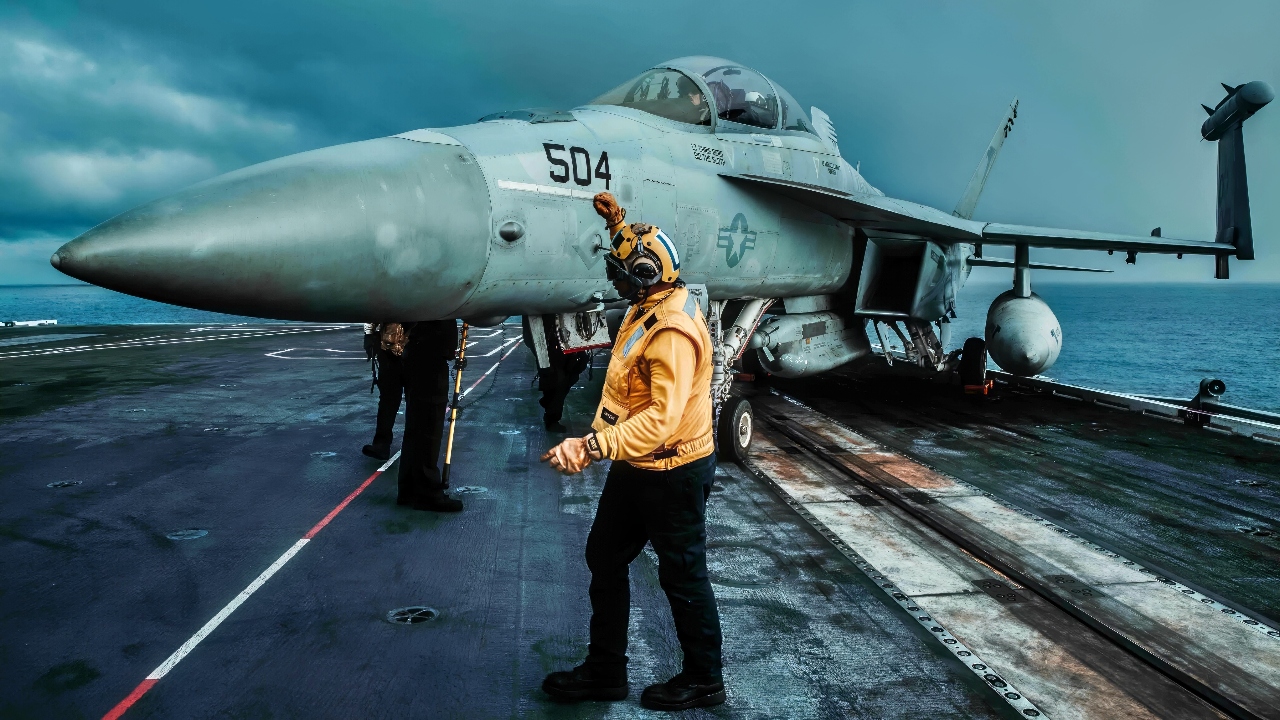
An E/A-18G Growler, attached to Electronic Attack Squadron (VAQ) 141, taxis on the flight deck of Nimitz-class aircraft carrier USS George Washington (CVN 73), while underway in the Indian Ocean, July 24, 2025. The USS George Washington Carrier Strike Group (GWA CSG) is conducting routine operations in the U.S. 7th Fleet area of operations. George Washington is the U.S. Navy’s premier forward-deployed aircraft carrier, a long-standing symbol of the United States’ commitment to maintaining a free and open Indo-Pacific region, while operating alongside allies and partners across the U.S. Navy’s largest numbered fleet. (U.S. Navy photo by Mass Communication Specialist Seaman Nicolas Quezada)
-This report analyzes the deployment of the AN/ALQ-249 Next Generation Jammer (NGJ-MB) and AGM-88E HARM missiles, exploring how the Growler’s Active Electronically Scanned Arrays (AESA) have successfully “blacked out” Chinese-made JY-27A and HQ-9 radars, enabling non-stealth strike packages to penetrate deep into Iranian territory.
How Important Is The E/A-18 Growler In The Air War Over Iran?
The EA-18G Growler is a critical, high-importance asset for potential U.S. military operations against Iran, serving as the premier electronic attack platform to suppress, jam, and destroy Iranian radar systems and surface-to-air missile batteries.
Operating from carriers in the region, Growlers are vital for blinding Iranian air defenses, allowing safe access for other strike aircraft.
How Will The Growler Be Used Over Iranian Airspace?
The Growler is the Navy’s Electronic Warfare (EW) superiority aircraft. The Growler uses ALQ-99 jamming pods to disrupt and blind Iranian air defense networks, effectively rendering them incapable of detecting or locking onto U.S. aircraft.
These jamming pods are carried under each wing and under the aircraft’s fuselage; a total of five are carried. During air strikes, the Growlers are the first to enter enemy airspace and are tasked with identifying and destroying enemy air defenses.
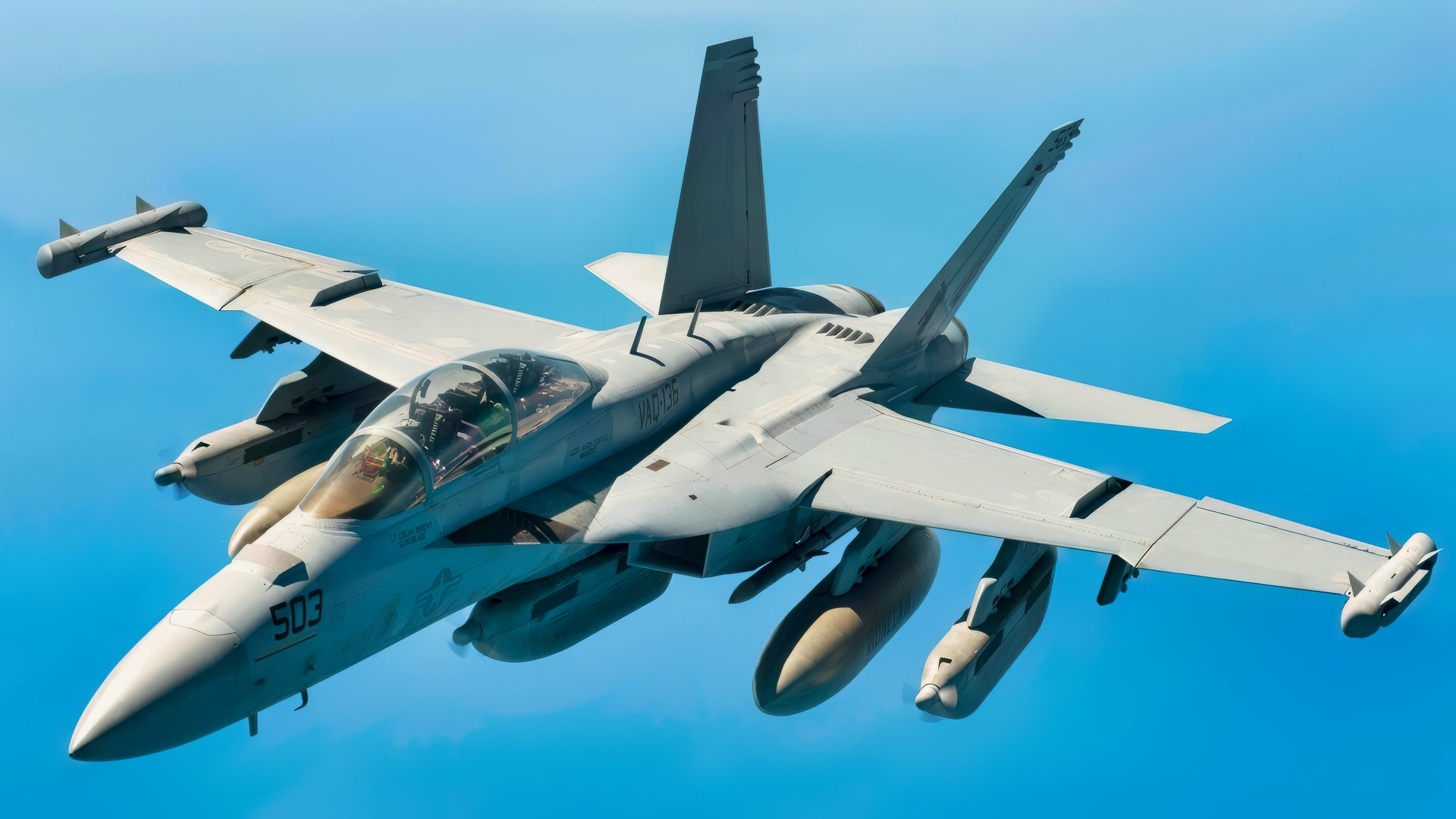
A U.S. Navy EA-18G Growler assigned to the USS Carl Vinson breaks away from a U.S. Air Force KC-135 Stratotanker from the 909th Air Refueling Squadron after conducting in-air refueling May 3, 2017, over the Western Pacific Ocean. The 909th ARS is an essential component to the mid-air refueling of a multitude of aircraft ranging from fighter jets to cargo planes from different services and nations in the region. (U.S. Air Force photo by Senior Airman John Linzmeier)

A joint test team including the Flight Test Division of the French Directorate General of Armaments (DGA/EV), the French Naval Aeronautics Experimentation Center (CEPA/10S), and the U.S. Navy’s Air Test and Evaluation Squadron (VX) 23 are leading flight tests that will enable the French fighter jet Dassault Rafale to aerial refuel with naval aviation’s F/A-18 Hornet and Super Hornet and EA-18G Growler. The tanker qualification partnership paves the way for an extended reach and enhanced interoperability for allied airpower. (U.S. Navy photo by Erik Hildebrandt) Erik_Hildebrandt
SEAD/DEAD Missions. The aircraft specializes in Suppression/Destruction of Enemy Air Defenses (SEAD/DEAD), using AGM-88E HARM anti-radiation missiles to target and destroy active radar sites.
The E/A-18 is an aircraft with strategic Importance and impact. Given Iran’s reliance on advanced land-based surface-to-air missile networks rather than a fighter fleet, the Growler’s ability to “blind” these defenses is paramount to establishing air superiority.
There are currently at least half a dozen Growlers operating in the region from carriers like the USS Gerald R. Ford and USS Abraham Lincoln.
The Growler’s forte is Force Protection. By jamming enemy radar and communications, the Growler protects not only strike fighters but also electronic surveillance, intelligence, and other support aircraft.
The Growler is considered the “only” specialized, modern airborne electronic attack platform in production, making it crucial for navigating Iran’s high-threat air defense environment.
Meet The E/A-18 Growler
The E/A-18 Growler is a derivative of the F/A-18E/F Super Hornet fighter. It is the essentially a two-seat version of the Super Hornet, but with robust electronic warfare capabilities. Its purpose is the suppression of enemy air defenses mission.
Besides the AGM-88E HARM missiles, the Growlers are also equipped with AIM-120 Advanced Medium-Range Air-to-Air Missiles (AMRAAM) to defend against adversary aircraft.
The Growler is designed to provide selective‑reactive and preemptive electronic attack to detect, target, and deny adversary radars, communications, and networks.
The aircraft’s Electronic Warfare Systems include the AN/ALQ-218(V)2 receiver suite, ALQ-99 Tactical Jamming System (TJS), and the AN/APG-79 AESA Radar. The Growlers are getting a significant upgrade to their jamming pods: the upgraded Next Generation Jammer Mid-Band (NGJ-MB) system.

An EA-18G Growler, assigned to Electronic Attack Squadron (VAQ) 209, U.S. Navy Reserve, prepares for takeoff as part of Exercise Southern Strike 2021 at the Gulfport Combat Readiness Training Center in Gulfport, Miss., April 19, 2021. Southern Strike is a large-scale, conventional and special operations exercise hosted by the Mississippi National Guard and is designed to maintain combat readiness, build relationships, and strengthen combat readiness across all branches of the U.S. military. (U.S. Air National Guard photo by Tech. Sgt. Jon Alderman)
“The NGJ-MB is an airborne electromagnetic attack system, consisting of two pods, mounted under the EA-18G wings, containing Active Electronically Scanned Arrays (AESA) that radiate over a range of frequencies.”
“The first of three proposed programs for the overall Next Generation Jammer upgrade that is intended to eventually replace the legacy AN/ALQ-99 Tactical Jammer System in the EA-18G, the report added.
“The NGJ-MB will add increased jamming capability at higher power and longer ranges than the AN/ALQ-99 Tactical Jammer System, as well as the ability to rapidly update hardware and software to counter rapidly evolving threat capabilities.”
The aircraft also retains all of the F/A-18E/F’s multi-mission capabilities with its validated design and the capability to perform a wide range of enemy defense suppression missions.
Within the U.S. Department of Defense, the U.S. Navy is the Growler’s sole operator, although the EA-18G is cooperatively operated with the Royal Australian Air Force.
The Super Hornet Combat History
The E/A-18 entered service with the US Navy in 2009. It replaced the E/A-6 Prowler and as Harry Kazianis wrote, “a brand-new, clean-sheet design was deemed too risky and astronomically expensive.
“The solution came from a stroke of pragmatic genius. The Navy and its industry partners proposed not to invent a new aircraft, but to adapt the most successful and reliable airframe already on the carrier deck: the F/A-18F Super Hornet. This was a brilliant move.
“By using the two-seat Super Hornet as the foundation, the Navy could leverage an existing, high-performance, supersonic airframe with a mature supply chain and a deep pool of trained pilots and maintainers.
“It dramatically reduced development costs, simplified logistics, and ensured the new electronic attack jet could not only keep up with the strike packages it was protecting but could also defend itself—a luxury the Prowler never had. The result was the EA-18G Growler, a machine that married the combat-proven brawn of a Super Hornet with the sophisticated electronic brain of a dedicated jamming platform.”
The Growler’s first baptism of fire came with Operation Odyssey Dawn in Libya 2011. This was followed by missions in Iraq/Syria (Operation Inherent Resolve) and the Red Sea (2024), protecting coalitions by suppressing air defenses
E/A-18E Super Hornet Specs
The Growler, like the Super Hornet, was built to be easy to maintain, and it has certainly lived up to that. Maintenance of technology-heavy combat fighters is time-consuming. But maintaining carrier jets is even more work. Growlers require half the maintenance time of an F-14 or an A-6.
The General Electric F404 engines are also easy to maintain. They are connected to the aircraft at just ten points and can be removed by a four-man team in just 20 minutes. Because of this, the Super Hornet had an excellent readiness record—over 80 percent.
-Length: 60.3 ft
-Height: 16 ft
-Wingspan: 44.9 ft
-Maximum take-off weight: 66,000 lbs
-Airspeed: Mach 1.8+
-Ceiling: 50,000+ ft
-Propulsion: Two F414-GE-400 turbofan engines
-Missiles: Typically armed with AGM-88 HARM anti-radiation missiles, AIM-120 AMRAAM air-to-air missiles, and underwing jamming pods.
How Has The E/A-18 Evolved For The Navy’s Mission?
The Growler inherited 90 percent commonality with the Super Hornet but was modified to improve stability and accommodate specialized EW equipment.
The cannon was removed to accommodate electronic equipment, and wingtip pods (ALQ-218) were added. It was designed with nine weapon stations to carry, in addition to jamming pods, AGM-88 HARM missiles.
The Growler continuously upgrades its suite, transitioning from the ALQ-99 Tactical Jamming System to the advanced AN/ALQ-249 Next Generation Jammer (NGJ).
Future evolution is upcoming. The Growler is undergoing Block II upgrades, incorporating an Advanced Cockpit System (ACS) is part of the Block II developments to improve operator interface and situational awareness, and enhanced sensors to counter modern threats and ensure operational capability through 2046.
The EA-18G Growler is undergoing a comprehensive 5-year Growler Capability Modification (GCM) program (begun in 2021) to maintain its edge against modern threats through 2040+.
The Growler Capability Modification (GCM) / Block II program is a major program to upgrade the fleet’s mission systems, including improved data transfer, faster ISR data processing, and enhanced sensors.
Improved Networking & Communications: Integration of advanced datalinks to improve information sharing with other aircraft and platforms.
Engine upgrades are planned. The Navy has initiated efforts to upgrade the F414-GE-400 engines, offering potential increased power output and better reliability
The Ford-class and Nimitz-class aircraft carriers of the Navy are America’s power projection icons. And with flight decks crammed with F/A-18E Super Hornets and F-35C Lightning II stealth fighters are more packed with firepower than many nations have.
But it is the Growlers that allow the Hornets and Lightning IIs to operate with impunity, by jamming and eliminating the enemy’s radar and communications networks.
About the Author: Steve Balestrieri
Steve Balestrieri is a National Security Columnist. He served as a US Army Special Forces NCO and Warrant Officer. In addition to writing on defense, he covers the NFL for PatsFans.com and is a member of the Pro Football Writers of America (PFWA). His work was regularly featured in many military publications.


Jack Studley
March 6, 2026 at 12:19 pm
Hi Steve,
I’ve really enjoyed reading your post. In 1968 I was assigned to VAW-13, a squadron with 3 EKA-3Bs and 2 KA-3Bs. Our mission was air to air refueling and EW. I was the intel officer. I gave all the briefings concerning EW to the Air Wing (CVW-14). I also briefed David Packard, dep sec def twice. in November the Navy decided VAW was not the correct designation. So we became VAQ-130 Det 64.
We returned January 31, 1969 and in March we became VAQ-133. So I’am a proud Plank owner in VAQ-133. Currently deployed on the USS Abraham Lincoln (CVN-72).
I’ve be glued to Fox News every day (and night). By the way my degree was Aeronautical Engineering.