

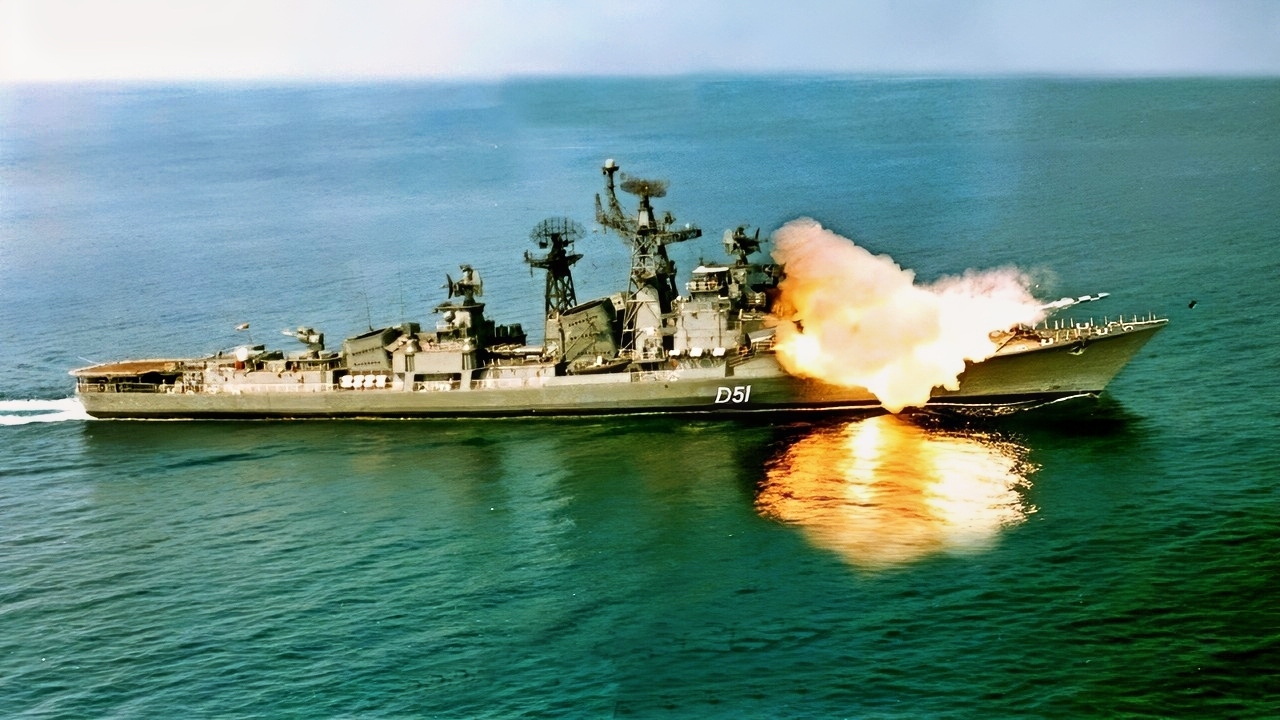
The BrahMos, jointly developed by India and Russia, is among the world’s fastest operational cruise missiles. And recently, National Security Journal attended a Defense Forum in Malaysia, where mockups of the missile were displayed. We have images below from that event for you to take a look at.
Built on a partnership established in 1998, the BrahMos is named after the Brahmaputra and the Moskva Rivers.
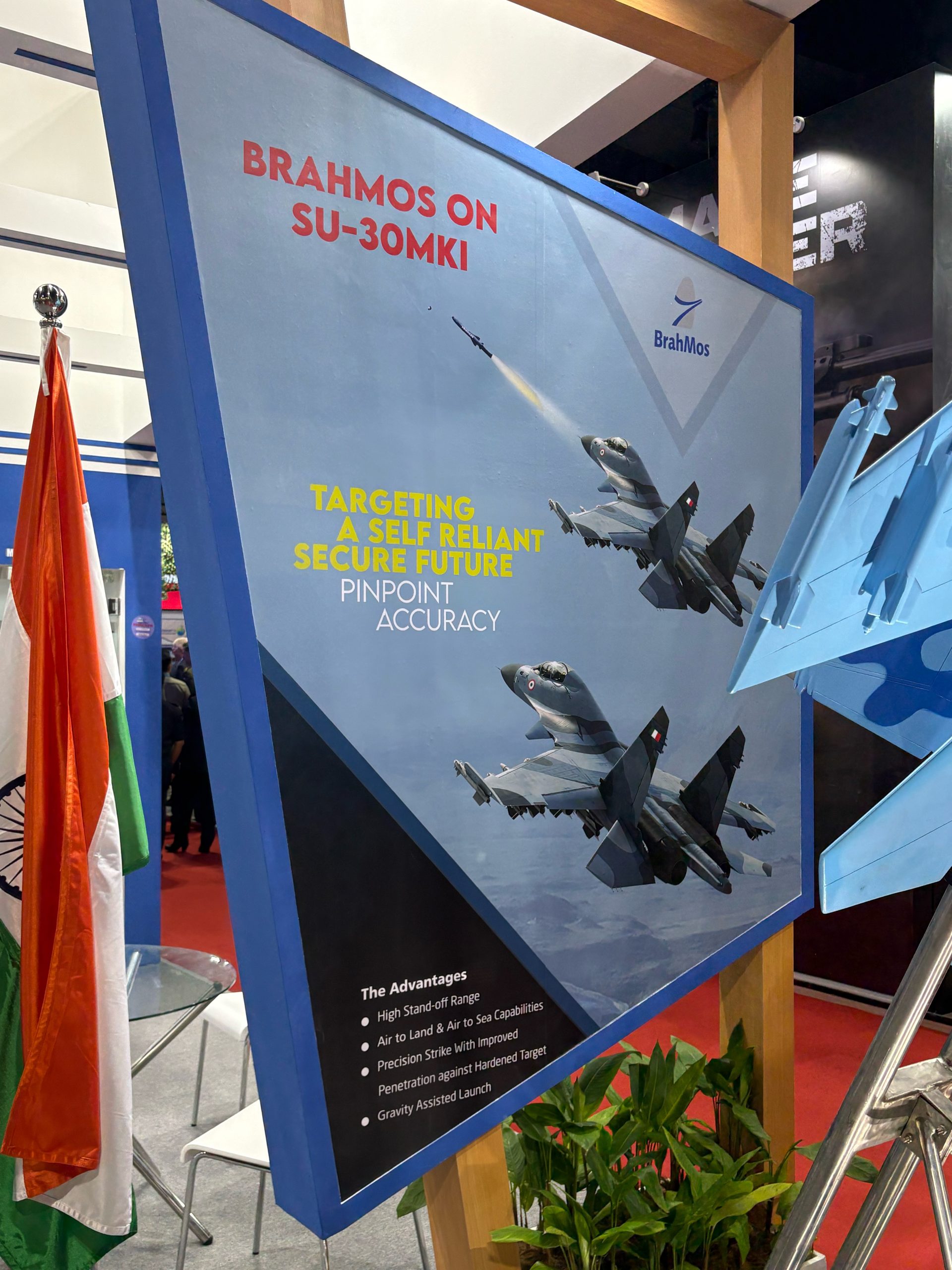
BrahMos Exhibit in Malaysia. National Security Journal Original Image.
Unlike traditional subsonic cruise missiles, the BrahMos maintains continuous supersonic speed, designed to overwhelm modern air defenses through speed and compressed reaction time.
Indeed, the BrahMos represents a major shift away from stealth-focused cruise missiles toward brute-force high-speed penetration.
Why the BrahMos Matters
The BrahMos, a multi-role supersonic cruise missile, can be used in a variety of roles, including anti-ship, land-attack, and bunker-strike missions.
The core advantage of the platform is the speed, of course, topping out near Mach 3.
The maximum speed—nearly three times the speed of sound—dramatically shortens the enemy’s reaction window, making it harder to track or intercept.
Then, if the BrahMos reaches its target, the kinetic energy generated at Mach 3 speeds is immense; the impact energy is 9 times that of a subsonic cruise missile.
And that’s all before the warhead detonates; even before detonation, the BrahMos can inflict massive structural damage simply through kinetic force.
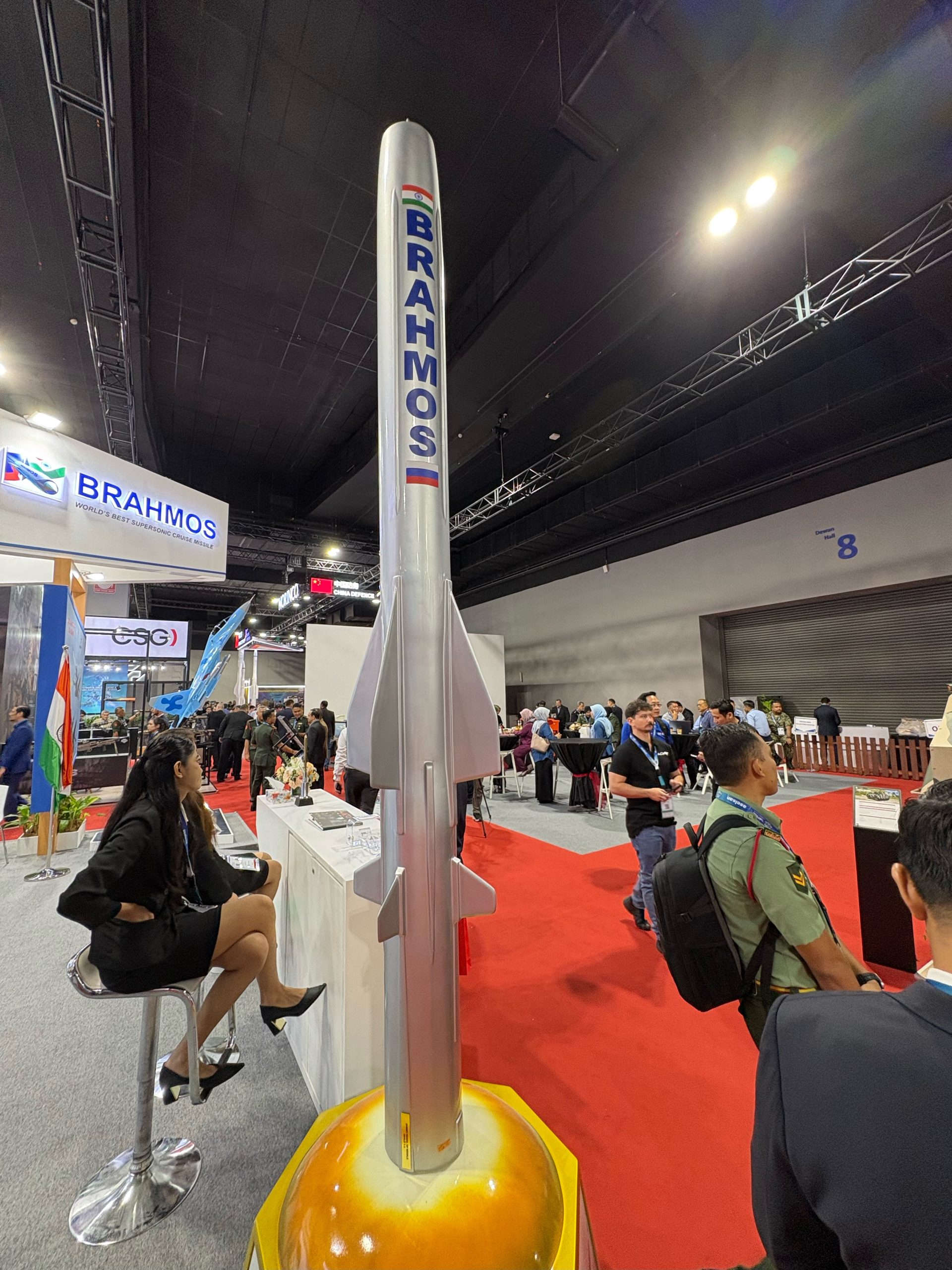
BrahMos Exhibit in Malaysia. National Security Journal Original Image.
Two-Stage Propulsion System
The BrahMos depends on a two-stage propulsion system. Stage 1 features a solid rocket booster that launches the missile from a canister and rapidly accelerates it beyond Mach 1. The booster is then discarded after burnout, at which point Stage 2 kicks in. Stage 2 features a liquid ramjet.
With no moving compressor blades, the missile’s speed is generated from the compression of incoming air (air intakes open after supersonic transition); then fuel is injected into the compressed airflow.
The result is sustained supersonic cruise throughout the entire flight profile. This system differs significantly from a Tomahawk, which relies on a turbofan and is limited to subsonic speeds.
The BrahMos’s propulsion architecture prioritizes speed and survivability over fuel efficiency or stealth; the two-stage propulsion system enables this.
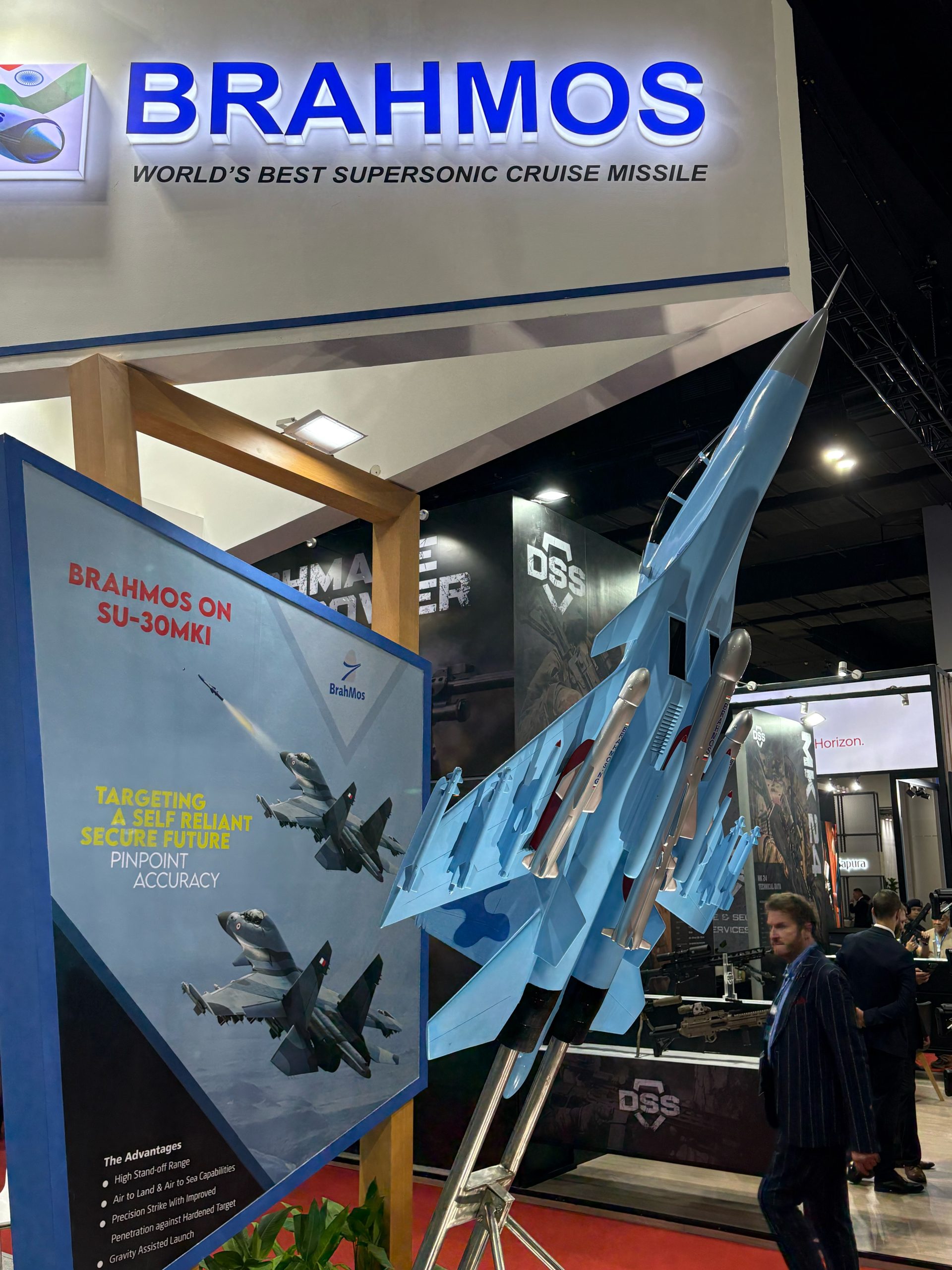
BrahMos Exhibit in Malaysia. National Security Journal Original Image.
Guidance and Targeting System
The BrahMos is a “fire and forget” weapon, meaning no operator input is required after launch. Instead, the BrahMos features a three-layered guidance architecture. The first layer is an Inertial Navigation System (INS) that uses laser gyroscopes and accelerometers.
The system is fully autonomous and immune to GPS jamming.
The second layer is midcourse satellite correction, enabled by a G30M navigation chip that integrates GPS, GLONASS, and the Indian GAGAN system. And last, the third layer is a terminal seeker, specifically an active X-band radar seeker that initiates engagement at 50–70 kilometers from the target and tracks moving ships autonomously.
Through a combination of autonomous navigation and terminal precision guidance, the BrahMos is capable of striking both fixed and moving targets with extreme precision.
Flight Profile
The BrahMos can operate in different flight profiles.
In sea-skimming mode, it flies at an altitude of just 3–10 meters above the ocean.
This is a surreptitious operating mode; the curvature of the Earth masks the missile from radar at such low altitudes, so target ships detect it only seconds before impact.
In land-attack mode, the BrahMos can cruise to an altitude of up to 15 kilometers before executing a steep terminal dive. For terminal maneuvers, the missile performs high-G “S” maneuvers in the final seconds before impact.
These are intended to overwhelm CIWS systems, like the Phalanx. In all, the BrahMos is engineered to shorten defensive reaction time, making the missile exceedingly difficult to intercept.
Flexible Deployment
The BrahMos can be deployed from different systems, including land-based launchers, naval VLS systems, aircraft, and submarines.
The BrahMos-A, for example, is an air-launched variant, integrated onto the Su-30MKI fighter.
But the missile is common across services, which simplifies logistics, production, and training. The BrahMos serves as a modular joint-force weapon system.
Strategic Implications
The BrahMos is ideal for Anti-Access/Area-Denial (A2/AD).
In anti-ship configurations, the BrahMos poses a threat to capital ships, such as US carriers, which could be forced to operate farther offshore.
As such, the BrahMos constitutes an asymmetric threat, as coastal missile batteries—far cheaper than blue-water fleets—can threaten major naval assets.
Naturally, the BrahMos is becoming an important feature of Indo-Pacific anti-ship deterrence strategy.
About the Author: Harrison Kass
Harrison Kass is a writer and attorney focused on national security, technology, and political culture. His work has appeared in City Journal, The Hill, Quillette, The Spectator, and The Cipher Brief. He holds a JD from the University of Oregon and a master’s in Global & Joint Program Studies from NYU. More at harrisonkass.com.


