

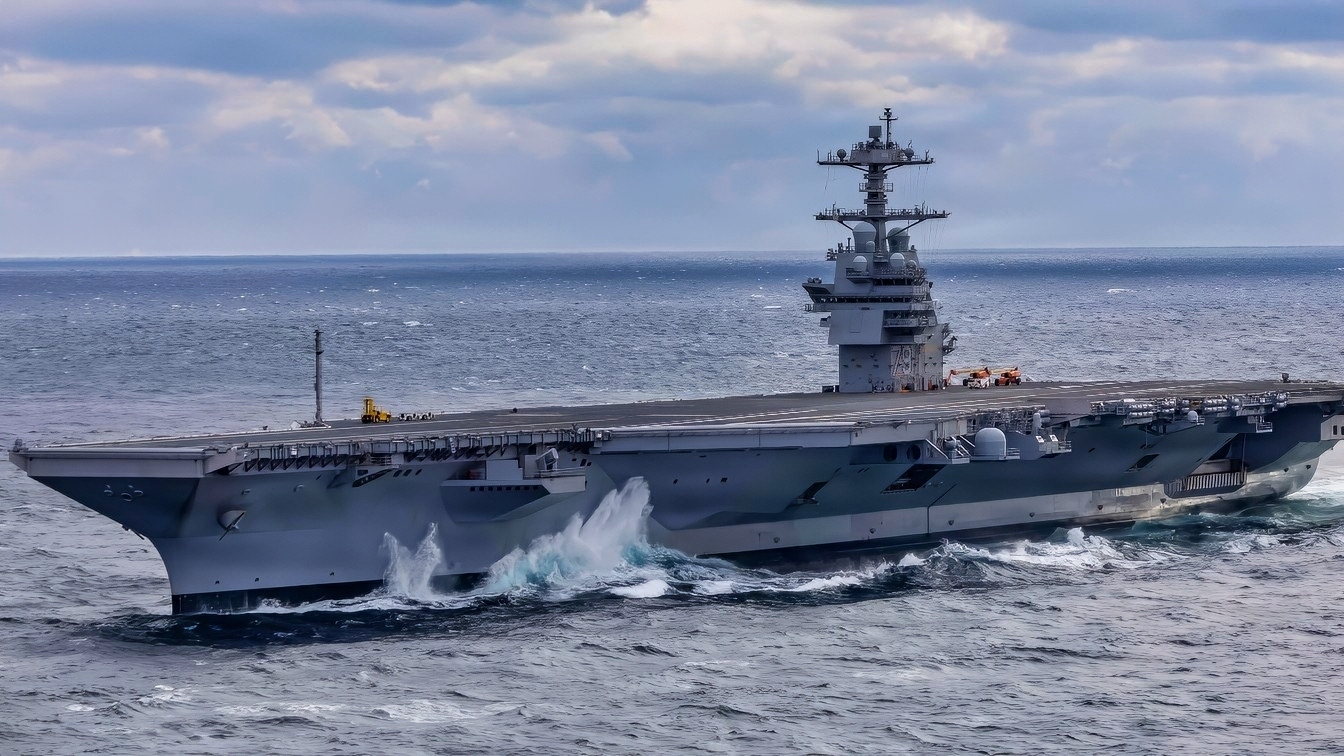
After spending $13 billion on the USS Gerald R. Ford, the U.S. Navy deployed the most advanced aircraft carrier ever built to the Middle East. The ship suffered clogged toilets that forced a retreat from combat, a laundry fire that rendered crew quarters uninhabitable, weapons-elevator failures, a malfunctioning electromagnetic aircraft launch system, and deck plating that could not withstand the heat from F-35 jet exhaust. Some critics now compare the Ford to Russia’s Admiral Kuznetsov, once a symbol of Soviet ascendancy but ultimately a drain on Moscow’s resources. It might be time to call the aircraft carrier era over.
The U.S. Navy Can’t Quit the Aircraft Carrier

Admiral Kuznetsov Aircraft Carrier Russia. Image Credit: Creative Commons.

Admiral Kuznetsov back in 2011. Image Credit: Royal Navy.
Going into the 1980s, most of the world perceived that the Soviet Union was riding higher than the United States. Indeed, following the disastrous presidency of Jimmy Carter, many believed that the United States, rather than the Soviet Union, was in relative decline. Around that time, the Soviets started investing in new capabilities and military technology. There was even a push to build a full-blown aircraft carrier for the Soviet Navy (until then, the Soviets preferred other platforms rather than aircraft carriers).
Over time, though, the Soviet aircraft carrier that became known as the Admiral Kuznetsov was a certifiable disaster. At the time of its conception, the Soviets and the world perceived the Admiral Kuznetsov as a symbol of Soviet ascendancy. By the end of the 1980s, that carrier program became the symbol of the USSR’s catastrophic decline.
Today, there is widespread perception that the United States is in terminal decline, despite the current administration claiming that we are in a “golden age.” The Trump administration promised to reinvigorate the American military through exponentially increasing military budgets.
The Trump administration has signed off on a bevy of new defense platforms, such as the F-47 sixth-generation warplane, while urging the Navy’s underperforming shipyards to produce new units of the Ford-class aircraft carriers faster.

NGAD F-47 Fighter. Image Credit: Creative Commons.
Yet reports indicate that the next Ford-class carrier, the John F. Kennedy, has been delayed. Those delays come after the Navy assured Congress that no further delays would occur with successive models of the Ford-class, because they had allegedly worked out all the technical complications that arose from the construction of the USS Gerald R. Ford.
That ship, the namesake of her class, was wildly delayed due to cost overruns and major technological issues.
The USS Gerald R. Ford’s Middle East Debacle
After the USS Gerald R. Ford’s abysmal performance in the Middle East, having spent $13 billion on that ship, Washington is now seriously reconsidering its commitment to these purportedly advanced (read “expensive”) aircraft carriers, which clearly are not delivering any significant return on investment.
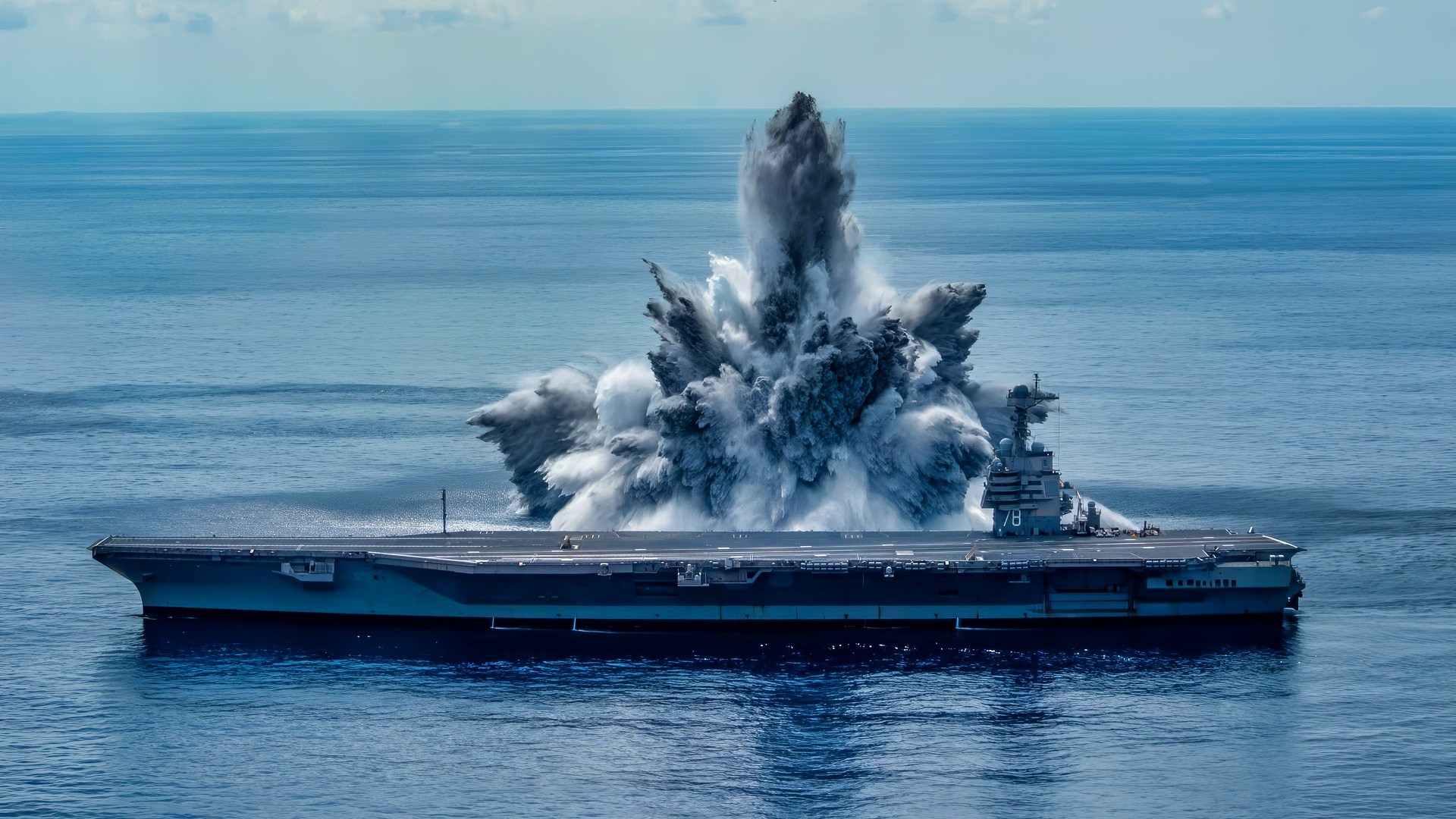
The aircraft carrier USS Gerald R. Ford (CVN 78) successfully completes the third and final scheduled explosive event of Full Ship Shock Trials while underway in the Atlantic Ocean, Aug. 8, 2021. The U.S. Navy conducts shock trials of new ship designs using live explosives to confirm that our warships can continue to meet demanding mission requirements under harsh conditions they might encounter in battle. (U.S. Navy photo by Mass Communication Specialist 3rd Class Novalee Manzella)

The aircraft carrier USS Gerald R. Ford (CVN 78) completes the first scheduled explosive event of Full Ship Shock Trials while underway in the Atlantic Ocean, June 18, 2021. The U.S. Navy conducts shock trials of new ship designs using live explosives to confirm that our warships can continue to meet demanding mission requirements under harsh conditions they might encounter in battle. (U.S. Navy photo by Mass Communication Specialist 3rd Class Riley B. McDowell)
In fact, one cannot help but be reminded of the shambolic showing of the Admiral Kuznetsov, once billed as the future of Soviet naval airpower, over the years, when thinking about the disastrous displays in the Middle East that the Gerald R. Ford put on.
Everything from purportedly clogged toilets necessitating a temporary retreat from the Iran War’s battlefields so the Navy could fix them in port to a supposed laundry fire that was so serious it rendered most of the crew’s living quarters uninhabitable while forcing the carrier to again flee the battlespace for the safety of a port, first in Greece but then, oddly, in Croatia.
Even before Ford made it to the US Central Command’s (CENTCOM) area of responsibility (AOR), the carrier was struggling. That’s a strange sentence to write, considering that on paper, the USS Gerald R. Ford is the largest, most advanced aircraft carrier ever built.
The Endless Technical Problems of the Ford-Class
After all, it took years to make the carrier’s newfangled electromagnetic aircraft launch system (EMALS) function properly and to ensure that its Advanced Arresting Gear (AAG), critical for maritime flight operations, worked the way it was supposed to. Then there was the problem of the weapons elevators not working. That’s kind of a big deal.

The world’s largest aircraft carrier USS Gerald R. Ford (CVN) 78 and the USNS Laramie (T-AO-203) conduct a refueling-at-sea in the Eastern Mediterranean Sea, Oct. 11, 2023. USS Gerald R. Ford is the Navy’s newest and most advanced aircraft carrier, representing a generational leap in the U.S. Navy’s capacity to project power on a global scale. The Gerald R. Ford Carrier Strike Group is currently operating in the Eastern Mediterranean Sea, at direction of the Secretary of Defense. The U.S. maintains forward deployed ready and postured forces to deter aggression and support security and stability around the world. (U.S. Navy photo by Mass Communication Specialist 2nd Class Jackson Adkins)
Without any ability to move those weapons to their planes, you’ve created a combat-ineffective warship.
And let’s not forget the ongoing humiliation of the USS Gerald R. Ford being unable to deploy F-35s because the deck plating cannot handle the intense heat generated by the plane’s jet blast.
Mind you, Ford-class carriers were supposed to carry the F-35 Lightning II fifth-generation warplanes as their main plane.
America’s Version of the Admiral Kuznetsov?
Ok, it’s not as bad as the Admiral Kuznetsov.
Given the amount of time, money, and resources–coupled with the abject humiliation this underperforming carrier has visited upon the once mighty American superpower–it might, in fact, be relatively worse for the Americans than the Admiral Kuznetsov debacle was for the Soviet Union.
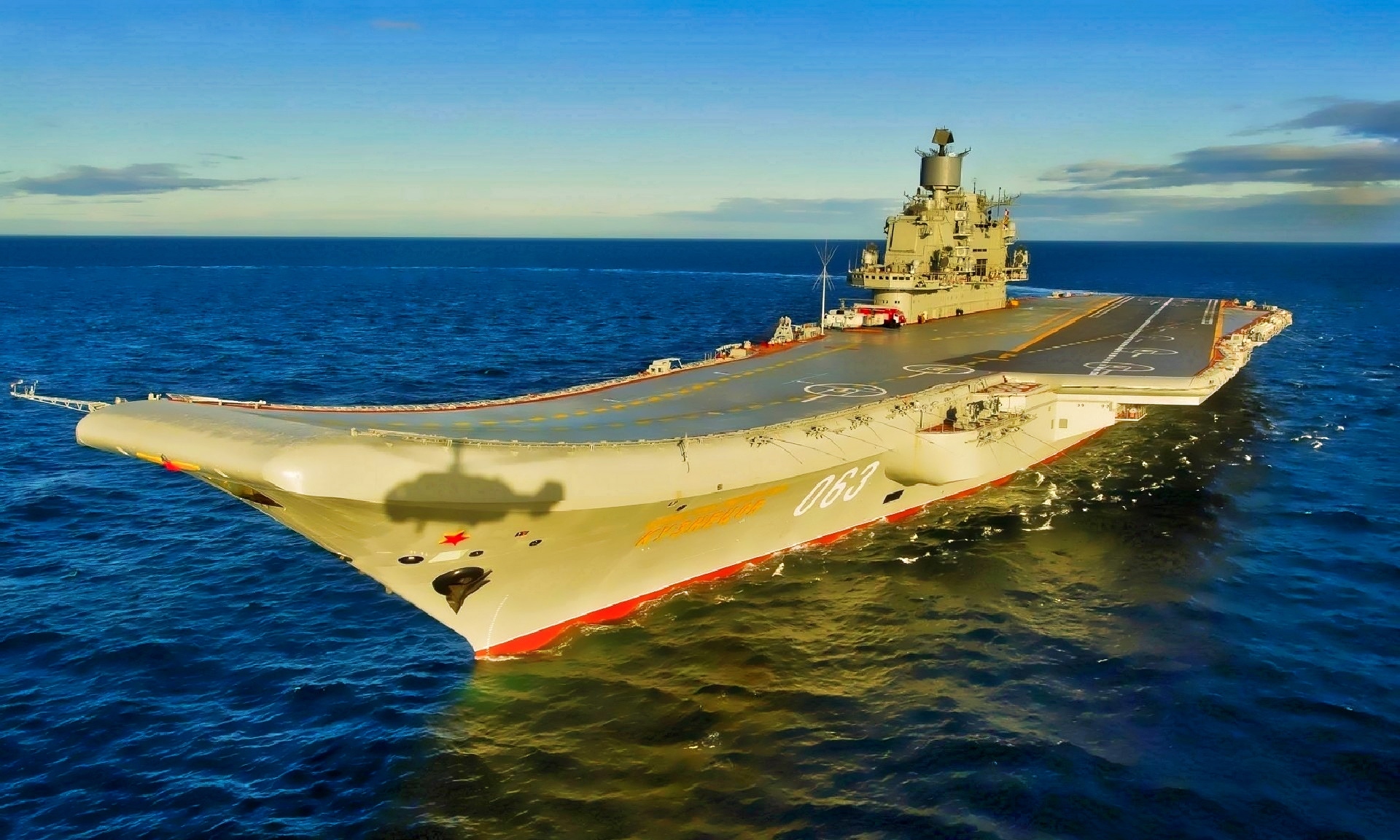
Admiral Kuznetsov Aircraft Carrier. Image Credit: Creative Commons.

Admiral Kuznetsov Russia Aircraft Carrier. Image Credit: Creative Commons.
At the time of the plumbing issues on the Ford and the subsequent laundry fire, many in the global media speculated that there was more to the story than was let on. Some claimed that the crew sabotaged their own sewage system to prevent yet another deployment of the carrier into a combat zone (all official sources have categorically denied this).
Meanwhile, others asserted that Iranian anti-ship fire hit the carrier. That, too, was denied by all official sources. On some level, if these stories were true, it would make it harder to dismiss the Ford as the American version of the Admiral Kuznetsov.
As it stands, however, the Navy insists that there was only a clogged toilet and a random laundry fire that erupted mid-battle.
So, it looks like the Ford is really just a big dud of an aircraft carrier, the way that Russia’s Admiral Kuznetsov was.
Now, the Ford is limping home after its global humiliation, where it will be kept at the shipyard for a minimum of 14 months of overhaul, at least that’s how I see it. One can assume, given the extent of wear and tear put on this new carrier and the turgid capacity of America’s naval shipyards, that the Ford will stay in the shipyard for far longer than that timeline.
The Aircraft Carrier Trap
The Navy’s decision to finally start questioning the wisdom of its continued support for the Ford-class is about a decade too late.
One might say that it’s better late than never. Indeed, that is true. Because even if the Ford went unscathed from enemy fire in its recent deployment to the Middle East, the fact is that all of America’s iconic aircraft carriers are quickly becoming sitting ducks in the age of anti-access/area-denial (A2/AD) warfare.
Rival states, like China, Russia, Iran, and North Korea, all have expansive anti-ship missile, drone, and hypersonic weapons capabilities that can target and destroy the flight decks, for instance, of American carriers. China has systems that could potentially sink an American carrier (although that is a more daunting task than it sounds).
Given the rise of A2/AD doctrines, the expansion of enemy anti-ship ballistic missiles (ASBM), drone swarms, and even hypersonic weapons, is it really wise to concentrate 5,000 sailors and dozens of aircraft onto a single $13 billion platform?
Finally, the Navy is starting to ask the tough questions: has the maritime branch allowed its surface warfare capability to become completely beholden to the aircraft carrier? Is this expensive system increasingly obsolete?
How America Avoids the Admiral Kuznetsov Trap
What’s more, how does the US Navy avoid the Admiral Kuznetsov Trap?
You see, even though the Russians were nowhere near as invested in their limited carrier capability, Moscow continued pouring gobs of their tax dollars into maintaining what was inherently a broken ship for far longer than anyone thought was possible (or necessary).
By the time that Moscow finally concluded the Admiral Kuznetsov was not worth sustaining, the carrier had become a massive drain on Russian resources and a strategic distraction from other, more important systems the Russian Navy needed to maintain and expand.
Similarly, the Americans have (on a grander scale) continued pouring boatloads of tax dollars into maintaining and expanding their aircraft carrier force. Fears of being left behind or of allowing an enemy, such as China, to catch up to that capability have fueled continued support for carriers within the Navy.
After the abysmal showing of the Ford in the Middle East, however, critics of America’s carriers are impossible to ignore.
The Ford-Class Reveals a Deeper American Crisis
For 80 years, the aircraft carrier has symbolized uncontested American maritime supremacy.
Today, sadly, the Navy is facing a bleaker reality. The country’s industrial base isn’t working; maintenance pipelines are overloaded; deployment cycles are growing longer; and peer competitors possess precision-strike capabilities the Navy has not faced in decades.
The Ford-class embodies the schizophrenia of America’s current surface warfare strategy. It is at once the most technologically advanced carrier ever made. But that advanced system has been paired with spiraling costs and tactical mediocrity.
America must wake up to the fact that the modern battlefield has shifted away from exquisite platforms like aircraft carriers. If it does not realize this now, then Gerald R. Ford becomes America’s Admiral Kuznetsov on a larger, more humiliating scale.
About the Author: Brandon J. Weichert
Brandon J. Weichert is a Senior National Security Editor. Recently, Weichert became the editor of the “NatSec Guy” section at Emerald. TV. He was previously the senior national security editor at The National Interest. Weichert hosts The National Security Hour on iHeartRadio, where he discusses national security policy every Wednesday at 8 p.m. Eastern. He hosts a companion show on Rumble entitled “National Security Talk.” Weichert consults regularly with various government institutions and private organizations on geopolitical issues. His writings have appeared in numerous publications, among them Popular Mechanics, National Review, MSN, and The American Spectator. And his books include Winning Space: How America Remains a Superpower, Biohacked: China’s Race to Control Life, and The Shadow War: Iran’s Quest for Supremacy. Weichert’s newest book, A Disaster of Our Own Making: How the West Lost Ukraine, is available for purchase at any bookstore. Follow him via Twitter/X @WeTheBrandon.


