

The USS Gerald R. Ford has now spent more than 10 months deployed since leaving Naval Station Norfolk in June 2025, making it the longest post-Vietnam deployment by a U.S. aircraft carrier and highlighting the growing strain across the Navy as global crises continue to stretch America’s carrier fleet across multiple regions simultaneously. The carrier, which departed Virginia on June 24, 2025, has spent the past year operating across Europe, the Caribbean, and the Middle East during a deployment that ultimately expanded into operations connected to Venezuela and the 2026 Iran conflict. By mid-April, Ford had surpassed the previous modern deployment record of 295 days set by USS Abraham Lincoln during the COVID-19 era.
The USS Gerald R. Ford Is Coming Home, Not a Moment Too Soon

Aviation Boatswain’s Mate (Equipment) 3rd Class Mark Ruiz, assigned to Air Department aboard the world’s largest aircraft carrier, USS Gerald R. Ford (CVN 78), prepares a Carrier Air Wing 8 F/A-18E Super Hornet attached to Strike Fighter Squadron 37 for launch on the flight deck, Aug. 1, 2025. Gerald R. Ford, a first-in-class aircraft carrier and deployed flagship of Carrier Strike Group Twelve, is on a scheduled deployment in the U.S. 6th Fleet area of operations to support the warfighting effectiveness, lethality and readiness of U.S. Naval Forces Europe-Africa, and defend U.S., Allied and partner interests in the region. (U.S. Navy photo by Mass Communication Specialist 2nd Class Mariano Lopez)
The long deployment has proven controversial – and for multiple reasons.
For the most part, the decision to extend the Navy’s newest carrier’s deployment reflects growing and sustained operational pressure on the Navy.
Although the service officially maintains 11 nuclear-powered aircraft carriers, only a fraction are fully deployable at any given time due to maintenance cycles and repair schedules. Ford’s extended deployment came as the Pentagon sought to sustain deterrence operations near Iran, maritime security missions in the Red Sea, NATO patrols near Europe, and operations in Venezuela.
From Europe to Venezuela to Iran
Ford originally deployed to the Mediterranean as part of routine European operations tied to NATO deterrence efforts following continued tensions with Russia after the Ukraine War. But the carrier’s mission rapidly expanded as global crises intensified. Earlier this year, Ford was redirected toward the Caribbean to support operations connected to the Trump administration’s pressure campaign against Venezuela. The carrier participated in missions linked to operations that ultimately culminated in the capture and arrest of Venezuelan President Nicolás Maduro.
Soon afterward, Ford was redirected again toward the Middle East as tensions with Iran escalated into open conflict.
The carrier later supported Operation Epic Fury, with its embarked air wing participating in strike operations and regional deterrence patrols.
The deployment eventually saw Ford placed alongside multiple other U.S. carrier strike groups in the region, creating one of the Navy’s largest Middle East carrier deployments since the early days of the Iraq War in 2003. The deployment has proven that aircraft carriers, despite becoming increasingly vulnerable to drones and long-range “carrier killer” missiles, remain central to U.S. military strategy because they enable sustained combat air operations without relying entirely on vulnerable regional air bases.
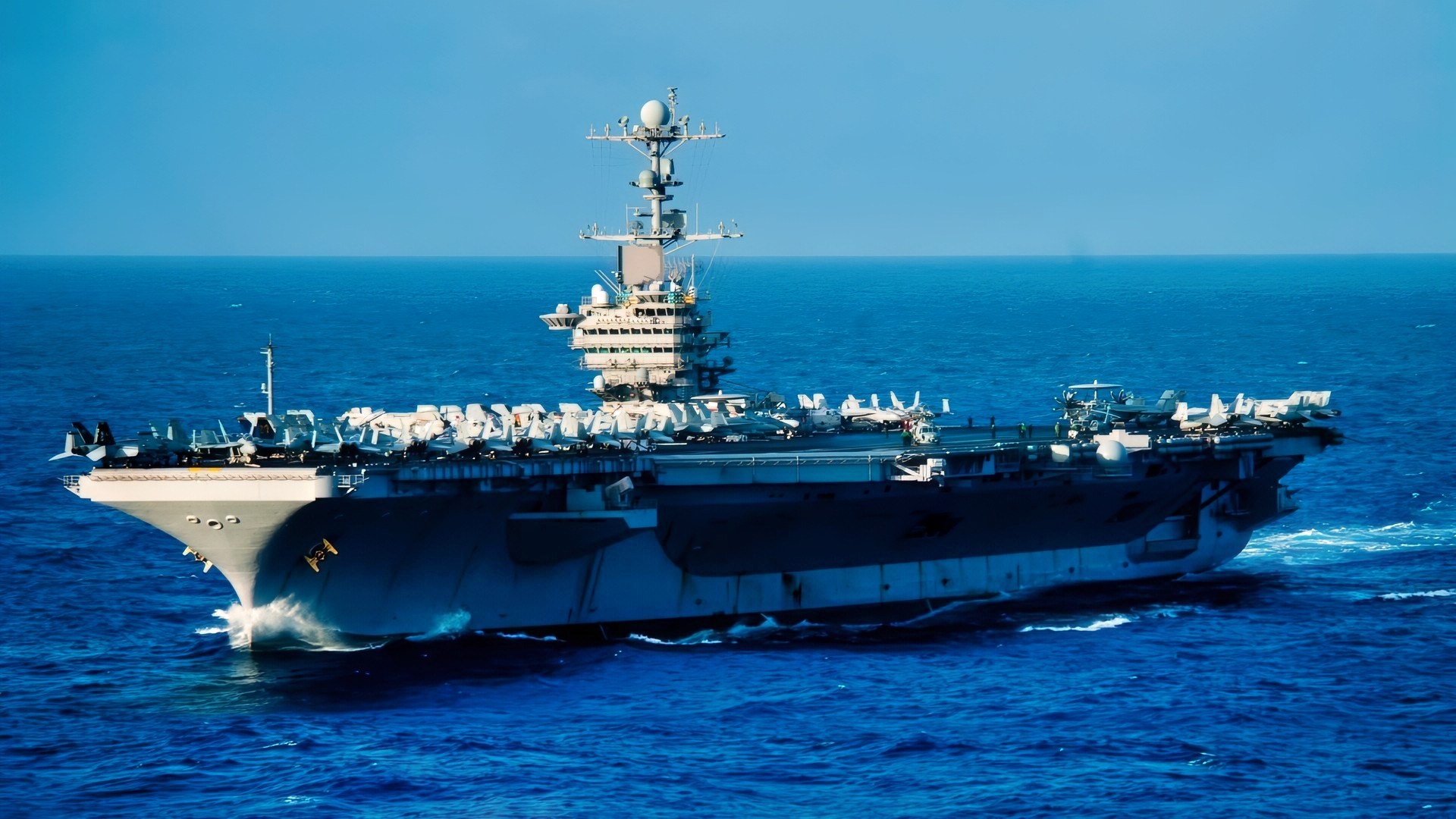
PACIFIC OCEAN (Feb. 9, 2012) The Nimitz-class aircraft carrier USS John C. Stennis (CVN 74) transits the Pacific Ocean. John C. Stennis is operating in the U.S. 7th Fleet area of responsibility while on a seven-month deployment. (U.S. Navy photo by Mass Communication Specialist 3rd Class Kenneth Abbate/Released)

Aug. 8, 2017 – The Arleigh Burke-class guided-missile destroyer USS Donald Cook (DDG 75) maneuvers between the Ticonderoga-class guided-missile cruiser USS Philippine Sea (CG 58), left, and the Nimitz-class aircraft carrier USS George H. W. Bush (CVN 77), right, for a photo exercise during exercise Saxon Warrior 2017, Aug. 8. Saxon Warrior is a United States and United Kingdom co-hosted carrier strike group exercise that demonstrates allied interoperability and capability to respond to crises and deter potential threats. (U.S. Navy photo by Mass Communication Specialist 1st Class Theron J. Godbold /Released)
At the same time, the deployment also illustrated how finite the carrier fleet is. The Navy operated 15 deployable carriers during the late Cold War, but now maintains 11 while simultaneously struggling with maintenance backlogs and shipbuilding delays.
Fire, Plumbing, and Maintenance Problems Galore
The extended deployment has placed a heavy strain on both the crew and the ship, exposing serious maintenance and quality-of-life issues aboard the carrier. In March, Ford suffered a major non-combat fire in its laundry facilities while operating in support of operations connected to Iran. The blaze damaged nearby berthing areas and reportedly displaced roughly 600 sailors after sleeping compartments were damaged by smoke and fire.
The carrier was later forced to undergo repairs in the Mediterranean, making stops near Greece and later in Split, Croatia. Reports indicated that sailors temporarily slept on floors and tables after the fire damaged mattresses and berthing spaces.
At the same time, Ford continued to experience recurring plumbing and sewage system problems during deployment.
Multiple reports described recurring failures involving the carrier’s vacuum waste system, including widespread toilet failures and sanitation issues affecting other crew living spaces.
The problems are particularly significant because Ford is supposed to represent the Navy’s next-generation carrier design.
The Ford-class introduced advanced systems, including electromagnetic aircraft launch technology, increased automation, and redesigned shipboard infrastructure intended to reduce manpower requirements and improve sortie generation rates. Instead, the class has faced years of technical scrutiny involving launch systems, weapons elevators, and maintenance complexity.
Norfolk Families Feel the Effects
Back in Virginia, military support organizations say the nearly year-long deployment is affecting sailors’ families financially and emotionally. According to an NPR report, many families originally expected Ford’s deployment to follow a more traditional six-to-seven-month timeline, only for the ship to be repeatedly redirected into new operations.
Some spouses have also described severe delays receiving packages and mail as the carrier rapidly moved between theaters.
A number of local organizations support military families in the Norfolk area, and representatives say the strain is becoming increasingly visible as the deployment drags on.
Blue Star Families, which recently opened a chapter in Norfolk, told NPR that many families are struggling financially and emotionally during the prolonged deployment.
“We’re hearing from families on the Ford that they are struggling. They’re struggling financially because a lot of them can’t keep working and are single-parenting. We’re hearing that people’s plans were disrupted and that they can’t make the next plan because they don’t know what’s going to happen, and so that puts them in a kind of limbo,” Blue Star Families CEO Kathy Roth-Douquet said.
Meanwhile, the Armed Services YMCA of Hampton Roads says demand at its food pantry has surged.
Ford’s record-breaking deployment has become a very visible example of the growing operational pressure facing the modern U.S. Navy as it attempts to sustain simultaneous global crises with a limited number of ships and constrained maintenance capacity.
About the Author: Jack Buckby
Jack Buckby is a British researcher and analyst specializing in defense and national security, based in New York. His work focuses on military capability, procurement, and strategic competition, producing and editing analysis for policy and defense audiences. He brings extensive editorial experience, with a career output spanning over 1,000 articles at 19FortyFive and National Security Journal, and has previously authored books and papers on extremism and deradicalization.


