


China’s J-15 Flying Shark, the backbone of the PLAN’s carrier air wing, traces its origin to a single T-10K-3 Su-33 prototype that Beijing bought from Ukraine in 2001. Russia had refused to sell production Su-33s unless China ordered at least 50, citing past Chinese reverse-engineering of the Su-27 into the J-11. Beijing reverse-engineered the aircraft instead. Early J-15s used Russian AL-31F engines; since 2022, newer J-15T variants fly on domestically produced WS-10B engines. In 2025, Chinese state media released footage of the J-15T performing launch and recovery tests on the EMALS-equipped Type 003 Fujian — the PLAN’s first catapult-launched naval fighter operation.
China’s J-15 Fighter Comes From Ukraine
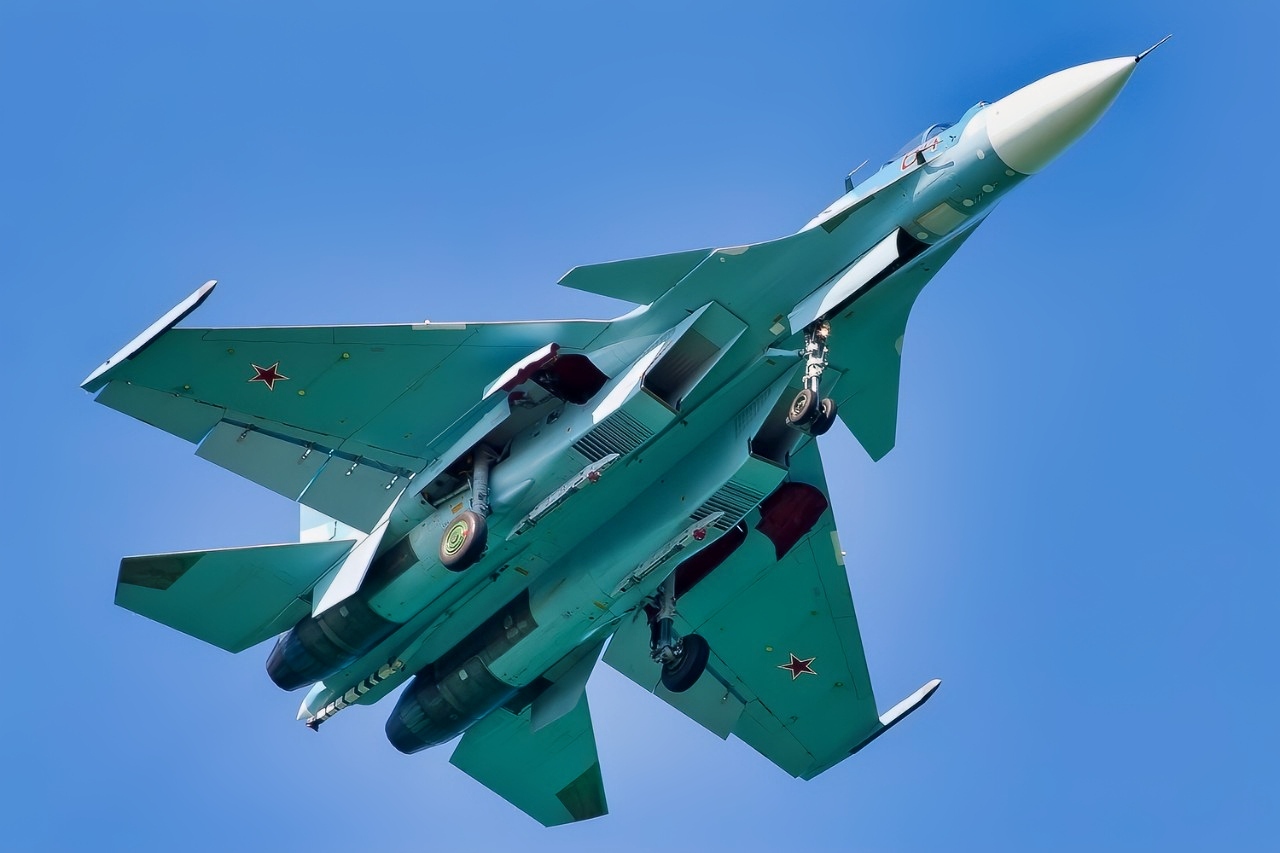
Su-33 Flanker from Russia. Image Credit: Creative Commons.

Sukhoi Su-33 launching from the Admiral Kuznetsov.

Sukhoi Su-33 launching from the Admiral Kuznetsov.
The J-15 “Flying Shark” (NATO designation: Flanker-X2) currently forms the backbone of China’s naval air wing. The aircraft is based on the Soviet Su-33, a navalized version of the Su-27 Flanker.
Unlike its Soviet counterpart, the J-15 is equipped with Chinese avionics and domestically made engines. The aircraft operates primarily on the Type 001 and Type 002, both of which use ski-jump ramps.
Recently, however, a newer version of the aircraft was developed to operate on the CATOBAR configuration of the Type 003 Fujian aircraft carrier. While J-15 may have Soviet origins, it has become a uniquely Chinese aircraft thanks to ongoing modernization efforts.
Development of China’s First Naval Aircraft
Development on the J-15 began in 2001, when China bought the T-10K-3, a prototype of the Su-33, from Ukraine.
Immediately after the acquisition, China sought to reverse-engineer the aircraft despite the prototype’s incompleteness.
Another prototype, T-10K-7, was purchased from Ukraine in 2004, giving the PLAN a better understanding of the aircraft, particularly its modifications for naval use.
These prototypes, along with the Shenyang Aircraft Corporation’s experience on the J-11, provided China with the experience necessary to create its own naval aircraft.
Despite this, China still attempted to acquire the Su-33 from Russia on several occasions.
These agreements never materialized, in part because Russia had already ceased Su-33 production and agreed to sell the aircraft only if China ordered a large batch of at least 50 aircraft.
The Russians were also wary of any deals, since the CCP had violated intellectual property agreements by reverse-engineering the Su-27 to create the J-11. The idea of buying a large number of Su-33s was unattractive to the PLAN, as the top brass believed the aircraft would become obsolete in the coming years.
China, therefore, opted to develop its own naval aircraft, using the prototypes purchased from Ukraine as a basis.
Design and Specs
From the outside, the J-15 and the Su-33 are almost indistinguishable.
It retains the same basic design and wing layout as the Flanker, along with the canards found on the Su-33. The aircraft’s structure is reinforced for carrier operations and is equipped with a tailhook and strengthened landing gear.
The aircraft also uses more composite materials than its Soviet counterpart to improve aerodynamic performance and shave off excess weight. This gives the aircraft a similar, if not better, aerodynamic profile than its predecessor, along with excellent maneuverability.
Early versions of the aircraft were equipped with Russian-made AL-31F engines as a stopgap measure.
This gave the aircraft a top speed of Mach 2.17 and a range of around 690 nautical miles.
The PLAN, however, was unhappy with this configuration, as it viewed the engines as the aircraft’s greatest weakness.
Some prototypes used WS-10H engines, but none entered mass production.
In 2022, the J-15 was fitted with domestically produced WS-10B engines, which reportedly deliver greater thrust and significantly increase the aircraft’s range.
Since then, J-15T and other newer variants of the aircraft have utilized the new engines.
Avionics and Sensors
What truly separates the J-15 from its Soviet counterpart is its avionics suite.
The aircraft is fitted with Chinese avionics and sensors, giving it capabilities that are drastically different from those of the Su-33. Early versions of the J-15 shared their avionics with the J-11B, including the Type 1493 Radar.
As a naval fighter, the aircraft was designed with enhanced air-to-ground capabilities, along with a glass cockpit and other systems whose exact specifications are as yet unknown in the West.
Over time, the aircraft has received various avionics upgrades to improve its capabilities. The most notable change is the inclusion of an advanced AESA radar, which reportedly significantly enhances its tracking and electronic warfare capabilities. Unfortunately, little information is known about these recent additions.
As a derivative of the Su-33, the J-15 was originally designed to operate from China’s ski-ramp carriers like the Type 001 Liaoning and the Type 002 Shandong.
The aircraft made its first flight from the Liaoning in 2012, proving its carrier compatibility. For a time, the aircraft experienced reliability issues.
In 2016, two aircraft crashed after experiencing issues with their flight control systems that caused them to lose control. The second crash resulted in the death of the pilot, who ejected too low to the ground for his parachute to activate.
Recent Developments
To accommodate the EMALS CATOBAR configuration on the Fujian, the J-15T was developed to operate with the new system.
In 2025, official Chinese state media released footage of the aircraft performing launch and recovery tests on the Type 003 aircraft carrier, setting a new milestone in the J-15’s service life.
The reliance on the older ski-jump configuration has long been seen as a critical limitation on the aircraft, which is too big to operate on the smaller Type 001 and Type 002 carriers in large numbers. Now aboard the Fujian supercarrier, the J-15 can be stored in larger numbers and operate alongside dedicated naval refueling aircraft to increase its overall combat range.
Despite the aircraft’s Soviet heritage, the Chinese continue to upgrade and experiment with the J-15. A twin-seat electronic warfare version of the aircraft, the J-15DH, was revealed in 2018.
This version incorporates EW pods and other specialized equipment and is also designed for CATOBAR operations.
The newest variant of the J-15, the J-15DT, is a single-seat EW aircraft that was first spotted in 2025 and features slight redesigns to its radome and modified antennas.
Despite some hiccups along the way and the introduction of the J-35 naval stealth fighter, the PLAN seems content with the aircraft and intends to keep it in service for the foreseeable future.
About the Author: Isaac Seitz
Isaac Seitz, a Defense Columnist, graduated from Patrick Henry College’s Strategic Intelligence and National Security program. He has also studied Russian at Middlebury Language Schools and has worked as an intelligence Analyst in the private sector.


