

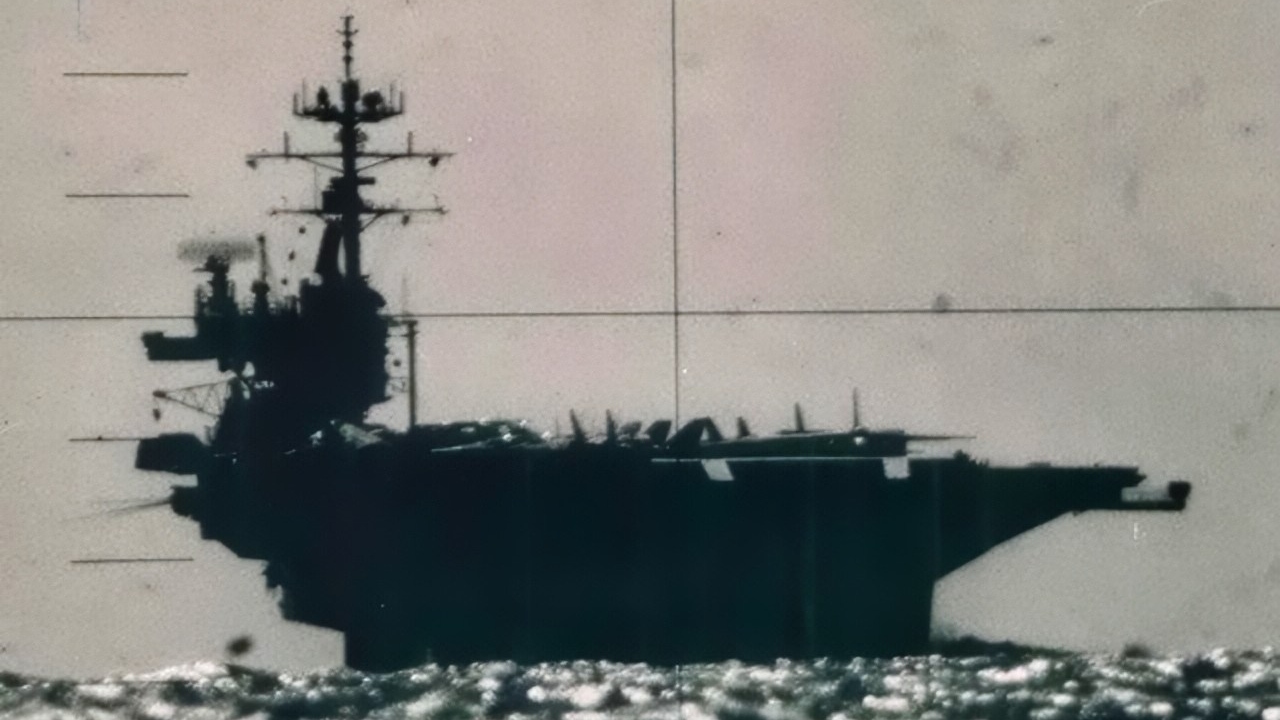
When China rolled the DF-17 through Beijing, it was unveiling a weapon built for one purpose: to sink American carriers before they get close. It flies too fast and turns too sharply for the defenses that stopped an earlier generation of missiles, and its reach covers nearly every U.S. base that matters in the Pacific. But the carrier-killer has a hidden weakness — and the Navy has built its defense around exploiting it. Whether that’s enough is the open question.
China’s DF-17 Hypersonic Missile Was Built To Kill American Aircraft Carriers — And The Navy Is Racing To Stop It

DF-17 Missile from China. Image Credit: PLA.

DF-17 Missile from China. Image Credit: Creative Commons.
China unveiled a weapon at its 2019 National Day parade that rolled past the reviewing stand looking like nothing else in the world’s arsenals, a stubby dark glider riding atop a road-mobile missile. The DF-17 was China’s first operational hypersonic weapon, and it was built around a single strategic purpose: to hold American aircraft carriers and forward bases at risk across the Western Pacific and to make the United States Navy think twice before sailing into a fight near China’s coast. Years later, it remains one of the most closely studied and most worrying pieces of hardware in the Chinese inventory, and the race to defeat it is now one of the US military’s most urgent missile-defense priorities.
From Secret Tests To A Parade Reveal
The DF-17 did not arrive overnight. American intelligence first confirmed the existence of the system’s hypersonic glide vehicle in 2014, identifying it by the early designation Wu-14 before it became publicly known as the DF-ZF. Between January 2014 and November 2017, China conducted nine flight tests of the DF-17 from the Taiyuan Satellite Launch Centre in Shanxi Province, a pace of testing that dwarfed anything the United States was doing at the time. By one US official’s accounting, China in this period conducted roughly twenty times as many hypersonic weapons tests as the United States had over the preceding decade.
The weapon was developed by China’s 10th Research Institute, also known as the Near Space Flight Vehicle Research Institute, an organization operating under the umbrella of China’s state aerospace conglomerate.
The missile that emerged is solid-fueled, measures around 11 meters in length, and weighs roughly 15,000 kilograms, with a booster derived from China’s existing DF-16 ballistic missile.
The solid-fuel design matters, because it makes the DF-17 faster to launch from a mobile transporter than a liquid-fueled missile would be, with no need for the time-consuming fueling and specialized storage that liquid propellant demands.
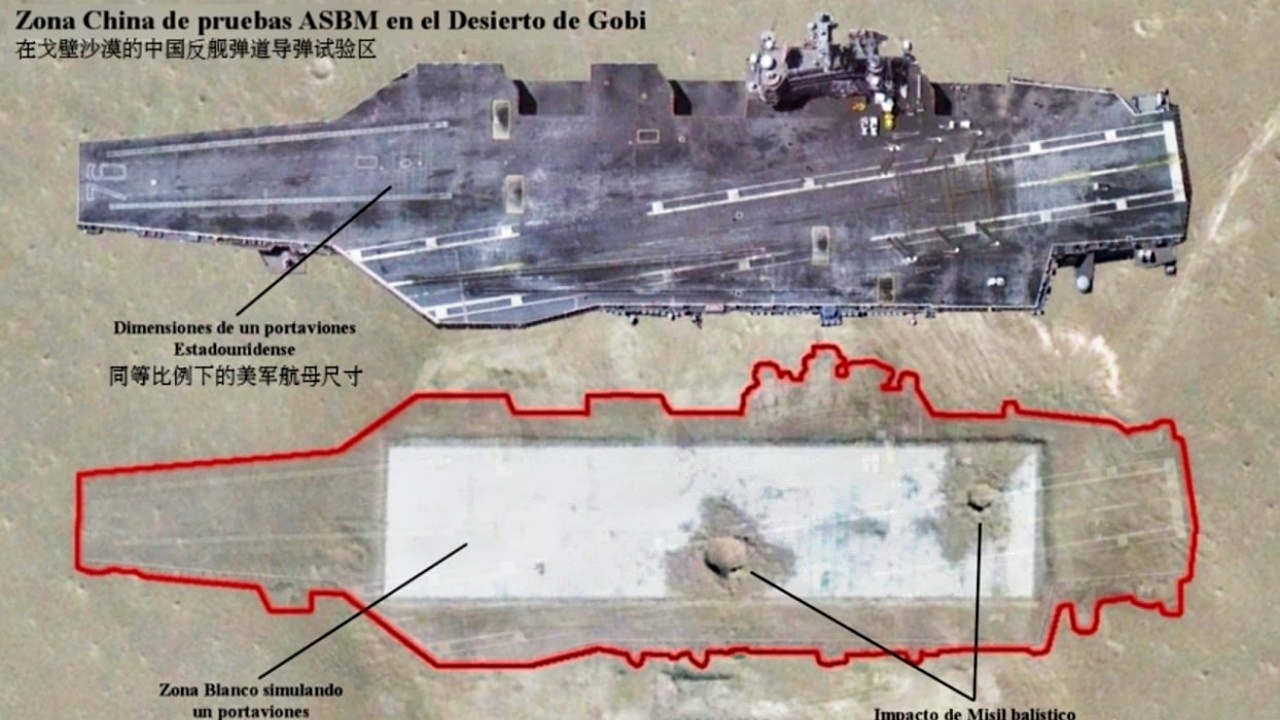
DF-26 China Missile Attack on Fake Aircraft Carrier Cut Out. Image Credit: Chinese Weibo Screenshot.
When the DF-17 rolled through Beijing on October 1, 2019, it was, by China’s own framing, the world’s first operational hypersonic weapon system to enter full service, and the DF-ZF glide vehicle it carried entered service in 2020 alongside it.
What Makes A Glide Vehicle So Hard To Stop
The DF-17’s lethality comes almost entirely from how its warhead travels, and understanding that requires distinguishing it from an ordinary ballistic missile. A traditional ballistic missile lofts its warhead on a high, predictable arc, and that predictability is what allows missile defenses to calculate where the warhead is going and position an interceptor to meet it. The DF-17 does something fundamentally different. Its booster carries the DF-ZF glide vehicle up to the edge of space, and then the glider separates and flies a flattened, maneuvering trajectory through the upper atmosphere toward its target.
The DF-ZF reportedly reaches speeds of Mach 5 to Mach 10 during its glide phase, somewhere between roughly 1.7 and 3.4 kilometers per second, while retaining the ability to change course along the way. That combination of extreme speed and in-flight maneuverability is what makes the weapon so difficult to defend against. A defender cannot simply plot the warhead’s arc and wait for it, because the glide vehicle can shift its path and its aim point, collapsing the time available to detect, track, and intercept it. The glider is also reported to be highly accurate, capable of striking within meters of its intended target, and it can be fitted with either a conventional or a nuclear warhead, an ambiguity that compounds the danger in any crisis where the defender cannot know which kind of warhead is inbound.
The Reach That Threatens The First And Second Island Chains
The DF-17’s range places the bulk of America’s Western Pacific military presence inside its reach. US intelligence assessments put the system’s range between 1,800 and 2,500 kilometers, enough to strike well out into the maritime approaches that American forces would have to use in any regional contingency. That envelope covers the major US hubs in the region, including bases in Japan, South Korea, Guam, and the Philippines, the very installations from which the United States would generate combat power in a conflict over Taiwan or the South China Sea.
It is the anti-ship role, though, that has drawn the most concern. The DF-17 and its glide vehicle were fielded to strike bases and surface combatants, and the maneuverability of the glide vehicle makes it a natural fit for hunting a moving warship.
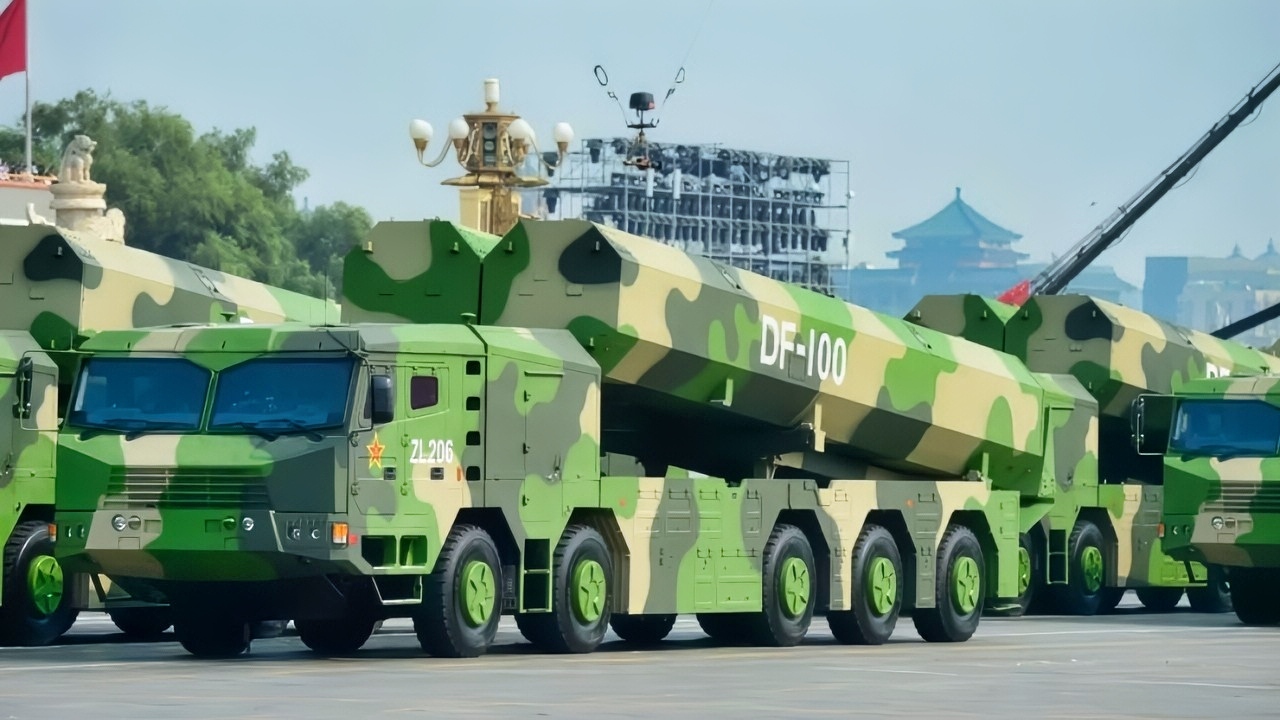
DF-100 Missiles: X Screengrab.
China’s existing anti-ship ballistic missiles, like the DF-21D, use conventional reentry vehicles that are faster but far less maneuverable than a hypersonic glider, which means the DF-17 offers Beijing a weapon that can both reach a carrier and adjust its course to track one as it tries to evade. The system sits at the center of what Chinese strategists envision as their anti-access and area-denial shield, the layered missile umbrella designed to keep American carrier strike groups so far from the Chinese coast that they cannot bring their airpower to bear.
The Kill Chain Is The Real Battleground
For all the alarm the DF-17 generates, the weapon’s effectiveness against a carrier depends on something far harder than building the missile itself. To actually hit a carrier maneuvering at sea, China has to complete an end-to-end targeting sequence that the military calls a kill chain, finding the carrier across vast stretches of ocean, fixing and continuously tracking its position, and feeding that targeting data to the missile in close to real time, all while the carrier is moving and actively trying to break the chain at every link.
A missile with the range and speed to reach a carrier is only as good as the sensor-to-shooter network that tells it where the carrier actually is at the moment of impact.
That dependency is precisely where the US Navy concentrates its defensive effort, because every link in the Chinese kill chain is something the Navy can attack. American carrier strike groups travel inside a layered defensive bubble built around the Aegis combat system, which networks shipboard radar, fire control, and interceptors into a single integrated web.
Through a system called Naval Integrated Fire Control–Counter Air, an airborne sensor node like an E-2D Hawkeye or an F-35 can feed targeting data to a ship’s fire control from beyond the horizon, giving commanders a longer window to detect an incoming threat and launch an interceptor earlier in its flight. Alongside the kinetic defenses sit non-kinetic tools, electronic warfare and high-powered microwave systems that can jam or spoof the guidance of an incoming missile, attacking the targeting picture rather than the missile itself. The Pentagon has also pressed to develop a layered defeat capability that includes left-of-launch options, sabotaging or striking missiles before they ever leave the ground.
Racing To Build A Hypersonic Shield
The kinetic side of the defense is improving, though it remains a work in progress.
The Standard Missile-6 is the nation’s only fielded interceptor with any capability against hypersonic threats, as the head of the Missile Defense Agency once put it, and that capability is limited to the terminal phase of the weapon’s flight, the final seconds as it bears down on its target. In mid-2025, a destroyer running the newest Aegis Baseline 9 software tracked and shot down a medium-range target that behaved like a hypersonic weapon, using an SM-6 Dual II interceptor.
Then on March 24, 2025, the Missile Defense Agency and the Navy conducted a test off Hawaii known as Flight Test Other-40, in which the destroyer USS Pinckney, cued by a prototype Hypersonic and Ballistic Tracking Space Sensor satellite, simulated an intercept against a live hypersonic target vehicle. It was a milestone, but a cautious one, because no live interceptor was actually fired.

ATLANTIC OCEAN (Sept. 21, 2024) The world’s largest aircraft carrier, USS Gerald R. Ford (CVN 78), sails in formation with the Japan Maritime Self Defense Force (JMSDF) Kashima-class training ship, JS Kashima (TV-3508), middle, and Hatakaze-class guided missile destroyer JS Shimakaze (TV-3521) while conducting routine operations in the Atlantic Ocean, September 23, 2024. The U.S. Navy and JMSDF continue to train together to improve interoperability and strengthen joint capabilities. For more than 60 years, the U.S.-Japan Alliance has been the corner stone of stability and security and is crucial to the mutual capability of responding to contingencies at a moment’s notice. (U.S. Navy photo by Mass Communication Specialist 2nd Class Jacob Mattingly)
The longer-term answer the Pentagon is pursuing is a purpose-built weapon. The Glide Phase Interceptor is a new ship-launched, hit-to-kill missile in development for the Missile Defense Agency in cooperation with Japan, designed to destroy a hypersonic glide vehicle while it is still maneuvering high in the atmosphere, far earlier in its flight than the SM-6 can reach. Defeating a glider in its glide phase requires detecting and tracking it from space, which is why the Pentagon is fielding a new layer of satellites built specifically to follow the dim, fast, maneuvering signature of a hypersonic weapon and hand a fire-control-quality track to a ship’s radar.
There is also a quieter, harder problem hanging over all of this. A congressional assessment has warned that the heavy use of the Navy’s interceptor inventory in Middle East operations across 2023 to 2025 has raised real questions about how many SM-3 and SM-6 missiles would remain available for a large-scale conflict with China, given how long it takes to rebuild those stockpiles. A defense that depends on having enough interceptors in the magazine is only as strong as the magazine is deep, and against a weapon China can produce in volume, depth is not guaranteed.
The DF-17 is a genuinely formidable weapon, the product of a hypersonic program that got a long head start on the United States, and it has forced the Navy into a defensive scramble that is still playing out. But the weapon is not the unstoppable carrier-killer of the most breathless coverage. Its threat rests on a fragile chain of sensors and data links that the United States is working hard to sever; its terminal defenses are improving with each test, and a dedicated glide-phase interceptor is on the way.
About the Author: Harry J. Kazianis
Harry J. Kazianis (@Grecianformula) was the former Senior Director of National Security Affairs at the Center for the National Interest (CFTNI), a foreign policy think tank founded by Richard Nixon based in Washington, DC. Harry has over a decade of experience in think tanks and national security publishing. His ideas have been published in the NY Times, The Washington Post, The Wall Street Journal, CNN, and many other outlets worldwide. He has held positions at CSIS, the Heritage Foundation, the University of Nottingham, and several other institutions related to national security research and studies. He is the former Executive Editor of the National Interest and the Diplomat. He holds a Master’s degree focusing on international affairs from Harvard University.


