

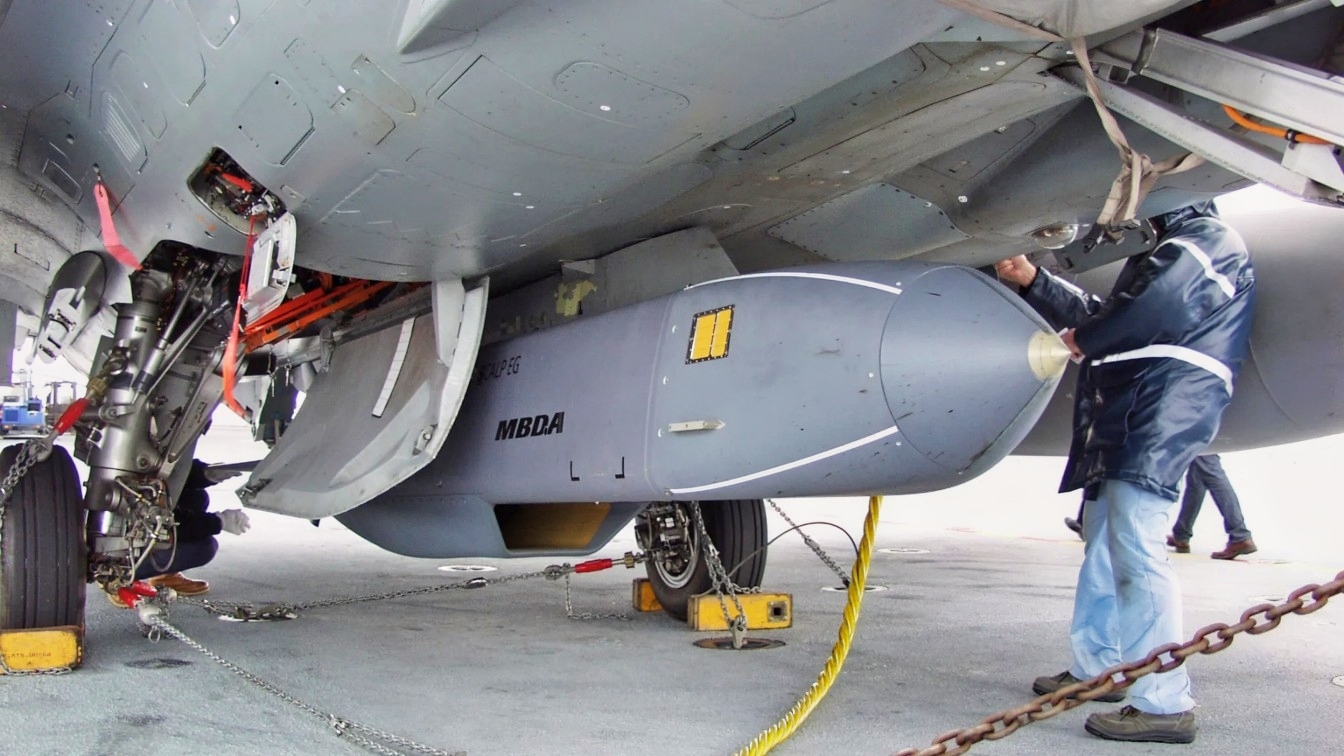
Ukraine is negotiating with France for a license to build the SCALP cruise missile on its own soil, a step that would hand Kyiv a homemade precision weapon it could produce in quantity and fire into Russia without waiting on an ally’s permission. The talks are early, and the obstacles are real. But the timing is pointed, because the missile would arrive as Russia’s air defenses are showing signs of strain under a relentless Ukrainian campaign, giving Moscow one more kind of threat to guard against across a country it is already struggling to cover.
Ukraine Wants A License To Build SCALP Itself

Storm Shadow Missile. Image Credit: Creative Commons.
Ukrainian Defense Minister Mykhailo Fedorov said the matter came up during President Volodymyr Zelensky’s recent visit to France, where he discussed with President Emmanuel Macron the possibility of France sharing a license to manufacture the SCALP missile.
Fedorov said the conversation is continuing with both the French government and the manufacturer, and that there has been progress, while cautioning that it is still too early to announce results because of intellectual-property questions, the work of standing up production, and the bureaucracy involved. He added that Ukraine is separately negotiating with the United States over licenses to build American weapons, talks he said were unprecedented in even being acknowledged.
The push fits a broader Ukrainian drive to become a weapons manufacturer rather than a permanent recipient of donations.
Kyiv has been scaling up domestic production of long-range systems, partly through what officials call the Danish model of financing, and the German firm MBDA recently signed a strategic agreement with Ukrainian Armor to develop long-range strike systems.
Zelensky has previously lobbied allies for licenses to produce Western weapons inside Ukraine, including American Patriot air-defense systems.
What The SCALP Missile Does
SCALP, known in British service as Storm Shadow, is an air-launched cruise missile built by the European manufacturer MBDA for precision strikes against fixed, heavily defended targets.
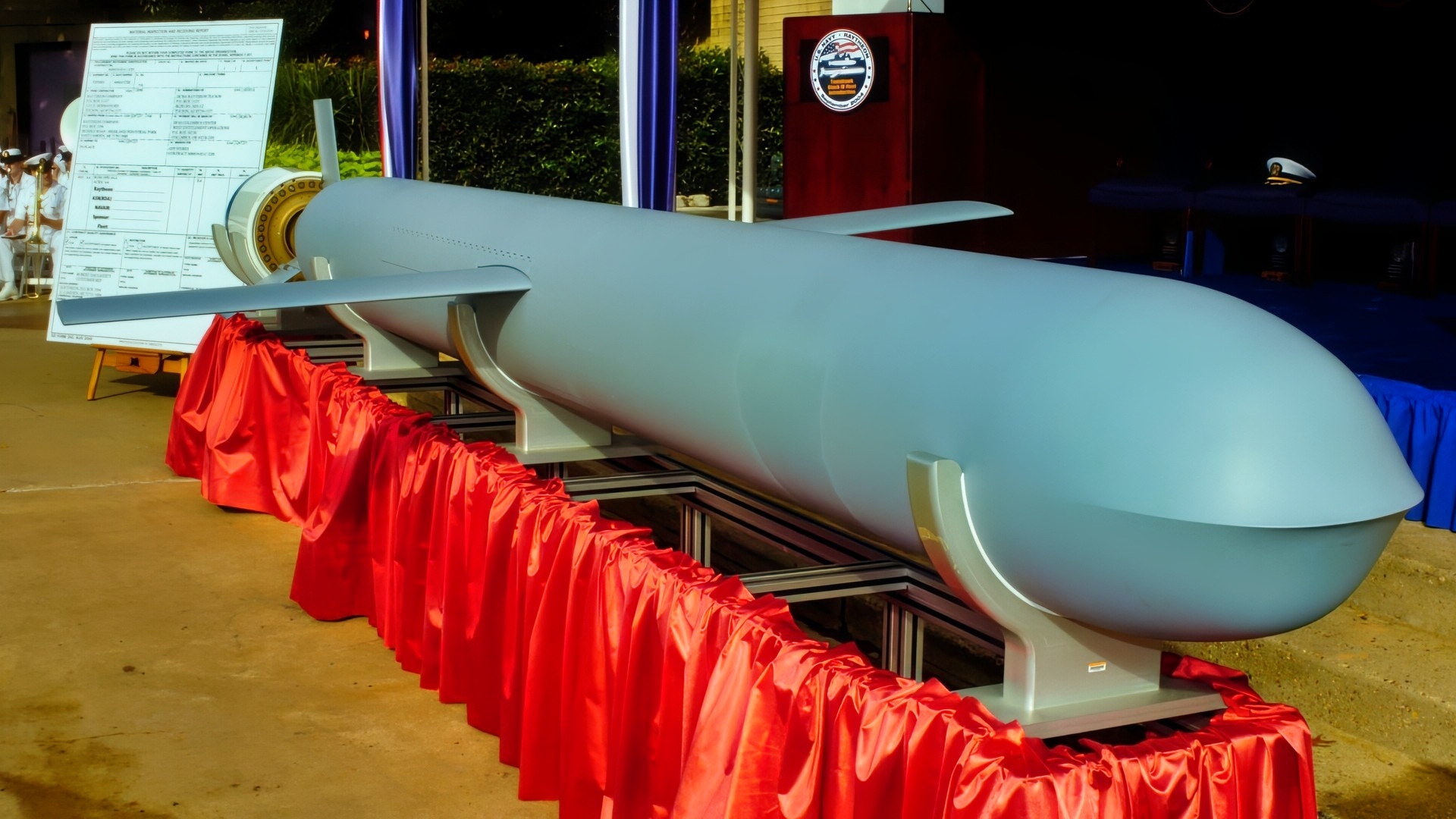
Tomahawk Block IV Missile. Image Credit: Creative Commons.

Tomahawk Launch. Image Credit: Creative Commons.
It flies low to avoid detection and uses a mix of inertial navigation, satellite positioning, and terrain matching, with an imaging seeker in the final phase that lets it stay accurate even when its satellite signal is jammed. Its two-stage BROACH warhead is designed to punch through hardened structures: the first charge opens a path, and the second detonates inside, making it suited to bunkers, command posts, and ammunition depots that smaller drones cannot reliably destroy. The export version has a declared range of about 250 kilometers.
Ukraine already knows what the missile can do. Firing SCALP and Storm Shadow rounds donated by France and Britain from adapted Soviet-era Su-24 bombers, Ukrainian forces sank or damaged multiple vessels of Russia’s Black Sea Fleet, struck the fleet’s headquarters in occupied Crimea, and hit Russian command targets, contributing to the withdrawal of the Black Sea Fleet from the northwestern part of the sea. France first agreed to supply the missiles in July 2023.
Why Building It At Home Matters
Range is not where domestic production would help most, because Ukraine’s own weapons already fly far deeper than SCALP. Kyiv’s indigenous arsenal now includes the Flamingo missile, which struck a factory roughly 1,400 kilometers inside Russia, and long-range drones such as the Liutyi that reach a thousand kilometers or more, both well beyond the SCALP’s couple of hundred kilometers.
The advantage of a homemade SCALP lies elsewhere. It would give Ukraine a precision penetrator for hardened targets that its drones cannot match, in a weapon it controls from the factory floor.
It would mean a reliable, scalable supply that does not depend on France and Britain restarting their own production lines to rebuild stockpiles they drained for Ukraine.
And it would free Ukraine from the political conditions that have repeatedly governed how donated Western missiles can be used against Russian territory, restrictions that have come and gone with each donor’s calculations. Built in Ukraine, the missile would be Ukraine’s to fire, adding another type of weapon, air-launched and stealthy, to a strike mix Russia must already work hard to stop.
Russia’s Air Defenses Are Already Stretched
That mix is landing on a defensive network under visible pressure. Russia is running short of S-300 interceptors, a mainstay of its air defenses, possibly at an unsustainable rate, three Ukrainian officials told CBS News, and has been repurposing the aging missiles for offensive strikes.
Ukraine has spent months systematically destroying Russian radars and launchers, and Kyiv’s defense ministry claims it has knocked out more than 1,450 air-defense systems since the 2022 invasion. Zelensky said this month that Moscow has pulled launchers back to ring the capital and a few leadership sites, leaving other regions thinly covered, though that claim has not been independently verified.
Putin himself acknowledged the strain yesterday, conceding that Ukrainian strikes were causing problems even as he insisted they do not affect the fighting at the front, and saying Moscow’s task is to quickly ramp up production of the air-defense systems it most needs.
The strain has limits worth noting. Russia retains more modern systems like the S-400 and Pantsir, and, as the German Marshall Fund’s Ian Lesser has pointed out, it holds a far larger long-range strike capacity than Ukraine does, while Kyiv has air-defense shortages of its own, particularly in the American PAC-3 interceptors it relies on against Russian ballistic missiles.
A licensed SCALP would not change any of this soon. The talks could stretch for years or collapse over intellectual property and the politics of a missile tied to British and other European partners, and standing up production of a weapon this complex is slow work.
What the effort reflects is a settled Ukrainian bet to build a long-range arsenal deep enough that its ability to strike Russia no longer hinges on allies’ stockpiles or their permission, and to keep adding weapons to a campaign that is already forcing Russia to defend more than it comfortably can.
About the Author: Harry J. Kazianis
Harry J. Kazianis (@Grecianformula) was the former Senior Director of National Security Affairs at the Center for the National Interest (CFTNI), a foreign policy think tank founded by Richard Nixon based in Washington, DC. Harry has over a decade of experience in think tanks and national security publishing. His ideas have been published in the NY Times, The Washington Post, The Wall Street Journal, CNN, and many other outlets worldwide. He has held positions at CSIS, the Heritage Foundation, the University of Nottingham, and several other institutions related to national security research and studies. He is the former Executive Editor of the National Interest and the Diplomat. He holds a Master’s degree focusing on international affairs from Harvard University.


