


The Ford-Class Is Finally Copying the One Thing That Made the Nimitz Great: The Nimitz-class supercarrier got better with each hull, ten ships built over thirty-four years, each one improved on the last until the final ship was the finest conventional carrier ever launched. The Ford-class aircraft carrier began the opposite way, with a lead ship that stumbled through years of delay and public ridicule because the Navy tried to reinvent everything at once. Now, with the second ship and the ships behind it, the service is visibly returning to the method that made the Nimitz great, applying each carrier’s lessons to the one before. The question is whether the Navy has truly relearned that discipline or merely rediscovered it in time for the next temptation to abandon it.
The Nimitz-Class and Ford-Class Might Share the Same Upgrade Fates
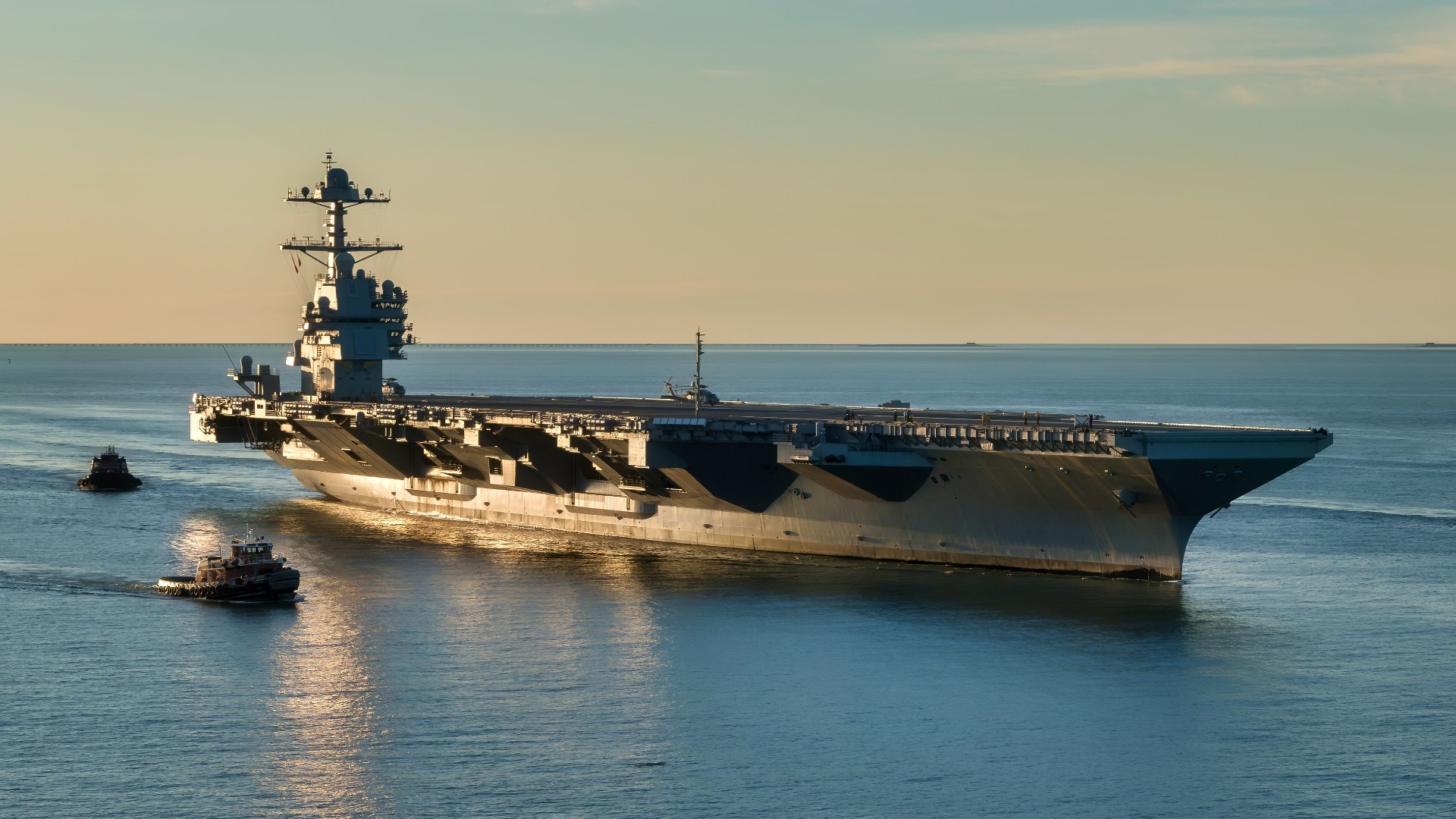
(April 14, 2017) The aircraft carrier Pre-Commissioning Unit (PCU) USS Gerald R. Ford (CVN 78) pulls into Naval Station Norfolk for the first time. The first-of-class ship – the first new U.S. aircraft carrier design in 40 years – spent several days conducting builder’s sea trails, a comprehensive test of many of the ship’s key systems and technologies. (U.S. Navy photo by Matt Hildreth courtesy of Huntington Ingalls Industries/Released)
The story of American supercarriers is really a story about two ways to build them. One is patient: settle on a sound design, then refine it hull by hull over decades. The other is ambitious: leap to a new design that changes everything at once and absorb the pain of making it work. The Nimitz class is the case study for the first approach, and the Ford class, at least in its opening years, became the cautionary tale for the second. What is happening now aboard the future USS John F. Kennedy suggests the Navy has decided the patient way was right all along.
How the Nimitz Got Great
The Nimitz class entered service in 1975 and did not stop growing better for a generation, a fifty-year run that made it the backbone of American power projection and a standing message to Russia and China. The first three ships established the template. Beginning with USS Theodore Roosevelt, commissioned in 1986, the Navy switched to modular construction that cut build time by sixteen months and added two and a half inches of Kevlar armor over vital spaces. Later hulls kept improving. USS Ronald Reagan and USS George H.W. Bush received a bulbous bow to cut wave resistance and burn less fuel, along with a reshaped island and curved deck edges that trimmed their radar signature.
The last of the ten, the Bush, commissioned in 2009, was built deliberately as a bridge to whatever came next. She carried a modernized island with an enclosed radar tower, armored windows, upgraded propellers, and a redesigned fuel system, the Nimitz design with more than three decades of corrections folded into one hull. The Navy also had a mechanism for spreading improvements backward: during each ship’s midlife refueling overhaul, older carriers were refitted toward the standard of the newest, so the whole class drifted upward over time rather than freezing at the moment each hull was launched.
The result is the carrier that sailors and analysts routinely call the best of the conventional era, and the deeper lesson is the method that produced it. Build a sound template, then improve it relentlessly, one ship at a time.

Ford-Class Aircraft Carrier. Image Credit: Creative Commons.
Why the Ford Aircraft Carrier Broke the Pattern
The Ford class was supposed to inherit that method. Instead it set the method aside. Rather than change one major system at a time, the Navy tried to introduce nearly everything new at once: electromagnetic catapults in place of steam, advanced arresting gear in place of hydraulics, linear-motor weapons elevators, a new A1B reactor, a dual-band radar, sweeping automation, and a redesigned flight deck, all on the same first hull. The Congressional Research Service notes the design kept the basic Nimitz hull form but layered on improvements meant to lift sortie rates, triple electrical power, and cut lifecycle cost by roughly four billion dollars per ship.
The bet did not pay off on schedule. USS Gerald R. Ford was commissioned in 2017 but did not begin its first deployment until October 2022, more than five years later, held up by first-of-a-kind technologies that fought their operators. The lead ship cost about $13.3 billion, and its weapons elevators were still being finished after delivery. Critics on this site have argued the whole approach was the error: that the Ford tried to reinvent too much at once and nearly broke the very model the Nimitz proved, and that the root flaw was concurrency, maturing technologies on a production hull instead of before it ever reached the water. That criticism has force. A carrier that cannot reliably launch aircraft is not yet a carrier in the operational sense, and for years, the Ford was closer to a laboratory than a warship.
The Method, Restarting
Then something changed, and it looks a great deal like the Nimitz habit is resuming. The future USS John F. Kennedy, the second Ford-class ship, is being finished as a measurably better carrier than the first. Its most visible upgrade is the radar: in place of the troubled dual-band radar on the Ford, which cost around $500 million, Kennedy carries the Enterprise Air Surveillance Radar, a cheaper and more common sensor drawn from the SPY-6 family, a swap that gives the ship capabilities the lead carrier still lacks while saving roughly $180 million. It is also built from the outset to fly the F-35C, which the Ford cannot yet do; Congress mandated the change, and the Navy folded the modifications into construction, with an official calling the shift the path to “a more capable and lethal carrier.”
Just as important is how Kennedy is being built. The Navy switched to a single-phase delivery that installs the combat system and finishes more integration before the ship is accepted, precisely to carry Ford’s lessons forward, and the program’s radar work ran a year ahead of what planners had projected, in the words of the carrier program’s executive officer. The shipbuilder used larger prefabricated sections and a more complete construction model than it had managed on the Ford.

The Ford-class aircraft carrier USS Gerald R. Ford (CVN 78) and the Italian aircraft carrier ITS Cavour (CVH 550) transit the Atlantic Ocean March 20, 2021, marking the first time a Ford-class and Italian carrier have operated together underway. As part of the Italian Navy’s Ready for Operations (RFO) campaign for its flagship, Cavour is conducting sea trials in coordination with the F-35 Lightning II Joint Program Office’s Patuxent River Integrated Test Force to obtain official certification to safely operate the F-35B. Gerald R. Ford is conducting integrated carrier strike group operations during independent steaming event 17 as part of her post-delivery test and trials phase of operations.
The clearest evidence is what comes next. The shipbuilder has acknowledged that Kennedy’s construction was already far along by the time many of Ford’s hard lessons were understood, which limited how much could be applied to her. The two carriers after her, the future Enterprise and Doris Miller, do not have that problem: they are incorporating Ford’s lessons earlier in their construction, the way each Nimitz hull banked the corrections of the ship before it. That is the method, visibly restarted.
Whether the Lesson Sticks
None of this means the Ford class has escaped its troubles. The lead ship pulled into Norfolk Naval Shipyard in July for its first major maintenance period, part of a repair and modernization stretch that follows a record 326-day deployment and includes restoring damage from an onboard fire and chronic system wear. The fleet is thin: with USS Nimitz retired in May and Kennedy not due until March 2027, the Navy is covering global commitments with ten carriers instead of the mandated eleven. The follow-on ships stretch out for years, with Enterprise projected for 2030 and Doris Miller for 2032, and each Ford still costs well over thirteen billion dollars.
There are real risks to the pattern holding. President Trump has repeatedly criticized the electromagnetic catapults and floated ordering future carriers back to steam, a change that would upend the entire logic of refining one design across a class. And the deeper danger is the one the Nimitz story warns against: that the Navy, having relearned the value of incremental improvement, discards it again on the next big leap. The two carriers planned after Doris Miller, possibly bought together, will be the test of whether the discipline sticks.
The direction, though, is set and the right one. The Nimitz class earned its place as the finest carrier of its age not through any single breakthrough but through the patience to get a little better with every hull. The Ford class spent its opening chapter proving what happens when that patience is abandoned, and it is spending its second chapter proving the Navy can still practice it. The lesson was always there in the ten ships that came before. It simply costs thirteen billion dollars to relearn.
About the Author: Harry J. Kazianis
Harry J. Kazianis (@Grecianformula) was the former Senior Director of National Security Affairs at the Center for the National Interest (CFTNI), a foreign policy think tank founded by Richard Nixon based in Washington, DC. Harry has over a decade of experience in think tanks and national security publishing. His ideas have been published in the NY Times, The Washington Post, The Wall Street Journal, CNN, and many other outlets. He has held positions at CSIS, the Heritage Foundation, the University of Nottingham, and several other institutions related to national security research and studies. He is the former Executive Editor of the National Interest and the Diplomat. He holds a Master’s degree focusing on international affairs from Harvard University.


