


Key Points and Summary – China’s shadowy JH-XX, also known as the J-36, is emerging as a stealthy medium bomber-fighter with a large internal bay and serious range.
-While Beijing keeps the program under wraps, analysts can infer its likely arsenal from existing PLAAF systems.

PLAAF Xian H-6M makes a turn over central Changzhou.
-At the high end, a nuclear-capable JL-1 air-launched ballistic missile would give the jet a strategic punch, while subsonic YJ-6 anti-ship missiles could threaten surface fleets.
-For air-to-air combat, the long-range PL-15—already blooded in South Asia—would let the JH-XX engage fighters well before visual range, turning it into a flexible strike and air dominance platform.
JH-XX Stealth Bomber Update – What Is the Likely Weaponry?
The current day and age of renewed Great Power competition between the (1) United States of America on the one hand and (2) the unholy alliance of the Russian Federation and the People’s Republic of China (PRC) on the other is very much a game of military technology one-upmanship.
This situation is especially true in the reality of stealth aviation technology.
When it comes to 6th-generation warbird competition, that game of one-upmanship has an additional element of semantical intrigue in the form of projects with the “XX” designation (not to be confused with the Amway Nutrilite Double X brand of multivitamins), for example.
The US Navy has the F/A-XX program, which is indeed intended to replace the F/A-18 Super Hornet. Meanwhile, not to be outdone, the PRC has the JH-XX medium bomber/fighter-bomber, AKA the J-36.
A Riddle Wrapped In (A) Mystery Inside An Enigma
The JH-XX/J-36 represents the PRC’s People’s Liberation Army Air Force’s (PLAAF; Zhōngguó Rénmín Jiěfàngjūn Hǎijūn Hángkōngbīng) second foray into the realm of stealth bombers, following in the footsteps of the Xi’an H-20. Chengdu Aircraft Corporation is presumably building the JH-XX, the same Chinese aerospace conglomerate that manufactures the PRC’s J-20 Wēilóng (“Mighty Dragon;” NATO reporting name “Fagin”) 5th-generation stealth fighter aircraft.
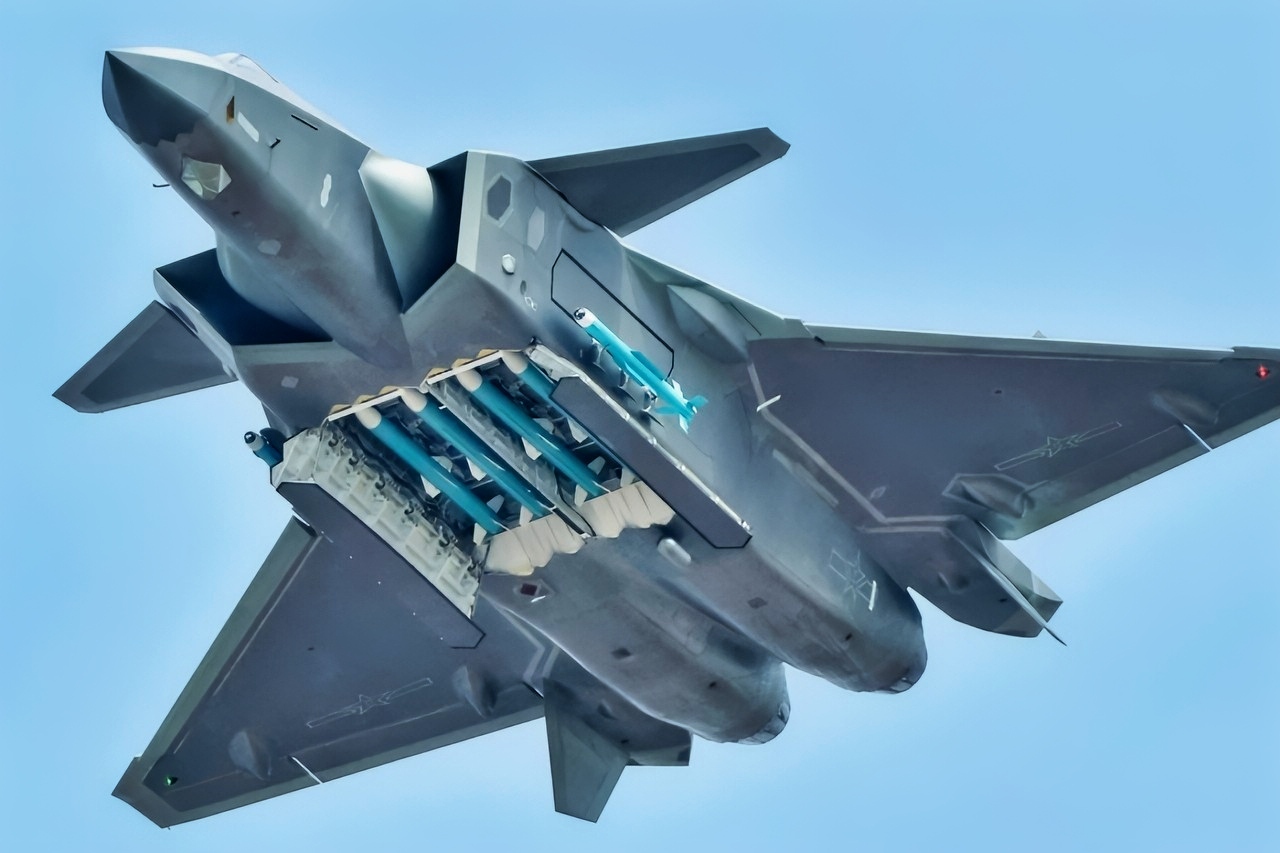
China J-20 Fighter with Missiles. Image Credit: Chinese Weibo.

J-20 Fighter from Chinese PLAAF. Image Credit: Creative Commons.
The J-36 made its maiden flight—or at least the first publicly observable test flight—on December 26, 2024, which coincided with Chairman Mao Zedong’s birthday; additional flights were observed in March and April 2025. Not surprisingly, the warbird’s specifications are still pretty much speculative, as it is (1) still in prototype status and (2) a design that’s being kept pretty hush-hush (as can be reasonably expected of any 6th-generation warplane project, especially in a totalitarian society like China’s).
It is believed to have a combat radius of 1,200 statute miles (1,931 kilometers; 1,042 nautical miles). But what about the weaponry?
Angad Singh, former Project Coordinator for the Strategic Studies Programme at the Observer Research Foundation (ORF), a thinktank based in New Delhi, India, observes that the plane has “a voluminous payload bay.” As far as further speculative specifics, one potential source of educated guesswork is the PLAAF’s currently operational strategic bomber, the 1959-vintage Xi’an H-6N Zhanshen (“War God”).
Potential Doomsday Device: The JL-1
The scariest and most potent weapon in the “War God’s” arsenal is the nuclear-capable Jīng Léi-Yī JL-1 (“Thunderclap-1; NATO designation CH-AS-X-13), which is in turn an air-launched ballistic missile (ALBM) version of the Dongfeng DF-21 (“East-Wind 2;” NATO reporting name CSS-5).
In its “doomsday” form, the DF-21 has a 200-300-500 kiloton warhead, along with an operational range of 1,500 kilometers (930 statute mi; 810 nautical miles) and a max speed of Mach 10.
Potential Conventional Strike: YJ-6
As for non-nuclear strike missions, such as, say, the ship-killing mission, one proverbial arrow in the Zhanshen’s quiver that could conceivably make its way over to the JH-XX’s armament package is the YingJi-6 (“Attacking Eagle-6”) YJ-6 (NATO designation CH-AS-1 “Kraken“).
This subsonic anti-ship missile has an overall weight of 2,440 kilograms (5,379 lb.), a piercing-fragmentation warhead with delayed ignition weighing 513 kilograms (1,130 lb.), an operational range of 95 to 100 kilometers (59 to 62 miles), and a reported hit probability of 70 percent.
Potential Air-to-Air Combat: PL-15
Okay, but what about the “fighter” portion of the JH-XX’s “fighter-bomber” designation? For that, we turn to the J-20 mentioned above as our source of educated guesswork.

J-20 on the Tarmac. Image Credit: Creative Commons.
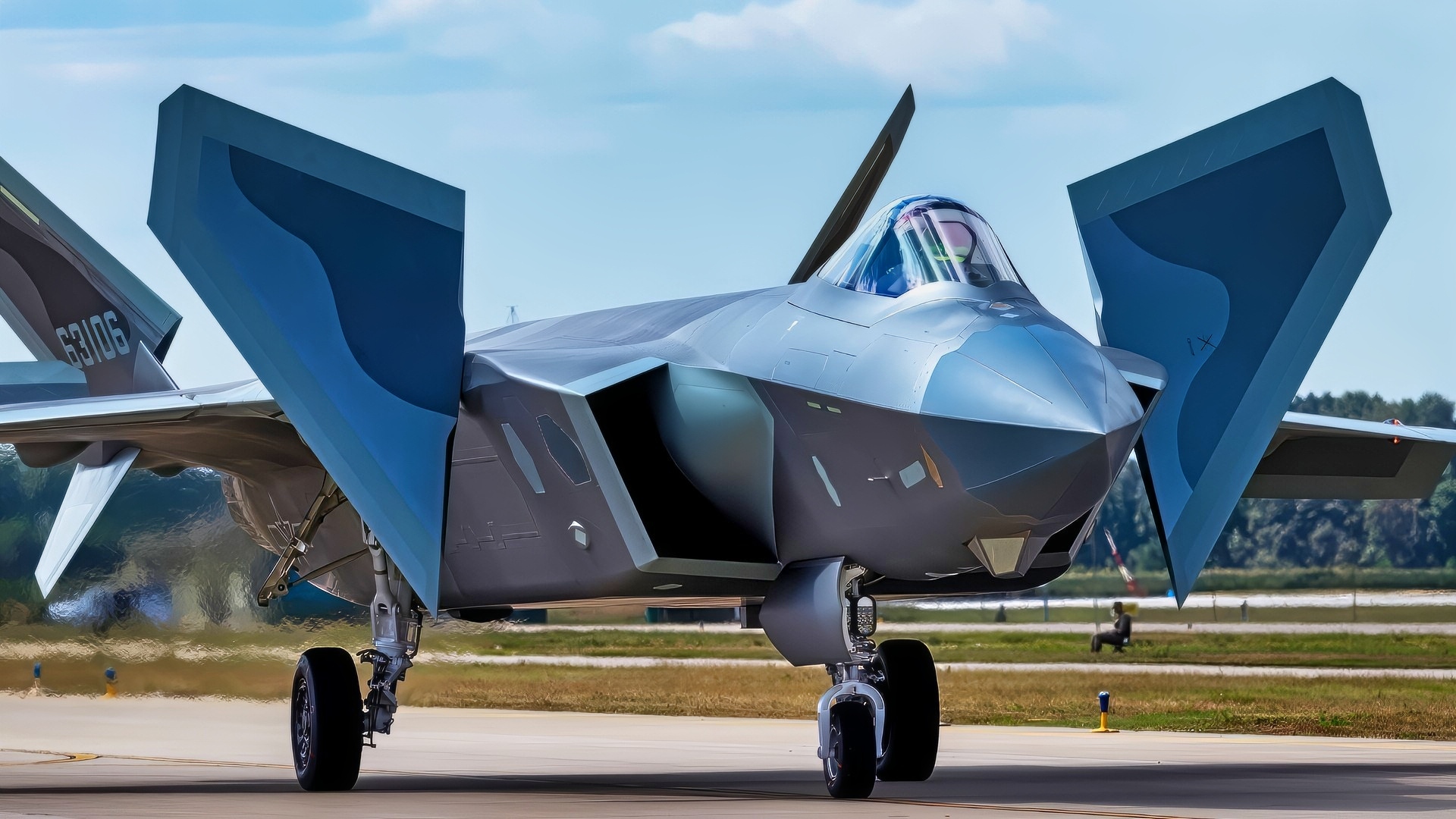
J-20 Fighter 2025 Photo. Image Credit: Chinese Military.
One of the deadliest pieces of ordnance in the arsenal of the “Mighty Dragon” is the PL-15 ( NATO reporting name: CH-AA-10 “Abaddon,” named for a demonic being in the Biblical Book of Revelation whose minions unleash in the fifth wave of trumpet judgments described in the apostle John of Patmos’s apocalyptic vision ) air-to-air missile (AAM).
It is a long-range active radar homing AAM with a mass between 200 and 230 kilograms (441–507 lb.), an operational range between 180 and 200 kilometers (110–120 miles), and a max speed of Mach 5+.
Though the “Fagin” hasn’t yet been tested in combat, the “Abaddon” missile certainly has. Earlier this year, during Operation Sindoor (the latest flare-up of the Indo-Pakistani War), Pakistani Air Force (PAF) fighter pilots using PL-15 missiles launched from Chengdu J-10″ Vigorous Dragon” fighters inflicted shocking and embarrassing losses against the Indian Air Force’s much-ballyhooed French-made Dassault Rafale and Russian-made MiG-29 and Sukhoi Su-30 jets in exchange for zero PAF air-to-air losses.
About the Author: Christian D. Orr, Defense Expert
Christian D. Orr is a Senior Defense Editor. He is a former Air Force Security Forces officer, Federal law enforcement officer, and private military contractor (with assignments worked in Iraq, the United Arab Emirates, Kosovo, Japan, Germany, and the Pentagon). Chris holds a B.A. in International Relations from the University of Southern California (USC) and an M.A. in Intelligence Studies (concentration in Terrorism Studies) from American Military University (AMU). He is also the author of the newly published book “Five Decades of a Fabulous Firearm: Celebrating the 50th Anniversary of the Beretta 92 Pistol Series.”


