

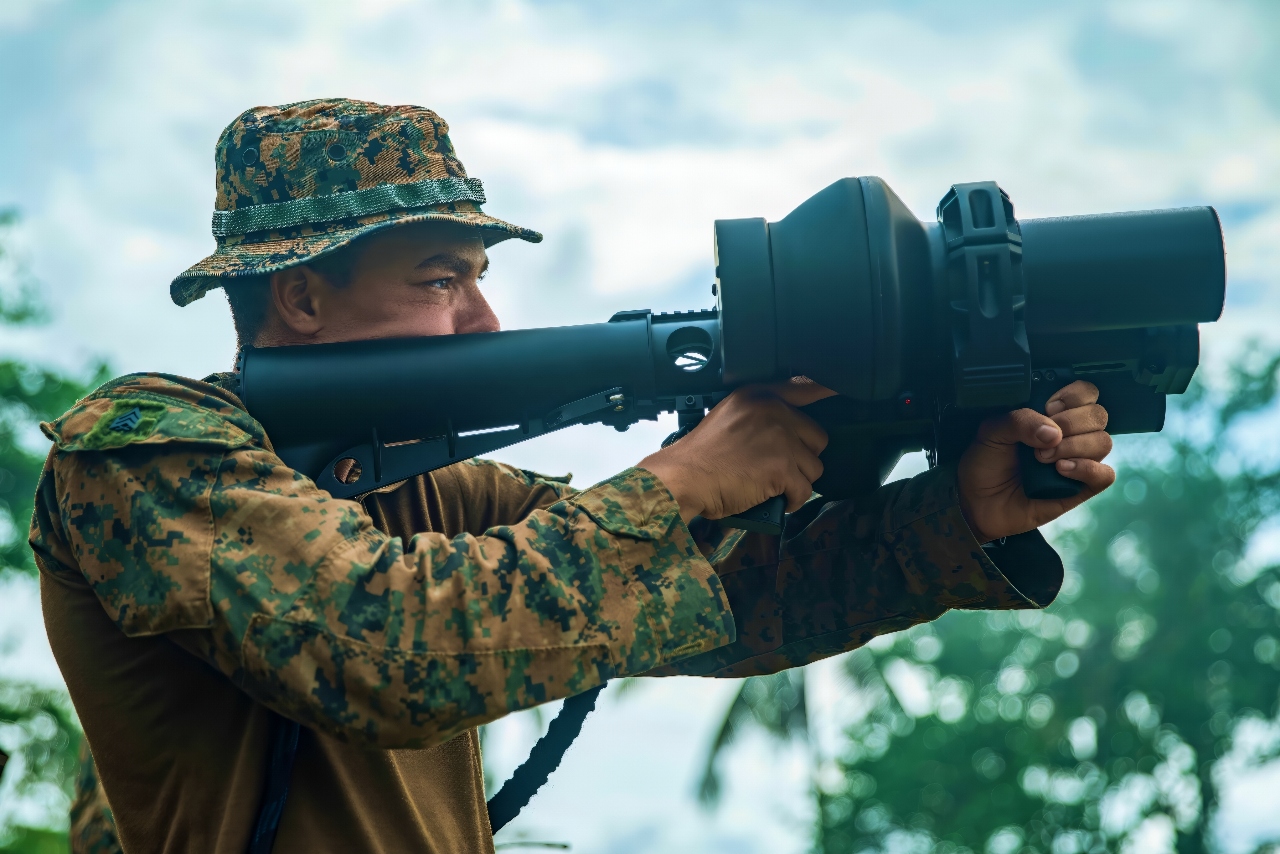
PUBLISHED on August 11, 2025, 11:50 AM EDT – Key Points and Summary – While a new Pentagon policy makes it easier for Marines to acquire and experiment with small drones, the U.S. military faces a catastrophic drone gap with Russia and China.
-A recent exercise highlighted the poor performance of the few approved, American-made models.
-The root of the problem is a nearly extinct domestic manufacturing base, leaving the U.S. unable to produce drones at scale without relying on Chinese components.
-The author, a retired Marine Colonel, concludes that to win a future “drone war,” Congress must enact major reforms to rebuild America’s industrial capacity and skilled workforce.
The U.S. Trails Badly When It Comes to Drones
The Department of Defense (DoD) has recently released a new policy that enables greater experimentation with small drones.
The policy is good news for the Marine Corps for three reasons.
First, it directs drones to be considered expendable consumables. This categorization is the difference between machine guns and machine gun bullets, and makes it much easier to get approval to purchase drones for experimentation.
Secondly, it speeds up the acquisition processes by lowering approval authority to Colonels (O-6 level officers).
Previously, drones could only be authorized for purchase through a single organization – Marine Corps Systems Command (the acquisition arm of the Marine Corps).
Thirdly, it encourages innovation. As an anecdotal example, I had four jobs as a Colonel of Marines. If this policy change had occurred on my watch, I would have used drones to experiment in delivering fuel to Marines in isolated locations, assisting with base perimeter security observation, breaching a minefield by dragging a sausage string of explosives into it, and replacing a high voltage insulator atop a power pole damaged by a hurricane.
Those ideas for experimentation are just off the top of my head. Marines will undoubtedly come up with many more.
What Recent Drone History Teaches Us on Drones
But there is bad news. The New York Times had an article about a military drone exercise in Alaska and describes it as a comedy of errors. Drones crashed, missed targets, and nearly flew into a group of observers, all while being flown by the drone manufacturers themselves.
The U.S. military trails the Russians and Chinese in manufacturing, training with, and using drones by the millions. The U.S. is behind in developing drone technology while the conflicts in Ukraine and Israel are “dominated by swarms of … inexpensive drones that are largely produced with components from China,” according to the Times. One Chinese company, DJI, accounts for 70% of all worldwide drone sales, and they make millions of drones a year.
Beyond the obvious overmatch concerns, technical and manufacturing concerns exist as well. DOD explicitly and wisely prohibits the military from using drones of Chinese origin, remembering the challenges of Lenovo computers and Haiwei phones and their links to the People’s Republic of China’s (PRC’s) government. DoD has a “Blue List” of drone manufacturers and models authorized for U.S. military use. However, only 14 companies and 20 models are on that approved list. Among these 20 models are the ones that performed so poorly in Alaska.
America Must Make More Drones at Home
So, if we need more American-made drones – let’s make more drones. Yet it isn’t that simple. The United States lacks the ability to manufacture these and other items. Destin Sandlin, a former missile flight test engineer for the U. S. Army and host of the Smarter Every Day series on YouTube, explains the problem in his video “I Tried to Make Something in America.”
He tells the story of how he set out to make a gadget using only parts from and manufacturing abilities in the United States. The video follows his year-long effort to source components and specialized fabrication techniques. He visited mills, technical schools, and businesses of all sizes to learn how to make the components for his gadget.
Despite his gadget having no moving parts, Destin was unable to complete his quest as he discovered that American manufacturing capability is nearly extinct. He found we don’t have dies to make necessary tools, molds to mass produce templates, tools to assemble and construct subcomponents, nor people with the necessary knowledge and experience to manufacture products. In short, America lacks the ability to make “things” – widgets, gadgets, or products.
Congress is appropriately concerned with acquisition reform. Any conversation about acquisition reform must start with restoring America’s manufacturing base. I recommend Congress do several things to address the American military’s drone shortage.
First, expand student eligibility for Pell Grants to cover training programs necessary for fabrication and manufacturing to enhance the availability of qualified workers.
Secondly, implement output capacity-based grants to incentivize to companies’ investment in technology.
Next, permanently allow full and immediate expensing for capital spending on structures.
I offer an additional recommendation for the Department of Education: ensure existing grants, scholarships, and prizes are available to encourage vocational schools to re-develop the necessary skills required in manufacturing; create and train the die makers, the machinists, the lathe and press operators, and all the fabrication skills required to get a “Made In America” stamp.
The Secretary of Defense expects training “force-on-force drone wars” in 2026. It is unlikely that the United States could win a drone war with China today with its 20 models and hundreds of copies versus the PRC’s millions. But, as the saying goes, “if the best time to plant a tree was 20 years ago, then the second-best time to plant a tree is today,” then let’s improve the manufacturing base so we can plant little drone trees today.
About the Author: Mike Jernigan
Mike Jernigan is a Visiting Fellow with the Allison Center for National Security at the Heritage Foundation. He spent 30 years as a U.S. Marine. This op-ed is based on his recent paper, “Good News and Bad News about Changed U.S. Military Drone Policy.” You can follow him on Linkedin here.



bish-noi-noi
August 11, 2025 at 3:23 pm
There’s a lot of hyperventilating going around on the topic of drones.
Drones are objects mostly now quite easily duplicated, if only if you actually bother to get your behind off the couch and head for the nearest work bench.
Already in many countries today, you have teams of schoolkids vying with one another building PK killin’-type robots. Robots that fight each other on a tabletop.
Anyway, in gaza, people use drones to decimate and destroy humans gathering at food distribution centers which tells you what drones are for.
In Ukraine, drones are overhyped.No doubt drones have been used to decimate tanks and IFVs. But it’s largely because they are already obsolete in design.
Drones persist in the fighting there today because nobody has employed or put to use the technique of squashing entire hamlets, villages, towns and cities. In one night.
The US (and UK) employed that technique in WW2 and in Korea and in nam. Including the use of napalm, agent orange and fleas and flies.
George
August 12, 2025 at 7:36 am
This guys is talking drones while our adversaries are evolving into robots. Way to stay abreast of the situation.
George
August 12, 2025 at 7:41 am
Nobody is left after a TOS barrage to tell people about it, that’s why the hype on drones.
George
August 12, 2025 at 7:31 am
Remember when they said the war in Ukraine was one of Attrition? Somebody forgot to tell these people the OTHER side is supposed to attrit.
George
August 12, 2025 at 7:33 am
BTW, America jettisoned Active Defense as a Strategic Doctrine in the 80’s. At what point do you wake up and realize your current doctrine of “combined arms” is a failure? (PS: The Russians are using it quite effectively)
Doug Mayfield
August 12, 2025 at 3:24 pm
Thank you for the article. Having read about the early history of WW2, I’m reminded of the ‘catch up’ which America had to go through to get into the war. Early WW2 was pretty hairy from America’s POV especially in the Pacific. I suspect that free countries are always going to be a bit behind tyrannies because focusing on war, preparing for war, is what tyrants do.
Pingback: Instapundit » Blog Archive » THIS IS A PROBLEM: America’s Drone Crisis: ‘Made In America’ Is Nearly Impossible. The New
PBAR
August 13, 2025 at 12:27 pm
People warned about the loss of manufacturing expertise when all the off-shoring was happening over the last 30 years but alas they were ignored.
Pingback: Links For Today | The Ethereal Voice
Steesh
August 15, 2025 at 7:19 am
I wonder if the author heard of Divergent Technologies. I just heard the founder on a podcast explaining his weapons building 3D printer using AI technologies. He was confident in his ability to mfgr rapidly.