

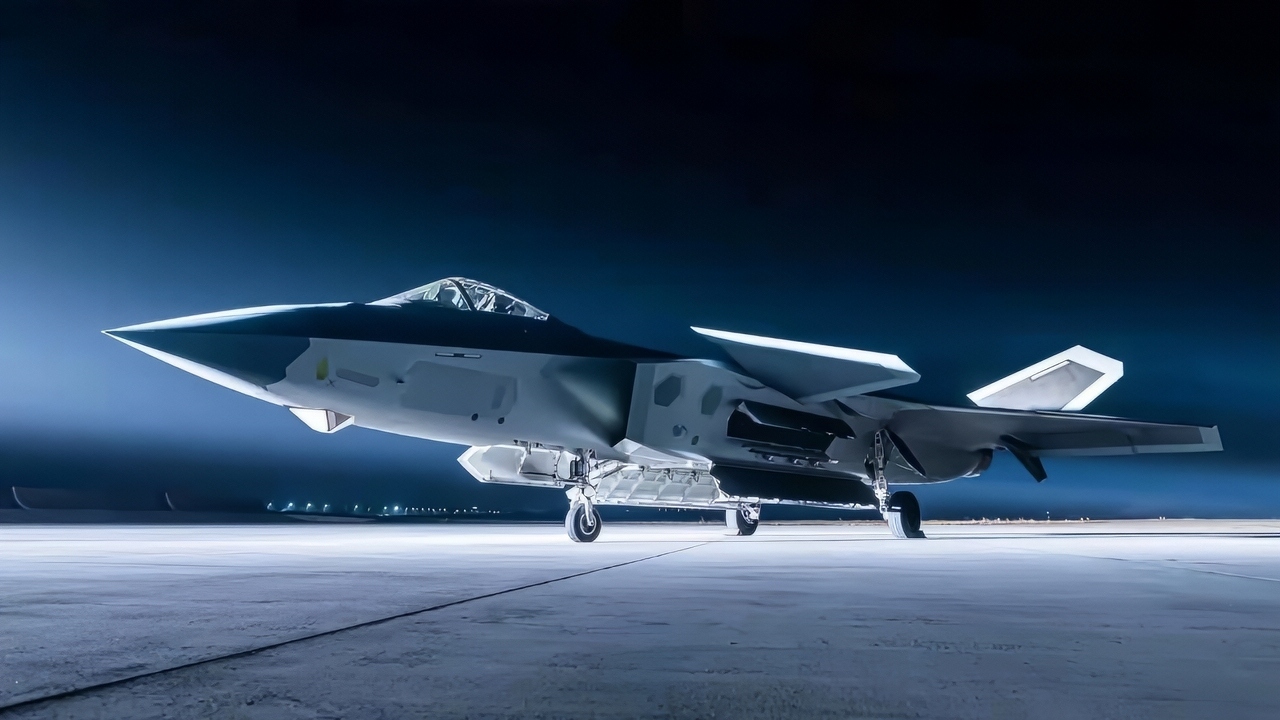
Key Points and Summary – A hypothetical air battle between China’s J-20 Mighty Dragon and Russia’s Su-57 Felon pits two very different fifth-generation fighters against each other.
-The J-20 boasts superior stealth and is being produced in large numbers, with a focus on long-range, beyond-visual-range combat.
-The Su-57, while arguably more maneuverable in a close-in dogfight, is plagued by production delays, a questionable stealth profile, and a lack of combat experience.
-While a one-on-one duel would be close, the J-20’s numerical superiority and focus on long-range engagement give it the decisive edge in any realistic conflict scenario.
The J-20 vs. The Su-57: Who Wins In An Air Battle?
Comparing the combat prowess of the Chinese J-20 and the Russian Su-57 aircraft seems somewhat futile right now, since the countries are nominally allies.
But we can provide a profile of each fighter, then compare them as best as possible, taking into consideration the massive amount of state propaganda with which each country promotes its combat systems.
China’s J-20 Mighty Dragon:
China’s J-20 “Mighty Dragon” represents a significant leap in the country’s military aviation capabilities. The Mighty Dragon is a fifth-generation stealth fighter designed to challenge Western air dominance – especially to go up against the F-22.
Aviation experts disagree on whether the J-20 helps to shift the global power balance in China’s favor, or if China’s government-controlled press exaggerates the aircraft’s abilities.
Its overall worthiness aside, the J-20 is very stealthy. The J-20’s airframe drastically reduces radar signature.
The aircraft also incorporates advanced avionics and sensors to network information in real time. Such capabilities provide a great advantage to the user in complex combat scenarios.
Recent reports have the Chinese transitioning the J-20 from training to combat roles – it will intercept foreign fighters that come close to Chinese airspace.
Chinese state-run media suggests there could be future encounters between the J-20 and the F-35 – China and Russia’s common enemy in the skies.
This would give the People’s Liberation Army Air Force and the U.S. Air Force ample opportunity to study and analyze each other’s frontline fifth-generation fighter jets.
WS-15 Engines Have Entered Service:
The latest shots on social media show the J-20A sporting modified diverterless supersonic inlets, which might show the Chinese are finally producing their latest jet engine, the WS-15.
The inlets are simple and thus cheap to manufacture. They are light, as they have no moving parts, and are effective at hiding the engine’s compressor blades from enemy radar, thus decreasing the aircraft’s radar cross-section.
The WS-15 is expected to provide a greater thrust of 18,143 kilograms, and a supercruise capability, which allows the plane to fly supersonic without having to engage the afterburners.
The new engine would also provide more electrical power for advanced avionics and sensors, as well as a newer generation of radars. China is also expected to pair the J-20A with its version of “loyal wingman” drones.
Russia’s Su-57 Fighter, Stealthy But Stealth?
The Russian Air Force prides itself on building fast, maneuverable fighter jets, and the Su-57 Felon is no exception. Say what you will about Russian manufacturing, but they sure do build ‘em pretty.
Russia’s fifth-generation “stealth” fighter is a twin-engine multi-role aircraft developed by Sukhoi. The Felon (as it is code-named by NATO) is capable of aerial combat, ground attack, and maritime strike. The Su-57 incorporates stealth, supermaneuverability, supercruise, integrated avionics, and large payload capacity into a single airframe.
The Russian Ministry of Defense designed and developed the Su-57 to replace the Su-27 and MiG-29 fighter aircraft. The Felon is expected to be widely exported, eventually. Currently, the only buyer is Algeria.
However, after years of development, the biggest flaw with the Su-57 remains money. The Russian economy is in such a bad state that only a handful of operational Su-57s are available.
The first flight took place in 2010. By 2013, Russia had built five prototypes, but the results weren’t satisfactory. Stress cracks were already showing on the airframes. After redesign and testing, the aircraft was finally ready for production; the first plane off the production line crashed.
In 2019, Russian President Vladimir Putin announced a deal to purchase 76 Su-57 aircraft, but as of January 2025, Russia had only 4 to 15 operational Su-57 aircraft.
Design and Specs:
Size: 20.1 meters long, 14.1 meters wingspan, 4.6 meters high
Weight: 18,500 kilograms empty, normal takeoff weight of 26,700 kilograms, maximum takeoff weight of 35,000 kilograms
Speed: Maximum speed of Mach 2.45 at altitude, afterburners Mach 2
Range: Range of 2,796 miles
Service ceiling: Service ceiling of 65,617 feet
Flight duration: Up to 5.8 hours
Weapons Storage: Internal weapons bays and smaller triangular-section bays under the wing
Radar: Active Electronically Scanned Array radar and phased-array radar Targeting: Infrared Search and Track targeting technology
Engines: Two Saturn AL-41F1 afterburning turbofan engines
Armament: 30-mm autocannon under the nose, various anti-ship, anti-aircraft, and anti-armor missile configurations with eight hard points in the storage bays.
Is It Really a Stealth Aircraft?
The Russians promote the Su-57 as a fifth-generation stealth aircraft. However, while they have made serious attempts to make it more stealthy, its radar signature is probably 20-30 times that of an F-22, according to Alex Hollings in Airpower.
Russia sent a Su-57 to China in November for the 15th China International Aviation and Aerospace Exhibition. It proved to be a PR disaster. Chinese government-run social media was quick to point out the flaws in the Russian design. Russia had made the mistake of sending a prototype Felon instead of a production model.
Granted, the Chinese are trying to drum up business for their own exports. But those social media reviews, scathing in their reports of exposed rivets and gaps in the frame, were all accurate.
Is the Su-57 a good fighter jet? Yes absolutely. While not a true fifth-generation stealth fighter, it is more than a match for older fourth-generation fighters.
Air-To-Air Matchup With Unproven Combat Designs
Both fighters are fast, agile, and designed to produce air superiority on the first day of a conflict. Neither has any true combat experience. China hasn’t fought a war since its disastrous invasion of Vietnam in 1979.
The Su-57 has largely been kept out of the Ukraine War. Russian President Vladimir Putin would prefer not to risk losing a premier fighter over Ukrainian skies.
The amount of stealth each fighter possesses is still a mystery, although the U.S. has undoubtedly been monitoring Chinese airspace for any J-20 flights.
Both fighters can easily top Mach 2. In a close-combat dogfight, the Felon would have an advantage. It carries a 30-mm gun, while the J-20 doesn’t have a cannon.
That was by design, as the Chinese decided they would prefer to engage enemy aircraft at far distances – before the J-20 can even be spotted.
In 2 Words: J-20 Wins?
A one-on-one matchup would be close and would depend on the individual pilots’ skills. But realistically, it wouldn’t be a one-on-one duel, and China has a couple of hundred J-20s.
About the Author: Steve Balestrieri
Steve Balestrieri is a National Security Columnist. He served as a US Army Special Forces NCO and Warrant Officer. In addition to writing on defense, he covers the NFL for PatsFans.com and is a member of the Pro Football Writers of America (PFWA). His work was regularly featured in many military publications
More Military
Iowa-Class Battleship Summed Up in 2 Words
China Wants the Ultimate Weapon: Nuclear Aircraft Carriers


