

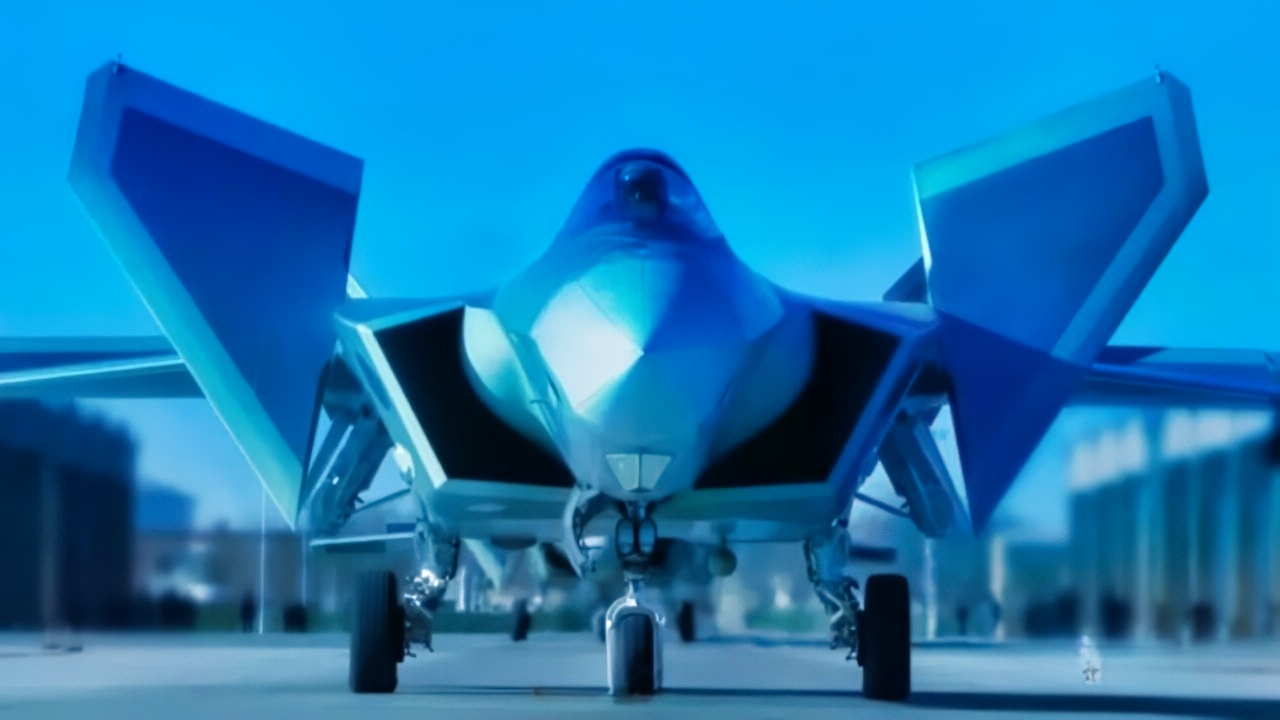
Key Points and Summary – The era of undisputed American air supremacy is over, and China’s J-20 stealth fighter is the cause.
-This formidable aircraft is not just a copy of U.S. designs but a weapon purpose-built to exploit American weaknesses in the Pacific.
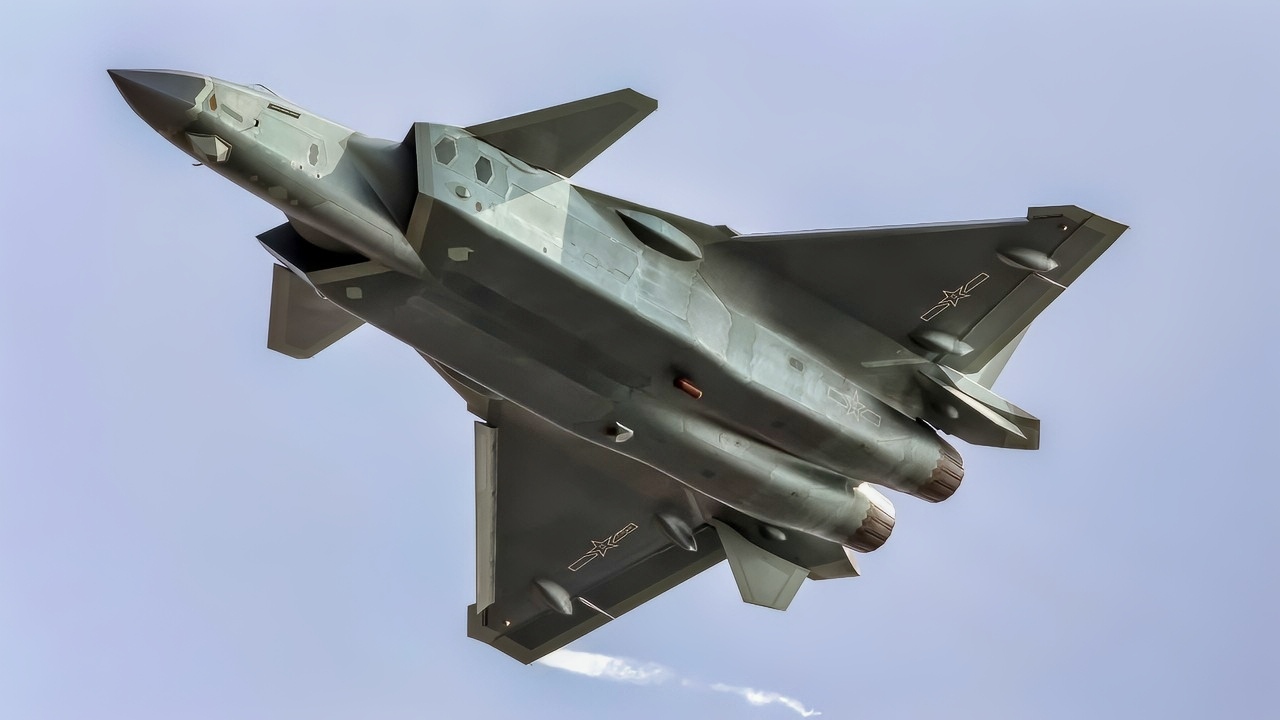
China J-20 Mighty Dragon Fighter. Image Credit: Creative Commons.
-Its extraordinary combat range allows it to bypass U.S. fighters and hunt the true backbone of American airpower: aerial refueling tankers and AWACS planes.
-Combined with new supercruise-capable engines, long-range missiles, and the ability to command drone swarms, the J-20 is a “clear and present danger” designed to dismantle the American way of war.
China’s J-20 Mighty Dragon Is Ready to Fight the U.S. Air Force
For the better part of three decades, the United States military enjoyed a luxury no other power in history has ever known: the absolute, unquestioned dominance of the skies.
Our stealth aircraft, the F-22 Raptor and later the F-35 Lightning II, were ghosts that could penetrate any defense, strike any target, and leave without a trace.
They were technological gods, symbols of an unassailable American advantage. That comfortable reality is now a memory.
The single greatest symbol of this paradigm shift is the Chengdu J-20 Mighty Dragon, China’s first operational fifth-generation fighter.
To the untrained eye, the J-20 is a sleek, menacing, and perhaps derivative design, an amalgamation of stolen F-22 and F-35 plans.

J-20. Image Credit: Creative Commons.
To dismiss it as such is to commit a grave and potentially fatal strategic error. The J-20 is not a clumsy copy; it is a purpose-built weapon, a system meticulously designed to exploit America’s specific vulnerabilities in a potential Pacific conflict. It is a machine that tells a story not of imitation, but of ruthless, targeted ambition.
You cannot understand the threat the J-20 poses by simply comparing its turning radius to that of an F-22.
That is the wrong fight, the wrong analysis.
The Mighty Dragon was not necessarily built to win a dogfight; it was built to win a war. By examining its five most crucial features, we can see the anatomy of a true peer competitor and understand the chillingly precise strategy it was designed to execute.
J-20 Strategic Reach: A Weapon That Masters Distance
In any potential conflict in the Indo-Pacific, the single most dominant factor is distance.
The vast, unforgiving expanses of the Pacific Ocean are a logistical nightmare, a “tyranny of distance” that has historically been one of America’s most significant challenges.
Our power projection has always depended on aircraft carriers pushed forward into harm’s way and a small, fragile fleet of aerial refueling tankers to extend the reach of our land-based fighters.
The designers of the J-20 were intimately aware of this vulnerability.
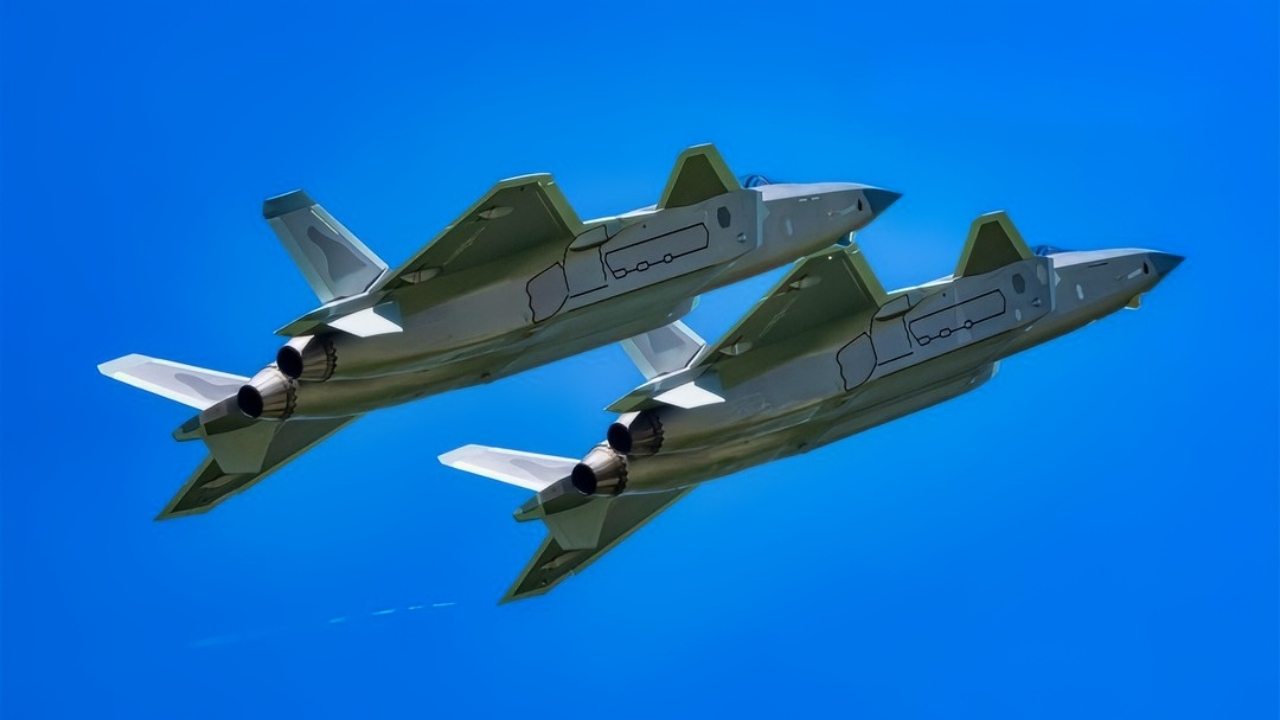
J-20 Fighter In Formation PLAAF Photo
The J-20’s most defining characteristic is its immense internal fuel capacity, granting it a combat radius estimated to be around 2,000 kilometers (over 1,200 miles). This is not just an incremental improvement; it is a fundamental design choice that reshapes the entire battlespace.
While America’s F-22s and F-35s are shorter-legged fighters, leashed to their bases or carriers, the J-20 is a long-range predator. It can take off from hardened airfields deep within the Chinese mainland—bases safe from initial cruise missile strikes—and still project lethal power far out into the first and second island chains.
Wargame Time
Let’s wargame this out. China’s anti-access/area denial (A2/AD) strategy is designed to force U.S. aircraft carriers to operate a thousand miles or more from its shores.
From that range, our F-35s would be operating at the extreme edge of their endurance, completely dependent on vulnerable KC-135 and KC-46 tankers.
The J-20 was built for this exact scenario. It has the legs to hunt those tankers, to strike at the logistical lynchpin of American airpower.
By reversing the tyranny of distance, turning our greatest challenge into its greatest advantage, the J-20 is a weapon designed not just to fight our forces, but to dismantle our entire strategy of power projection.
Purpose-Built Stealth: A Dagger, Not a Shield
A common critique of the J-20 is that its stealth is flawed. Analysts correctly point out that its canards and its less-refined engine nozzles likely give it a larger radar cross-section from the sides and rear compared to the F-22.

J-20 Fighter. Image Credit: Creative Commons.
But to focus on this is to miss the point of its design. The J-20’s low-observability was not engineered to make it invisible from all angles like a B-2 bomber; it was optimized for a specific mission profile: a high-speed, frontal-aspect penetration.
The aircraft’s chiseled nose, blended wing-body, internal weapons bays, and diverterless supersonic inlets are all meticulously crafted to minimize its radar signature from the front. It is a ghost to any radar it is flying towards.
This doesn’t need to be perfect all-around stealth; it only needs to be good enough to delay detection long enough to achieve its objective. It is a stealthy dagger designed for a specific kind of kill.
That kill is not a twisting, turning dogfight with an F-22. The J-20’s stealth is designed to allow it to slip past enemy fighter patrols and strike at the high-value assets in the rear—the AWACS, the JSTARS, and the tankers. It is a weapon of ambush.
By the time a J-20 is detected from the side as it turns to leave, it will have already fired its long-range missiles and accomplished its mission. It sacrifices the perfection of all-aspect stealth for the practical lethality of being invisible during the most critical phase of its attack run.
Advanced Avionics: The All-Seeing Dragon
A fifth-generation fighter is defined as much by its brain as by its airframe. Here, the J-20 represents a monumental leap for China’s aerospace industry. The aircraft is equipped with a sophisticated suite of integrated electronics that gives its pilot a panoramic view of the battlefield.
This includes a large Active Electronically Scanned Array (AESA) radar, a chin-mounted Electro-Optical Targeting System (EOTS) similar to the F-35’s, and a 360-degree Distributed Aperture System (DAS) composed of multiple infrared sensors.
This suite of sensors allows the J-20 to act as a penetrating intelligence, surveillance, and reconnaissance (ISR) platform. It can fly deep into contested airspace, passively soaking up electronic emissions and tracking targets with its infrared systems, all without emitting a single radar pulse that could give away its position.
More importantly, the J-20’s powerful processors are designed for sensor fusion, taking the streams of data from all these different sensors and fusing them into a single, coherent picture. This information is then shared across the PLA’s network, linking air, sea, and ground assets.
A J-20 can detect a U.S. warship and silently transmit its precise location to a land-based DF-21D anti-ship ballistic missile battery hundreds of miles away. It becomes the forward eyes and ears of the entire kill chain, making every other weapon in China’s arsenal more lethal and more precise.
A Deadly Arsenal: The J-20 As a Long-Range Sniper Rifle
A fighter is only as deadly as the weapons it carries, and it is here that the J-20’s threat becomes most tangible. Its large internal weapons bay is designed to carry China’s most advanced air-to-air missile: the PL-15. This missile is a weapon of profound strategic significance.
With a reported range of over 200 kilometers, and potentially as high as 300, it significantly out-ranges America’s frontline AIM-120 AMRAAM.
This range advantage is the final piece of the strategic puzzle. It allows the J-20 to execute its mission as a high-value asset hunter with brutal efficiency. An F-22 pilot may be a superior dogfighter, but that skill is irrelevant if their aircraft is destroyed by a missile fired from a J-20 that was 150 miles away—well outside the Raptor’s own engagement envelope.
This turns any aerial engagement on its head. It forces U.S. fighters to be reactive, to defend against an unseen enemy firing from standoff ranges. When paired with the J-20’s stealth and range, the PL-15 creates a vast “no-go” zone for the critical support aircraft that are the lifeblood of American airpower.
This combination represents not just a threat to individual U.S. aircraft, but to our entire operational architecture in the Pacific.
The Two-Seat Revolution: Commanding the Robotic Swarm
Perhaps the most forward-looking and potentially game-changing feature of the J-20 is something the U.S. has yet to field: an operational two-seat stealth fighter, the J-20S.
The second crew member is not a traditional co-pilot or weapons officer; they are a mission commander, a battle manager for the robotic age of warfare.
The J-20S is explicitly designed to serve as a command-and-control node for a swarm of unmanned “loyal wingman” drones.
This is the operationalization of manned-unmanned teaming, a concept the U.S. is still developing with its own Collaborative Combat Aircraft (CCA) program. China, however, already has the command platform in the air.
Imagine a single J-20S penetrating enemy airspace while directing a half-dozen armed, autonomous drones. It can send them forward to scout, to jam enemy radars, to soak up enemy missiles, and to conduct their own attacks. This fundamentally changes the math of air combat. It is no longer a one-on-one engagement between fighters, but a single manned aircraft directing a multi-front assault. This capability multiplies the J-20’s lethality, complicates enemy targeting, and represents a clear attempt by China to leapfrog a generation of tactical development and seize the advantage in the future of air warfare.
Conclusion: A New Era of Contested Skies
The J-20 Mighty Dragon is far more than the sum of its parts.
It is a weapon system that reflects a clear, intelligent, and deeply unsettling understanding of American military strategy. It may not be the equal of the F-22 in a classic, one-on-one dogfight, but it was never intended to be.
It is a specialized predator, a long-range assassin designed to cripple the enablers of U.S. airpower and dismantle our ability to project force across the Pacific.
Its combination of strategic range, purpose-built stealth, advanced sensors, lethal long-range missiles, and a revolutionary approach to manned-unmanned teaming makes it a profound challenge.
The J-20 is the sound of the starting gun for a new era—an era where American air supremacy is no longer a given, but something that will have to be fought for and earned in the contested skies of the 21st century.
About the Author: Harry J. Kazianis
Harry J. Kazianis (@Grecianformula) is Editor-In-Chief and President of National Security Journal. He was the former Senior Director of National Security Affairs at the Center for the National Interest (CFTNI), a foreign policy think tank founded by Richard Nixon based in Washington, DC. Harry has over a decade of experience in think tanks and national security publishing. His ideas have been published in the NY Times, The Washington Post, The Wall Street Journal, CNN, and many other outlets worldwide. He has held positions at CSIS, the Heritage Foundation, the University of Nottingham, and several other institutions related to national security research and studies. He is the former Executive Editor of the National Interest and the Diplomat. He holds a Master’s degree focusing on international affairs from Harvard University.
More Military
The F-14D Was the Ultimate U.S. Navy Fighter
The F-22 Raptor Has a Message for the U.S. Air Force


Krystal cane
September 5, 2025 at 12:39 pm
Is it Trump’s a chump
Krystal cane
September 5, 2025 at 12:43 pm
If you want to know all about this website all you need to do is scroll down to the bottom and look at all the ads they placed if you’re stupid inbred hillbilly you’ll find some ads that’ll offend you and make you want to click on them this site is full of right-wing propaganda and not much else