

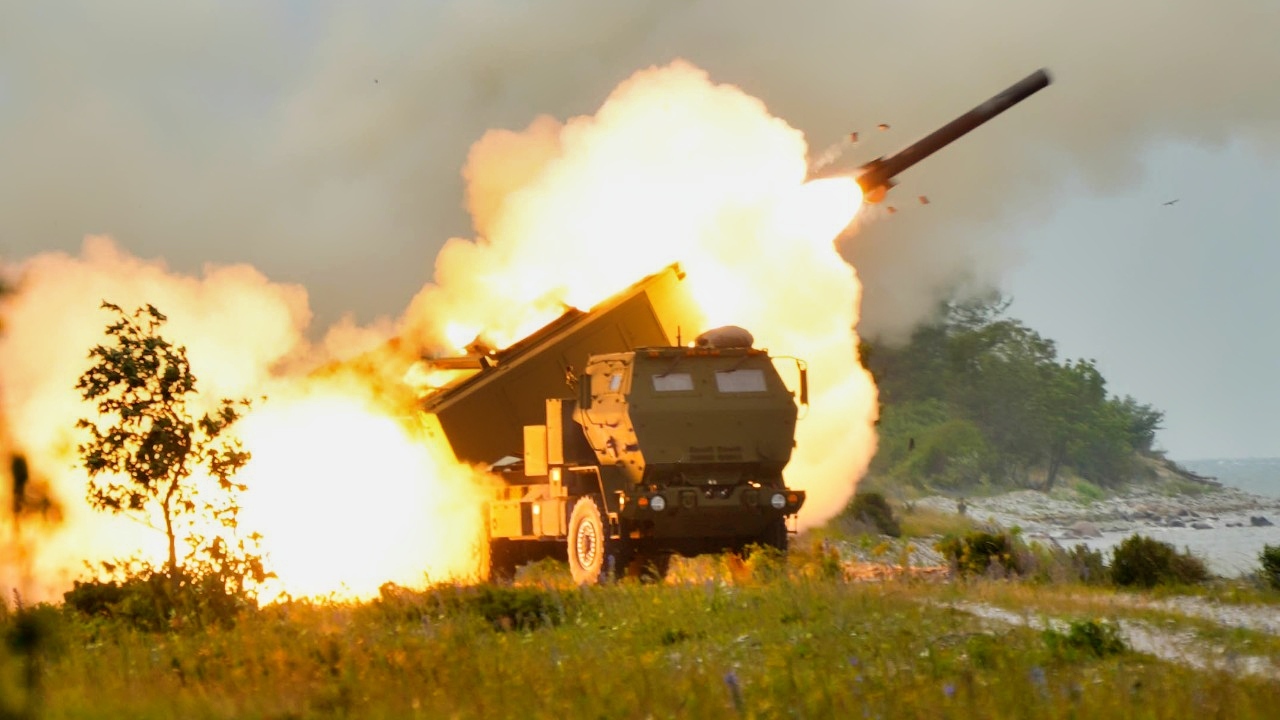
Key Points and Summary on HIMARS – The combat-proven M142 HIMARS, which gained fame for its devastating effectiveness in Ukraine, is getting a hypersonic upgrade.
-The U.S. Army is integrating the new “Blackbeard” missile, developed by the startup Castelion, which will give the mobile rocket launcher the ability to fire munitions at over Mach 5.
-This move will transform the already sought-after system into a more lethal, longer-range weapon.
-The upgrade is a direct response to the lessons of modern warfare, aiming to provide a cost-effective hypersonic strike capability to counter peer adversaries and further solidify HIMARS’s reputation as a battlefield game-changer.
HIMARS’ Hypersonic Upgrade: Ukraine Made The Missile Popular
The Russian invasion of Ukraine has made the M142 High Mobility Artillery Rocket System (HIMARS) the most sought-after rocket artillery system for NATO nations bordering Russia.
Ukraine has made great use of HIMARS, destroying high-value targets in Ukraine and inside Russia, such as ammunition dumps, headquarters, and command posts.
During the battle of Kherson in 2022, HIMARS took out the Antonivka Road Bridge. It was the lifeline for Russian forces, as all of their supplies, troops, and ammunition moved across the Dnipro River via the bridge.
The Ukrainians used surgical strikes to punch holes in the bridge to render it unusable. It wasn’t destroyed, but the hammering it took pushed Russia into a desperate situation. They attempted to repair the bridge using a ferry service, and ultimately, a pontoon bridge was constructed. Ukrainian forces just used these remedies as more targets.
The HIMARS made it all possible.
Now, several other countries are requesting more HIMARS from the US, including Poland and the Baltic nations of Latvia, Lithuania, and Estonia. The Russians have been threatening the former members of the Soviet Union in the small Baltic nations.
They insisted that as part of a peace proposal for Ukraine, NATO would have to withdraw from the three nations.
Hanno Pevkur, Estonia’s defense minister, told Western media that his country believes acquiring the combat-tested HIMARS will send a “deterrence message” to Russia.
“We have the long strike capability, deep strike capability in Estonia already today,” he explained, showing that his country is preparing for the worst potential actions from Moscow.
However, countries like the current HIMARS wait until they see the upgrades that the missile system is receiving.
The US Is Going To Load Hypersonics On HIMARS
Alex Miller, the Army Chief’s chief technology officer, has been teasing a future Precision Strike Missile (PrSM) variant that could “double the range” of the baseline weapon but at a cheaper price point.
The Army plans on testing Castelion’s Blackbeard hypersonic missile as a way to hit “time-sensitive moving targets and hardened targets” at a “much-reduced cost per missile than currently exists in the Army inventory.”
Army leaders plan to allocate $25 million in FY26 for Blackbeard development, with two phases in mind.
In the first phase, the company will deliver a “prototype proof-of-concept” that will be demonstrated sometime between January and March 2026.
If that demonstration goes well, the company will then be tasked with delivering a minimum of 10 viable product prototypes for flight testing from an M142 HIMARS by the end of FY26.
The Blackbeard rollout is scheduled to begin with a flight test of an air-launched variant in 2026, followed by a live-fire demonstration in 2027, and a potential battlefield deployment in 2028.
Hypersonic missiles generate a speed of greater than Mach 5 (3,836 mph). They are capable of maneuvering during atmospheric flight to avoid air defense missiles. It makes them harder to shoot down.
Blackbeard And HIMARS Seems Like A Perfect Match
The Army plans to integrate the Blackbeard missile into existing HIMARS platforms, combining high-speed precision with the system’s mobility and established infrastructure.
Castelion Corporation is developing the Blackbeard GL, which will use self-guiding tech to strike targets at Mach 5 speeds. It is designed for attacking precision targets and engaging reinforced and moving enemy assets.
HIMARS standard missiles have a range of up to 80 kilometers (50 miles), and they can also fire a single Army Tactical Missile System (ATACMS) with a range of 300 kilometers (186 miles).
Now, the Blackbeard GL missile aims to take that firepower even further, bringing hypersonic capabilities to HIMARS while still using the same mobile launcher. It is expected to further increase the range.
Blackbeard GL is designed for tactical flexibility, unlike the Long-Range Hypersonic Weapon (LRHW), which has a range exceeding 2,700 kilometers (1677 miles) and supports strategic deterrence missions.
The Army has posted documents stating that Blackbeard GL is not intended to replace the Long Range Hypersonic Weapon, but rather to complement it within a broader, layered hypersonic fires framework.
HIMARS in 1 Word: Hypersonic
The HIMARS forced the Russians to take several actions to prepare their defenses against the system. With the soon-to-be hypersonic missiles loaded onto the same launcher systems, the HIMARS will still possess the “Shoot and Scoot” capability, but with a longer range and a hypersonic missile that will arrive faster and be able to evade missile defenses.
It will be a game changer for the US and our allies.
About the Author:
Steve Balestrieri is a National Security Columnist. He served as a US Army Special Forces NCO and Warrant Officer. In addition to writing on defense, he covers the NFL for PatsFans.com and is a member of the Pro Football Writers of America (PFWA). His work was regularly featured in many military publications.
Military Concepts
A 7th Generation Fighter Is Coming


