

Key Points and Summary – Ukraine’s brilliant 2022 counteroffensive, which liberated Kharkiv and Kherson, was a squandered opportunity for a decisive victory.
-Western hesitancy, caused by bureaucratic delays and fear of Russia’s nuclear bluffs, failed to provide Kyiv with the weapons needed to press its advantage.

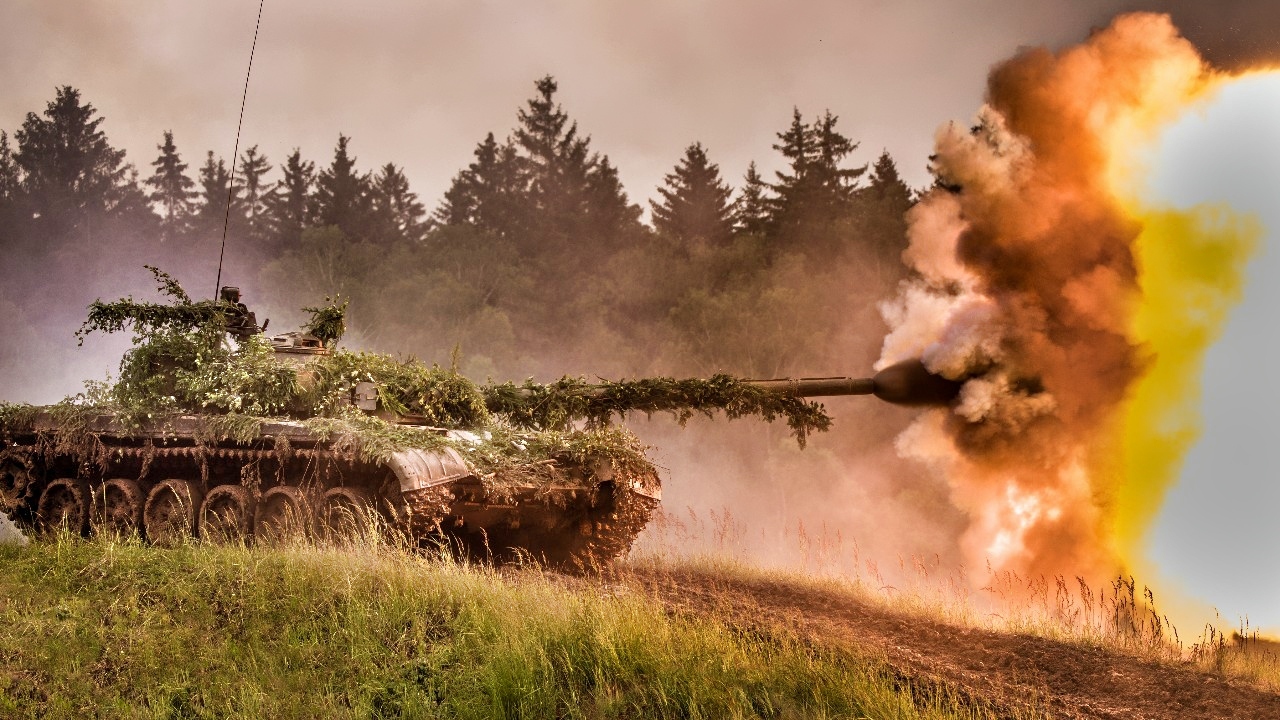
T-84 Tank Ukraine. Image Credit: Creative Commons.
-This pause allowed Russia to retreat in good order, mobilize hundreds of thousands of troops, and build the formidable “Surovikin Line.”
-This is a painful lesson: similar indecisiveness in a future conflict, such as over Taiwan, would be catastrophic.
The Painful Lesson from Ukraine the U.S. Must Not Repeat in Taiwan
Ukraine’s 2022 counteroffensive caught both Russian forces and Western states off guard. While maintaining operational security, Kyiv identified major weak points and gaps in the overstretched and thinly manned Russian lines. The offensive liberated Kharkiv and the right bank of Kherson.
Despite the Ukrainian success, Russian forces were able to save many of their key units from incapacitation. Kyiv could not immediately follow up on its counteroffensive, and the Russians were able to regroup and fortify critical defenses into what became known as the Surovikin Line. A major reason Ukraine could not continue its offensive into winter was bureaucratic backchanneling and slow allocations of Western weaponry, all of which left time for Russian forces to dig in.
Miscommunication and lack of will gave new life to the Russian invasion and allowed Moscow to continue its occupation of several Ukrainian oblasts. The effects are still felt on the battlefield today.
2022 Counteroffensive
Utilizing medium-range rockets to decimate Russian logistics, the Ukrainian Armed Forces pushed on the right bank of Kherson throughout the summer of 2022. The Kremlin ordered units to redeploy from Kharkiv, Luhansk, and Donetsk to reinforce their garrison. Russian forces had overstretched themselves – only 180,000-200,000 troops occupied five different oblasts. With Ukraine having a manpower advantage, Kyiv would strike Moscow where it was least expected.
On Sept. 5th, 2022, after quietly amassing troops in the east that Russia’s high command ignored, Kyiv caught Moscow off guard with a lightning offensive that liberated the majority of Kharkiv oblast. Ukraine’s military command used an initial offensive in Kherson to divert Russian forces from maintaining readiness in other oblasts, such as Kharkiv.
The Kharkiv offensive sent a shockwave through the Kremlin, prompting Russian President Vladimir Putin to declare the illegal annexations of Luhansk, Donetsk, Zaporizhzhia, and Kherson on Sept. 30, 2022, despite the Ukrainian military still holding major footholds in all four oblasts. Furthermore, Putin ordered a partial mobilization of more than 300,000 conscripts to stabilize the frontlines.
But Russia’s new conscripts would not be able to reach the frontlines for several months due to logistical challenges of supply and transportation; this gave Ukraine time to complete the liberation of Kherson. After a few more weeks of making Russian logistics and fortifications untenable on the right bank of Kherson, Russia’s high command under Gen. Sergey Surovikin led an orderly retreat, which saw the Russians retain heavy equipment with minimal losses.
Russia was able to save its Kherson garrison in part thanks to backchannels with Western leaders, who were spooked by the Kremlin’s bluff that it would use nuclear weapons. The Ukrainian military had sufficient strength to continue advancing in the south and east, such as along the Kremmina-Svatove Highway. However, because of Western indecision, the counteroffensive was halted, and Russia bolstered the territory it occupied with hundreds of thousands more troops.
Western Indecision That Helped Russia Dig In
Ukraine’s battlefield success in 2022 was particularly shocking to Western countries because the UAF completed key objectives without the benefit of Western weapons such as F-16 fighter jets, long-range missiles, cluster munitions, and modernized tanks. But Kyiv could not continue the offensive and conduct combined-arms operations without aerial and armored support.
According to Bob Woodward, Russia’s nuclear bluffs also played a substantial role in slowing the trickle of Western aid, robbing Ukraine of potentially decisive victories. Woodward claims Russia told Western leaders that if Ukraine decimated or captured the 30,000 Russian troops on the right bank of Kherson, Putin would use nuclear weapons.
These claims cannot be independently verified, but they line up with the policy of escalation management that the United States and some European nations employ when considering how much to support Ukraine militarily.
As Western bureaucratic debates dragged on, Russia’s high command under Gen. Surovikin oversaw construction of one of the densest fortification networks in modern history. The Surovikin line would later hinder Ukraine’s failed 2023 counteroffensive, which saw numerous Western armored platforms destroyed and resulted in critical manpower losses for the UAF.
Simultaneously, the Ukrainian government miscalculated the extent of Russia’s partial mobilization and monthly recruitment numbers. Russia, at the height of the war, recruited 25,000 to 30,000 contract soldiers per month by offering lucrative contracts – although these often remain unfulfilled because of the heavy casualty rate.
The Ukrainian government’s reluctance to expand its own mobilization to counter Putin’s decree was costly, as it translated into the manpower shortages seen on the battlefield today.
Lessons for Today
In a war in which timing, reluctance, and hesitancy could mark the difference between life or death for Ukrainian defenders, indecision on critical wartime matters must be minimal. And with tensions rising in crucial regions such as the Indo-Pacific, it is worth noting how Western hesitancy and bureaucratic slowness can be detrimental to the outcome of any major war.
In the Taiwan Strait, for example, Washington cannot afford to hesitate to arm Taipei or directly intervene – Beijing holds major advantages in manpower, missiles, aircraft, and naval vessels over its cross-strait rival. Likewise, with a growing Chinese navy, American maritime deterrence and force projection will be necessary if armed conflict arises involving treaty allies, such as Japan and the Philippines, over the East and South China Seas.
Taiwan, Japan, and South Korea, three countries that receive significant American backing, have adversaries that seek to expand their territorial sovereignty. Meanwhile, trust in and favorable perception of the United States have fallen in 2025.
Not only is trust essential in building a front that can maintain deterrence, but it is also key to coordinating decisions and mitigating the fear of escalation. The West and its global allies should enact policies that make it clear any escalation by any adversary will be met by greater reprisals – that is the meaning of deterrence.
Ukraine’s 2022 counteroffensive was a turning point in the war. It could have been decisive, leaving Kyiv in a much better place militarily and diplomatically, had the Ukrainian Armed Forces received sufficient weapons and backing before the Russians were able to stabilize the frontlines. Instead, Russian troops were able to recover and organize, and NATO’s command is now preparing for the possibility of war with Moscow in other Eastern European theaters.
Western and Ukrainian government hesitance to take advantage of a weakened adversary is a painful lesson. The war continues to grow, as do battlefield losses in numbers not seen in a conventional conflict since the Korean War. Learning from bureaucratic mistakes, and updating doctrines to meet the demands of modern warfare, is necessary for NATO and its allies.
About the Author: Julian McBride
Julian McBride is a forensic anthropologist and independent journalist born in New York. He is the founder and director of the Reflections of War Initiative (ROW), an anthropological NGO which aims to tell the stories of the victims of war through art therapy. As a former Marine, he uses this technique not only to help heal PTSD but also to share people’s stories through art, which conveys “the message of the brutality of war better than most news organizations.” Julian is also a new contributing editor to the National Security Journal.
More Military
The YF-23 Black Widow II: Better Than the F-22 Raptor?
The A-12 Avenger II Stealth Bomber: What Navy Aircraft Carriers Almost Had
America’s Big Boeing X-32 Stealth Fighter Mistake Still Stings
The B-52J Bomber Might Never Fly: Here’s Why
K3: The New Tank That Looks Like the B-21 Raider Stealth Bomber


Swamplaw Yankee
September 8, 2025 at 2:56 am
Art, Art, + away! Is art actually useful in an ancient 1000 year old russkie Genocide campaign?
Lessons, Bureaucratic, this, hesitancy that: what gives?
First: the language. This is not a war. In 2014 POTUS Obama’s Democratic Cabal unilaterally green lit the RE-start of the ancient 1000 year old Genocide of Ukrainians by the ethnic Ruskkie peasant butchers.
100, 500 or 1000 years back, the ethnic ruskie butchers came out in different costumes on scary Halloween nights to mass kidnap little Ukrainian children. The russkie genetic need to satiate themselves on little children is so strong that in 2025 Putin’s “little green groomer” military is busy filtering “Lolita” packages and free air shipping the victim kids to so very needy muscovite russkie language and depraved tabletop dancing teachers.
The WEST could not stop Benedict Arnold Obama in 2014. WHY exactly is that? The Obama betrayal of NATO was obvious to every member state! The loss to NATO of the geopolitical advantage of Ukraine’s Crimean soil, families and Black/Azov Sea jurisdictional zones to the WEST’s prime vile cold war enemy; Putin the paedo, was slow and evident. Ukrainian Fathers rushed to Iloviask for weeks to stop the local russkie traitors from Basement butchering Ukrainian parents so “Lolita” packages could be traded for Putin’s tanks/trucks/ammo. The Fathers were not prepared for the over the border tsunami wave of russkie army orcs all blessed by marxist Obama and his blood brothers in moscow.
Jus contra bellum was not heard in 2014 in the marxist POTUS Obama MSM releases. Indecision, reluctance, cowardice, all intermix depending on who recalls and who was even watching Obama do the chicken talk/dance. One would think the USA was back in 1939-40-41.
As the orc dress in their halloween costumes, the MAGA POTUS Trumpkins drinks in the Putin “Redline” agit/prop as if he had never heard the same commie redlines before. Tried and true cons from the Balkan war ( 1986), georgia, all work as Trumpkins deeply inhales old scams that genius Trumpkins actually never did hear before.
The only updating that this 1000 year old Genocide requires is the prepayment by Putin of $10,000,000 in Gold bullion to each and every Ukrainian victims as compensation and reparation for 11 years of russkie human trafficking.
Only after the deviant Putin pays in full the Ukrainian victims can the Weirdo Whackoff slime circus be taken out of the closet to clown shoe their code words of peace, cease fire, land swap, etc.
This MAGA POTUS Trumpkins has character cast a Fellini 3 ring circus movie set, comparable to the movie 8 1/2. -30-