

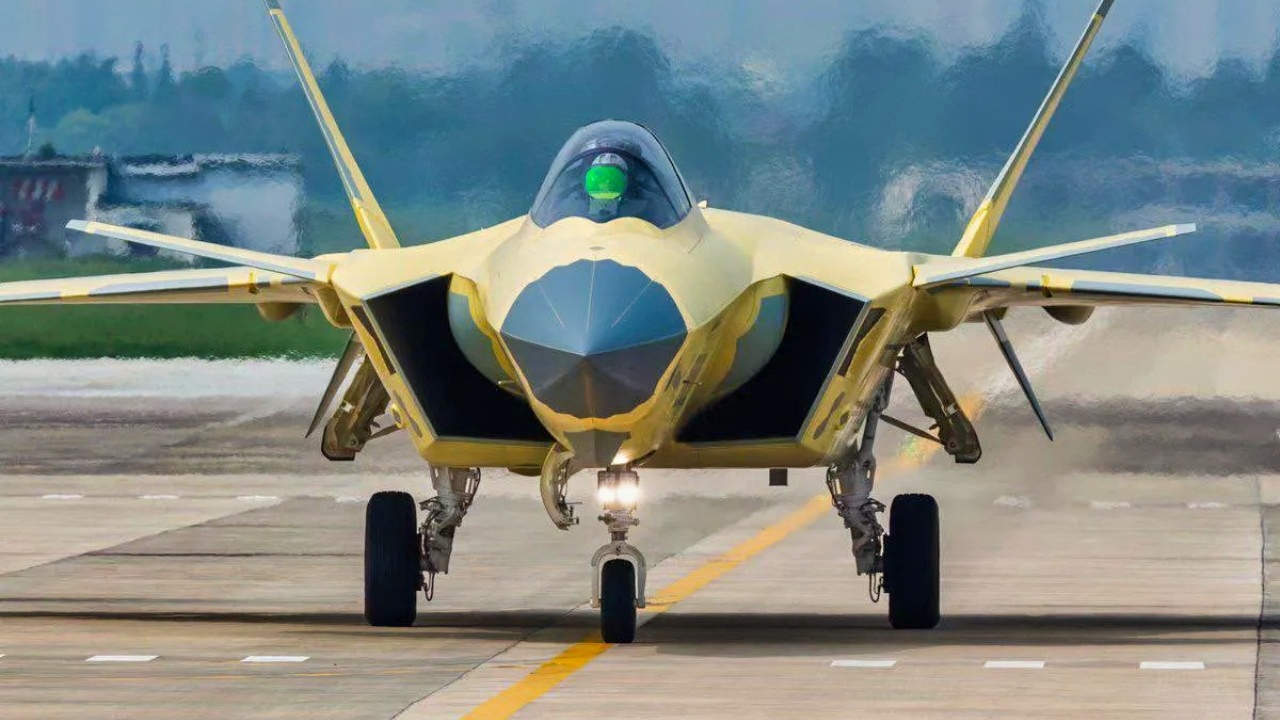
China’s Military Looks Like a Real Powerhouse Built for War
-While the West focused on a defense expo in Poland, China staged one of the largest military parades in its history—a meticulously controlled pageant of new weaponry aimed directly at the United States.
-The event, closed to the public, was less a celebration and more a strategic message. It showcased China’s alarming ability to innovate and mass-produce a wide range of advanced systems, from sixth-generation fighters to new drones.
-The key takeaway for the Pentagon is clear: China has moved far beyond its “copycat” past and is now a modern, formidable military power.
China: Now a Real Military Superpower?
Kielce, Poland – The world’s defense companies descended on the medium-sized Polish city of Kielce for a major arms show. In contrast, half a world away, the People’s Republic of China (PRC) unveiled a long list of new weapons, drones, and other military hardware.
The occasion was the largest military parade in the nation’s history, held to commemorate 80 years since Japan’s surrender and the official end of World War II.
On the surface, this event was an opportunity for the PRC and Chinese Communist Party (CCP) General Secretary Xi Jinping to show off just how mighty and capable the country’s defense industrial enterprises are.
The event was also intended to demonstrate to the Chinese public and the world the numerous new weapons their nation’s defense sector has produced in recent years.
But the ordinary Chinese citizen was ironically only permitted to be impressed through the screens of their televisions or mobile devices via a livestream of the event. This parade was closed to the public, with the main route being heavily cordoned off and patrolled.
The entire procession and all the forming up sites comprised about six square miles—or four times the size of New York’s Central Park—and were all under complete lockdown.
Beyond more than 20 world leaders in attendance, only party dignitaries and select individuals were permitted to attend.
Total Control
“Looking at the parade itself, you really are just going to see a stage-managed performance of total control,” said Carl Minzner, a senior fellow with the Council on Foreign Relations for CNBC. Minzer is also the author of “End of an Era: How China’s Authoritarian Revival is Undermining Its Rise.”
Even the buildings located along the parade route were under strict instructions. Local authorities along Chang’an Avenue, the main thoroughfare in Beijing that runs through Tiananmen Square, were responsible for controlling those who live along the parade route. Those Beijing residents were ordered to keep their windows shut, and those in offices were ordered to stay home from early Tuesday evening until well after the 70-minute procession ended the following day.
“On TV, the party authorities want the public to see the party firmly in control,” Minzner explained. “They’re worried that there are discontented people in China and something might go wrong. They want at all costs to prevent that from happening. They’re worried about the impact that it might have on the perceptions that it’s giving to Chinese citizens.”
Trying to Intimidate
Experts in Washington, Europe, and across Asia widely agree: the real audience for China’s parade was not the friendly dignitaries or the Chinese public, but the United States.
The primary purpose was to send a clear signal to Washington about China’s growing military prowess and strategic ambitions.
These analysts say China aimed to impress Pentagon planners with specific demonstrations of its new defense sector capabilities. The parade was designed as strategic messaging directed toward America’s security community.
Number one is that for months now, Beijing has been revealing piecemeal a variety of new weapon systems—most notably a raft of new 6th-generation fighter aircraft that began to be seen in December of last year. However, the existence of these and other new weapons was not the primary point that Beijing and its military, the People’s Liberation Army (PLA), sought to impress upon its main adversary.
The second, more crucial point: China demonstrated its ability to rapidly produce a wide range of weapons, showcasing them in large numbers to signal a productive capacity far surpassing that of the US.
Concentrating on the main, large weapons and what their mission is would be missing the main point, said one retired US military intelligence officer. What we are seeing now, he explained, “is a degree of innovation and the production of a wide range of weapons—far beyond anything we have seen before,” he said.
“The Chinese used to be limited to making copies of Russian or other peer nation weapons – and sometimes not terribly good copies,” he continued. “Everything we saw today tells us that they have gone way past those old days and are a modern force to be reckoned with.”
About the Author: Reuben F. Johnson
Reuben F. Johnson has thirty-six years of experience analyzing and reporting on foreign weapons systems, defense technologies, and international arms export policy. Johnson is the Director of Research at the Casimir Pulaski Foundation. He is also a survivor of the Russian invasion of Ukraine in February 2022. He worked for years in the American defense industry as a foreign technology analyst and later as a consultant for the US Department of Defense, the Departments of the Navy and Air Force, and the governments of the United Kingdom and Australia. In 2022-2023, he won two awards in a row for his defense reporting. He holds a bachelor’s degree from DePauw University and a master’s degree from Miami University in Ohio, specializing in Soviet and Russian studies. He lives in Warsaw.
More Military
5 Ways Aircraft Carriers Could Be Destroyed in a War
Dassault Rafale Fighter: Stealth Made it Obsolete?


Jim
September 4, 2025 at 2:43 pm
It’s been coming for a long time, and they haven’t tried to hide it.
You could see it on the horizon with China’s ability to mass produce consumer goods (i.e. piles of unused bicycles).
Now, it’s apparent they’ve applied the same mass production ability to their military and with a technological edge which maybe surprising to average Joe’s, but again has been visible on the horizon for some time… for anybody who cared to look.
Yes, it’s pointed directly at us, but also any allies who might be inclined to join us against China.
The days of glib assurances about U. S. Military superiority are over for serious analysts.
China’s military is strong for close in actions along their coastline and expanding in range with short, interior lines of logistics and striking power.
But China isn’t going to send their military over here en mass to the Western Hemisphere.
It’s about the Western Pacific & East Asian Seaboard.
Do we want to stick our nose in that potential buzz saw?
Or get in a full-blown arms race?
Serious thought needs to be given to our actual vital interests in that part of the World without illusions or self-deceptions about the balance of forces and in a clear-eyed fashion account for China’s burgeoning military capacity.