


Summary and Key Points: When Russia invaded Ukraine in February 2022, the Black Sea Fleet had 74 vessels, a Slava-class flagship cruiser, and overwhelming superiority against a Ukrainian Navy that had almost no operational warships.
Four years and three months later, approximately 30 percent of the fleet has been destroyed or seriously damaged.
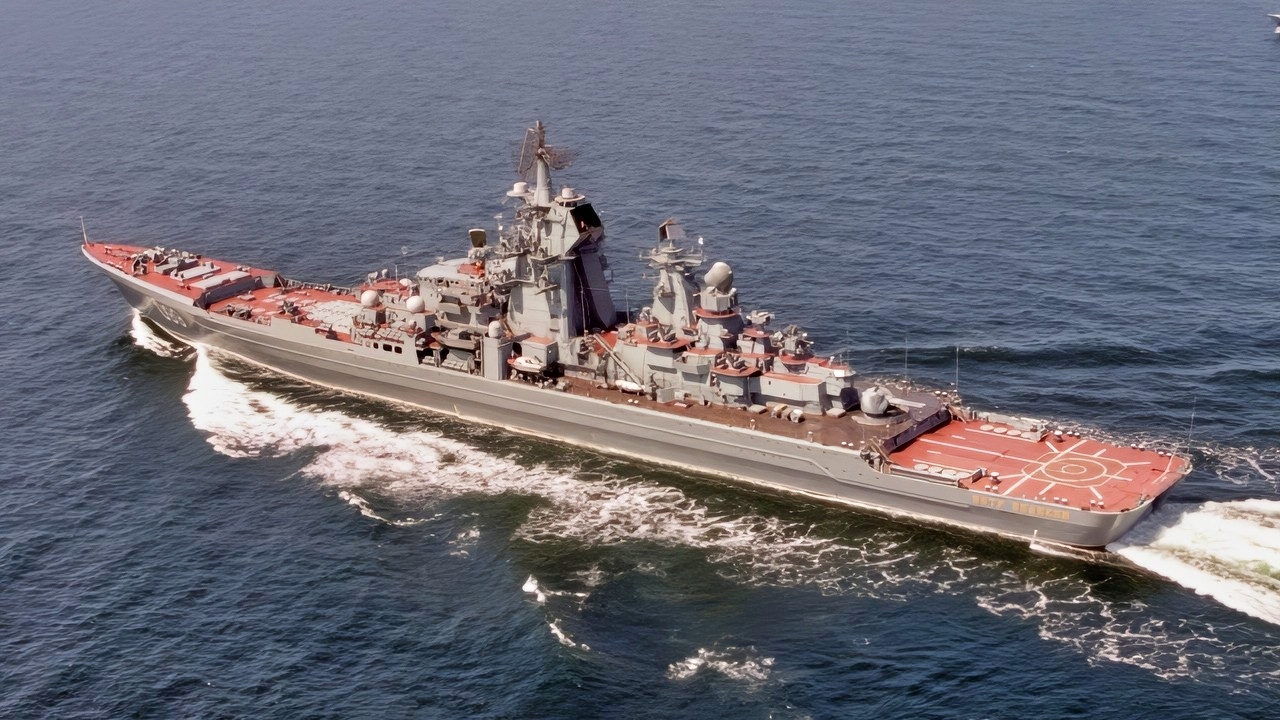
Russian Navy Kirov-Class. Image Credit: Creative Commons.
How the Russian Navy Fell Apart in the Ukraine War
Nothing has gone right for Russia during the Ukraine war, especially when it comes to Putin’s Air Force. The Russian Navy has not done any better.
When the Russian General Staff finalized the plan for the February 2022 invasion of Ukraine, the Russian Black Sea Fleet was assigned a central role across multiple phases of the campaign.
Russian naval planners expected the fleet to project power into the western Black Sea, blockade the Ukrainian ports of Odesa, Mykolaiv, and Mariupol, conduct amphibious landings against Ukrainian coastal territory south and east of Odesa, provide naval gunfire support to Russian ground forces advancing along the Black Sea coastline, and launch substantial volumes of Kalibr cruise missile strikes against Ukrainian command and infrastructure targets across the entire depth of Ukrainian territory.
The Black Sea Fleet at the start of the war consisted of approximately 74 surface combatants, submarines, amphibious ships, and patrol craft, supplemented by additional vessels that Russia had transferred into the Black Sea via the Bosphorus Strait before Turkey closed the strait to military transit. The fleet’s flagship was the Slava-class guided missile cruiser Moskva, a 12,500-ton vessel that provided long-range air defense coverage and anti-ship capability for the entire surface action group. Six Project 636.3 Improved Kilo-class diesel-electric submarines provided submerged strike capability. Multiple Ropucha-class and Alligator-class large landing ships were positioned to conduct the amphibious operations required by the Russian campaign plan.

Akula-Class Submarine from Russian Navy. Image Credit: Creative Commons.
The qualitative gap between the Russian Black Sea Fleet and the Ukrainian Navy at the start of the war approached the absurd.
Ukraine entered the conflict with almost no operational warships of any consequence. The Ukrainian flagship Hetman Sahaidachny was scuttled by its own crew in the first week of the war to prevent capture. The Ukrainian Navy possessed no destroyers, no cruisers, and no submarines.
By every conventional measure of naval power, the contest between the Russian Black Sea Fleet and Ukraine was so lopsided that pre-war Western assessments did not seriously consider whether Ukraine could meaningfully damage the Russian fleet.
And yet, nothing went as planned for what many experts, including myself, considered one of the most powerful naval forces on the Earth.
The Black Sea Collapse
The Moskva sank on April 14, 2022, after taking two Ukrainian-built R-360 Neptune anti-ship cruise missile hits off the coast near Snake Island.
The flagship of the Russian Black Sea Fleet was reportedly carrying 485 crew members when it was struck. The Kremlin claimed the ship sank in stormy seas after ammunition detonated due to an onboard fire of unknown origin. Western intelligence and Ukrainian military sources confirmed the Neptune strikes. The loss of the Moskva removed Russia’s primary long-range air defense coverage from the entire Black Sea theater and forced the rest of the surface fleet to operate without the umbrella protection the cruiser had provided.
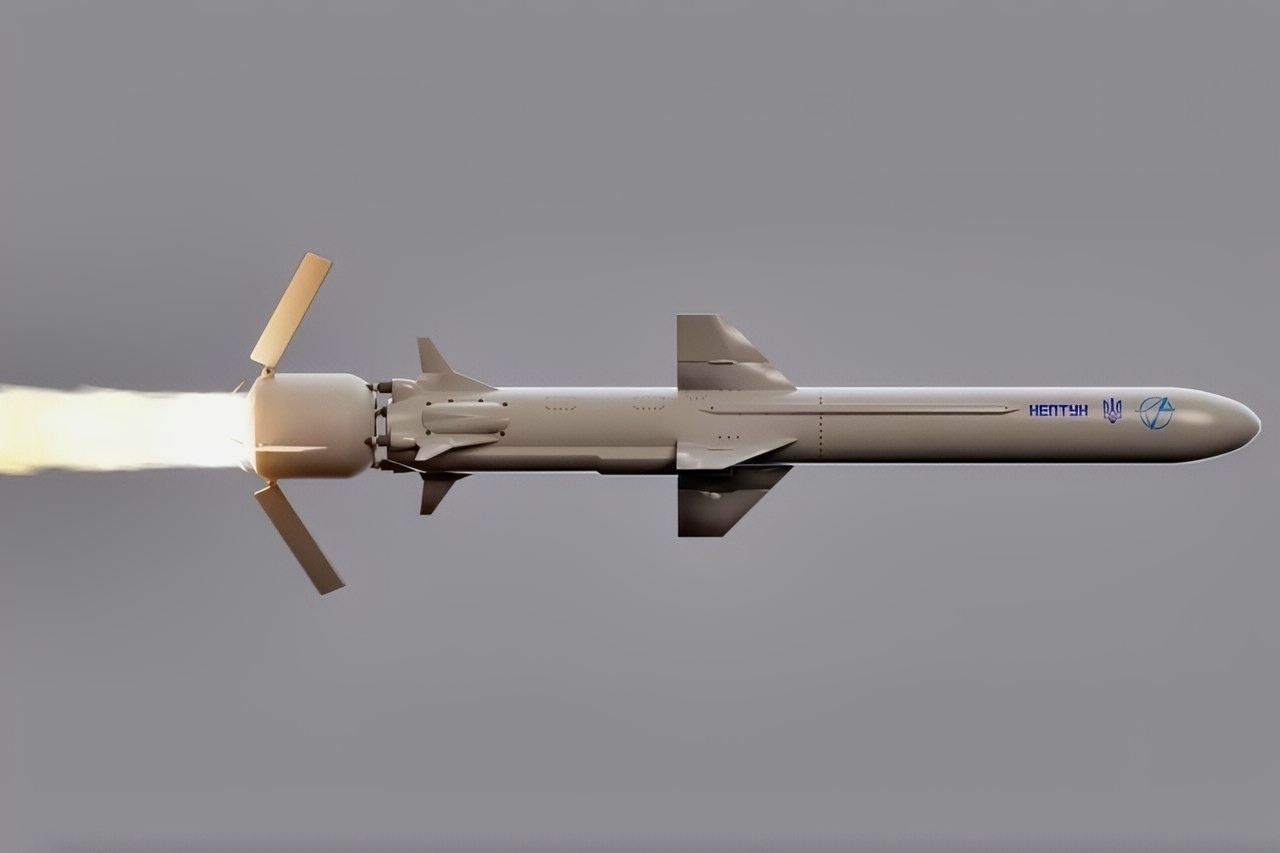
Neptune Missile. Image Credit: Government of Ukraine.
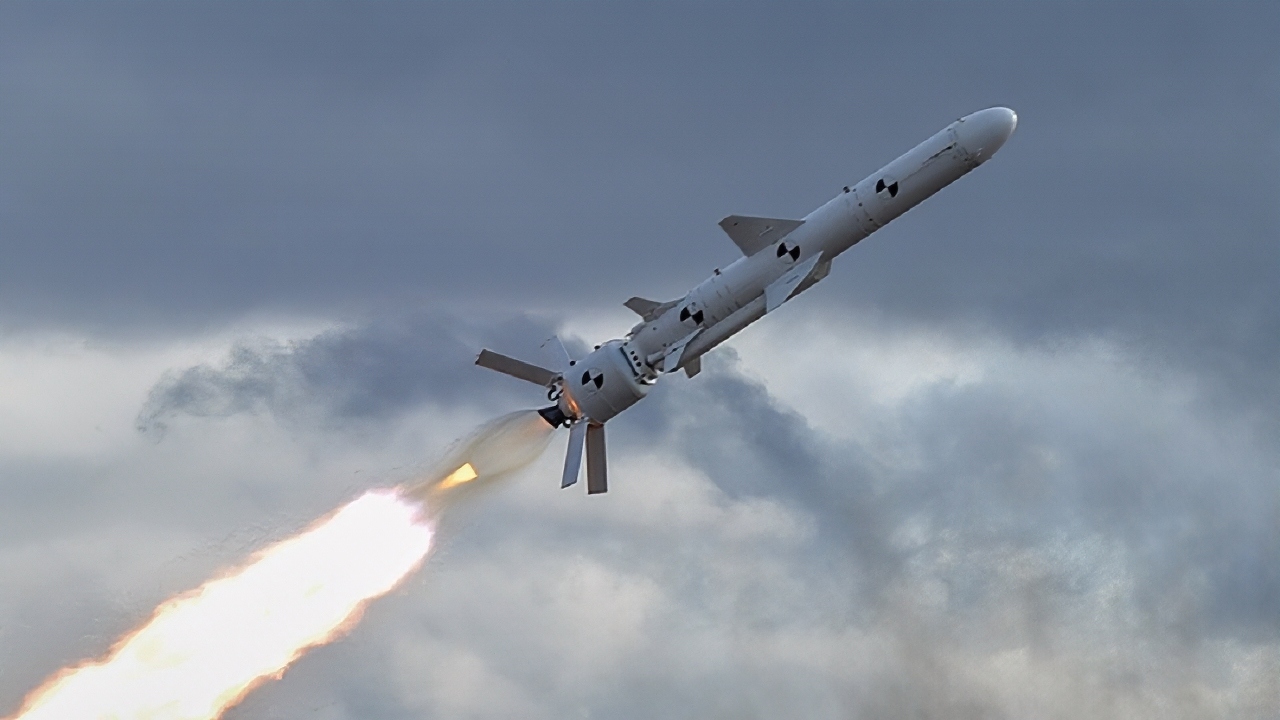
Neptune Missile. Image Credit: Creative Commons.
The losses compounded across 2022 and 2023. The large landing ship Saratov was destroyed at dockside in occupied Berdiansk on March 25, 2022, by a Ukrainian Tochka-U ballistic missile strike, with the sister ships Novocherkassk and Caesar Kunikov badly damaged in the same engagement.
Ukrainian special operations forces conducted naval drone strikes against the Black Sea Fleet headquarters at Sevastopol in July 2022, forcing the cancellation of the Russian Navy Day celebrations that year. Strikes on the Saky airbase in occupied Crimea destroyed more than half of the Black Sea Fleet’s air component combat jets in a single coordinated operation in August 2022.
Ukrainian innovation accelerated through 2023 and 2024. The Magura V5 unmanned surface vessel, an explosive-laden naval drone developed under the Ukrainian military intelligence service’s Group 13 special unit, became the platform that fundamentally rewrote Black Sea naval warfare. Magura drones sank the landing ship Caesar Kunikov on February 14, 2024. They sank the missile patrol boat Sergei Kotov on March 5, 2024. They sank the missile corvette Ivanovets in February 2024. The Sergei Kotov loss was the third Russian Black Sea Fleet vessel sunk in five weeks, prompting the Russian Defense Ministry to dismiss Black Sea Fleet Commander Admiral Viktor Sokolov on February 15, 2024.
By June 2024, the United Kingdom Ministry of Defence assessed that at least 26 Russian Navy vessels had been damaged or destroyed in the Black Sea and that the surviving Russian surface fleet had been pushed east to the Russian port of Novorossiysk because Sevastopol was no longer survivable as a forward operating base. UK defence minister Grant Shapps had publicly described the Russian Black Sea Fleet as “functionally inactive” in March 2024. UK Chief of the Defence Staff Admiral Sir Tony Radakin used the framing that Russian naval forces in the Black Sea had been brought “to heel through a combination of drones and long-range missiles.”
How Russia Tried To Bounce Back
The Russian response to the Black Sea collapse was withdrawal followed by adaptation. Russian surface combatants were relocated from Sevastopol to Novorossiysk and to smaller, dispersed harbors farther east along the Russian Black Sea coast.
The remaining Russian submarines were withdrawn from operational patrols and held in defensive postures. Russian amphibious operations against Ukrainian coastal territory were quietly abandoned. The blockade of Ukrainian ports collapsed by mid-2023, with commercial shipping returning to near pre-war levels through the Ukrainian-established grain export corridor.
Russian naval planning shifted toward layered defenses for the surviving fleet. Additional anti-drone netting, electronic warfare jamming, and close-in weapon system batteries were installed around Russian naval bases. Russia attempted to develop counter-USV tactics and weapons across 2024 and 2025, with mixed operational results. The Black Sea Fleet that survives today is fundamentally a coastal defense force operating from Russian home waters, not the offensive naval projection force with which Russia entered the war.

Sea Baby Drone Ukraine. Image Credit: Creative Commons.
The Ukrainian campaign did not stop with the withdrawal. Ukrainian drones struck the Conro Trader railway ferry in the Kerch Strait, severing one of Russia’s primary fuel and ammunition supply routes to occupied Crimea. The autonomous underwater drone strikes that crippled the Buyan-M class missile ship near Novorossiysk in August 2025 demonstrated that even the new fleet based on the Russian coast was no longer safe. The December 15, 2025, strike that damaged a Varshavyanka-class submarine near Sevastopol showed that Russian submerged assets were also vulnerable to combined Ukrainian drone operations.
The State Of Play As Of May 27, 2026
The Ukrainian Ministry of Defence assesses approximately 30 percent of the Russian Black Sea Fleet’s combat strength has been destroyed or seriously damaged since February 2022. The figure includes the flagship Moskva, multiple large landing ships, the missile corvettes Ivanovets and Sergei Kotov, the patrol boats and supply vessels lost across the war, and the more recent losses in 2025 and 2026 to combined drone strikes against the surviving fleet base at Novorossiysk.
The March 2, 2026 large-scale Ukrainian drone strike on Novorossiysk sank the minesweeper Valentin Pikul and inflicted heavy damage on the ASW ships Yeysk and Kasimov. The April 2026 combined operation against Novorossiysk inflicted critical damage to the frigate Admiral Makarov’s superstructure and Kalibr missile launchers — meaning the ship that had been serving as the Black Sea Fleet flagship after the Moskva sinking is now functionally out of action. The Ukrainian Ministry of Defence’s most recent assessment describes the Russian fleet as having lost its offensive capability entirely and as now fighting for its own survival rather than projecting power.
Russia’s Ukraine Navy Plan Failed
The strategic implications are significant. Russia’s pre-war plan for the Black Sea was to use naval power to compel Ukrainian surrender and to project Russian influence across the entire Black Sea littoral. That plan has failed comprehensively.
Ukraine — with no conventional navy and almost no large surface warships — has reduced one of the major Cold War-era European fleets to a coastal defense force operating from a single secondary port that is itself under regular attack. The pre-war fleet of 74 vessels has shrunk to approximately 50 operational hulls, and the operational fleet is in worse condition than the headline numbers suggest because of layered combat damage, deferred maintenance, and parts shortages resulting from sanctions on Russian shipbuilding.
The Russian Black Sea Fleet that existed on February 23, 2022, is gone. The fleet that exists today is a substantially smaller, substantially less capable, substantially more defensive force operating in waters that Ukraine — a country without a navy — has converted into a high-risk environment for any Russian-flagged warship. The naval campaign intended to dominate the Black Sea has resulted in one of the most decisive asymmetric naval defeats in modern military history.
Russia is not going to rebuild the Black Sea Fleet to anything approaching its pre-war strength across the next decade. The damage is structural, and the lessons that Ukrainian forces taught the world about how a country without a navy can defeat a major surface fleet using drones and long-range missiles are now being studied by every other navy on the planet.
About the Author: Harry J. Kazianis
Harry J. Kazianis (@Grecianformula) was the former Senior Director of National Security Affairs at the Center for the National Interest (CFTNI), a foreign policy think tank founded by Richard Nixon based in Washington, DC. Harry has over a decade of experience in think tanks and national security publishing. His ideas have been published in the NY Times, The Washington Post, The Wall Street Journal, CNN, and many other outlets worldwide. He has held positions at CSIS, the Heritage Foundation, the University of Nottingham, and several other institutions related to national security research and studies. He is the former Executive Editor of the National Interest and the Diplomat. He holds a Master’s degree focusing on international affairs from Harvard University.


