

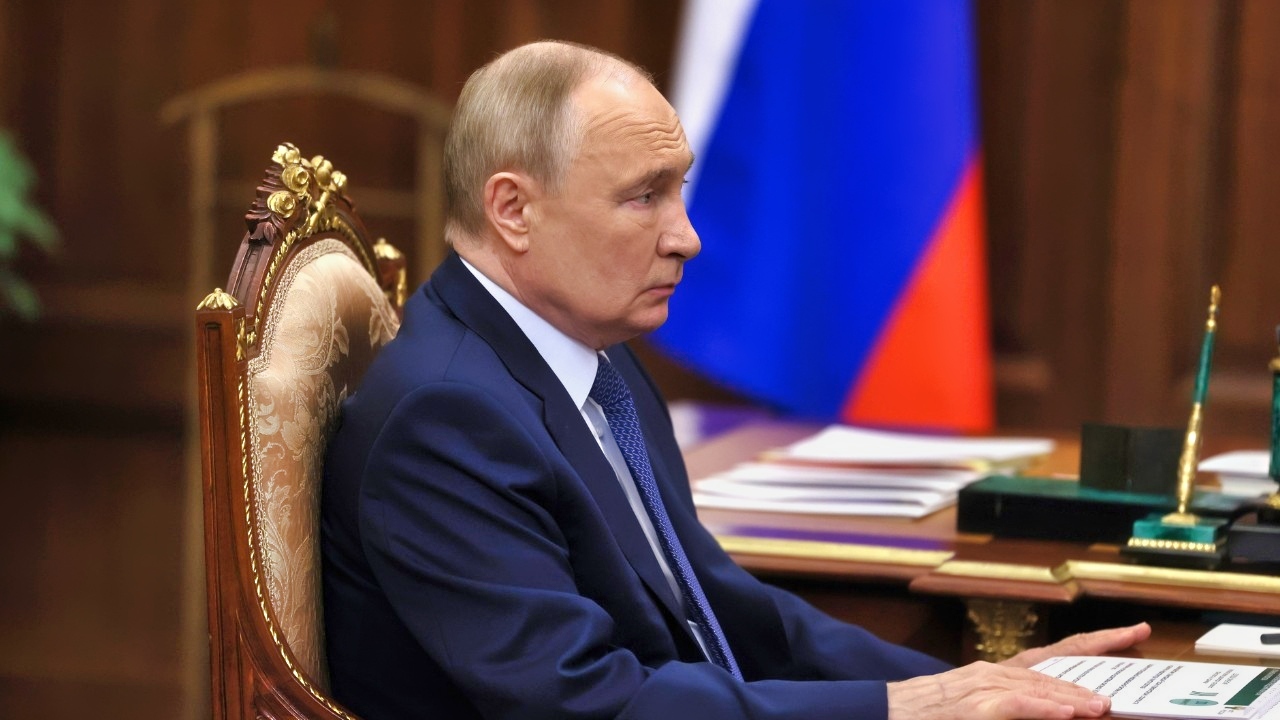
On May 25, 2026, Russian Foreign Minister Sergey Lavrov placed a phone call to U.S. Secretary of State Marco Rubio. The substance of what Lavrov said in that call has now been confirmed by the Russian Foreign Ministry’s own readout and tracked across multiple Western and Ukrainian outlets. Moscow had decided to begin striking what it called the “decision-making centers” of the Ukrainian government in Kyiv. Lavrov urged Rubio to “ensure the evacuation of their diplomatic personnel” from the Ukrainian capital — a phrasing that the Ukrainian Foreign Ministry has since described as “shameless blackmail” rather than a serious diplomatic warning.
The Ukraine War Goes from Bad to Worse

German soldiers assigned to Surface Air and Missile Defense Wing 1 fire the Patriot weapons system at the NATO Missile Firing Installation (NAMFI) during Artemis Strike Nov. 7 in Chania, Greece. Artemis Strike is a German-led multinational air defense exercise. German soldiers Over 200 U.S. soldiers and approximately 650 German airmen will be participating in the realistic training within a combined construct, exercise the rigors associated with force projection and educate operators on their air missile defense systems. (Photo By Officer Candidate Sebastian Apel, Air Defence Missile Group 24)
The call was a formal declaration that Russia intended to expand the targeting envelope of its ongoing aerial campaign against Kyiv beyond residential buildings, energy infrastructure, and military-industrial facilities — into the political and administrative core of the Ukrainian state.
Russian Foreign Ministry statements following the Lavrov-Rubio call urged foreign nationals, diplomatic missions, and staff of international organizations to leave the city. Kyiv residents were told to stay away from military and administrative facilities of the Zelensky government.
The European Union’s ambassador to Ukraine publicly responded that her team would remain in place. Ukrainian Foreign Minister Andrii Sybiha called for additional defense capabilities, increased pressure on Russia, and accelerated EU accession decisions in response.
As one former top NATO military commander told me today: “Russia is going to escalate in the Ukraine war. And it could get very messy, very fast.”
The First Wave
The strikes that immediately preceded the Lavrov call were among the largest combined missile and drone attacks of the entire four-year war.
On the night of May 23 into May 24, Russia launched approximately 90 missiles and 600 drones against Ukraine in a series of waves that hit Kyiv between roughly 1 a.m. and 5 a.m. local time.
The weapons used included an Oreshnik intermediate-range hypersonic ballistic missile — the third confirmed combat use of the nuclear-capable weapon — alongside Iskander short-range ballistic missiles, Kinzhal hypersonic air-launched missiles, Tsirkon cruise missiles, and approximately 600 Shahed-type one-way attack drones.

Iskander-M. Image Credit: Creative Commons.
The damage in Kyiv extended across every district of the capital. Four people were killed in Kyiv and the surrounding region. More than 80 were wounded. Approximately 30 residential buildings were damaged or destroyed. The Ukrainian government’s cabinet building and the Foreign Ministry suffered window and structural damage.
The Museum of Chernobyl, the institution dedicated to documenting the 1986 nuclear disaster, was destroyed. One of Kyiv’s oldest markets burned to the ground. Several schools were hit, including one in which children were sheltering at the time of the strike. Water-supply infrastructure was deliberately targeted ahead of the summer demand season, according to President Zelensky.
Ukraine’s culture minister stated that more cultural institutions were damaged in the single overnight attack than at any point since the full-scale invasion began in February 2022.
Ukrainian air defenses intercepted most of the drones and more than half of the inbound missiles, but the volume of the salvo was sufficient to ensure that significant numbers of weapons reached their targets.
The Second Wave
The follow-on attack came less than 24 hours later, overnight on May 25 into May 26 — coinciding deliberately with Kyiv Day, the city’s traditional founding anniversary celebrated on the last Sunday of May.
Russia launched 69 missiles and 298 drones, killing 12 people and injuring at least 79, according to Ukrainian Interior Minister Ihor Klymenko. Three of those killed were children. Ukrainian air defenses shot down 45 cruise missiles and neutralized 266 drones. Twenty-two locations recorded direct strikes.
The pattern across the two attacks was the clearest signal yet that Russia is pursuing a deliberate strategy of saturation rather than precision. The targeting selection was broad enough to put pressure on Ukrainian air defenses across multiple districts simultaneously. The repetition was rapid enough to ensure that the air defense system could not fully reload, repair, and reposition between waves.
What Triggered The Escalation
The justification Russia offered for the strikes was retaliation.
On Saturday, May 23, Ukrainian forces struck the Russian-occupied town of Starobilsk in Luhansk Oblast. Russian occupation authorities described the strike as a Ukrainian attack on a college dormitory that killed civilians. The Ukrainian military disputed that characterization, stating that the actual target was the headquarters of Russia’s elite Rubicon Center for Advanced Unmanned Technologies — the drone warfare unit Russia formed in 2024 specifically to develop and field next-generation unmanned combat aerial systems.
It would seem President Putin personally ordered the retaliation. The scale of the response — and the expansion of targeting to Ukrainian government decision-making infrastructure — went well beyond what the Starobilsk strike alone would have warranted in any conventional reading of escalation dynamics.
What This Actually Means
The Lavrov-Rubio call is the moment Russia publicly committed to attacking Ukrainian government infrastructure with the explicit knowledge of the U.S. State Department. The diplomatic framing — urging the evacuation of American personnel — is the kind of advance notice that nuclear powers historically extend to one another before strikes that risk escalation beyond the bilateral relationship in question.
For Ukraine, the escalation cycle has now produced what is likely the most operationally demanding period of the entire war in terms of sustained Russian aerial pressure on the capital. The May 14 attack, 10 days earlier, set a record with 1,560-plus drones across two days. The May 24 and May 26 attacks reset that record. The May 25 Lavrov call announced that the pattern would continue.
For the United States, the question is whether the State Department interprets Lavrov’s warning as a serious diplomatic communication or as a public-relations stunt designed to extract concessions in ongoing back-channel negotiations. The European Union has already answered. Brussels is staying in Kyiv. Russian threats have not changed allied behavior on the ground. Time will tell what happens next in the war in Ukraine. But things clearly don’t look like peace is at hand anytime soon.
About the Author: Harry J. Kazianis
Harry J. Kazianis (@Grecianformula) was the former Senior Director of National Security Affairs at the Center for the National Interest (CFTNI), a foreign policy think tank founded by Richard Nixon based in Washington, DC. Harry has over a decade of experience in think tanks and national security publishing. His ideas have been published in the NY Times, The Washington Post, The Wall Street Journal, CNN, and many other outlets worldwide. He has held positions at CSIS, the Heritage Foundation, the University of Nottingham, and several other institutions related to national security research and studies. He is the former Executive Editor of the National Interest and the Diplomat. He holds a Master’s degree focusing on international affairs from Harvard University.


