

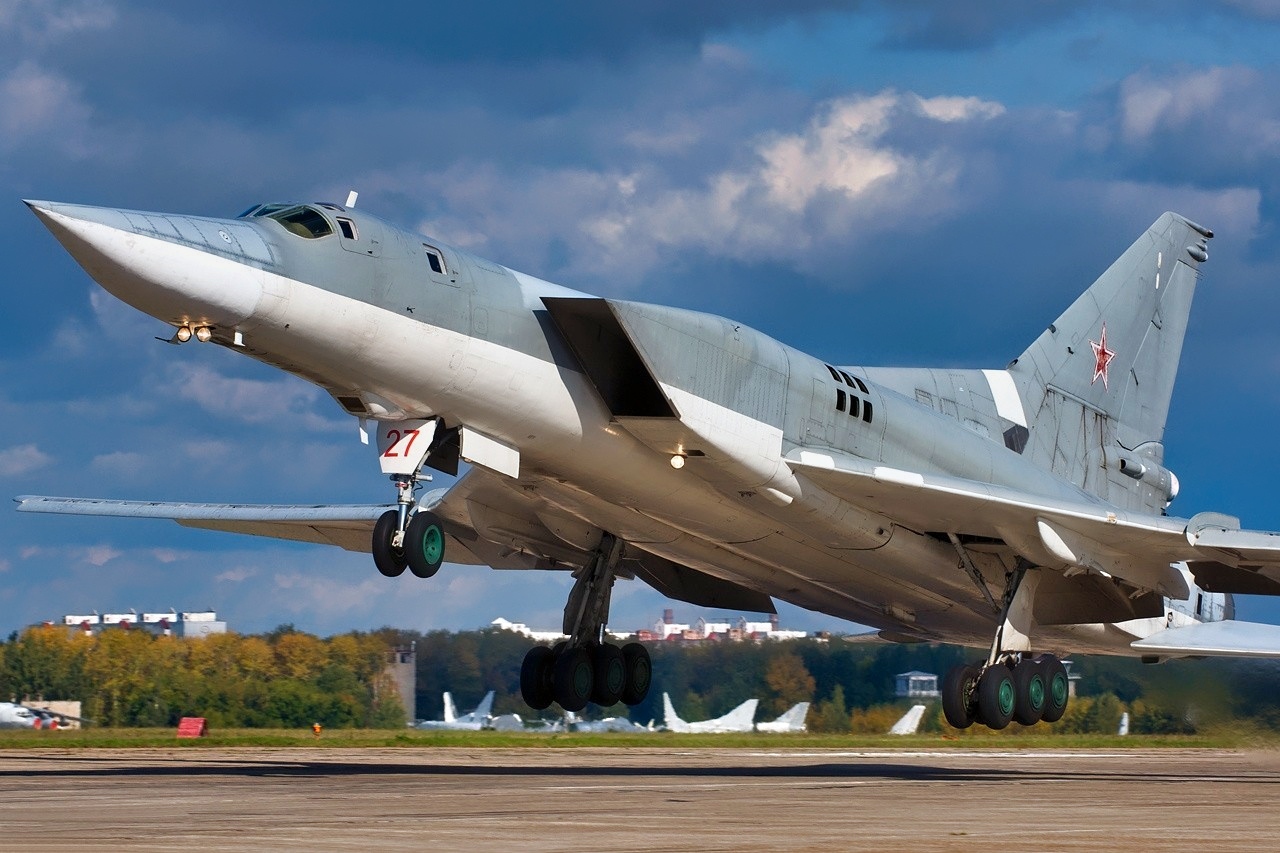
Key Points – The Russian Tu-22M3 “Backfire,” a supersonic, variable-sweep wing bomber, remains a formidable long-range strike platform.
-Evolving from the flawed 1960s Tu-22 “Blinder,” the Tu-22M3 variant (introduced in 1983) became the definitive version with more powerful engines and improved aerodynamics.
– It had one mission: win a war with NATO.
-Its primary threat lies in its potent arsenal of anti-ship cruise missiles, including the Mach 4.6 Kh-22 “Kitchen” and its modernized, longer-range successor, the Kh-32.
-An ongoing modernization program is upgrading the fleet to the Tu-22M3M standard with digital cockpits and restored in-flight refueling capabilities, ensuring its continued role in Russia’s military doctrine.
Tu-22M3 ‘Backfire’: The Story of Russia’s Supersonic ‘Carrier Killer’ Bomber
The Tupolev Tu-22M Backfire was Russia’s first supersonic bomber. Originally designed by the Soviet Union, the T-22 was designed to penetrate deep into enemy airspace with high speeds and deliver a conventional or nuclear strike.
It’s wide arsenal of bombs and missiles makes the aircraft a force to be reckoned with even by today’s standards. However, the Tu-22M3 had a rather complicated design history, requiring multiple upgrades and modernization efforts to keep
What Makes the Tu-22M3 So Deadly?
The Tu-22M3’s arsenal makes it a highly deadly weapon. It is capable of carrying both conventional and nuclear missiles as well as a variety of cruise missiles and bombs. It can carry up to 24,000 kilograms of ordnance, both internally and on external hardpoints.
Among its most notable weapons is the Kh-22 missile, known to NATO as the AS-4 “Kitchen.” This long-range, supersonic cruise missile was designed to destroy aircraft carriers and large naval vessels. It has a range of approximately 600 kilometers and can carry either a conventional or nuclear warhead. The missile travels at speeds up to Mach 4.6, making it difficult to intercept.
Another key weapon in the Tu-22M3’s arsenal is the Kh-15, or AS-16 “Kickback.” This missile is smaller and has a shorter range—around 300 kilometers—but it is extremely fast, reaching speeds of Mach 5. It is typically carried in a rotary launcher within the aircraft’s bomb bay. The Tu-22M3 can also be equipped with the Kh-32, a modernized version of the Kh-22. The Kh-32 features improved guidance systems and enhanced resistance to electronic countermeasures, with a range of up to 1,000 kilometers.
In addition to missiles, the Tu-22M3 can carry a variety of bombs. These include the FAB-series of conventional free-fall bombs, which are used for general-purpose bombing missions. For more precise strikes, the aircraft can be equipped with KAB-series precision-guided bombs, which use laser or satellite guidance systems. Russia has also floated the idea of upgrading Tu-22M3Ms to make them capable of carrying hypersonic weapons such as the Kh-47M2 Kinzhal, although this upgrade has not yet been implemented.
The Backfire’s Complicated History
The Tu-22M3 first began as the Tu-22 “Blinder,” an aircraft that left a lot to be desired. This bomber was designed to fill the USSR’s need for a long-range intercontinental bomber. Although the Tu-22 was the Soviet Union’s first supersonic bomber, it was plagued by numerous issues. It had poor handling characteristics, high landing speeds, limited range, and was difficult to maintain. These problems led Soviet military planners to seek a more capable replacement that could fulfill both strategic and maritime strike roles.
In 1962, the Tupolev Design Bureau began work on a new bomber that would eventually become the Tu-22M. Although the aircraft was fundamentally different from the Tu-22, the Soviet government allowed it to be designated as an upgrade rather than a new design. This decision was largely political, aimed at avoiding bureaucratic hurdles and budgetary constraints that are often associated with launching an entirely new aircraft program. The first prototype of the Tu-22M flew in 1969, and the aircraft entered limited service in 1972.
The early versions of the Tu-22M, including the Tu-22M0 and Tu-22M1, were primarily used for testing and evaluation. The Tu-22M2, introduced in the mid-1970s, featured improved engines and avionics, but it was the Tu-22M3, introduced in 1983, that became the definitive and most widely produced version. The Tu-22M3 incorporated significant design changes, including more powerful NK-25 engines , redesigned air intakes, and a modified airframe that improved aerodynamics and reduced radar cross-section. It also featured a variable-sweep wing design, allowing it to optimize performance at both high and low speeds.
Capable of reaching speeds up to Mach 1.88 and with a combat range of approximately 7,000 kilometers with aerial refueling, the Tu-22M3 was designed to perform a wide range of missions. These included strategic bombing, maritime strike, and reconnaissance. Its versatility made it a key component of both the Soviet Air Forces and Soviet Naval Aviation. During the Cold War, the Tu-22M3 was primarily tasked with delivering long-range cruise missiles against NATO carrier battle groups and strategic land targets.
The Tu-22M3 After the Fall of the USSR
Following the collapse of the Soviet Union, the Tu-22M3 fleet was divided among the newly independent states. Ukraine inherited a significant number of these bombers but later dismantled them under the Nunn–Lugar Cooperative Threat Reduction Program, aimed at reducing the proliferation of nuclear weapons and delivery systems. Russia retained and continued to operate its Tu-22M3 fleet, gradually modernizing the aircraft to extend its service life and enhance its capabilities.
In the 2010s, Russia began a comprehensive modernization program for the Tu-22M3, resulting in the Tu-22M3M variant. This upgraded version features a digital cockpit, modern avionics, improved navigation and electronic warfare systems, and compatibility with new-generation weapons. One of the most significant changes is the restoration of in-flight refueling capability, which had been removed under previous arms control agreements. This enhancement significantly extends the bomber’s operational range and strategic flexibility.
Despite its age, the Tu-22M3 still plays a unique role in Russian military doctrine today. It serves as a bridge between tactical bombers and intercontinental strategic bombers like the Tu-95 and Tu-160. Its ability to deliver high-speed, long-range missile strikes makes it a key asset in both strategic and tactical operations. In maritime roles, it is a central component of Russia’s anti-access/area denial strategy, particularly in contested regions such as the Black Sea, the Baltic, and the Pacific.
About the Author:
Isaac Seitz, a Defense Columnist, graduated from Patrick Henry College’s Strategic Intelligence and National Security program. He has also studied Russian at Middlebury Language Schools and has worked as an intelligence Analyst in the private sector.
Fighter Jet Fails
Russia’s Su-57 Felon Stealth Fighter Is a Waste of Rubles


