


Summary and Key Points: The Eurofighter Typhoon began as a high-performance interceptor but has evolved into a multi-role platform through sweeping upgrades to weapons, software, sensors, and avionics.
-While it lacks the stealth of fifth-generation fighters, the Typhoon pairs Mach 2 speed and strong thrust-to-weight performance with a continually expanding arsenal—ranging from precision-guided bombs to stand-off weapons like Storm Shadow, plus advanced air-to-air missiles such as Meteor.

Eurofighter Typhoon Upgrade. Image Credit: Creative Commons.
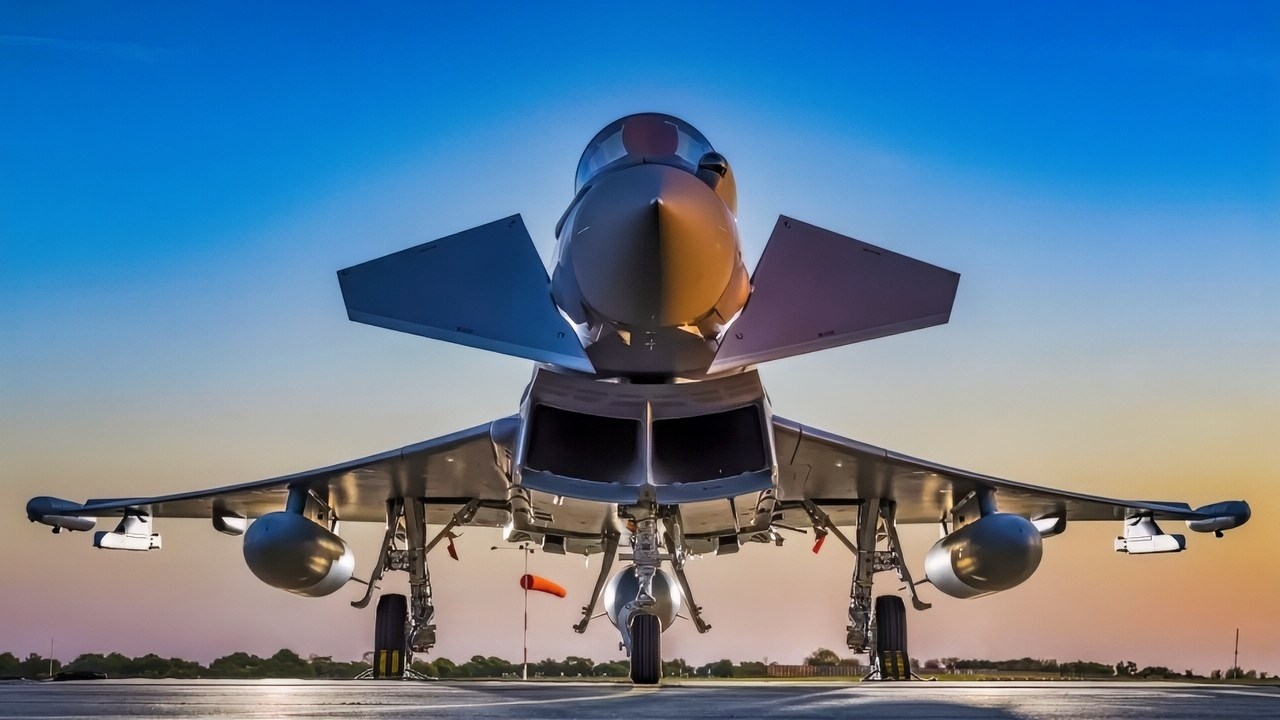
Eurofighter Typhoon on the Runway. Image Credit: Creative Commons.
-New radar and infrared sensing upgrades broaden detection and targeting options, while cockpit and software enhancements improve flexibility across missions.
-The result is a modernized fighter expected to remain viable into the 2040s.
In 2 Words: Massive Upgrades.
The Eurofighter Typhoon’s Evolution: From Interceptor to Multi-Role Powerhouse
The famous multinational Eurofighter Typhoon fighter jet entered service 20 years ago, just a few years before the arrival of the US F-22 in 2005.
However, much like the F-22, the Typhoon has received such a high volume of advanced weapons and technology upgrades that it is expected to fly successfully into the 2040s and beyond.
The Typhoon is not as stealthy as the 5th-generation F-22, yet it is engineered with an F-22-like speed of Mach 2 and an excellent thrust-to-weight ratio.
While the Typhoon’s airframes trace back several decades, they have remained quite viable and have received maintenance and sustainment in recent years.Airframes themselves can remain viable for decades, provided they receive sufficient and regular maintenance with structural reinforcement as needed.
Therefore, with a solid airframe, a fighter jet can be upgraded with new weapons, software, sensors, computing, avionics, and communications technology, making it almost an entirely different aircraft from its inception.
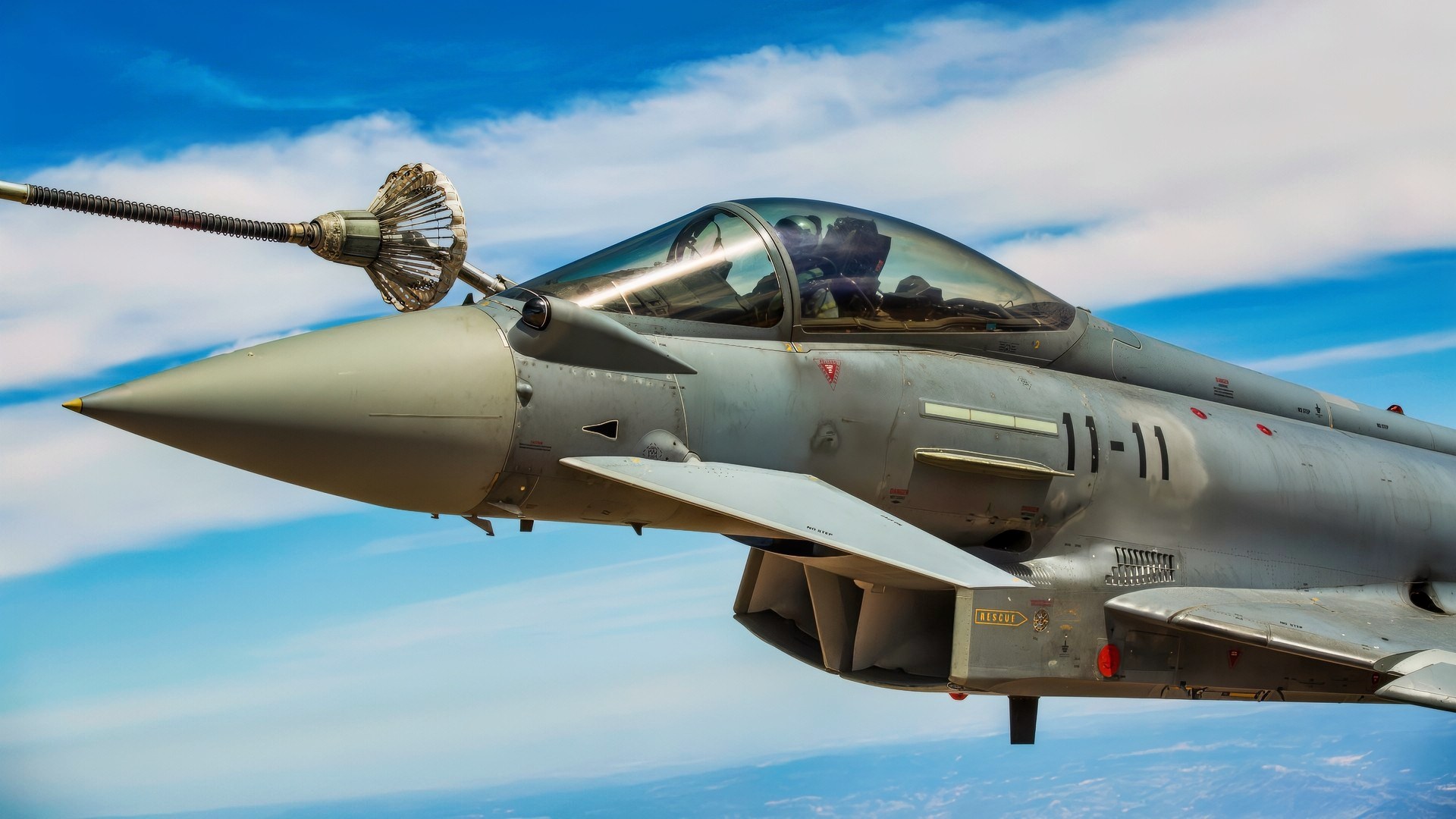
A Eurofighter Typhoon with the Spanish Air Force based out of Morón Air Base, Spain, refuels from a KC-130J Hercules, a first for the Marines from Special-Purpose Marine Air-Ground Task Force Crisis Response-Africa, Aug. 13, in Spain. The U.S. and Spain have been fostering one of the closest defense partnerships around the world for more than 60 years. (U.S. Marine Corps photo by Staff Sgt. Vitaliy Rusavskiy/Released)
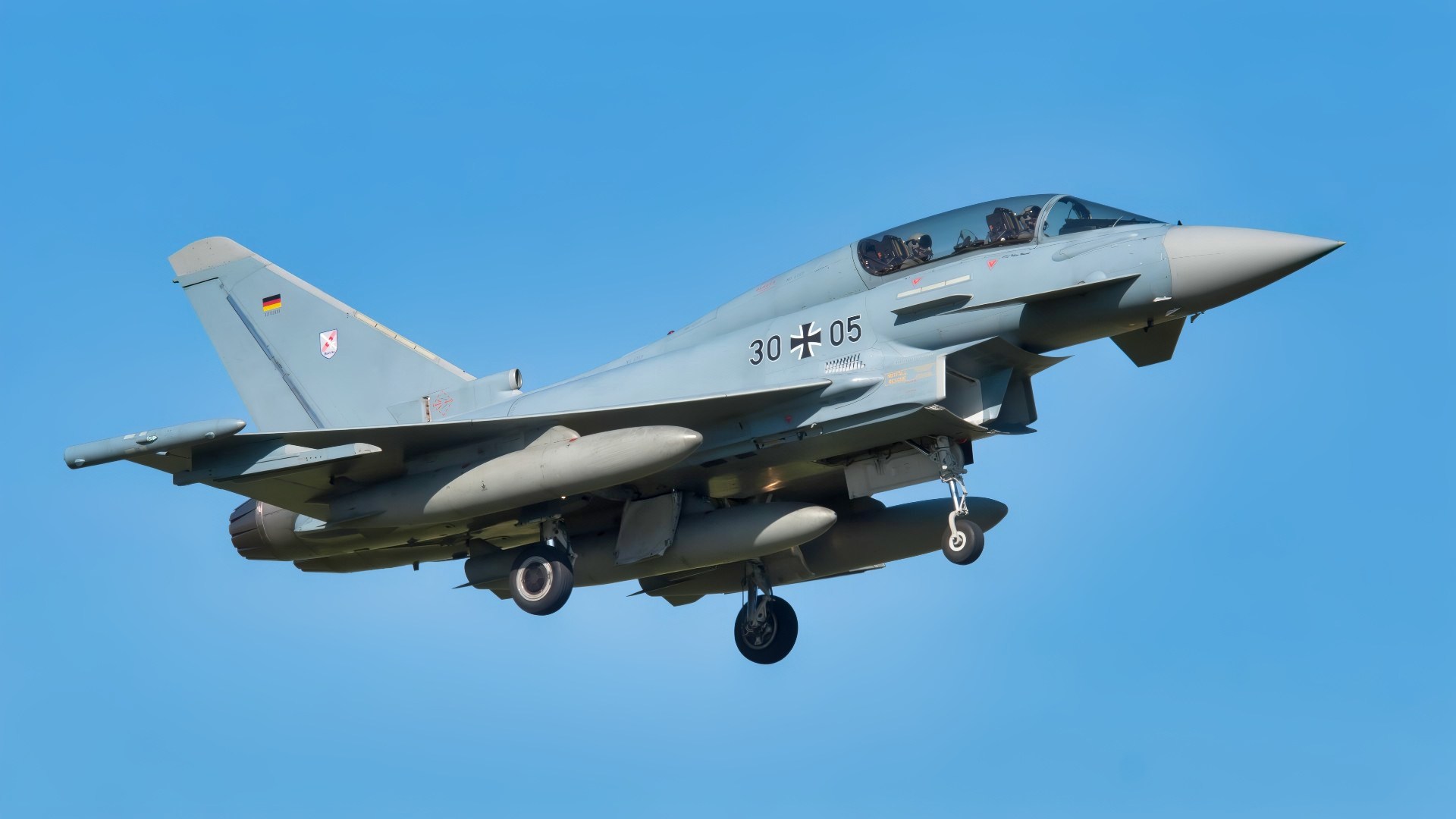
Eurofighter Typhoon Training in Sky. Image Credit: Creative Commons.
The aircraft originally operated with the UK, Germany, Italy, and Spain, but has since expanded to fly with many countries, including Austria, Saudi Arabia, and Kuwait.
Eurofighter Typhoon and F-22
The Eurofighter Typhoon achieves an F-22-like thrust-to-weight ratio with its lightweight materials and Eurojet 2000 engines; it is built with 70 percent carbon-fiber composites.
Software upgrades to the Typhoon have enabled a “swing-roll” capability, something Typhoon pilots say allows the fighter to perform multiple functions at once, such as firing missiles and dropping bombs.
In recent years, the Eurofighter has been equipped with an entirely new generation of weapons and technologies that have drastically improved its range, reach, accuracy, and lethality. The aircraft has 13 hardpoints, and the GPS- and laser-guided bombs carried by the Typhoon include 2,000-, 1,000-, and 500-pound GBUs, as well as the Paveway IV, a 500-pound laser-guided bomb.
The Typhoon has, for instance, been armed with a European missile referred to as the Storm Shadow, a highly lethal air-launched missile used to destroy Saddam Hussein’s bunkers at the beginning of Operation Iraqi Freedom in 2003.
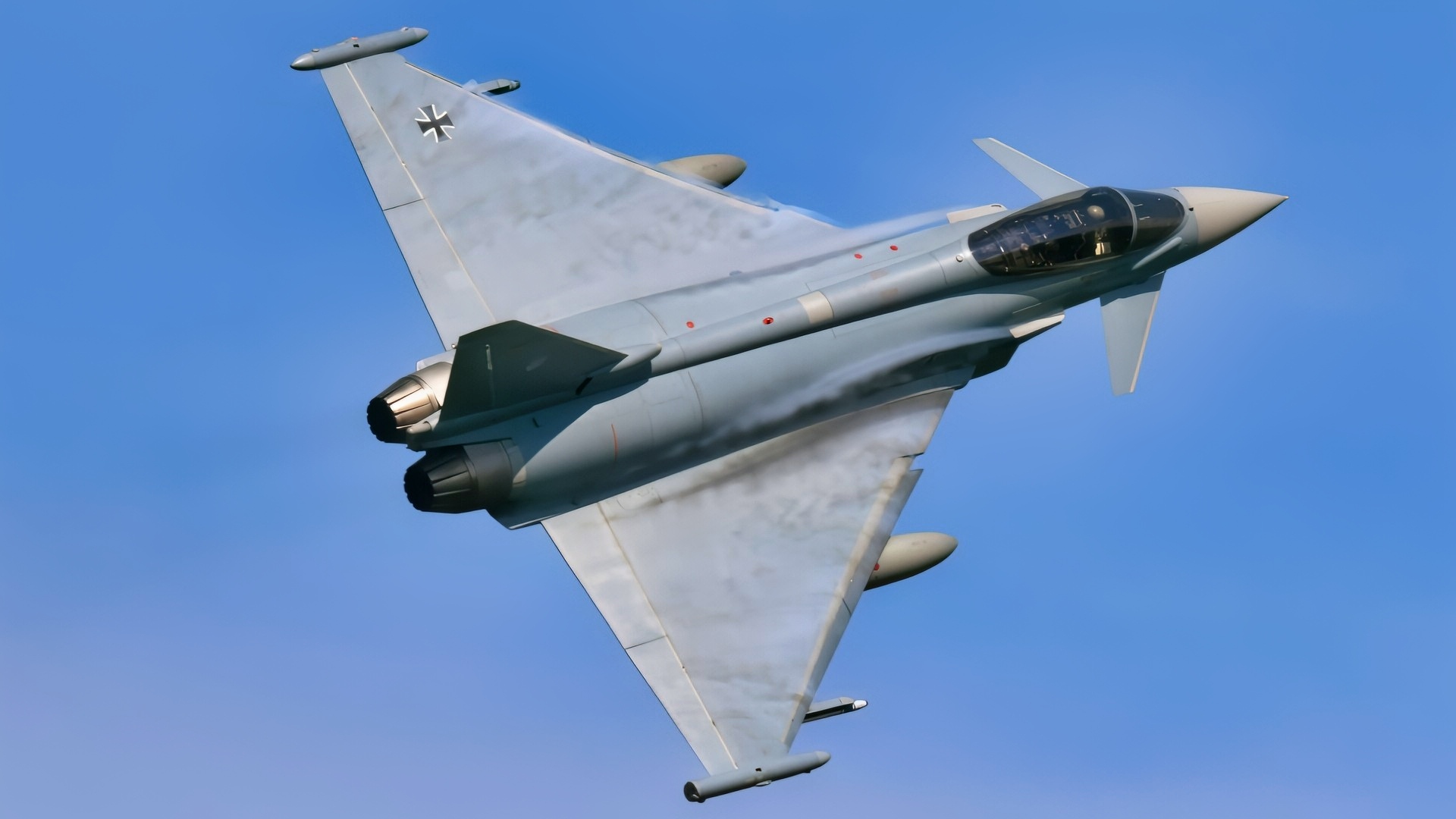
A German Air Force pilot, assigned to the German Air Force Weapons School, conducts strafing runs with an Eurofighter Typhoon in conjunction with U.S. Air Force Joint Terminal Attack Controller assigned to 2d Air Support Operations Squadron identifying targets on the ground at the 7th Army Training Command’s Grafenwoehr Training Area, Germany, June 9, 2021. (U.S. Army photo by Gertrud Zach)
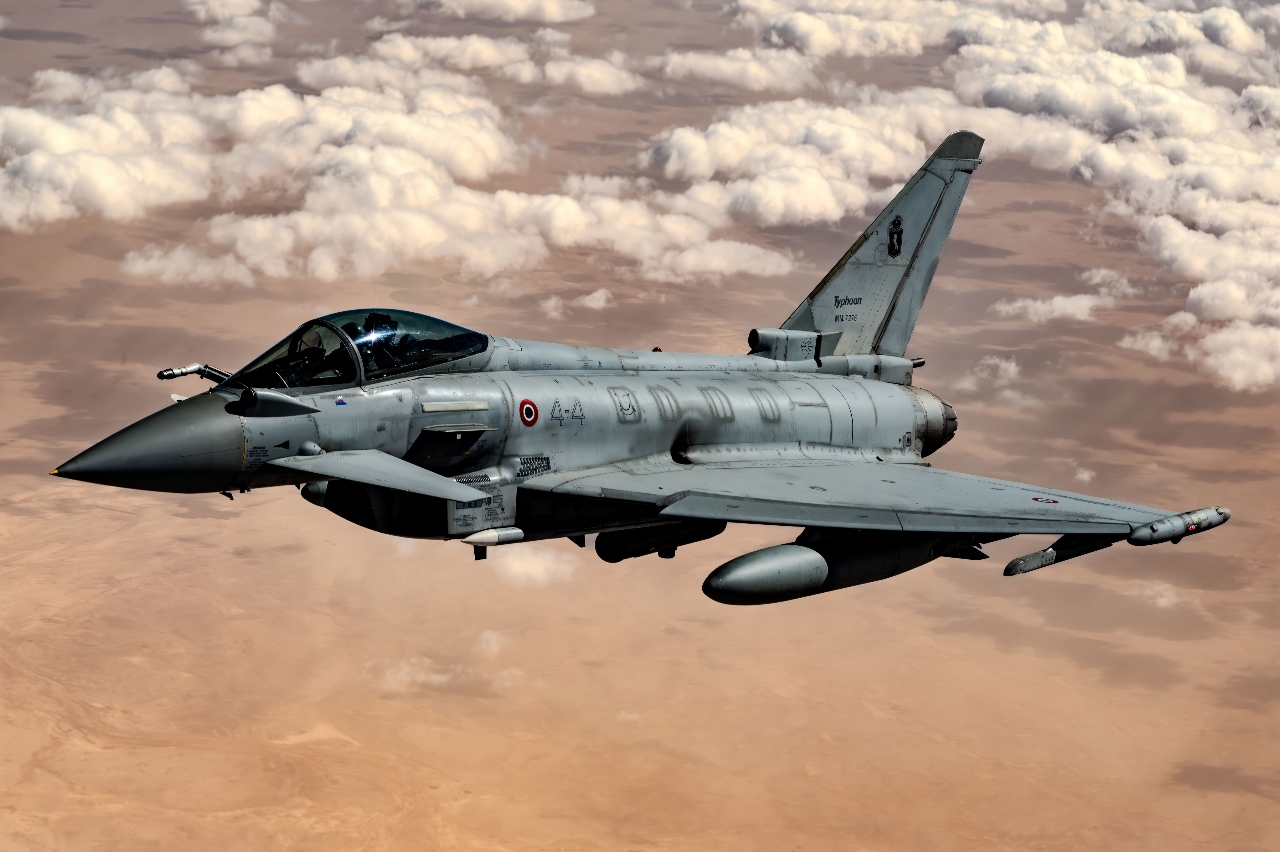
An Italian Air Force F-2000 Eurofighter Typhoon flies a routine presence patrol mission over the U.S. Central Command area of responsibility, Feb. 6, 2025. Close collaboration with partner nations improves interoperability, ensuring rapid crisis response and sustained operations to protect vital mutual interests in the AOR.
(U.S. Air Force photo by Staff Sgt. Jackson Manske)
Known for its accuracy, the Storm Shadow can achieve precision targeting and fire two missiles through the same hole in an enemy bunker target. The weapon used a special double-charge explosive effect, called a BROACH warhead, which includes an initial penetrating blast followed by a controlled detonation of the main warhead using a variable-delay fuze.
Eurofighter Typhoon Weapons
The Storm Shadow, also on the Royal Air Force’s Tornado aircraft, is built with a stealthy external configuration and a precision-guidance system that uses multi-mode GPS and inertial navigation.
Eurofighter was armed with a European missile called Meteor, which significantly increases what pilots refer to as the “no-escape range”—the distance or point at which an air-to-air adversary cannot fly away from or “escape” an approaching missile.
The Typhoon enhancements have also included the addition of a short-range standoff missile, Brimstone II.
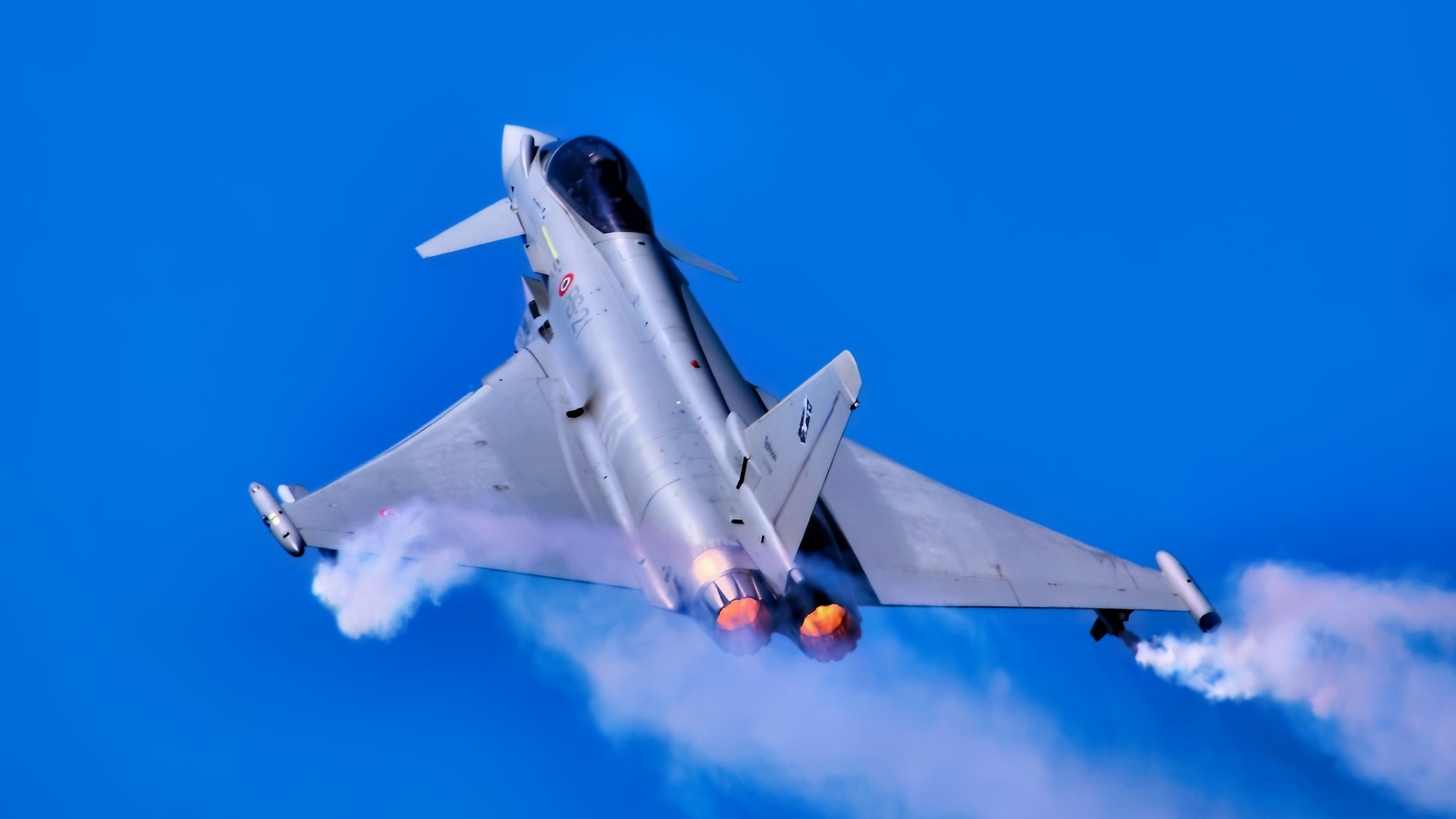
Eurofighter Typhoon Test Flight in 2013. Image Credit: Creative Commons.
This precision-guided weapon has also been in service on the British Tornado aircraft. Originally designed as a tank-killer weapon, Brimstone II is engineered with an all-weather, highly precise millimeter-wave seeker. In Afghanistan many years ago, a Brimstone was used to destroy an Al Qaeda traveling at 60km per hour.
The Typhoon has also been armed with a European missile called Meteor, which greatly increases what pilots refer to as the “no-escape range”—the distance or point at which an air-to-air adversary cannot fly away from or “escape” an approaching missile.
Eurofighter Typhoon Sensing
The sensing technology on board the Typhoon fighter is called Pirate, or passive infrared and targeting equipment.
It is a combination of infrared search-and-track and forward-looking infrared sensors.
MORE – The U.S. Navy Can’t Ever Build New Stealth Seawolf-Class Submarines
MORE – Israel’s F-15I Ra’am Has a Deep-Strike Advantage the F-15EX Eagle II Fighter Is Missing
MORE – A War Against Iran Could Open Up a Pandora’s Box That Won’t Be Easy To Close
The Typhoon’s cockpit has three large LCDs, which the pilot can switch between when assessing mission requirements. Many of the displays include situational awareness information such as moving digital maps, atmospheric information, sensor data, and targeting information.
The Typhoon’s active electronically scanned array radar, or AESA, provides pilots with an expanded field of view compared to most existing radar, as it can track multiple targets at one time. The AESA provides the mechanical ability to rapidly reposition the receiver, increasing the area it can pick up signals.
The new radar is designed to work with other on-board sensors, such as forward-looking infrared sensors and passive infrared tracking technology, to locate stealth aircraft with low radar cross-sections.
About the Author: Kris Osborn
Kris Osborn is the President of Warrior Maven – Center for Military Modernization. Osborn previously served at the Pentagon as a highly qualified expert in the Office of the Assistant Secretary of the Army—Acquisition, Logistics & Technology. Osborn has also worked as an anchor and on-air military specialist at national TV networks. He has appeared as a military expert on Fox News, MSNBC, The Military Channel, and The History Channel. He also has a Master’s Degree in Comparative Literature from Columbia.


