

Summary and Key Points: Four years of conflict have fundamentally rewritten the rules of heavy armor. Initially crippled by tactical errors and poor infantry screening, Russia’s tank fleet now faces a lethal ecosystem of first-person view (FPV) drones that conduct up to 45,000 “target engagements” per month.
-This relentless aerial observation has forced Moscow to resurrect obsolete T-62 and T-55 tanks to conserve its dwindling modern stock.

Marines with Bravo Company, 4th Tanks Battalion, fire the M1A1 Abrams tank during a live-fire exercise as part of Exercise Arrow 18 in Pohjankangas Training Area near Kankaanpaa, Finland, May 15, 2018. Exercise Arrow is an annual Finnish multi-national exercise with the purpose of training with mechanized infantry, artillery, and mortar field training skills in a live-fire exercise. This is the first year the Marine Corps is participating in this exercise and the first time the M1A1 Abrams tanks have been in Finland. (U.S. Marine Corps photo by Staff Sgt. Marcin Platek/Released)
-With Ukraine targeting a 4.5 million drone production goal for 2025, the tank is no longer a spearhead but a target, surviving only through dense electronic warfare protection and constant concealment.
The Drone Ecosystem: Ukraine’s 4.5 Million Target
For almost four years, the Russia-Ukraine conflict has shown the world what to expect in future conflicts, with battlefield and heavy-armor tactics changing dramatically during that period, owing to the emergence of new technologies.
Tanks were central to Russia’s initial invasion plan in February 2022, when armored columns were sent directly to Kyiv and other major cities. And, those tanks remain central today, as both armies continue to fight an attritional ground war.
What has changed, though, is the kill chain – the process used to identify, target, and neutralize an adversary capability. Cheap drones are now capable of spotting, tracking, and destroying armored vehicles at a tempo that was unimaginable during the initial stages of the war – not because the technology didn’t exist, but because the infrastructure wasn’t there to make these devices at scale.
Today, tank losses are becoming increasingly visible – and it’s a growing problem, particularly for the Russians, who entered the war with a larger fleet and have been forced to use its armor more aggressively.

T-90M from Russia. Image Credit: Creative Commons.
While analysts don’t fully agree on the numbers just yet, an update from the General Staff of Ukraine’s Armed Forces claimed on February 9 that Russia has lost 11,654 tanks and 24,013 armored fighting vehicles throughout the conflict.
How It Started
In the war’s first months, in early 2022, Russia’s tank losses were driven largely by tactical planning errors and poor execution of arms.
Russian armored units frequently advanced along predictable routes, sometimes with inadequate infantry screening, limited air support, and reconnaissance.
That created repeated opportunities for Ukrainian defenders to ambush and isolate vehicles, sometimes destroying them outright or forcing crews to abandon intact tanks that were later captured. Those tactics are reflected in data that shows a large number of “abandoned” and “captured” tanks.
Reports supported by open-source information, presented by Oryx, indicate that Russian losses included 4,308 tanks, 8,735 armored and infantry fighting vehicles, and 722 armored personnel carriers in 2025 alone, with a total of 1,209 vehicles abandoned and 3,169 captured.
Ukraine, however, has also paid heavily in terms of armor – especially in 2022 – because tanks were still essential to holding ground and counterattacking, and indeed providing direct fire support.
The difference, however, is that Ukraine began the war on the defensive with a smaller starting fleet, and its tank losses were often tied to holding contested towns or delaying Russian advances. Oryx’s visually confirmed totals – which are conservative by design – put Ukraine’s tank losses in the four figures, with 5,571 armored combat vehicles (including tanks and others) damaged, abandoned, or captured.
Drone Warfare Changed Everything
The primary reason tank losses have remained so high is that the battlefield is now constantly observed in greater detail than in previous conflicts, thanks to the use of inexpensive unmanned aerial vehicles (UAVs). Small quadcopters can now scout treelines and routes, and fixed-wing drones provide extended reconnaissance abilities. First-person view (FPV) drones are also utilized to deliver the final strike in many circumstances.
Ukraine’s drone sector has grown substantially since the outset of the war and has now expanded into a sprawling ecosystem that consists of private producers, amateur enthusiasts, and state-backed manufacturers.

Russian T-90 Tank. Image Credit: Creative Commons.
The exact numbers of drones being produced vary depending on the definition – FPVs vs all UAVs, for example – but the direction is this: Ukraine has moved toward industrial-scale output for these weapons. In 2025, Ukrainian President Zelenskyy publicly called Ukraine the “world leader in drone warfare,” calling for a 4.5 million production target for drones that year – all of which are coming from Ukrainian factories. Meanwhile, Russia’s own target for the year was also between three and four million.
Those drones are being used at scale as well. A Kyiv School of Economics Institute report has claimed Ukrainian forces are conducting between 30,000 and 45,000 FPV “target engagements” per month. Almost four years into the war, the battlefield now looks very different; tanks cannot move without overhead cover and electronic warfare protection, or they’ll be quickly found and hit by a munition that costs a tiny fraction of the vehicle it disables.
Russia is doing this, too. Reports from mid-2025 described a notable jump in drone production, and the Institute for the Study of War noted Russia’s “large-scale production of glide bombs and Shahed-type drones” that “will continue to facilitate Russia’s BAI campaign on the front.”
The race to produce and deploy drones has driven both armies away from traditional armored assaults and toward new, more dispersed tactics that utilize concealment and decoys. Both sides also now frequently employ the “shoot-and-scoot” tactic designed to minimize tank exposure to overhead threats.
T-90M from Russia. Image Credit: Creative Commons.
Drones Are Shaping Russian Tank Deployment
Not only does drone warfare influence Russian tank tactics, their use – and effectiveness – are forcing the Russian side to deploy aging and dangerous tanks that suffer from a catastrophic “jack-in-the-box” design flaw.
Russian commanders have increasingly turned to refurbished Soviet-era platforms – most notably T-62s and even T-54/55 variants – as FPV drones and constant aerial surveillance make the deployment of scarce modern tanks riskier and harder to replace.
Reports indicate that Russia has lost at least 334 T-62s by January 2026, with losses accelerating as the vehicles are being pushed forward for direct-fire purposes despite known survivability flaws. FPV drones exploit the so-called jack-in-the-box effect by delivering top-attack strikes that ignite ammunition stored in the turret carousel, causing catastrophic explosions that eject the turret.
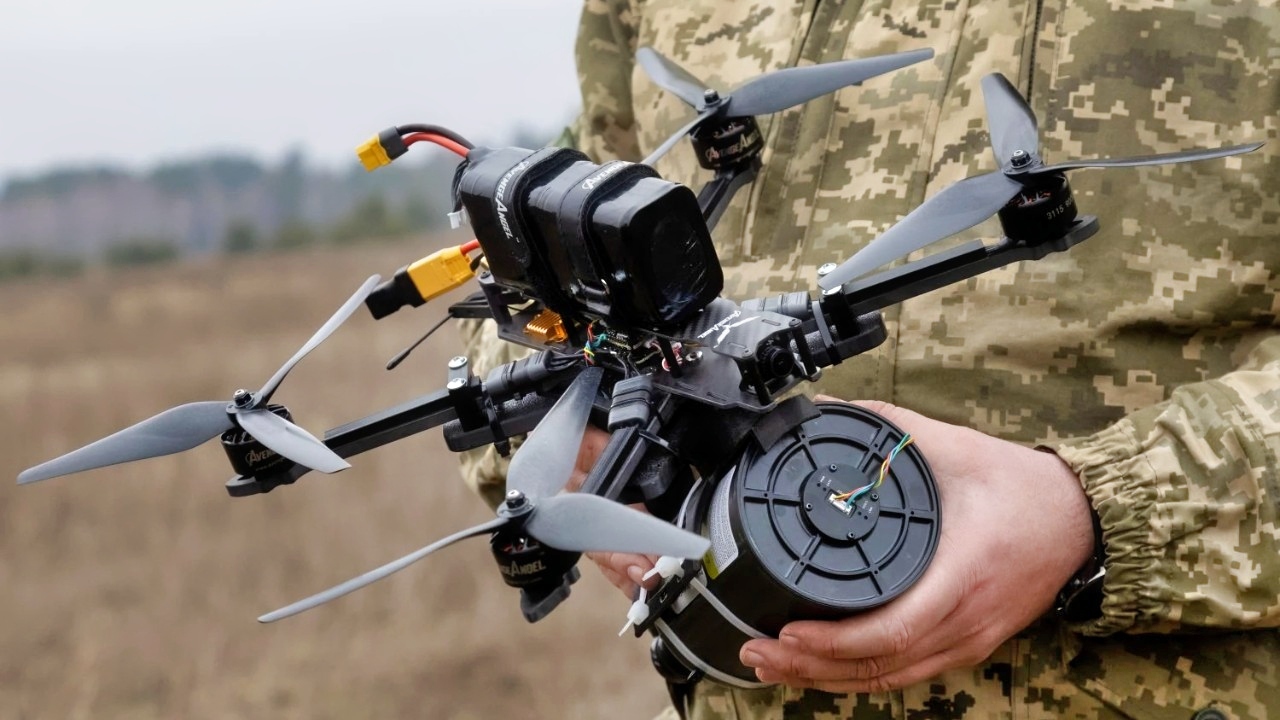
Ukraine Drone. Image Credit: Creative Commons.
Drone-driven attrition is now forcing Russia to conserve its remaining modern tanks while relying increasingly on older, less survivable vehicles to sustain ground operations; even so, visual OSINT tracking shows Russia’s confirmed cumulative tank losses rising by roughly 6 per day in early February, 2026.
About the Author: Jack Buckby
Jack Buckby is a British researcher and analyst specialising in defence and national security, based in New York. His work focuses on military capability, procurement, and strategic competition, producing and editing analysis for policy and defence audiences. He brings extensive editorial experience, with a career output spanning over 1,000 articles at 19FortyFive and National Security Journal, and has previously authored books and papers on extremism and deradicalisation.


yeye
February 10, 2026 at 9:25 am
The Ukraine conflict has shown that truly modern tanks need to have engines at the front for survival in today’s combat scenarios, but so far no heavy-class tank or MBT today is following that design principal, except for the merkava.
New tank designs have emerged but all of them still have their engines at the rear of the chassis, meaning missiles can easily home in on their hot exhausts rising vertically at the rear.
As for the Ukraine conflict itself, it’s bound to lead to either, ww3 in Europe (direct clash between NATO & Russia) or a nuclear showdown, or both in order to put an end to the fighting.
Eventually, Vladimir Putin has to go, either has to be forced out of his job or sent straight to the pearly gates, in order for Russia to crush the nazis.
Crushing the Nazis is a must or compulsory requisite for Russia to win the conflict, no two ways about it.
How to crush the nazis.
Learn from the US. The use of A-bombs in 1945 and also the Christmas bombing of Hanoi in 1972 (known as the &eleven days of Christmas’ in US military circles).
Both brought a firm end to the fighting or combat which had them been dragging on for years and years.
birbir
February 12, 2026 at 7:41 am
Ukraine, fascist ukraine, is being propped up by western money, western intelligence, western ground specialists, western satellite technology including starlink, western political support and western intransigence(bullheadedness).
Plus drones, and drone components from east asia.
Yet, russia is continuing the hard struggle against the nazis, direct leftovers from ww2.
But, but, but, there’ll come a time or moment when the current hard struggle cannot be sustained any further.
So, WHAT to do.
Surrender, and bow to trump trump, whose name appears over a MILLION times in the ‘files’ and thereby obediently awaits the eruption of renewed fighting twenty years from now.
Or settle it, once and for all, today.
Recall this famous motto – aut vincere aut nihil.
One can choose to totally vanquishing the foe, or to accepting total hopelessness and emptiness.
Swamplaw Yankee
February 13, 2026 at 12:23 pm
What is the 2026 data on World War Xi? What is the production capability and fleet dynamics of the PRC controlled Tank fleets in 2026 WW Xi?
OP-ed that appears without any mention of the KHOLOD War managed by the PRC thru its vassals avoids the morphology of innovative WW Xi. Op-ed appearing in the WEST mostly shows the shared mechanics that makes pro-Kremlin + Pro-PRC agit-prop visible, laundering pro WW Xi narratives thru American language MSM and culture. Who in op-ed dares speak of the long-terminated COLD War and the new era KHOLOD War?
2026 tank production capabilities of the PRC + its vassals might be of interest to the peer readers into content analysis. What does WW Xi intelligence glean on tank performance from the serial Genocide meat grinder tech line run by its vassal, Kremlin Muscovy families? How many tank varieties/numbers exist in the PRC + its vassal empire?
Op-ed Speaking ‘only’ of the Kremlin Muscovy family controlled tank fleets clearly falls into a distribution node for Kremlin (PRC) -aligned narratives. The peer reader knows that the Kremlin Muscovy is as married to the PRC as the Kremlin Muscovy married to NAZI Hitler in 1939! The Kremlin Muscovy loved to steal land and children in both theatres just as they have in the 1000 year serial Genocide Genetic need of the Muscovy to extirpate Ukrainians.
Should the MAGA POTUS elite of 2026 sell out Ukraine to the Kremlin Muscovy this year, how many thousands of functional tanks can the PRC immediately ship to the EU front: 15,000, 20,000 or 25,000? Can the MAGA POTUS Trump even show any concern in 2026 for 20,000 tanks moving to the Baltic front? The EU nations seem uninterested in such realistic gaming.
The 3 Whackoff ethnic clown show blabbers seem very dedicated to the prompt sell out of the illegal occupied Ukrainian soil. The PRC is planning for this ethnic clown show in its WW Xi strategies. Or, does someone out there disagree that the Han intelligence is way ahead of the inner beltway brains in the DNI + all its alpha bet agencies?