

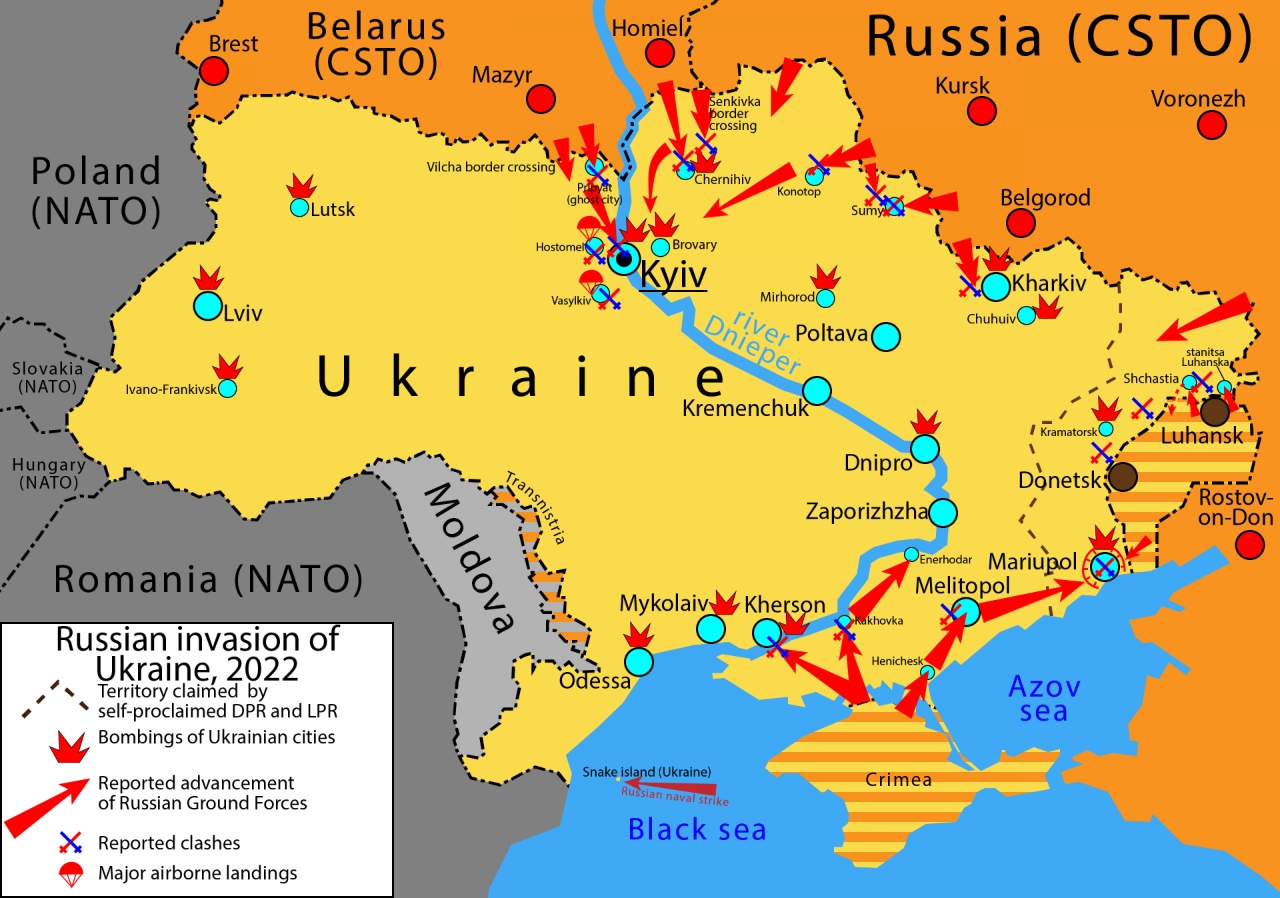
Key Points and Summary – As the Trump administration pushes for a quick peace deal, ceding the remaining Ukrainian-held territories in the Donbas would be a strategic catastrophe for Kyiv.
-This region is not merely land but a heavily fortified fortress, including key strongholds like Kramatorsk and Sloviansk, which have allowed Ukraine to inflict massive casualties on advancing Russian forces.
-Surrendering these critical defensive lines would not only be politically suicidal for President Zelenskyy.
-Still, it would also hand Moscow a perfect launching pad for a future invasion, repeating a historical pattern of broken peace deals.
The Donbas Region is a Fortress Kyiv Cannot Cede to Moscow
Russia’s invasion of Ukraine, now in its eleventh year with three full years of full-scale war, has seen Russia fail to achieve its key objectives. Ukraine has not been landlocked, nor have Kherson, Zaporizhzhia, Donetsk, or Luhansk been fully captured. Volodymyr Zelensky remains as Ukrainian President, and Russia has suffered over one million casualties, with the Black Sea Fleet decimated.
Despite the attrition, both Ukraine and Russia have exhausted militaries, and the current Trump Administration wants to find a solution to end the war as quickly as possible. Russia’s longtime autocrat, Vladimir Putin, wants the entirety of the remaining Ukrainian-held territories of Donetsk and Luhansk, along with keeping their current occupations of large areas of Zaporizhzhia, Kherson, and Crimea.
Ceding the remaining Ukrainian-held parts of the Donbas region is not only potentially politically suicidal, but strategically, as Russian forces have paid in blood by the hundreds of thousands to make incremental gains along Ukraine’s Eastern strongholds. Knowing any delay that cedes the strategically important areas of the East, Moscow could use it as a launching pad in any future war, which Kyiv has already calculated.
The Alaska Summit and Putin’s Demands
On Friday, August 15th, 2025, President Donald Trump hosted his Russian counterpart, Vladimir Putin, in Alaska to discuss a potential ending to Russia’s invasion of Ukraine. Russia’s delegation presented demands to keep the current frontlines frozen, along with the remaining Ukrainian army (ZSU) areas of Donetsk and Luhansk, as capturing the Donbas region fully is a central war goal for the Kremlin.
The Administration is leaning towards the proposal and hopes to draw Kyiv into the same deal. The coalition of European leaders reaffirmed that internationally recognized sovereignty of territory cannot be moved or annexed by force and will not legitimize the Russian occupation.
According to the Ukrainian constitution, the post-Soviet borders of 1991, including Crimea, are internationally recognized as part of Ukraine. If Zelensky were forced to cede the occupied lands, it would not only cause a constitutional crisis but also potentially spark a domestic conflict, with far-reaching consequences.
Akin to Russia, Ukraine has lost many of its best and brightest from a decade of war. If Russian forces still end up occupying 1/5th of Ukrainian territory, discontent could ensue in the country. A loss of land in the Winter War led to anger and feelings of abandonment in Finland, which would nominally ally with Nazi Germany against the USSR during Barbarossa. A significantly larger nationalist movement could emerge under occupation, as has been seen throughout history.
Why Surrendering the Remaining Ukrainian-Held Territories in Donbas is Unrealistic
The Donbas region is not just a sovereign and integral part of Ukraine. Still, it is also a major strategic topography that has helped the ZSU stave off a plethora of Russian military assaults. The rigid terrain, various canals, rivers, and tree lines allow the ZSU to create a strong fortification structure that makes Russian forces pay for every inch in which Moscow tries to advance.
For key cities in Luhansk and Donetsk oblasts such as Severodonetsk, Lysychansk, Marinka, Mariupol, Vuhledar, Bakhmut, Toretsk, Chasiv Yar, and others, Russia suffered significant casualties, with much of their one million plus dead and wounded being from battles in the region.
Despite occupying 70% of Donetsk oblast and almost the entirety of Luhansk, Russia is still no closer to fully capturing all of the Donbas region today. Russian forces have pushed towards the logistical hub of Pokrovsk. They are still nowhere near the urban battles towards the city while taking tens of thousands of casualties and numerous armor losses.
Furthermore, Russia has still not captured the Donetsk strongholds of Druzhkivka, Kostiantynivka, Kramatorsk, Sloviansk, and Lyman. The latter three cities are some of the most fortified strongholds in Ukraine today.
Akin to the Surovikin fortifications in Zaphorizhzhia, Ukraine has also built an extensive defensive line in the remaining free cities that could see Russia suffer hundreds of thousands of casualties even to attempt further offensives towards them. Russia’s military is exhausted, akin to Ukraine’s, and will likely need to mobilize to even push on the remaining Ukrainian-held cities of Donetsk Oblast.
Despite ministers in the Duma and the Ministry of Defense calling for mobilization, Putin has been hesitant and is likely to stick to recruitment due to fears that the Russian economy will be exhausted and potentially driven to collapse. Because of these factors, Kyiv indeed has cards to play as time is on its side more than Moscow’s.
Contingencies and Cards to Play
If the Trump Administration wishes to freeze the war on its current lines and force Ukraine to cede its strongholds in the Donbas region, NATO membership or a mutual defense pact placing Kyiv under the American nuclear umbrella akin to South Korea should be immediately considered. Suppose the U.S. government does not wish to see Ukraine fully under the Western fold. In that case, the current negotiations and authorization of allowing European countries to purchase weapons for the Ukrainian military are a substantial policy.
Aforementioned, Moscow is also exhausted from war, hence why Putin is asking Trump to force Zelensky to cede key strategic areas of Ukraine. The Administration should not fall for the Kremlin’s deception, as historically, Russia has frequently broken peace deals with Finland, the Baltics, Chechnya, and others.
Suppose the U.S. wishes to exit the war completely. In that case, Ukraine and Europe should continue growing production and not give in to Russia’s demands, as Moscow could easily restart a new war akin to their strategic positioning in 2014 and 2022.
Ukraine’s military intelligence chief, Lieutenant General Kyrylo Budanov, estimates that Russia’s war footing will run out of steam sometime in 2026, and by then, Russia will be no closer to breaching Ukraine’s Donetsk line or capturing the strongholds of Kramatorsk, Sloviansk, and Lyman. Ukraine and Europe instead should force Russia to exhaust its offensive military capabilities until Moscow can no longer physically continue the war and be forced to negotiate fairly.
Simultaneously, convincing the Trump Administration to maintain sanctions without being drawn into the war should be a priority for the European Union and Ukraine. Now is the time to show the U.S. that Europe can indeed step up, take charge of its defense, and demonstrate a determination to safeguard all democratic countries on the continent.
The remaining Ukrainian-held cities in Donetsk and the Donbas defensive fortifications are too crucial to cede to Russia’s imperial ambitions. Oversight over Donbas and the fortifications will be absent, leaving no guarantee from Russia, just as Finland, Lithuania, Estonia, Latvia, and Chechnya have learned. Moscow will wait several years, rebuild its forces, and attack again from strategic heights and terrain of Donetsk and Luhansk.
About the Author: Julian McBride
Julian McBride is a forensic anthropologist and independent journalist born in New York. He is the founder and director of the Reflections of War Initiative (ROW), an anthropological NGO which aims to tell the stories of the victims of war through art therapy. As a former Marine, he uses this technique not only to help heal PTSD but also to share people’s stories through art, which conveys “the message of the brutality of war better than most news organizations.” Julian is also a new contributing editor to the National Security Journal.
Military Affairs
China’s Stealth Air Force Has 1 Mission


Off-McBride
August 21, 2025 at 3:01 am
This article contains the biggest crapload of garbage that has ever appeared on this website.
It’s like saying germany should keep prussia after end of ww2.
After ww2, the wartime victors agreed to dissolve prussia altogether, with the land going to poland and the USSR.
Poland benefited the most, with the main part becoming part of poland, including rastenburg and the ruins of the wolf’s lair.
The most important thing going forward today is the building of a fence to separate the nazis from the non-nazis, and so donbass must be completely free of ukro nazi possession.
In addition, the nazis must clear thenselves away from the border region adjacent to kursk and belgorod.
Lastly, the nazis must accept the loss of the majority part of zaporizhzhia and kherson.
The nazis are not the victors and they must accept the loss.
Pingback: Putin needs Pokrovsk to unlock the Donbas—but it’s costing him everything – Ultimele Știri din Europa