


Key Points and Summary – Though officially retired since 2008, the F-117A Nighthawk remains a vital and highly active asset for the U.S. Air Force, performing critical secret missions.
-Its primary new role is that of a high-tech “aggressor”; its older-generation stealth profile is perfect for simulating the radar signature of Chinese and Russian adversary aircraft to train U.S. pilots.
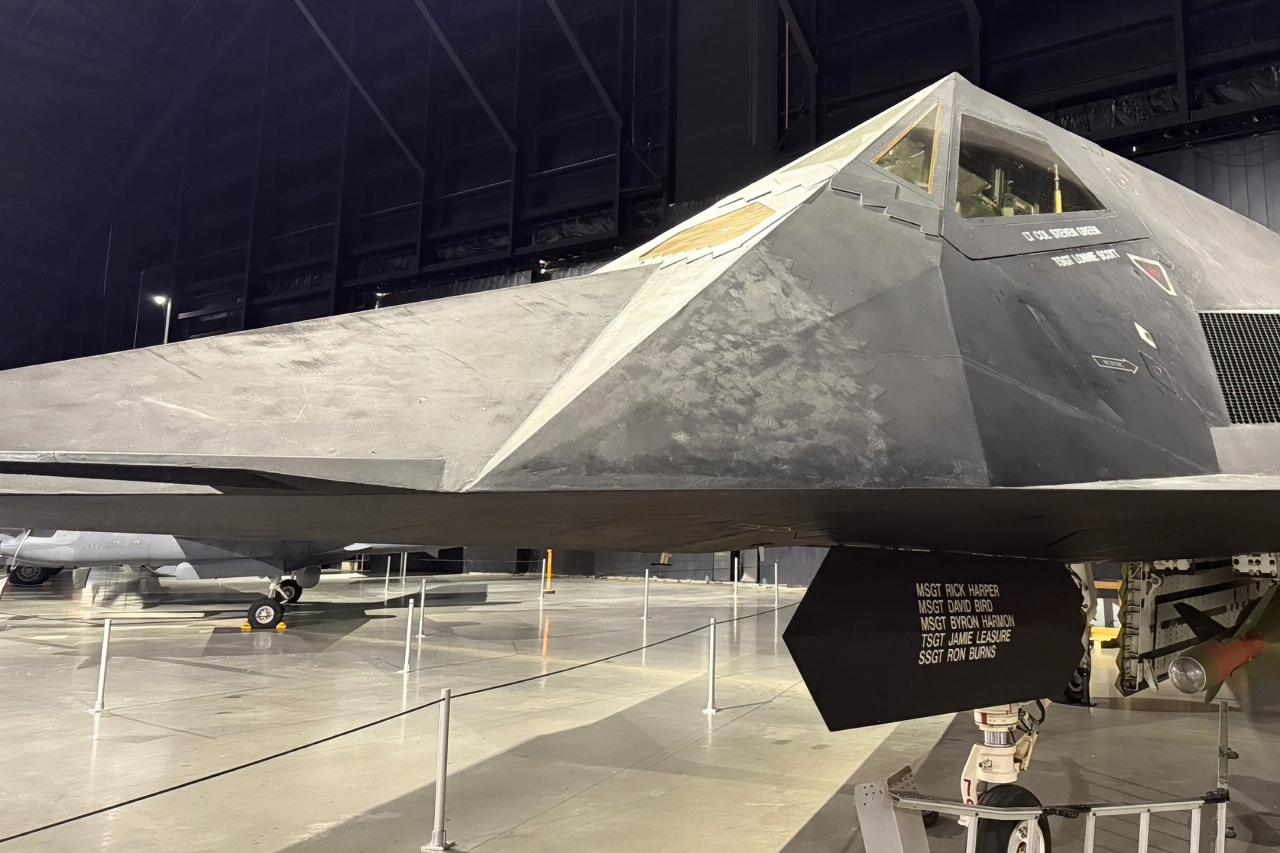
F-117 As Close As We Can Get. National Security Journal Original Photo.
-Additionally, the F-117 serves as a cost-effective testbed for validating new sensors, stealth coatings, and other advanced technologies being developed for next-generation platforms like the B-21 Raider and F-47 fighter.
What We Learned (And Are Still Learning) With The F-117A
Since the United States Air Force (USAF) finally confirmed that the famous F-117A Nighthawk Stealth Fighter is still in use, although it was officially retired from service in 2008, more details are coming out about how it is still utilized. Many of the functions of the aircraft serve as training, testing, or evaluation methods.
Despite being continuously seen in the skies above Nevada for years, the USAF had long revealed little about the aircraft’s function, as it was still being operated. The force has since officially confirmed that a small number of the F117As were being maintained in operational service.
Several F-117As are based at Tonopah Test Range Airport in Nevada, and at Groom Lake, the latter being a facility more commonly referred to as Area 51. The testing and other missions that the aircraft were engaged in had been previously classified at high levels.
An article that had previously been published in the National Security Journal publicized these sightings. This record permitted a combination of these recorded appearances of the aircraft together with listings from the community of tail spotters and other aircraft enthusiasts to construct the flight profile and frequency of operation of these F-117A models.
Why The Aircraft is Still Needed: Aggressor Platform
The USAF still has several high-priority uses for the aircraft, despite it having been built more than four decades ago. Even though its stealthy design is several generations out of date, its performance and low radar cross section (RCS) are still of high utility for several types of developmental activity.
Among other experimental capabilities, this aircraft is an excellent platform for testing next-generation radar systems, infrared search-and-track (IRST), and other types of sensors. It can also be used as a a means of validating new low-observable technologies and modifications that can be made to reduce the signature of any aircraft.
Its older-generation and less-sophisticated stealth profile also makes the F-117A a perfect platform to simulate the RCS profile of one of the stealthy aircraft produced by the People’s Republic of China (PRC) or Russia.
“The F-117A is from the US perspective maybe a second or 2.5-generation of stealth technology,” said a former Lockheed designer. “So, when our adversaries have copied or reverse-engineered that older-generation US technology, then improved on it and integrated into their aircraft designs they end up with a fighter that an F-117A can do a very capable job of imitating—this makes it a highly effective aggressor aircraft.”
Technology Validation
Some of the training the aircraft is used for is to test new technologies and experimental designs. One method to reduce the signature of legacy aircraft is to apply special materials to their exterior or the interior of their air inlets. The F-117A functions very well to validate those kinds of advancements in materials.
The Nighthawk can also be used for testing new-age on-board systems to determine whether they generate specific emissions or have other characteristics that would degrade the signature reduction of state-of-the-art aircraft. These F-117As can additionally be employed to test the effectiveness of newer materials being developed for the B-21.
As one article on the aircraft’s surface materials points out, “the technology that makes the Nighthawk largely undetectable by radar is known as ‘faceting’. The surface of the airframe is divided into triangular facets, scattering radar at odd angles, and preventing it from being reflected to the receiver.”
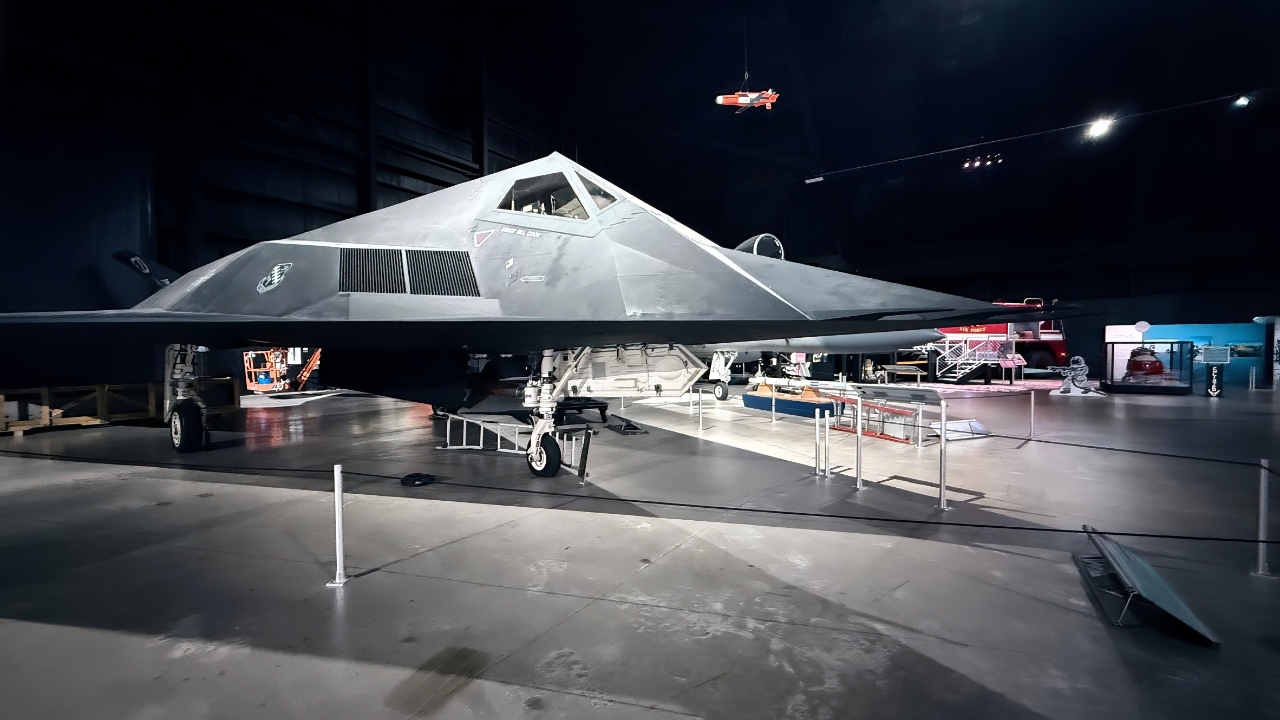
F-117 Still Looks Amazing National Security Journal Photo. All Rights Reserved.
“The entire surface of the F-117 is also covered with radar-absorbing material. The exhaust nozzle was also made to be ‘slit-shaped’ in order to minimize the volume of exhaust and increase the speed at which the hot exhaust mixed with cool night air, reducing its infrared signature.”
Historical documents on the aircraft point out that the surface of the F-117A is mainly constructed of aluminum, with titanium for areas of the engine and exhaust systems. The surface of these alloys isis then coated with anotheranother aircraft surface composed of radar-absorbing materials (RAM).
The aircraft was powered by two low-bypass General Electric F404-GE-F1D2 non-afterburner turbofan engines. Gratings cover the rectangular air intakes on both sides of the fuselage, nicknamed the ice cube maker, which are also coated with radar-absorbent material in order to prevent any radar reflection from the front fan of the engine.
The degree to which these low-observablelow-observable techniques can be improved aids the development of aircraft like the B-21, as well as the just-now-beginning development of the F-47. Testing new concepts for these programs on the F-117A also makes for valid comparisons of the different generations of stealthy materials, as well as costs far less than testing them on heavier, later-model platforms like the F-22.
In essence, every stealth aircraft that followed the F-117A has inherited something from the Nighthawk’s design. Even though it is no longer in service and is only used for testing now, the impact it still has on military aviation is incalculable.
About the Author: Reuben F. Johnson
Reuben F. Johnson has thirty-six years of experience analyzing and reporting on foreign weapons systems, defense technologies, and international arms export policy. Johnson is the Director of Research at the Casimir Pulaski Foundation. He is also a survivor of the Russian invasion of Ukraine in February 2022. He worked for years in the American defense industry as a foreign technology analyst and later as a consultant for the US Department of Defense, the Departments of the Navy and Air Force, and the governments of the United Kingdom and Australia. In 2022-2023, he won two awards in a row for his defense reporting. He holds a bachelor’s degree from DePauw University and a master’s degree from Miami University in Ohio, specializing in Soviet and Russian studies. He lives in Warsaw.
Military Affairs
China’s Stealth Air Force Has 1 Mission


bish-bish
August 21, 2025 at 1:30 pm
F-117 is a certified failed/pseudo stealth jet.
During the 1999 air onslaught against the former yugoslavia, two f-117 jets were hit, although one succeeded in returning to base.
The same for the f-22.
Why did gates propose cancellation of the f-22 in early 2009.
It was reportedly due to a classified loss of a f-22 over zhejiang province on aug31/sept1 2007.
Today, there’re ‘eyes’ watching the western pacific region 24/7, during night and day, in good weather and bad weather, in full sunshine or in heavy fog conditions.
Stealth is passe.
As the USSF has said, ‘space is the important new all-domain battleground’. Not the skies over the pacific region.
Pingback: The F-117A now plays the role of a Chinese stealth jet in disguise – Morning Overview