


Key Points and Summary: A new GAO report says the F-35’s Block 4 modernization is at least five years late and $6B over estimates.
-The upgrade—more than 75 enhancements enabled by the TR-3 hardware/software baseline—has been slowed by TR-3 integration, immature engine turbine blades, and weak production performance: all 110 jets delivered in 2024 were late, by an average 238 days.
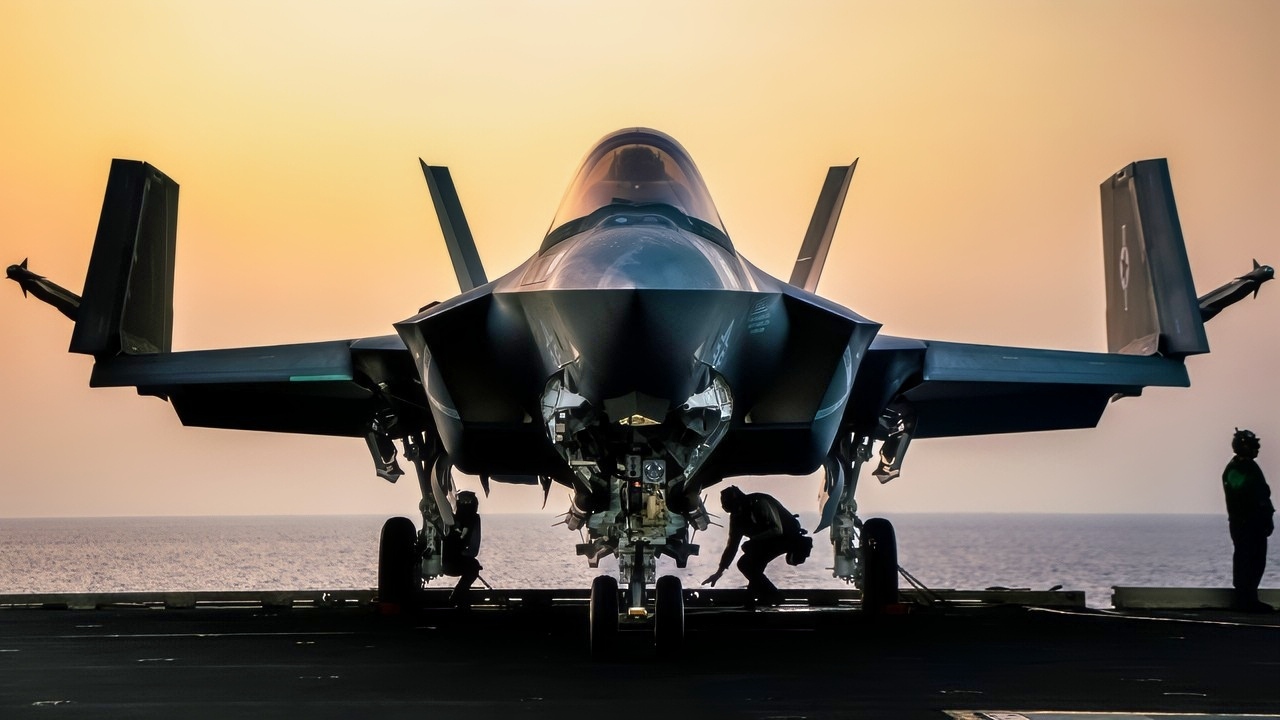
U.S CENTRAL COMMAND AREA OF RESPONSIBILITY (April 24, 2025) U.S. Sailors conduct pre-flight safety checks on an F-35C Lightning II, attached to Strike Fighter Squadron (VFA) 97, on the flight deck of the Nimitz-class aircraft carrier USS Carl Vinson (CVN 70) in the U.S. Central Command area of responsibility. (Official U.S. Navy photo)
-GAO criticizes misaligned incentive fees that still reward tardy deliveries and urges DoD to reassess Lockheed Martin’s capacity, realign incentives to on-time outcomes, and adopt “leading practices” such as minimum viable products, digital twins, and real-time modeling. Block 4’s total modernization effort now tops $16.5B.
Delayed and Over-budget: the F-35 Block 4 Upgrade
A recent report from the Government Accountability Office outlines trouble with the F-35 Block 4 Upgrade.
The report provides a detailed account of the issues that have caused delays in a series of upgrades to the stealth fighter.
A recent report by the Government Accountability Office, a federal, non-partisan audit body that compiles and collates reports for the United States Congress, detailed some of the issues with the F-35’s Block 4 upgrade.
“After years of cost growth and schedule delays in its hardware and software modernization effort for the F-35 aircraft, known as Block 4, the Department of Defense (DOD) is in the process of establishing a new major subprogram to help meet cost, schedule, and performance goals. Currently, Block 4 costs are over $6 billion more and completion is at least 5 years later than original estimates. The program plans to reduce the scope of Block 4 to deliver capabilities to the warfighter at a more predictable pace than in the past.”
The GAO report explains that the “contractors for the program, Lockheed Martin and Pratt & Whitney, continued delivering aircraft and engines late. For instance, in 2024, Lockheed delivered 110 aircraft. All were late by an average of 238 days, up from 61 days in 2023.”
The F-35 corporate website, which highlights the stealth fighter’s capabilities and international partnerships, also lists the substance of the Block 4 modernization, which encompasses more than 75 upgrades across all three F-35 variants: A, B, and C.
The Block 4 basics “provide the most significant evolution of capabilities to date for the F-35, including increased missile-carriage capacity, added advanced non-kinetic electronic warfare capabilities and improved target recognition.”
But the Block 4 upgrades are facilitated by Tech Refresh-3, or TR-3, which “enables Block 4, introduces open mission systems architecture, a new integrated core processor with greater computing power, an enhanced panoramic cockpit display, a larger memory unit,” and also includes “other classified capabilities.”
The Department of War is now in its seventh year of the F-35 modernization effort, which is slated to cost $16.5 billion. Part of the upgrade effort includes safety measures designed to protect the jet and its pilots, such as collision prevention technology.
Although Block 4 is not anticipated to be the final Block of updates for the stealth fighter, it is an important one. An increase in missile capacity would be hugely important for the platform. Combined with a boost to target recognition, the Block 4 update is significant.

Royal Netherlands Air Force F-35 Lighting II fighters fly in formation with Polish Air Force MiG-29 Fulcrums during a training sortie over Poland on 21 March 2023.

Dutch F-35s and Polish MiG-29s train together over Poland as part of NATO’s Air Policing mission
However, one aspect of the upgrade that was to be expected as part of the Block 4 package will not be ready: improvements to the F-35’s engine, and more specifically, engine turbine blades that “are not mature.”
The GAO went so far as to say that although the Block 4 subprogram will not be entirely dependent on that engine upgrade, it will ultimately delay capabilities that were scheduled following the Block 4 update and delay the program as a whole.
Show Me the Money
The GAO report finds fault with the incentive fees that the F-35 program has attempted to use as leverage to hold Lockheed Martin, Pratt & Whitney, and other contractors accountable for their involvement in the F-35 program.
One of the core issues, the report found, was the redirection of financial incentives toward different areas of the F-35 program after it became clear that production goals would not be met. And therein lies one of the most significant aspects of the F-35 program, according to the GAO.
“Unless the F-35 program reevaluates its use of incentive fees and better aligns them to achieving desired production schedule outcomes,” the document explains, “it will be at greater risk of continuing to reward contractors for delivering engines and aircraft late.” Under the contractual terms for the lot 12 through 14 aircraft, Lockheed Martin was able to deliver finished fighters up to two months behind schedule and still earn part of the incentive fees for on-time builds.
What Happens Now on the F-35 Fighter?
The Government Accountability Office made six recommendations to the Department of Defense in the course of their investigation and subsequent report.
One of the first recommendations is for the Department of Defense to evaluate Lockheed Martin’s production capacity and ability to meet future production schedules. A reevaluation of program incentive fees is also outlined, and the use of “leading practices” is recommended.
According to the GAO, these practices include “product development, such as developing a minimum viable product, pursuing digital twins that can be used to inform development, and updating modeling and simulation tools in real time.”
Whether these issues can be rectified in a timely and affordable manner remains to be seen.
About the Author: Caleb Larson
Caleb Larson is an American multiformat journalist based in Berlin, Germany. His work covers the intersection of conflict and society, focusing on American foreign policy and European security. He has reported from Germany, Russia, and the United States. Most recently, he covered the war in Ukraine, reporting extensively on the war’s shifting battle lines from Donbas and writing on the war’s civilian and humanitarian toll. Previously, he worked as a Defense Reporter for POLITICO Europe. You can follow his latest work on X.
More Military
The B-58 Hustler Mach 2 Bomber: The Air Force’s Big Blunder?
Russia’s Su-33 Flanker Fighter Mistake Still Stings
The Navy’s Columbia-Class Submarine Mistake Still Stings
4 Hellfire Missiles, 3 Harpoon Missiles and More: The Navy Couldn’t Sink Its Own Destroyer
The Midway-Class Aircraft Carriers Have A Message for the U.S. Navy


