

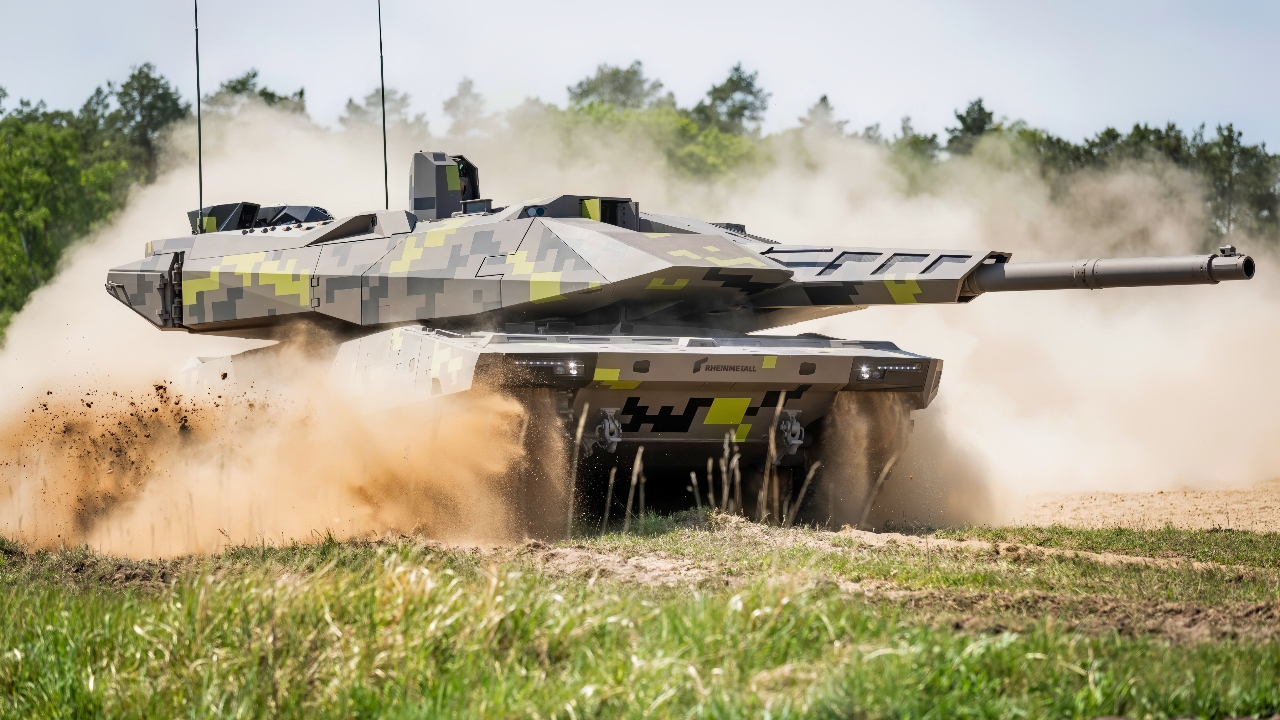
PUBLISHED on August 11, 2025, 10:33 AM EDT – Key Points and Summary – Germany is undertaking a massive military revitalization, committing to spending 3.5% of its GDP on defense with a new €400 billion special fund.
-This historic shift, supercharged by Chancellor Friedrich Merz’s coalition, aims to create the “strongest conventional military in Europe.”
-A key sign of this new assertiveness is the first-ever permanent overseas deployment of a German combat brigade to Lithuania.
-Driven by the threat from Russia and persistent pressure from the U.S., Germany is reversing decades of military decline, though making the Bundeswehr truly “combat-ready” will require sustained investment and cultural change.
Germany is Building Europe’s ‘Strongest Conventional Military’. Here’s Why.
Nearly 400 billion Euros have been earmarked in Berlin as a significant injection of cash aimed at reversing the steep decline in military spending — and military capabilities — since the end of the Cold War.
For the first time since then, Germany is committing to spending 3.5 percent of its GDP on defense, and essentially doubling spending over the next five years.
Zeitenwende
This latest cash boost comes several years after Olaf Scholz, the previous German Chancellor, announced in his Zeitenwende, or Turning Point speech, in the immediate aftermath of Russia’s full-scale invasion of Ukraine.
In that speech, Scholz said that Germany must once again become, if not the dominant military power on the continent, one of the significant players. In his speech before Germany’s lawmakers at the Bundestag, or the German parliament, Scholz stated that the creation of a special one-time fund of 100 billion euros would provide the Bundeswehr with the necessary funds to revamp and modernize.
To face the threat that had reemerged from the east, Berlin would have to make a serious investment in the Bundeswehr to revive a fighting force that had become emaciated and was a shadow of its former self during the Cold War.
New Governing Coalition
Germany’s current governing coalition, headed by Chancellor Friedrich Merz of the center-right Christian Democrats, has taken even more dramatic steps to revamp the Bundeswehr, to transform not only Germany’s capabilities but also its strategic posture in Europe.
Germany should become the “strongest conventional military in Europe,” Merz famously asserted, a sentiment from a German head of state that had not been expressed in many decades.
One of the most significant hurdles that Merz had to navigate was Germany’s debt brake, a highly restrictive clause in the German constitution that prohibits government spending in excess of .35 percent of GDP.
Despite typically Teutonic protestations against borrowing for any reason — this, despite Germany’s gold-plated credit rating and the necessity of boosting defense amid the continent’s bloodiest war in 80 years — Merz secured an exemption for raising a 500 billion euro special fund to replace Scholz’s Zeitenwende fund.
Lithuania Deployment
One of the most remarkable manifestations of Germany’s newfound assertiveness — and willingness to take responsibility for European security — is its Lithuania deployment.
By the end of 2027, the 45th Panzer Brigade, part of the 10th Panzer Division, comprising 4,800 Bundeswehr soldiers and 200 civilian employees, will be stationed in the Baltic nation on a permanent and non-rotational basis, as part of NATO’s reinforcement of its eastern flank.
The significance of the deployment is difficult to overstate. It is the first permanent deployment of troops abroad in the history of the Bundeswehr, and the first time since World War II that German troops have been permanently stationed outside of Germany.
Bundeswehr recruitment
There are currently approximately 182,000 active-duty German soldiers, but Germany’s Defense Ministry aims to increase this figure to around 203,000 by 2031.
Though the Bundeswehr has struggled to attract recruits and been undermanned for many years, this year marked an uptick in new recruits not seen since the West German Bundeswehr numbered half a million during the Cold War.
And while the eye-catching investments in the Bundeswehr may certainly be a factor, the newly remembered reality that Germany’s revanchist neighbor to the east is again a threat to Germany and Europe as a whole has been a powerful recruitment tool.
The Trump Factor
American President Donald Trump and his administration have repeatedly leveled sharp criticism at their European allies in NATO, particularly at Germany.
Trump has repeatedly asserted that NATO allies who do not meet the alliance’s previous 2 percent of GDP target for defense spending are delinquent, urging countries to pay what he characterizes as their fair share. Trump has also publicly lambasted those allies as freeloaders.
And while the language and tone toward allies has gone down extremely poorly on the European continent, it is part of a trend expressed by previous American leaders, albeit less forcefully.
While an American withdrawal from NATO, despite significant jitters from European leadership and press, is extremely unlikely, the Trump administration’s openly hostile rhetoric toward those NATO countries that did not meet the agreed upon spending target has proven to be, in some ways, a more powerful motivating factor than even Russia’s full-scale invasion of Ukraine, which failed to shock Germany out of its post Cold War military complacency.
What Happens Now?
It will take much more than opening the federal purse strings to revive the Bundeswehr and make it, in the words of German Defense Minister Boris Pistorius, Kriegstüchtig, or combat-ready.
A great deal depends on how Berlin chooses to spend those euros, and what happens once that money runs out.
It will require a sustained investment — 3.5 percent of GDP is already a significant positive step, although the accounting math to reach that figure includes some funding that does not directly contribute to combat readiness.
Still, considering the historically unshakeable pacifism that runs deeply through the minds of many Germans, the change has been extraordinary, despite the slow start.
About the Author: Caleb Larson
Caleb Larson is an American multiformat journalist based in Berlin, Germany. His work covers the intersection of conflict and society, focusing on American foreign policy and European security. He has reported from Germany, Russia, and the United States. Most recently, he covered the war in Ukraine, reporting extensively on the war’s shifting battle lines from Donbas and writing on the war’s civilian and humanitarian toll. Previously, he worked as a Defense Reporter for POLITICO Europe. You can follow his latest work on X.
Defense Watch
F/A-XX Is the YF-23 on a Carrier?


Pingback: 8-12-25 | MARK13NEWS.com